
AI Competition's New Battlefield: Long-term Memory Becomes the Pain Point, How Users Can Secure Their Own Context Ownership

marsbitPublicado em 2026-06-02Última atualização em 2026-06-02

Resumo

A new front is emerging in the AI competition: user ownership of long-term memory and context. As AI models like ChatGPT evolve from chat tools into persistent digital assistants that learn user preferences and workflows, a critical question arises: who owns this accumulated "memory"? Currently, this personalized data is siloed within each platform (e.g., OpenAI, Anthropic, Google), creating a fragmented experience when users switch models. The article highlights ZetaChain's strategic pivot from blockchain interoperability to addressing this AI "memory" challenge. Its new focus is on building a "Private Memory Layer" and an "AI Consumer Layer." Through its consumer product Anuma, ZetaChain aims to give users encrypted, portable memory that can be used across different AI models. This system also envisions programmable, auditable permissions for AI agents and a framework where user knowledge can be monetized as shareable assets. Ultimately, ZetaChain's transformation reflects a broader infrastructure shift. The future bottleneck is less about raw model capability and more about continuous context, user-controlled identity, and permission management across multiple collaborating AI agents. The company's ZETA token is being repositioned as an "AI infrastructure token" to facilitate access, payments, and permissions within this proposed ecosystem. The core narrative advocates for returning control of personal context and AI relationships to users, rather than leaving them locke...

Author: Zen, PANews

You spent half a year training ChatGPT to understand your work habits, writing style, and long-term projects. It learned how you like to revise articles, which companies you often follow, and gradually came to understand your preferences for content structure, tone, and information density.

But one day, a newer, more powerful model appears. You open Claude, Gemini, or DeepSeek, and find yourself having to start all over again. The new model doesn't know you, isn't aware of the work context you've accumulated over the past months, and doesn't understand how you think, write, or make decisions.

Over the past two years, the most important competition in the AI industry revolved around "model capabilities." Whose reasoning was stronger, whose context window was longer, whose coding ability was better—these factors almost decided everything. But now, a new issue is emerging: AI is getting to know you better, but who exactly does this "understanding" belong to?

Role Shift: AI Transforms from Chat Tool to Personal Digital Assistant

In November 2022, the AI chatbot ChatGPT debuted, sparking a global chat craze. It reached 100 million monthly active users in just two months, becoming the fastest-growing consumer application in history. At that time, large language models were more like an "advanced search." Users asked AI questions, it generated instant answers, and when the conversation ended, the relationship also ended.

But in recent years, the role of AI has been undergoing a significant shift. As reasoning capabilities, coding abilities, and tool-calling functionalities have continuously improved, AI has begun to deeply integrate into real workflows. More and more people are using it to write code, organize information, analyze data, plan trips, manage schedules, and even for long-term participation in content creation and business decisions.

In many cases, users are no longer just "asking AI questions" but are engaging in long-term collaboration with AI. It starts to understand your working style, expression habits, and long-term goals, begins to consistently participate in the same project, the same workflow, and even gradually takes on some execution tasks. To some extent, AI is evolving from a one-time Q&A tool into a persistently available personal digital assistant.

And as model capabilities have significantly increased, the capabilities of top products have increasingly converged, and with AI being used long-term and extensively, new issues have begun to surface.

Once AI begins long-term collaboration, "memory"—the system storing and recalling past experiences to improve decision-making and overall performance—ceases to be just an inconsequential database. In many application scenarios, the bottleneck is no longer the model's reasoning level, but the capabilities related to long-term memory and context management. Cloudflare has also directly labeled agentic memory as one of the biggest challenges and fastest-developing areas in current AI infrastructure.

Leading AI companies have also realized that long-term memory is becoming part of the product experience. OpenAI has split ChatGPT's memory into saved memories and reference chat history. The former saves information users wish to retain long-term, while the latter allows ChatGPT to extract useful content from past conversations for subsequent personalized responses. Gemini has also begun learning user preferences based on prior conversations. Claude has introduced Memory and supports memory import and export.

Platform Silos Turn AI 'Memory' into a New Industry Battlefield

But the problem is that these memory capabilities are largely still confined to their respective platforms, belonging only to the platform's independent account systems and product environments—they remain isolated islands. Although Anthropic supports memory import/export, it currently functions more like a migration tool for Claude rather than a universal memory standard jointly adopted by various companies.

And this is precisely the gap ZetaChain aims to fill. After fully pivoting to AI, ZetaChain began extending the concept of "ownership," originally from the crypto world, further into AI memory and user context. What it hopes to build is not just a chat product, but a privacy memory layer (Private Memory Layer) independent of model platforms, allowing users to truly own their long-term memories, behavioral preferences, and AI context.
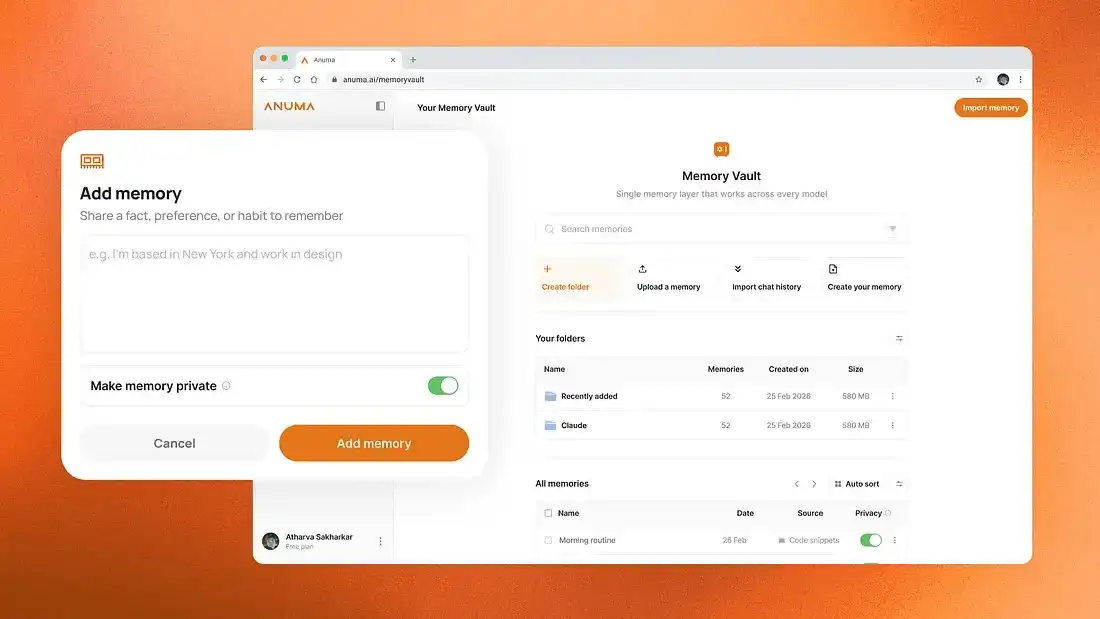
ZetaChain's consumer AI product, Anuma, advocates for users to own a set of encrypted private memory, supporting seamless use across mainstream AI models like ChatGPT, Claude, Gemini, etc. Users don't have to rebuild context, preferences, and work habits every time they switch models. Instead, users control access permissions and bring their historical memory to different models and agents.

As AI gradually accumulates users' usage preferences, writing habits, workflows, and historical conversations, the so-called "memory" will increasingly resemble a layer of "personality mirror." It not only determines whether a model's responses align with user preferences but may also determine whether the model, when making decisions on your behalf in the future, acts according to your habits and values.

Beyond giving users ownership of memory and allowing them to choose models with different strengths for different tasks, Anuma is also building a programmable, auditable, and revocable permission system. It allows AI agents to read records once, with permissions revocable at any time, and all permission changes can be recorded and tracked on-chain.

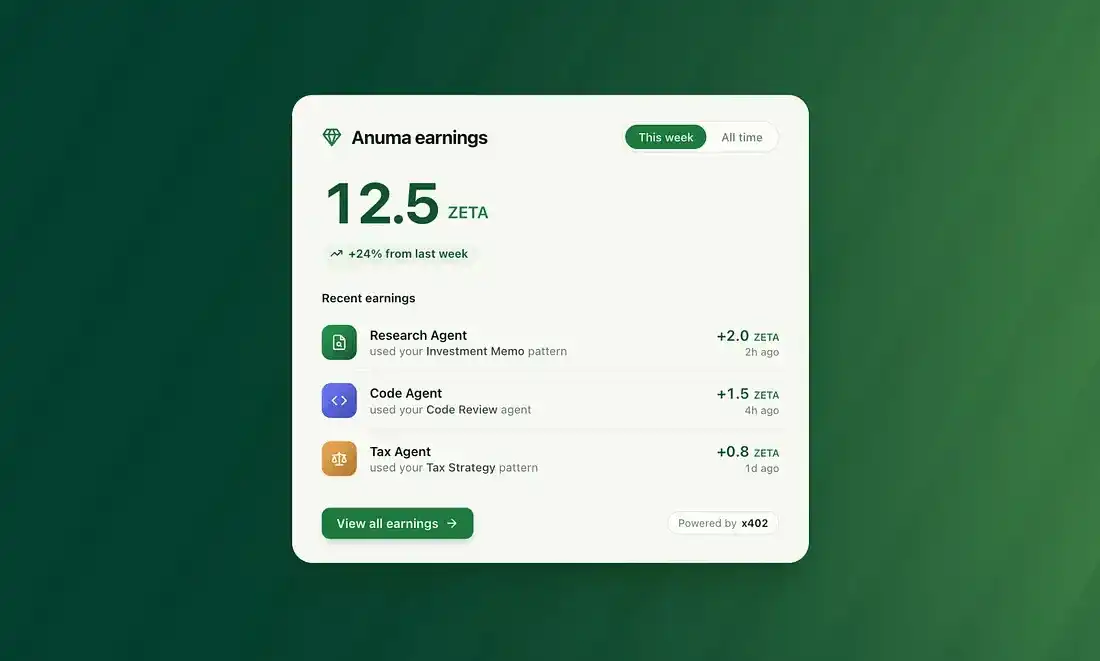
Moreover, users' memory and knowledge graphs can become assets that can be shared, authorized, and monetized without exposing raw data. This enables professional users such as investors, doctors, lawyers, and developers to encapsulate their expertise into agents, publish them to an Agent Marketplace, and earn revenue when others call upon them.

From Cross-Chain to Cross-AI Platform: Why Did ZetaChain Pivot?

What enables Anuma to achieve these functions is the underlying infrastructure, Private Memory Layer, developed by ZetaChain. As an infrastructure for AI-focused private memory, identity, permissions, payments, and agents, it aims to allow applications and agents to collaborate across models while users retain control.

ZetaChain had long focused on cross-chain interoperability infrastructure, with the core goal of solving asset and message transfer issues between different blockchains. Regarding the "unified multi-chain entry point," it built a considerable network and narrative. According to official data, there are 11.9 million unique addresses and 241 million transactions on its blockchain.

But after Anuma publicly launched on April 27th this year and surpassed 50,000 users in its first month, ZetaChain began deciding to fully pivot to AI, gradually phasing out its cross-chain interoperability business. Behind this pivot lies a relatively clear internal logic.
In the past, ZetaChain mainly dealt with the issue of incompatibility between different chains. In today's AI world, similar fragmentation exists. To some extent, digital assets are to blockchain what memory and context are to AI. Different models have their own closed memory systems; once users switch platforms, the long-accumulated context and behavioral preferences are often interrupted.

With developments in recent years, ZetaChain believes the biggest challenge it faces now is no longer cross-chain transfers between blockchains, but continuity between different models and agents, and the issue of user ownership over their own context.

a16z crypto previously mentioned in an analysis article that agents have begun to become economic participants, but they still lack portable identities, programmable payments, verifiable authorization, and the public coordination layer needed for cross-environment collaboration. Therefore, compared to many AI + Crypto projects awkwardly searching for application scenarios, ZetaChain's pivot logic is much smoother.

In business history, successful pivots by infrastructure companies are not uncommon. Such companies often don't simply switch tracks but chase new bottlenecks based on product logic. NVIDIA's most important initial narrative was graphics computing and gaming GPUs. But with the rise of AI, its GPU architecture ultimately became the core infrastructure for the entire AI industry. Infrastructure never revolves around the same constraint point forever, and true winners are often those who earliest identify that the "next constraint point" is emerging.

From Privacy Memory Layer to AI Consumer Layer

With the explosive development of AI, the future form of AI will clearly not be confined to chat windows but will gradually evolve into numerous long-term, collaborative AI assistants. Based on this judgment, after proposing the "Privacy Memory Layer" and attempting to solve how AI can understand users long-term, ZetaChain further proposed the concept of the "AI Consumer Layer," hoping to redefine the relationship between users and AI after AI works on behalf of users long-term.

In ZetaChain's vision, future AI won't just answer questions but will deeply participate in users' workflows and daily decisions. Different AI assistants will be responsible for different tasks—some handling code, others organizing finances, some planning schedules, and others participating long-term in content creation and research analysis. For these AIs to truly collaborate, they need to share the same set of long-term context, identity, and permission systems.

Therefore, the so-called "AI Consumer Layer" essentially attempts to integrate originally scattered capabilities into a unified framework. Among them, Memory handles long-term context, Permissions handles access control, Identity handles the identity system, Payments handles invocation and payments between AIs, and Agents are the AI networks that ultimately execute tasks on behalf of users.

This is why "ownership" has become the core concept ZetaChain repeatedly emphasizes.

Because in this system, whether users still own their context, permissions, and identities becomes paramount. For example, in the future, an AI responsible for code review could be temporarily authorized to read a GitHub repository; an AI handling tax organization could read tax filing materials once; an AI arranging travel could only access travel history and calendar permissions. Permissions would no longer be uniformly controlled by the platform but dynamically allocated by users and revocable at any time.

And this is precisely why blockchain is starting to reconnect with AI.

As more and more AIs simultaneously work on behalf of users, "who can access what," "whether permissions are revocable," and "whether invocations are traceable" will gradually become new infrastructure issues. And on-chain permission systems are naturally suited to handle this kind of multi-party collaboration.

'AI Infrastructure Token' ZETA Brings Utility Growth Alongside Pivot

Alongside ZetaChain's strategy adjustment, the functionality and utility of the ZETA token have also been adjusted. In the past, ZETA was more like a traditional public chain token, primarily serving Gas, validation, and cross-chain network security functions, with not much innovation in its mechanism design. But under the new narrative, ZETA will become an "AI Infrastructure Token," with its utility significantly enhanced.

According to ZetaChain's current description, ZETA will serve several purposes in the future:

Firstly, access permissions for AI models and Agents. Access to certain advanced models, specialized AI tools, or Agent services may require unlocking or payment of invocation fees using ZETA.

Secondly, payment settlement between Agents. ZetaChain mentions that future interactions between different AIs and applications will be completed via on-chain payments through the x402 protocol. Its goal is clear: if AIs in the future will automatically invoke other AIs, then machines also need a native payment system.
Thirdly, on-chain operations for permissions and memory updates. User modifications to permissions, access controls, and memory states may all become on-chain records in the future.

Fourthly, the creator economy. ZetaChain hopes that in the future, professionals like developers, researchers, lawyers, and doctors can encapsulate their knowledge into AI tools or Agents, earn revenue through invocations, with ZETA facilitating the flow of value.

However, it's important to note that this part currently remains largely at the narrative stage. Because the AI Agent economy itself is still far from mature, and truly large-scale "AI invoking AI" and "Agent autonomous payments" have not yet emerged. Concepts like x402, on-chain permissions, and AI identity currently belong more to pre-built infrastructure than to validated, large-scale demand.

But the reason ZetaChain and its product logic are noteworthy is not just because it's building an infrastructure paired with an AI product. More importantly, it attempts to redefine whether users' future memory, identity, context, and AI permissions belong to the platform or to users themselves. What ZetaChain wants to do, in essence, is to ensure these things are no longer controlled by platforms but returned to the hands of users.


Perguntas relacionadas

QWhat is the core issue regarding AI 'memory' that the article identifies as a new competitive battleground?

AThe article identifies that AI 'memory' or long-term context is becoming a new competitive battleground. Currently, AI models like ChatGPT, Claude, and Gemini store user preferences, work habits, and project contexts, but this 'memory' is siloed within each platform. This creates a problem where users lose their accumulated context and personalized AI understanding when switching between different AI models or services.

QWhat problem does the company ZetaChain aim to solve with its 'Private Memory Layer'?

AZetaChain aims to solve the problem of fragmented and platform-owned AI memory. Its Private Memory Layer is designed to be a user-owned, encrypted layer for storing long-term memory, behavior preferences, and AI context. This allows users to take their personalized 'memory' and seamlessly use it across different AI models (like ChatGPT, Claude, Gemini) and agents, maintaining continuity without starting over on each platform.

QWhat major strategic shift did ZetaChain make, and what was the logical connection behind this shift?

AZetaChain made a major strategic shift from being a cross-chain interoperability infrastructure for blockchains to focusing entirely on AI. The logical connection is that the core problem of interoperability and fragmentation exists in both domains. Just as it previously solved the issue of assets and data being siloed on different blockchains, it now addresses the similar issue of user context and memory being siloed within different, closed AI platforms.

QAccording to the article, how does the role of AI assistants evolve in the future vision presented by ZetaChain?

AIn ZetaChain's future vision, AI assistants evolve from simple chat tools into a network of long-term, specialized digital assistants that deeply collaborate. Different AI agents will handle specific tasks (e.g., coding, finance, travel planning, content creation). For them to work together effectively, they will need to share a unified framework for long-term context (memory), user identity, permissions, and a native payment system for inter-agent transactions.

QWhat new utility is the ZETA token expected to gain following ZetaChain's转型 (transformation) to AI?

AFollowing its transformation, the ZETA token is expected to evolve into an 'AI infrastructure token' with significantly expanded utility. Its expected new uses include: 1) Access and payment for premium AI models and agent services. 2) Settlement for payments between different AI agents (via protocols like x402). 3) Facilitating on-chain operations for updating user permissions and memory access controls. 4) Powering a creator economy where professionals monetize their expertise by packaging it into AI agents or tools.

Leituras Relacionadas

The Foundation of SpaceX's Trillion-Dollar Valuation: Who is Dividing Up Musk's Annual Tens of Billions in Capital Expenditure?

SpaceX's trillion-dollar valuation is built on its three core businesses: Starlink (profitable, 60% of revenue), rockets (driving down launch costs), and AI (a major investment area). This creates a financial cycle: Starlink funds rocket development, which enables low-cost launches for AI hardware, generating future revenue. This cycle fuels annual capital expenditures of tens of billions, flowing to a vast supply chain. Suppliers are categorized by their replaceability. The first group includes irreplaceable players like NVIDIA (GPU/CUDA ecosystem), Eutelsat (critical radio spectrum), Filtronic (specialized amplifiers), Materion (strategic beryllium), and STMicroelectronics (antenna chips). The second group consists of hard-to-replace suppliers due to high switching costs, such as Honeywell (flight control), Carpenter Technology (specialty alloys), Hexcel (carbon fiber), Broadcom (data exchange), and Linde (industrial gases). The third group comprises high-volume, cost-critical suppliers for mass-produced items like Starlink terminals. Key names include Wistron NeWeb (primary manufacturer) and several A-share companies like Shenzhen Sunway (connectors), Pies New Materials (forgings), Western Superconducting (alloys), and Yingliu (castings). Other niche players include Trimble (timing), Astronics (power distribution), and CTS (thermal management). The article argues that investing in these suppliers, rather than SpaceX stock directly, offers an alternative opportunity. The rationale is threefold: procurement is just beginning to scale, SpaceX's IPO brings new transparency to its supply chain, and the situation mirrors early stages of past "super terminal" ecosystems like Apple or Tesla. While risks exist (commodity cycles, geopolitical factors, technology shifts), the core thesis is that SpaceX's massive, ongoing procurement will translate into reliable revenue for its key suppliers, regardless of its own stock price volatility.

marsbitHá 3m

The Foundation of SpaceX's Trillion-Dollar Valuation: Who is Dividing Up Musk's Annual Tens of Billions in Capital Expenditure?

marsbitHá 3m

SpaceX's Trillion-Dollar Valuation Base: Who's Sharing in Musk's Annual Tens of Billions in Capital Expenditure?

**Title: The Foundation of SpaceX's Trillion-Dollar Valuation: Who Benefits from Musk's Annual $100 Billion Capital Expenditure?** This article argues that investors seeking to benefit from SpaceX's growth might find greater opportunities in its supply chain rather than directly investing in the company itself, drawing parallels to historical successes with Apple, Tesla, and NVIDIA suppliers. **SpaceX's Business Model & Cash Flow:** SpaceX generates revenue from three main areas: 1. **Starlink:** Its profitable core, earning $11.3B in 2023 (60% of revenue), funding other ventures. 2. **Rockets (Falcon/Starship):** Requires $3B+ in annual R&D but achieves the world's lowest launch costs. 3. **AI:** Currently unprofitable (-$6B+ in 2023), investing heavily in ground-based supercomputers (220,000 GPUs) and future orbital data centers. The cycle is: Starlink profits → fund cheaper rockets → low-cost launches deploy AI hardware → AI compute rentals generate future revenue. This cycle drives annual procurement spending of tens of billions of dollars. **The Supply Chain Beneficiaries:** Suppliers are categorized by their replaceability: **1. Nearly Irreplaceable (High Barriers to Entry):** * **NVIDIA:** Powers the Colossus supercomputer; its CUDA ecosystem creates immense switching costs. * **Eutelsat (SATS):** Controls critical radio spectrum for satellite communications; holds a ~3% stake in SpaceX. * **Filtronic (FTC):** Supplies millimeter-wave signal amplifiers for Starlink satellites; SpaceX constitutes 83% of its revenue. * **Materion (MTRN):** Global leader in beryllium production, a strategic material used in Starship structures. * **STMicroelectronics (STM):** Supplies phased-array antenna chips for Starlink satellites. **2. Replaceable, but Switching Cost is Prohibitively High:** * **Honeywell (HON):** Provides flight control and inertial navigation systems with decades of certification. * **Carpenter Technology (CRS):** Manufactures ultra-pure specialty steel alloys for Raptor engines. * **Hexcel (HXL):** Supplies custom carbon fiber composites developed over a decade with SpaceX. * **Broadcom (AVGO):** Manages high-speed data switching. * **Linde Group:** Supplies industrial gases (liquid oxygen/nitrogen) from facilities built near SpaceX launch sites. **3. High-Volume, Cost-Critical Manufacturing:** Focuses on mass-producing components like Starlink user terminals (target: 30 million units). * **Key Players:** Wistron NeWeb (6285, primary terminal manufacturer), several Chinese A-share companies (e.g., Sunway Communication, PAX New Materials, Western Metal Materials, Yingliu Co.), and smaller US firms like Trimble (TRMB, timing systems). **Why Now?** Three factors make the supply chain opportunity timely: 1. **Volume Ramp-Up:** SpaceX plans 100 launches in 2026, aims for 30 million Starlink terminals, and will deploy AI data centers, meaning procurement will accelerate. 2. **Increased Transparency:** The IPO provides public financial data, allowing investors to track supplier order growth. 3. **Historical Precedent:** The current phase is likened to Tesla's early mass-production stage (circa 2018), suggesting a long growth runway for suppliers. **Conclusion:** The article posits that while investing in SpaceX stock is betting on Elon Musk's ambitious vision at a high valuation, investing in its established suppliers is a bet on the tangible, recurring revenue from its massive procurement budget, which is largely decoupled from day-to-day stock price volatility.

链捕手Há 6m

SpaceX's Trillion-Dollar Valuation Base: Who's Sharing in Musk's Annual Tens of Billions in Capital Expenditure?

链捕手Há 6m

The U.S. Government Blocked the Anthropic Model. It Wasn't About 'Jailbreaking' at All.

Last Friday, the U.S. Commerce Department issued an enforcement letter that forced Anthropic to take its two most advanced AI models, Fable 5 and Mythos 5, offline. The stated reason was unspecified national security concerns, initially linked to potential "jailbreaks" of the models' safeguards. However, new details suggest the action stemmed more from a deteriorating relationship between the Trump administration and Anthropic, rather than a genuine technical threat. According to reports, the government cited a little-known export control regulation, compelling Anthropic to block access for all non-U.S. persons, including its own international employees. The company complied, shutting down the models without a court order or specific technical details from the government. Cybersecurity expert Katie Moussouris revealed she was privately shown a research paper detailing a potential safeguard bypass in Fable 5. She argued the described method was minor and did not warrant an export ban, stating that attempts to "fix" it would only weaken the model's defensive capabilities. Moussouris and other experts have since called for the order to be revoked, warning it dangerously removes advanced cybersecurity tools from U.S. defenders. Analysts like Justin Hendrix suggest the move appears retaliatory and sets a dangerous precedent, signaling that the U.S. government can unilaterally shut down a tech company's products. The incident has raised concerns about the reliability of American AI and the potential for political interference in the tech industry, serving as a warning to the broader sector.

marsbitHá 10m

The U.S. Government Blocked the Anthropic Model. It Wasn't About 'Jailbreaking' at All.

marsbitHá 10m

Ray Dalio: AI Bull Market Continues to Soar, Should Investors Go All In or Cash Out and Leave the Field?

In his latest notes, Ray Dalio addresses a critical question for investors amid the AI-driven stock market surge: how should one allocate assets during a transformative technological revolution? Dalio emphasizes that technological advancement does not automatically make related stocks attractive. Historical tech cycles—marked by excitement, crowding, volatility, and eventual shakeouts—show that even long-term winners like Microsoft and Apple experienced severe drawdowns. Today's AI sector faces similar uncertainties: overinvestment, intensifying competition, geopolitical tensions (e.g., Taiwan's chip supply), tax policy shifts, anti-AI sentiment, and potential disruption from future technologies like quantum computing. Dalio's core argument focuses on the highly concentrated market structure, where a few tech giants dominate major indices. He warns investors against unknowingly holding concentrated, correlated exposures. Instead of chasing a handful of AI leaders, he advocates for a robust, diversified portfolio of 15 or more high-quality, uncorrelated investments, risk-balanced to match an investor's volatility tolerance. Mathematically, such diversification significantly improves the risk-return ratio—for example, holding 15 uncorrelated assets can boost the ratio by over four times compared to a single concentrated bet. Dalio cautions that future equity returns appear low, with his bubble indicator suggesting real returns could be negative over the next 5-10 years. He stresses that knowing what you don't know is as important as knowing what you do. In an environment of high uncertainty and concentration, avoiding large, concentrated bets on AI stocks is prudent. The optimal strategy is disciplined diversification—the "holy grail" of investing—to navigate this technologically driven cycle with lower risk and comparable or better returns.

marsbitHá 13m

Ray Dalio: AI Bull Market Continues to Soar, Should Investors Go All In or Cash Out and Leave the Field?

marsbitHá 13m

Trading

Spot
Futuros

Artigos em Destaque

Como comprar ZEN

Bem-vindo à HTX.com!Tornámos a compra de Horizen (ZEN) simples e conveniente.Segue o nosso guia passo a passo para iniciar a tua jornada no mundo das criptos.Passo 1: cria a tua conta HTXUtiliza o teu e-mail ou número de telefone para te inscreveres numa conta gratuita na HTX.Desfruta de um processo de inscrição sem complicações e desbloqueia todas as funcionalidades.Obter a minha contaPasso 2: vai para Comprar Cripto e escolhe o teu método de pagamentoCartão de crédito/débito: usa o teu visa ou mastercard para comprar Horizen (ZEN) instantaneamente.Saldo: usa os fundos da tua conta HTX para transacionar sem problemas.Terceiros: adicionamos métodos de pagamento populares, como Google Pay e Apple Pay, para aumentar a conveniência.P2P: transaciona diretamente com outros utilizadores na HTX.Mercado de balcão (OTC): oferecemos serviços personalizados e taxas de câmbio competitivas para os traders.Passo 3: armazena teu Horizen (ZEN)Depois de comprar o teu Horizen (ZEN), armazena-o na tua conta HTX.Alternativamente, podes enviá-lo para outro lugar através de transferência blockchain ou usá-lo para transacionar outras criptomoedas.Passo 4: transaciona Horizen (ZEN)Transaciona facilmente Horizen (ZEN) no mercado à vista da HTX.Acede simplesmente à tua conta, seleciona o teu par de trading, executa as tuas transações e monitoriza em tempo real.Oferecemos uma experiência de fácil utilização tanto para principiantes como para traders experientes.

227 Visualizações TotaisPublicado em {updateTime}Atualizado em 2026.06.02

Como comprar ZEN

Discussões

Bem-vindo à Comunidade HTX. Aqui, pode manter-se informado sobre os mais recentes desenvolvimentos da plataforma e obter acesso a análises profissionais de mercado. As opiniões dos utilizadores sobre o preço de ZEN (ZEN) são apresentadas abaixo.

活动图片