Optimism涨超11%,交易量激增88%,OP能否站稳上方?

ambcryptoPublicado em 2026-05-11Última atualização em 2026-05-11

Resumo

OP重新夺回头肩底颈线突破区,买方大幅提升市场参与度。

Optimism(OP)上涨11.14%至0.1656美元,交易量激增88.31%至2.331亿美元,反映出围绕OP的投机参与度显著上升。

此轮反弹出现在买方强势回归之后——此前数周,价格一直压缩在0.12美元附近窄幅整理。

突破期间交易活动迅速加速,同时现货和衍生品市场的看涨情绪同步增强。

然而,OP当前仍低于近期局部高点0.1718美元,表明尽管反弹强劲,卖方仍在死守更高的阻力位。

最新的价格扩张也恰逢整个山寨币市场结构的改善,这为Optimism这类高贝塔资产提供了更强的风险偏好支撑。

交易所流出持续塑造Optimism的走势结构

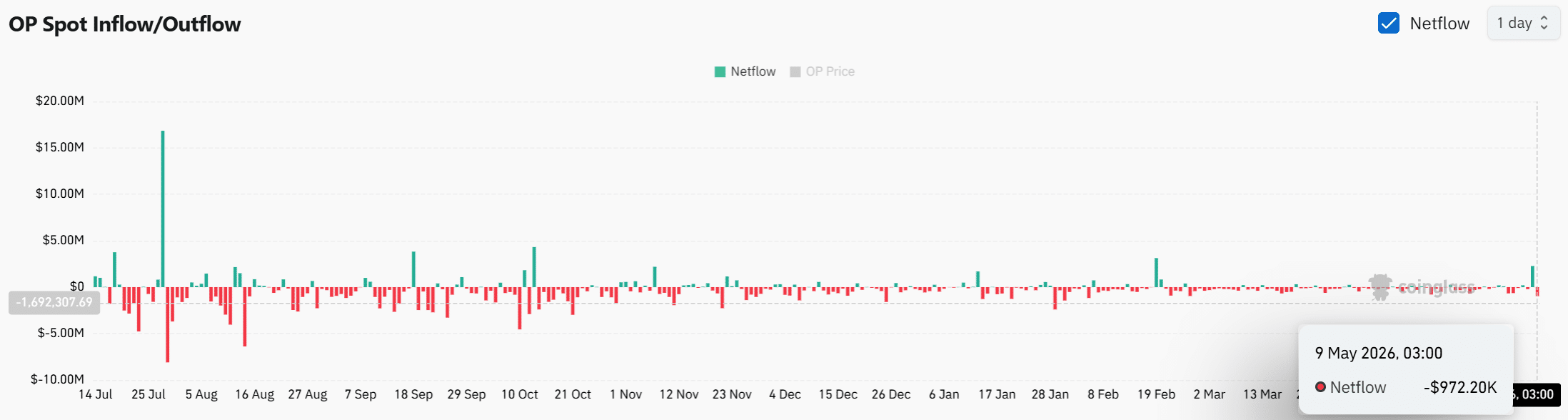
尽管大幅反弹,现货净流量仍为负值,显示交易所流出依然占据主导。

CoinGlass数据显示,Optimism单日净流出97.22万美元,延续了代币从中心化交易所流出的整体趋势。

这一行为表明,交易者仍在将OP提取到私人钱包,而非准备立即卖出。

此前几个月,尤其是7月和10月附近的大幅波动期,也曾反复出现大额流出。

而这次突破发生在流出持续的情况下,进一步强化了市场参与者更倾向于吸筹而非激进获利了结的判断。

在需求上升的阶段,交易所余额的减少往往会收紧即时可用的供应。
来源:CoinGlass

Optimism是否已确认看涨反转结构?

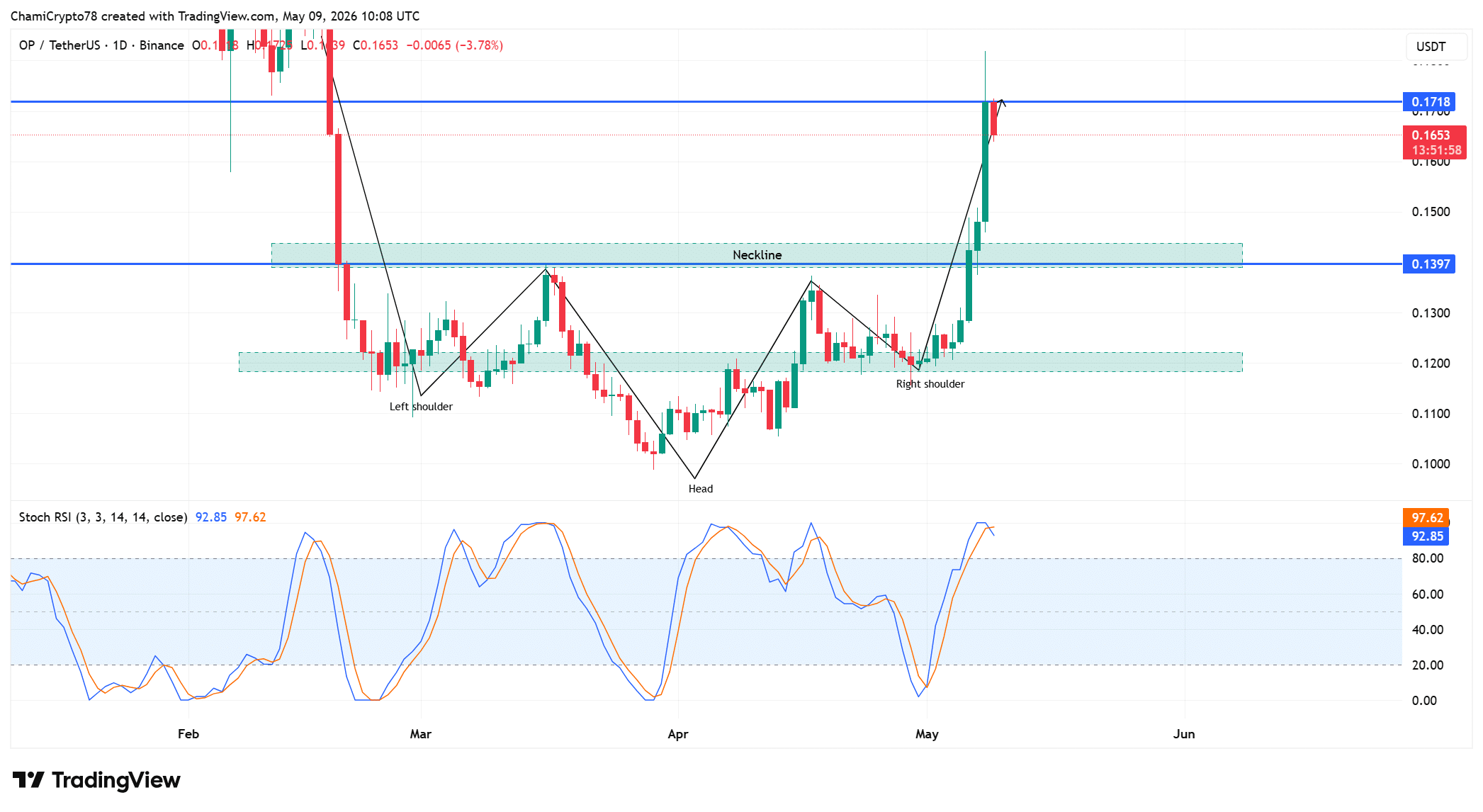
Optimism突破了日线图上的头肩底颈线(约0.1397美元),终结了此前数月连续走低的高点结构。

突破后价格迅速推向关键阻力区0.1718美元,卖方在此开始阻挡上涨势头。

价格结构还显示,从0.12美元支撑区的右肩形态出现了强劲的扩张,证实了反弹过程中多头控制力不断增强。

与此同时,随机RSI急剧拉升,进入超买区域,两项指标分别达到92.85和97.62。

这表明颈线突破后看涨动能正在加速。

不过,超买状况也增加了在下一轮上涨尝试之前出现短期回调的可能性。

如果买方能够令人信服地收复0.1718美元,OP有望向更高的反弹目标迈进。

若未能果断突破阻力位,则可能在颈线上方迎来短暂盘整,等待下一轮方向选择。
Optimism价格走势,来源:TradingView

顶级交易员仍偏向看涨

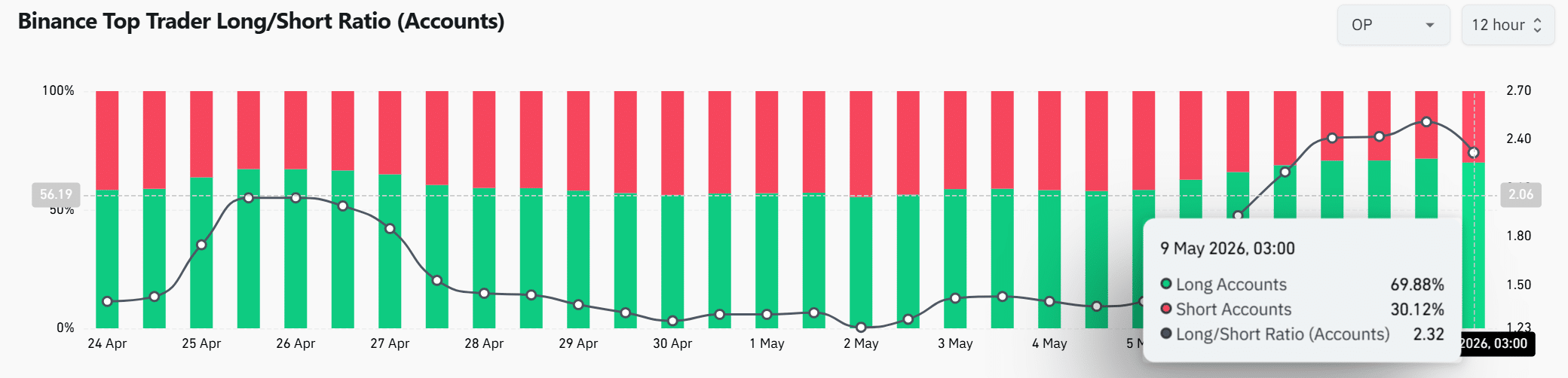
随着衍生品市场看涨情绪增强,币安顶级交易员的持仓继续偏向多头。

多头账户占全部仓位的69.88%,空头账户仅占30.12%。

多空比攀升至2.32,显示出大型参与者越来越激进的上行押注。

这一失衡反映出,在头肩底形态确认突破后,市场对OP的上涨结构信心增强。

随着价格从数月低点回升,看涨持仓在5月上旬也在稳步扩大。

然而,在剧烈波动期间,过于拥挤的多头头寸有时会增加爆仓风险。
来源:CoinGlass

总结

总体而言,Optimism的突破结构、不断上升的交易活动以及激进的多头持仓,反映出市场看涨条件正在增强。

交易所的持续流出也支持了更广泛的复苏叙事——交易者仍在将OP从中心化平台撤出。

尽管超买指标可能引发短期降温,但在重新夺回颈线突破区之后,多头仍掌控着更大级别的结构。

如果买方能够在关键支撑位上方维持压力,OP有望在未来几个交易日延续反弹轨迹。

最终总结

OP重新夺回头肩底颈线突破区,买方大幅提升市场参与度。

Criptomoedas em alta

Leituras Relacionadas

You Use Claude and Codex Every Day, but Meta Has Restricted Internal Use

In May, Meta imposed internal restrictions on its engineers regarding the use of Claude Code and Codex, two widely used AI programming tools. Despite being a major client, Meta's guidelines, still in effect, prohibit these external models from being used for specific tasks to prevent potential "escalations with partners." The core concern is "distillation"—the risk that outputs from Claude or Codex could inadvertently contaminate the training data and evaluation processes for Meta's in-house AI coding assistant, MetaCode. If MetaCode is trained or evaluated using data generated by these external models, it risks learning their capabilities rather than developing its own, blurring the line of intellectual origin. The restrictions are precise: engineers cannot use the external models to generate test questions, debug source code, or suggest test cases. AI-generated content is also barred from environments accessible to MetaCode. However, AI can still assist with peripheral tasks like workflow setup and code organization, provided all outputs are manually reviewed. This caution reflects a broader industry dilemma. While distillation is a common technique, using a competitor's model output for training raises legal and ethical questions about the ownership of derived capabilities. Contractual terms from companies like OpenAI and Anthropic explicitly forbid using their outputs to build competing products, putting enforcement power in the hands of rivals. The move is also financially motivated, as Meta seeks to reduce its hefty internal AI spending, estimated in the billions this year. Meta's policy illustrates the delicate balance companies must strike: leveraging powerful external AI tools while safeguarding the integrity and independence of their own AI development. As AI systems increasingly help build other AIs, distinguishing the origin of capabilities becomes a fundamental challenge for the entire industry.

marsbitHá 1h

You Use Claude and Codex Every Day, but Meta Has Restricted Internal Use

marsbitHá 1h

Why Do We Need an AI Content Perspective Today?

The article "Why Do We Need an AI Content Perspective Today?" explores the complex and often contentious integration of AI into the cultural and creative industries, particularly film and television. It begins with the cancellation of Amazon's AI-generated animation "Punky Duck," highlighting the ethical debates surrounding AI content. AI's rapid advancement is transforming video production, enabling cost-effective, full-length AI films (e.g., "RAPHAEL," "Dreams of Violets") while sparking industry resistance over issues like "synthetic actors." The core debate has shifted from whether to use AI to how to use it responsibly. The article analyzes why AI's entry into film is uniquely unsettling. It distinguishes between "cultural fast food" (short-form, fast-paced content like micro-dramas) and "cultural main courses" (traditional, long-form film/TV). AI currently excels at the former, matching its fragmented narratives, shallow emotional needs, and free-to-consumer models. However, venturing into the latter challenges the human-centric essence of storytelling—creativity, emotional depth, and the unique value of human labor and experience. While AI can generate massive volumes of content and lower costs, it risks devaluing human creativity, leading to homogenized output, and creating unfair competition through potential intellectual property infringement. Its efficiency also amplifies content safety risks, making preemptive governance crucial. To counter these risks, the article proposes establishing clear boundaries guided by a human-centered AI content perspective. It outlines four principles: 1) Amplify, rather than displace, human creative space; 2) Respect and protect human creative output; 3) Ensure human creative control and responsibility remain paramount; and 4) Guarantee transparency and traceability in AI creation. The conclusion emphasizes that humans must act as the "helmsmen" of technology, steering AI development to enhance, not replace, the core human values at the heart of cultural expression.

marsbitHá 2h

Why Do We Need an AI Content Perspective Today?

marsbitHá 2h

Planck Retracted? The Father of Quantum Tripped by an Algorithm

The recent discovery that two articles (published in 1940 and 1942) by Max Planck, the Nobel laureate and founder of quantum theory, are marked as "retracted" on Springer's digital platform highlights a curious clash between historical publishing practices and modern automated systems. An investigation suggests these retractions are algorithmic errors, not due to fraud or misconduct. The papers, philosophical reflections on science published in *Die Naturwissenschaften*, were likely flagged by the platform's systems. One article, a republished lecture, may have been mistaken for duplicate publication. Another, sharing a title with a prior article by a different author (a common practice for continuing debates at the time), may have triggered a similar automated check. The digital versions have even been replaced with blank pages, contrary to normal practice of preserving retracted texts. This incident underscores how contemporary digital infrastructure, built around concepts like "self-plagiarism" and strict copyright, can misclassify and obscure legitimate historical scholarly communication. It serves as a warning that digital archives are not neutral mirrors of the past but are filtered by platform rules, potentially distorting the scientific record. As AI systems increasingly rely on such databases, such erroneous metadata could propagate, affecting how future tools interpret and access historical knowledge.

marsbitHá 2h

Planck Retracted? The Father of Quantum Tripped by an Algorithm

marsbitHá 2h

Trading

Spot

Artigos em Destaque

Como comprar OP

Bem-vindo à HTX.com!Tornámos a compra de Optimism (OP) simples e conveniente.Segue o nosso guia passo a passo para iniciar a tua jornada no mundo das criptos.Passo 1: cria a tua conta HTXUtiliza o teu e-mail ou número de telefone para te inscreveres numa conta gratuita na HTX.Desfruta de um processo de inscrição sem complicações e desbloqueia todas as funcionalidades.Obter a minha contaPasso 2: vai para Comprar Cripto e escolhe o teu método de pagamentoCartão de crédito/débito: usa o teu visa ou mastercard para comprar Optimism (OP) instantaneamente.Saldo: usa os fundos da tua conta HTX para transacionar sem problemas.Terceiros: adicionamos métodos de pagamento populares, como Google Pay e Apple Pay, para aumentar a conveniência.P2P: transaciona diretamente com outros utilizadores na HTX.Mercado de balcão (OTC): oferecemos serviços personalizados e taxas de câmbio competitivas para os traders.Passo 3: armazena teu Optimism (OP)Depois de comprar o teu Optimism (OP), armazena-o na tua conta HTX.Alternativamente, podes enviá-lo para outro lugar através de transferência blockchain ou usá-lo para transacionar outras criptomoedas.Passo 4: transaciona Optimism (OP)Transaciona facilmente Optimism (OP) no mercado à vista da HTX.Acede simplesmente à tua conta, seleciona o teu par de trading, executa as tuas transações e monitoriza em tempo real.Oferecemos uma experiência de fácil utilização tanto para principiantes como para traders experientes.

426 Visualizações TotaisPublicado em {updateTime}Atualizado em 2026.06.02

Como comprar OP

Discussões

Bem-vindo à Comunidade HTX. Aqui, pode manter-se informado sobre os mais recentes desenvolvimentos da plataforma e obter acesso a análises profissionais de mercado. As opiniões dos utilizadores sobre o preço de OP (OP) são apresentadas abaixo.

活动图片