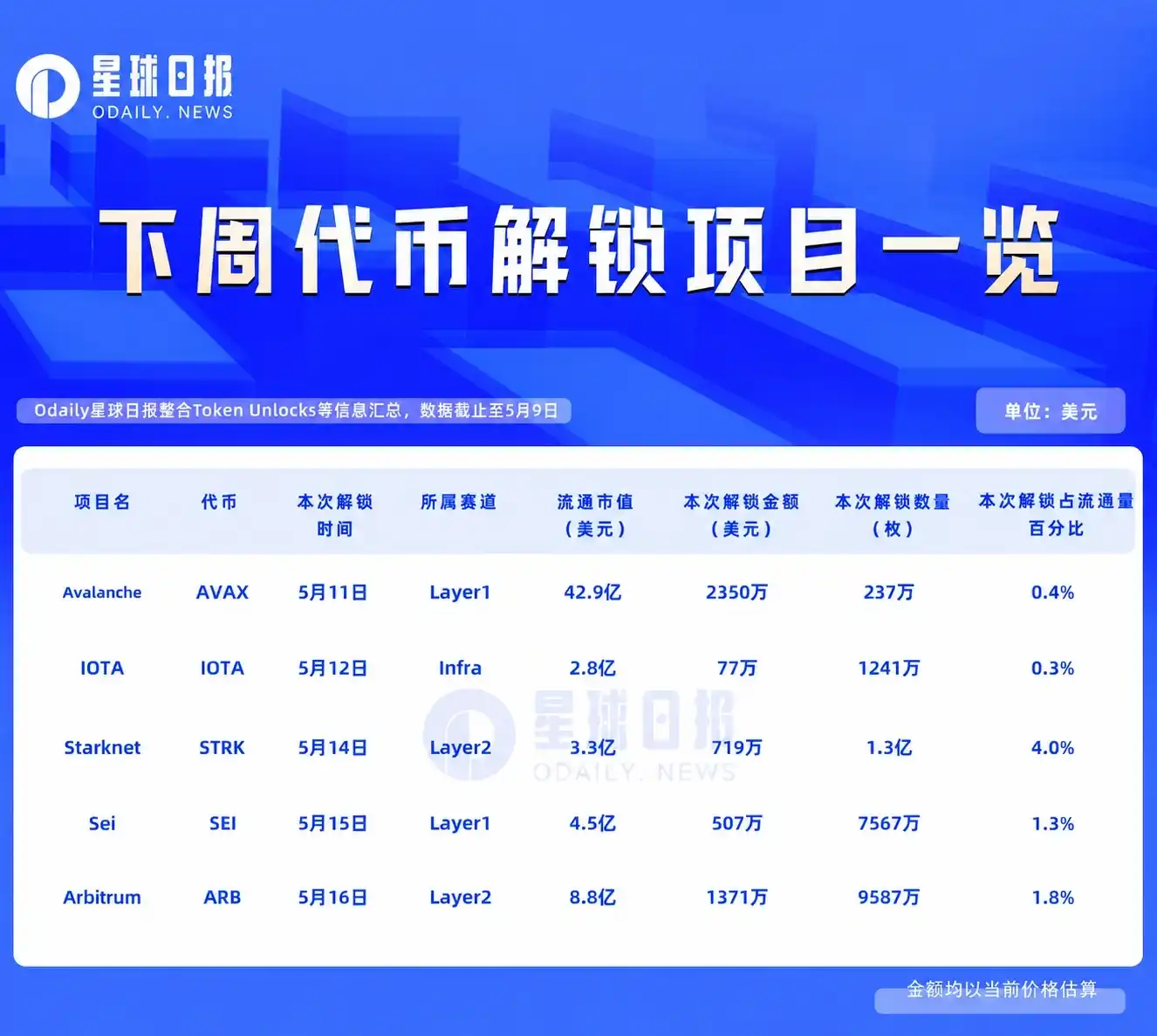
Desbloqueo de tokens de la semana: STRK desbloquea el 4% del suministro circulante mientras el precio sube

marsbitPublicado em 2026-05-10Última atualização em 2026-05-10

Resumo

**Resumen de desbloqueo de tokens esta semana** **Starknet (STRK)** - **Cantidad desbloqueada:** 130 millones de tokens - **Valor aproximado:** ~7.19 millones de dólares - **Detalles:** Starknet es una solución de Capa 2 (Layer 2) para Ethereum que utiliza tecnología zk-STARKs para hacer las transacciones más rápidas y económicas. Este desbloqueo representa aproximadamente el 4% del suministro circulante. A pesar de esta liberación de tokens, se observó una tendencia alcista ("pull-up") en el precio. **Arbitrum (ARB)** - **Cantidad desbloqueada:** 95.87 millones de tokens - **Valor aproximado:** ~13.71 millones de dólares - **Detalles:** Arbitrum es un rollup optimista de Ethereum diseñado para mejorar su escalabilidad. Agrega y procesa transacciones fuera de la cadena principal, ofreciendo operaciones más rápidas y baratas mientras mantiene la seguridad de Ethereum. Los poseedores del token ARB pueden participar en la gobernanza del protocolo.

Starknet

Twitter del proyecto:https://twitter.com/Starknet

Sitio web del proyecto:https://starknet.io/

Cantidad desbloqueada esta vez: 130 millones

Valor del desbloqueo esta vez: Aproximadamente 7.19 millones de dólares

Starknet es una capa 2 de Ethereum que utiliza tecnología zk-STARKs para hacer que las transacciones en Ethereum sean más rápidas y económicas. La empresa matriz de StarkNet, StarkWare, fue fundada en 2018 y tiene su sede en Israel. Sus principales productos desarrollados son Starknet y StarkEx. Al utilizar STARK, Starknet verifica transacciones y cálculos sin necesidad de que todos los nodos de la red verifiquen cada operación. Esto reduce significativamente la carga computacional y aumenta el rendimiento de la red blockchain.

Arbitrum

Twitter del proyecto:https://twitter.com/arbitrum

Sitio web del proyecto:https://arbitrum.io/

Cantidad desbloqueada esta vez: 95.87 millones

Valor del desbloqueo esta vez: Aproximadamente 13.71 millones de dólares

Arbitrum es un Rollup de Ethereum diseñado para mejorar la escalabilidad de Ethereum. Agrega y procesa transacciones fuera de la cadena antes de enviar una única transacción a la red principal de Ethereum. Esto significa que los usuarios pueden disfrutar de transacciones más rápidas y económicas, al tiempo que se benefician de la seguridad y descentralización de la red de Ethereum. El token nativo de Arbitrum es ARB. Los poseedores de ARB pueden participar en el proceso de toma de decisiones, como proponer y votar sobre actualizaciones o cambios en el protocolo.


Perguntas relacionadas

Q¿Qué es Starknet y cuál es su propósito principal?

AStarknet es una solución de capa 2 (Layer2) para Ethereum que utiliza tecnología zk-STARKs para hacer que las transacciones de Ethereum sean más rápidas y con tarifas reducidas. Su propósito principal es aligerar la carga computacional y aumentar el rendimiento de la red blockchain.

Q¿Cuántas monedas STRK se desbloquearán esta semana y cuál es su valor aproximado en dólares?

AEsta semana se desbloquearán 130 millones de monedas STRK, con un valor aproximado de 7.19 millones de dólares.

Q¿Qué es Arbitrum y cómo funciona para mejorar Ethereum?

AArbitrum es un Rollup de Ethereum diseñado para mejorar su escalabilidad. Funciona agregando y procesando transacciones fuera de la cadena antes de enviar una sola transacción a la red principal de Ethereum, permitiendo transacciones más rápidas y baratas mientras mantiene la seguridad y descentralización de Ethereum.

Q¿Quién fundó Starknet y cuál es otra de sus principales soluciones?

AStarknet fue fundada por la empresa StarkWare, establecida en 2018 con sede en Israel. Otra de sus principales soluciones es StarkEx.

Q¿Cuántas monedas ARB (Arbitrum) se desbloquearán esta semana y cuál es su valor aproximado?

AEsta semana se desbloquearán 95.87 millones de monedas ARB, con un valor aproximado de 13.71 millones de dólares.

Leituras Relacionadas

Has the Crypto Market Bottomed? Here's What Institutions Think

The crypto market is in a period of significant debate, with leading institutions offering differing views on whether a bottom has been reached. Three prominent firms have published detailed analyses: * **Galaxy Digital** argues Bitcoin has **not yet bottomed**. Their analysis of 13 historical indicators across six dimensions (valuation, profit-taking, miner pressure, etc.) shows only four are fully met. They project a potential bottom range between $30k and $54k. * **NYDIG** states a bottom is **possible but not likely**. While metrics are close to historic bear market extremes, they note the absence of a classic panic-selling event. They also suggest increased institutional adoption may have structurally altered the market cycle, potentially leading to a shallower downturn. * **Standard Chartered Bank** asserts the **bottom has already occurred** at around $59k. They cite two key factors: potential US-Iran diplomatic progress and the anticipated SpaceX IPO, which they believe absorbed capital and caused ETF selling pressure that is now subsiding. They forecast a year-end price target of $100k. Despite the surface-level disagreement, the reports share critical common ground more valuable for long-term investors: 1. All three believe the market bottom will form **within this year**. 2. All agree the current price is **closer to the bottom than to previous highs**. 3. All maintain a **bullish long-term outlook** for Bitcoin and a new cycle. The core takeaway is that while the exact bottom price ($40k, $50k, or $60k) is debated, the consensus is that a bottom is imminent. For long-term holders, the primary focus should not be pinpointing the absolute low, but on the future potential for prices to reach $100k, $200k, or higher. The fundamental thesis for Bitcoin—sovereign debt accumulation, inflation, declining trust in centralized institutions, global digitization, and improved accessibility—remains intact and is arguably strengthening. The overall landscape is viewed as more favorable than in previous crypto winters.

marsbitHá 5m

Has the Crypto Market Bottomed? Here's What Institutions Think

marsbitHá 5m

The 'Chip' Challenge and Breakthroughs in China's Optical Industry Chain

China's Photonics Industry: Bottlenecks and Breakthroughs In the global AI race, computing chips dominate the narrative, but the underlying bottleneck increasingly defining the scale of AI clusters is light—or more specifically, optical connectivity. Optical modules, which translate electrical signals to light and vice versa, are crucial for connecting thousands of GPUs in AI data centers, preventing data congestion and ensuring efficient model training. High-speed modules (800G, 1.6T) are now standard, with performance hinging on advanced DSP (Digital Signal Processor) chips. This is where a critical dependency lies. Two US giants—Marvell and Broadcom—collectively dominate over 90% of the high-end DSP chip market. Chinese optical module leaders like Zhongji Innolight and Eoptolink rely on these chips to manufacture modules for overseas AI customers, primarily in North America. While this creates a supply chain vulnerability, complete decoupling is difficult. Marvell derives over half its revenue from Greater China, and the US firms depend on Chinese partners for chip packaging and optical components. The risk from laser chips (e.g., from Lumentum), another key component, is considered more manageable due to multiple global suppliers and faster progress in domestic alternatives from companies like YOFC and Accelink. To mitigate risks, China's industry is pursuing a multi-pronged strategy: diversifying supply chains and locking in long-term orders; fostering a domestic market ecosystem to adopt homegrown DSPs from firms like Huawei HiSilicon and CETC; accelerating R&D in high-speed DSPs and advanced packaging; and investing in next-gen technologies like silicon photonics and Co-Packaged Optics (CPO) to reduce reliance on discrete DSPs. The ultimate solution lies not in short-term博弈 but in persistent advancement of domestic high-end chip R&D and manufacturing. While challenges remain in performance, certification, and ecosystem building, China's vast domestic market and manufacturing base provide a crucial buffer, buying time for the industry to achieve greater technological independence.

marsbitHá 18m

The 'Chip' Challenge and Breakthroughs in China's Optical Industry Chain

marsbitHá 18m

Behind SpaceX's $2 Trillion Market Cap: Why Does Musk Always Have the Next Move Planned?

On June 12th, SpaceX debuted on the Nasdaq, reaching a valuation that briefly touched $2 trillion. This marked the culmination of a 24-year journey from its founding in 2002, driven by Elon Musk's frustration at the high cost of buying rockets. The company's path was defined by early failures, with its first three Falcon 1 launches ending in explosions before a successful 2008 flight opened the era of commercial spaceflight. Key to its model was a fixed-price NASA contract, incentivizing cost reduction. SpaceX mastered rocket reusability, first achieving a Falcon 9 landing in 2015, which drastically cut launch costs. This enabled its profitable Starlink satellite internet constellation, envisioned years before reusability was proven, to create an internal market for frequent launches. Similarly, the next-generation Starship rocket was in development long before its first flight, with its business case evolving from Mars colonization to supporting the emerging concept of in-orbit data centers for AI—a story now central to its valuation. The company's recent IPO, a reversal of its long-standing "no IPO" stance, is funding this ambitious "space-based compute" vision. While major tech players like Google, Blue Origin, and others are investing heavily, significant technical and cost hurdles remain. Ultimately, SpaceX's history is one of creating its own demand: first with Starlink and now with space-based AI compute, betting that its next rocket will enable its next giant market.

marsbitHá 21m

Behind SpaceX's $2 Trillion Market Cap: Why Does Musk Always Have the Next Move Planned?

marsbitHá 21m

When Crypto Meets the World Cup: CoinW and Modrić's Art of "Navigating Cycles"

When Encryption Meets the World Cup: CoinW and Modrić's "Transcending Cycles" Philosophy In the context of the 2026 FIFA World Cup and its massive global audience, the crypto exchange CoinW announced football legend Luka Modrić as its global brand ambassador. This move is framed not merely as a marketing tactic, but as a strategic experiment in user profile migration. It targets mature, financially stable football fans—particularly in Europe, Southeast Asia, and Latin America—who traditionally have low crypto awareness but value trusted, time-tested authority figures like Modrić. The article draws parallels between Modrić's enduring, disciplined career—marked by consistency and success at the highest level over two decades—and CoinW's own development path. Founded in 2017 during a volatile industry period, CoinW focused on building robust infrastructure and risk management. It weathered the 2022 industry crisis without major security incidents, subsequently earning recognition like "Europe's Most Trusted Exchange" and growing to over 20 million registered users. This "long-termism" is translated into user-centric products. CoinW Academy lowers the initial knowledge barrier. Its integrated ecosystem (CoinW, GemW, DeriW, PropW) and the recent launch of a TradFi section—offering perpetual contracts on traditional assets like stocks, gold, and oil—aim to create a unified platform for diverse assets. For the World Cup, CoinW launched the "We Are The Game" campaign, collaborating with Alchemy Pay to offer zero-fee deposits and local payment options, aiming to transform spectators into participants and lower entry barriers. Ultimately, CoinW's sports partnerships and product strategy are presented as a concerted effort to build trust and accessibility for the "silent majority" still outside crypto—shifting the industry narrative toward inclusivity and long-term value.

Foresight NewsHá 27m

When Crypto Meets the World Cup: CoinW and Modrić's Art of "Navigating Cycles"

Foresight NewsHá 27m

Trading

Spot
Futuros

Artigos em Destaque

Como comprar 4

Bem-vindo à HTX.com!Tornámos a compra de 4 (4) simples e conveniente.Segue o nosso guia passo a passo para iniciar a tua jornada no mundo das criptos.Passo 1: cria a tua conta HTXUtiliza o teu e-mail ou número de telefone para te inscreveres numa conta gratuita na HTX.Desfruta de um processo de inscrição sem complicações e desbloqueia todas as funcionalidades.Obter a minha contaPasso 2: vai para Comprar Cripto e escolhe o teu método de pagamentoCartão de crédito/débito: usa o teu visa ou mastercard para comprar 4 (4) instantaneamente.Saldo: usa os fundos da tua conta HTX para transacionar sem problemas.Terceiros: adicionamos métodos de pagamento populares, como Google Pay e Apple Pay, para aumentar a conveniência.P2P: transaciona diretamente com outros utilizadores na HTX.Mercado de balcão (OTC): oferecemos serviços personalizados e taxas de câmbio competitivas para os traders.Passo 3: armazena teu 4 (4)Depois de comprar o teu 4 (4), armazena-o na tua conta HTX.Alternativamente, podes enviá-lo para outro lugar através de transferência blockchain ou usá-lo para transacionar outras criptomoedas.Passo 4: transaciona 4 (4)Transaciona facilmente 4 (4) no mercado à vista da HTX.Acede simplesmente à tua conta, seleciona o teu par de trading, executa as tuas transações e monitoriza em tempo real.Oferecemos uma experiência de fácil utilização tanto para principiantes como para traders experientes.

622 Visualizações TotaisPublicado em {updateTime}Atualizado em 2026.06.02

Como comprar 4

Discussões

Bem-vindo à Comunidade HTX. Aqui, pode manter-se informado sobre os mais recentes desenvolvimentos da plataforma e obter acesso a análises profissionais de mercado. As opiniões dos utilizadores sobre o preço de 4 (4) são apresentadas abaixo.

活动图片