Understanding $UORE in One Article: The V4 Hook Project That Packs Mining, Lottery, and NFTs into a Single Transaction

marsbitPublicado em 2026-05-08Última atualização em 2026-05-08

Resumo

The article discusses the emergence of a new Ethereum project, $UORE, which leverages Uniswap V4's "Hook" mechanism to combine multiple DeFi and NFT functions into a single transaction. $UORE integrates on-chain mining, a lottery system, and generative pixel NFTs (called Orelings) directly into its Uniswap V4 liquidity pool. Each whole UORE token held automatically generates an Oreling NFT, with its rarity and a random "Hash" value determining its "Mining Power" for staking rewards. A daily token emission, subject to a 1% decay, is distributed to stakers. The project also includes a "Motherlode" lottery triggered by purchases and a deflationary mechanism with buy/sell taxes funding automatic buybacks and burns. The project is a fork of the earlier uPEG V4 Hook project, incorporating ideas from Solana's ORE. However, it faces challenges including high transaction gas fees (2-3x a normal swap due to multiple contract actions), significant complexity for users, and a potentially narrowing attention window as it is the fourth project in a trending but possibly cooling V4 Hook narrative. The founder's message, "Read the contracts and understand the mechanics before deploying capital," underscores its experimental and high-risk nature.

Curry, Shenchao TechFlow

Still FOMOing over Slonk, the hot Ethereum on-chain project from yesterday? Actually, a new narrative has arrived:

V4 Hook.

Over the past two weeks, Uniswap V4's Hook mechanism suddenly caught fire. SATO used Hooks to create an on-chain bonding curve, pushing its market cap to $40 million. uPEG rode the viral story of an unused Uniswap name draft to over $30 million in two weeks. Slonks crammed an AI model into a smart contract to mimic CryptoPunks, achieving 586 ETH in trading volume six days after launch.

Although these three projects have different playstyles, they all leverage Uniswap's V4 mechanism.

Now the fourth one is here.
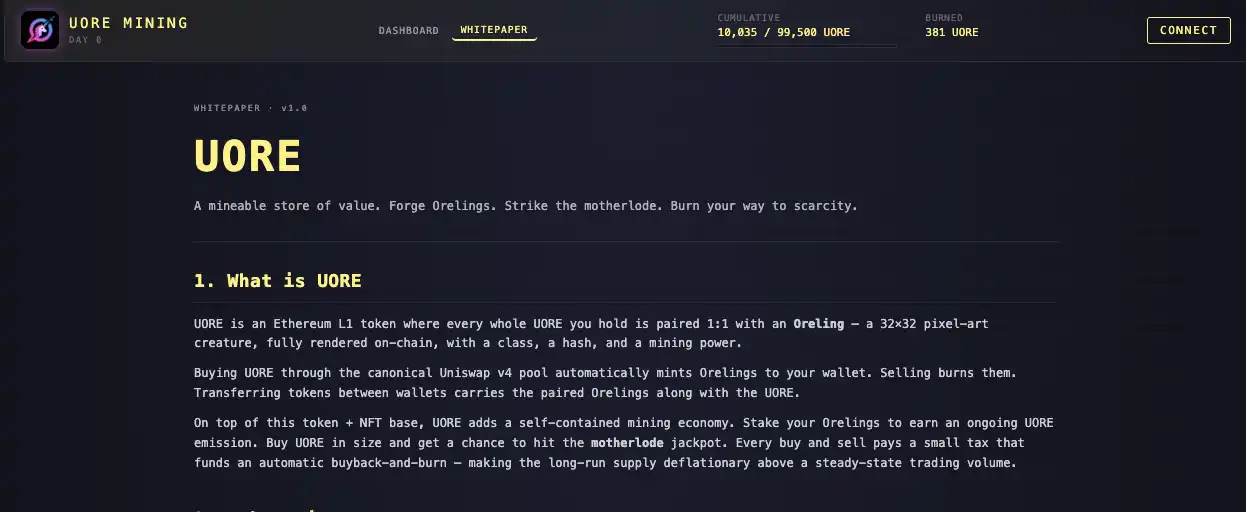
The new project is called $UORE, launched just yesterday. In one sentence, what it does is: Packaging on-chain mining, token-buying lottery, pixel NFT auto-generation, and a deflationary burn mechanism all into a single Uniswap V4 trading pool.

Because when you buy tokens in this pool, the contract will execute the aforementioned six things in the background simultaneously, the gas fee for one transaction is two to three times that of a regular swap...

Currently, if you open CT, you'll see everyone complaining about this high gas.

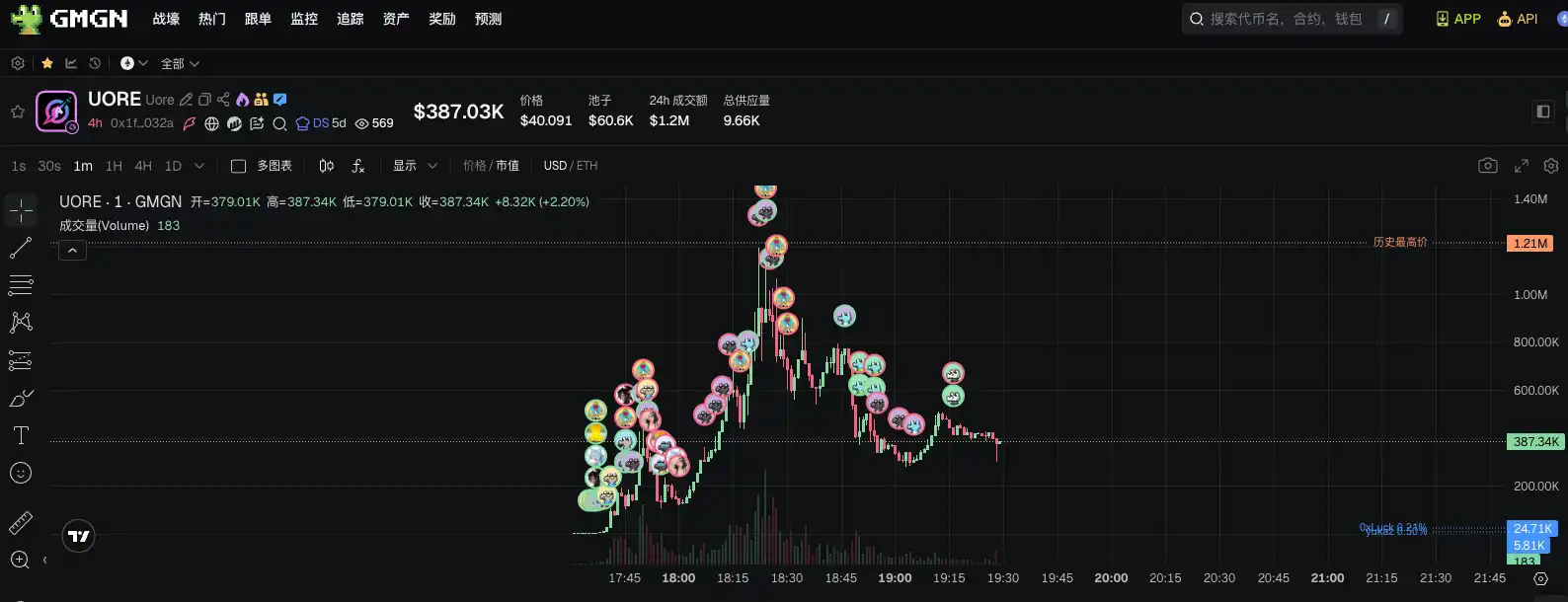
Regarding the token, according to GMGN data at the time of writing, $UORE reached a market cap of $1.2 million within hours of launch, then quickly dropped to $440k. The pool liquidity is only $64k, but the 24-hour trading volume is $1.2 million, meaning the money in the pool has turned over nearly twenty times.

However, there are only 741 holders, with a total supply of less than ten thousand tokens.
Currently, the risk appears extremely high. After some preliminary research, I personally think it's the most complex mechanism-wise among the V4 Hook ecosystem projects (the recent wave of new on-chain plays tends to make their mechanisms hard to understand...).

It is simultaneously a token, an NFT collection, a staking mine, and a lottery system. Moreover, these four things aren't independent; they are welded together.

Four-in-One Mine

For most NFT projects, the token and the NFT are separate things, bought and sold separately.

UORE is different. Its NFT is called Oreling, a 32×32 pixel miner character, embedded directly within the token. For every whole integer UORE token you hold in your wallet, you automatically have one corresponding Oreling.
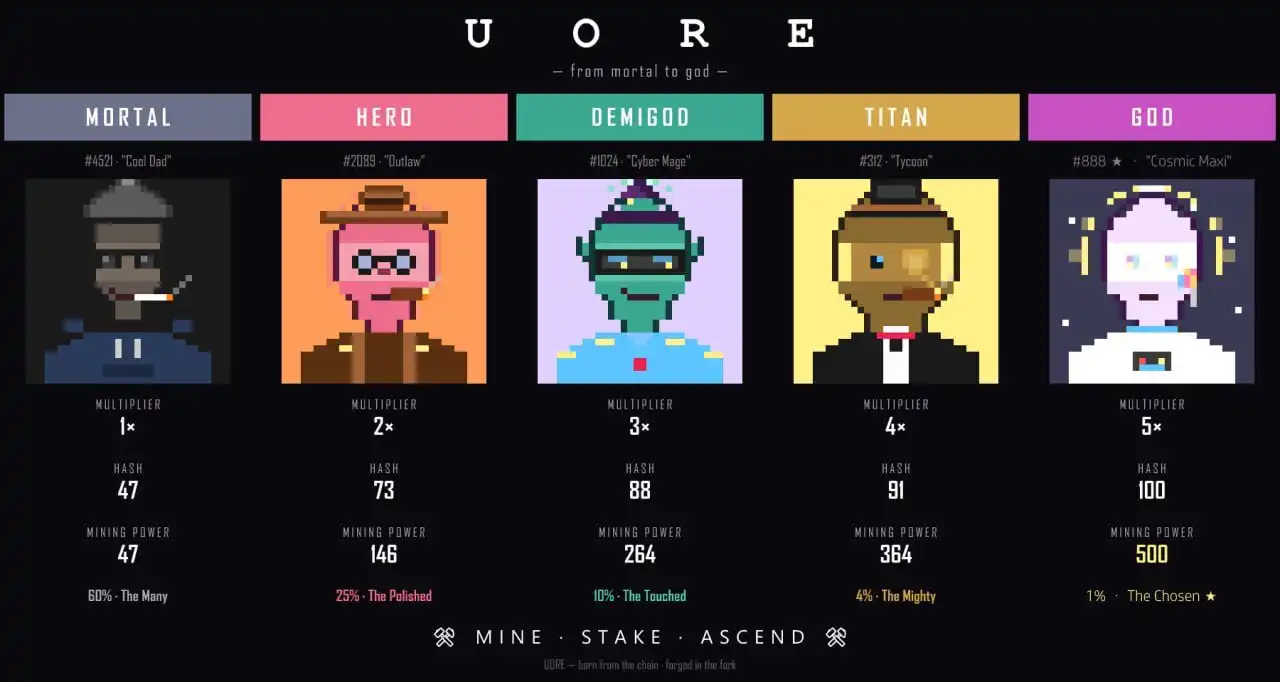
The contract mints it for you when you buy tokens, burns it when you sell, and the Oreling moves with the token when transferred. You cannot buy an Oreling separately, nor can you detach it from UORE.

The traits of each Oreling are determined by the hash of the next block at the moment of minting. This means you don't know what kind of character you'll get when buying, not even the validators can see the result beforehand.

The differences between these characters aren't just about looks.

Each Oreling has a Class (rarity) and a Hash (a random number from 1 to 100). Multiplying the two gives its Mining Power.

The most common Mortal makes up 60% with a 1x multiplier; the rarest God has only a 1% chance with a 5x multiplier. If you're lucky and mint a God with Hash 100, its power is 500, over ten times that of a common miner.

What's the use of mining power? Classic play: staking.

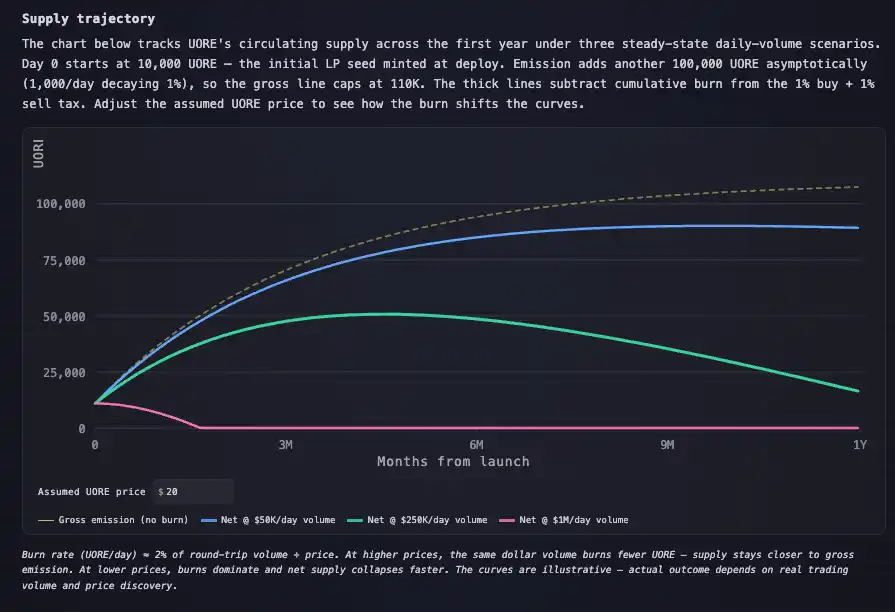
Stake your Oreling into the mine pool, and you start receiving a share of the daily UORE release proportional to your mining power. According to the project's whitepaper, 1000 UORE are released on the first day, then decaying by 1% daily, with a half-life of roughly 69 days. 80% of the release goes to stakers, 20% goes into the Motherlode prize pool.

This decay rate means 97% of the total emissions will be released within a year. The earlier you enter the mining game, the bigger your share of the pie.

There's a noteworthy design when claiming rewards: a 10% "refining tax" is deducted and redistributed to all stakers who haven't claimed yet. The whitepaper calls this the refined-ore boost.

In plain terms, those who claim later eat more of the taxes paid by others. People in a hurry to withdraw are subsidizing the patient ones.
Then there's the Motherlode, which translates to "lode prize".

Every time you buy UORE worth ≥ 0.1 ETH through the official channel, you automatically get a lottery ticket. The winning probability is linked to the purchase amount: 0.1 ETH gives about a 1/600 chance, 0.5 ETH about 1/200, and 1 ETH caps at 1/100. Buying over 1 ETH doesn't increase the probability further, preventing whales from farming chances.

If you win, the prize pool is split in half: 50% goes directly to the buyer, and 50% is randomly distributed to one staker (weighted by mining power). As of writing, there have only been 4 wins historically, with the largest prize being 6.4 UORE.

Finally, the deflationary flywheel.

Buying incurs a 1% tax directly burned, selling incurs a 1% tax sent to a buyback treasury. When the treasury accumulates 0.1 ETH, anyone can trigger an automatic buyback, and the bought-back UORE are all burned. As of writing, 58 buybacks have been executed, cumulatively burning 358 UORE.
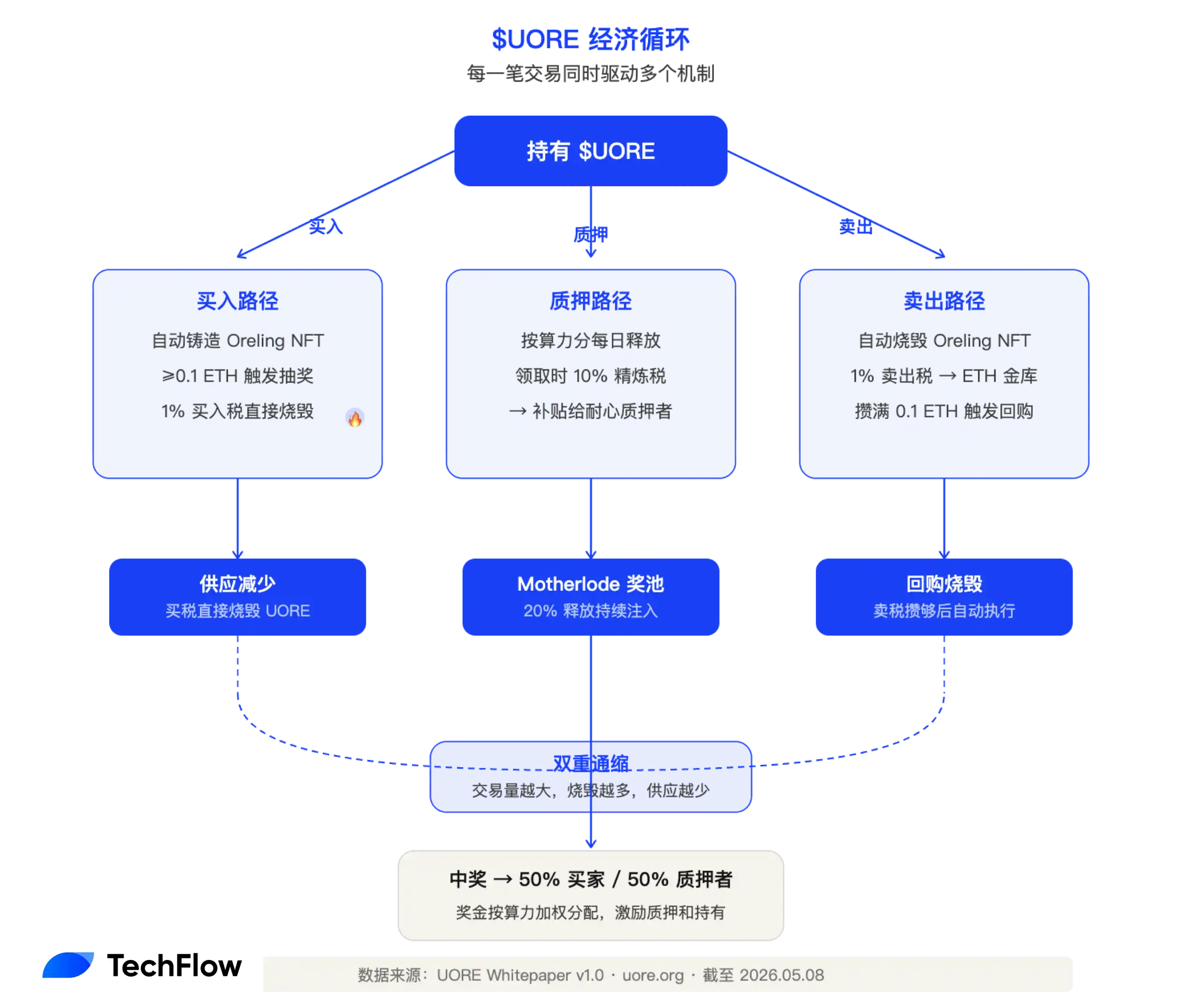
Looking at the entire design, it's a minor innovation in token-NFT play, an old trick for creating scarcity, yet another Ponzi in economic model design.

The Project's Code is Forked, Its Playstyle is Frankensteined

UORE wasn't written from scratch.

People in the community looked at the source code and found a folder named `reference/unipeg-hook-source/`. The founder, Noah, didn't hide it either. He directly stated on Twitter that UORE's contracts are forked from uPEG, and that he fixed two known issues with uPEG: duplicate NFT generation and flash loan attacks for farming rarity.
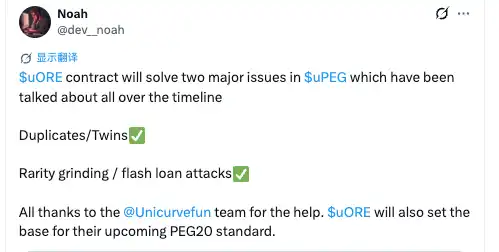
A quick look at this founder's profile shows a bio: "Ethereum dev & BAYC holder". On May 2nd, he tweeted his first post about UORE, saying the project combines the mining concept from Solana's ORE with the V4 Hook architecture of uPEG.

He also proactively @ mentioned Unicurvefun and Openpeg, asking if they could support Orelings trading once their markets go live.

From this public information, UORE's lineage is clear:

Solana ORE provided the "on-chain mining + lottery" gameplay template, uPEG provided the V4 Hook code skeleton, and Noah made improvements and assembled on top of these two.

Forking itself isn't the issue. I think the current problems are:

  1. Gas. There are reports on CT that each UORE transaction requires the Hook to execute six steps, consuming two to three times the gas of a normal swap. Swapping back and forth might leave little to no profit.
  2. Time window. The V4 Hook narrative was affected by uPEG's price drop, and subsequent projects will likely have lower ceilings. UORE is the fourth project in this wave of Hook hype, with the heat from the first three already cooling. The attention window for this sector waits for no one.
  3. Complexity. UORE is probably the most mechanically dense among these four projects. For an average user to understand the whole set of rules—Oreling rarity, mining power calculation, staking decay, refining tax, Motherlode probability, buyback trigger conditions—the barrier is high, and the official website is cryptic.

And the project's whitepaper is also interesting:
Read the contracts and understand the mechanics before deploying capital.

Translated into Chinese, this roughly means "Understand it first, don't blame me if you don't."

Combining insights from previous Hook projects, we can see this wave of on-chain trends features complex mechanism designs + massive information asymmetry. They have alpha potential, but the shelf life of that alpha is getting shorter.

SATO gave you a week, uPEG gave you a few days, and by the time it's UORE's turn, the time you have to understand the rules might be down to just a few hours...

By the time you understand it, the market move might be over.

Criptomoedas em alta

Perguntas relacionadas

QWhat is the core innovation or 'hook' of the $UORE project on Uniswap V4?

AThe $UORE project packages multiple mechanics into a single Uniswap V4 pool transaction. With one buy or sell, the contract simultaneously handles token swapping, NFT (Oreling) minting/burning, staking power calculation, participation in the Motherlode lottery, token buyback for burning, and applying transaction taxes.

QHow does the $UORE project integrate an NFT (Oreling) with its token?

AThe Oreling NFT is directly embedded into the $UORE token. Each whole number of $UORE tokens held in a wallet automatically corresponds to one Oreling. The NFT is minted when tokens are bought and burned when tokens are sold, and it cannot be traded separately from the token.

QWhat is the 'Motherlode' mechanism in $UORE and how does it work?

AThe Motherlode is a lottery prize pool. Buying $UORE through the official pool with ≥ 0.1 ETH automatically grants a lottery ticket. The winning probability scales with purchase amount up to a 1% max chance for 1 ETH purchases. If a buyer wins, 50% of the prize pool goes to them, and the other 50% is randomly distributed to a staker, weighted by their mining power.

QWhat are the main criticisms or potential risks mentioned about the $UORE project?

AThe article highlights several risks: very high gas fees (2-3x a normal swap), a short attention window as it's the fourth V4 Hook project in a fading trend, and high complexity which creates a barrier for understanding. Additionally, its liquidity is low, token distribution is concentrated, and the economic model is described as a Ponzi.

QAccording to the article, what existing projects did $UORE fork or draw inspiration from?

A$UORE's smart contracts are forked from the uPEG project, fixing known issues. Its core 'on-chain mining + lottery' gameplay concept is inspired by the ORE project on Solana. The founder combined these two templates to create $UORE on the Uniswap V4 Hook framework.

Leituras Relacionadas

After Three Consecutive Quarters of Decline, Can the Crypto Market Find a Window for Stabilization in Q3?

The cryptocurrency market has just concluded its worst-performing quarter since 2022, with total capitalization dropping 12.6% to $2.1 trillion. All core metrics indicate capital is leaving the sector, not just rotating within it. Bitcoin fell 14.2% and Ethereum dropped 25.4% in Q2, breaking their previous correlation with US tech stocks. A key driver is the reversal in US spot Bitcoin ETF flows, which saw a net outflow of approximately $4.67 billion in Q2, including a record monthly outflow near $4.5 billion in June. While recent data suggests long-term holders are accumulating again, sustained ETF outflows mean continued selling pressure. Market focus is now singularly on the Federal Reserve. The upcoming July FOMC meeting is seen as the most critical event for Q3. A dovish signal could support Bitcoin reclaiming a $68,000-$84,000 range, while a hawkish stance might establish a new trading band around $50,000-$56,000. Additionally, regulatory uncertainty persists, with the progress of the crucial *CLARITY Act* stalling in the Senate, reducing its perceived 2026 passage probability to 40-45%. Despite the broad downturn, a few sectors showed growth. Prediction markets saw nominal volume surge 48.7% year-over-year to $113.8 billion, and tokenized collectibles transaction volume rose 143% quarterly to $1.4 billion. The Real-World Asset (RWA) tokenization sector also continued steady growth, now representing ~$28.1 billion in on-chain value. The market's foundation for an extreme crash appears limited, with Bitcoin price hovering near its 200-week moving average. However, the trading paradigm has shifted from narrative-driven speculation to decisions based on price action, policy developments, and interest rate expectations, making a broad sentiment-driven rally unlikely in the near term.

marsbitHá 22h

After Three Consecutive Quarters of Decline, Can the Crypto Market Find a Window for Stabilization in Q3?

marsbitHá 22h

BIT Trading Moment: BTC Still Suppressed by Weekly 200 EMA, Rejection May Restart Decline; Storage and Semiconductors that Surged Last Night Begin Falling in Evening Trading

**Crypto & Stock Market Wrap: Bitcoin Tests Resistance, Stocks Retreat After AI Surge** Bitcoin consolidates around $66,000, facing key resistance near $68,000—an area seen as a major psychological and technical hurdle where previous rallies have failed. Analysts note the cryptocurrency is caught between its 200-week moving average (~$63,333) and 200-week EMA (~$68,328). A clear break above $68k is needed to signal a stronger bullish trend, while a rejection could lead to a retest of $63k support. Market sentiment remains cautious, with low futures open interest pointing to a low-liquidity rebound rather than a full bull market. Bitcoin spot ETFs saw another $203 million inflow. US stock futures pointed lower after a strong Tuesday session led by a massive rebound in semiconductors and memory stocks. The rally was fueled by renewed optimism about AI-driven hardware demand, with Micron, SanDisk, and SK Hynix surging. However, those gains reversed in pre-market trading. Super Micro Computer (SMCI) soared over 20% after hours on strong guidance and a record backlog. Other standouts included Rocket Lab and nuclear energy plays Oklo and X-Energy. Rising oil prices (Brent above $91) and climbing Treasury yields (10-year near 4.64%), however, are reigniting inflation concerns and acting as a headwind for equities. In Asia, markets were mixed. South Korea's KOSPI pared early gains to close slightly higher as semiconductor stocks like SK Hynix gave back initial surges. Japan's Nikkei edged lower as the yen hit a fresh 38-year low against the dollar, raising fears of potential market intervention. Key events to watch include the Samsung Galaxy launch, AMD's AI event, and a slew of major tech earnings from Alphabet, Tesla, and IBM after the close on Wednesday, followed by the ECB meeting and Intel's earnings on Thursday.

marsbitHá 22h

BIT Trading Moment: BTC Still Suppressed by Weekly 200 EMA, Rejection May Restart Decline; Storage and Semiconductors that Surged Last Night Begin Falling in Evening Trading

marsbitHá 22h

Former CFTC Chairman, Circle President Tarbert: Preaching Long-Termism While Cashing Out $30 Million Himself

Former CFTC Chairman and Circle President Heath Tarbert has consistently advocated for a long-term vision in public, urging patience from investors as Circle’s stock price has fallen significantly from its peak. However, it has been revealed that since Circle’s IPO, Tarbert has continuously sold his CRCL shares through pre-arranged trading plans, cashing out approximately $30 million, without making any public market purchases. This contrast between his public messaging and personal actions has drawn criticism. Tarbert joined Circle in July 2023 as Chief Legal Officer, leveraging his regulatory experience to help guide the company through its IPO and expansion. Despite promoting stablecoins as long-term infrastructure, he established a 10b5-1 trading plan just before Circle went public, leading to substantial stock sales over the following year. In March 2026, he initiated another plan to sell more shares. His career trajectory highlights a pattern of moving between high-level regulatory roles and influential positions in the financial sector. After resigning as CFTC Chairman in early 2021, he joined Citadel Securities as Chief Legal Officer just 27 days later, during a period of intense regulatory scrutiny for the firm. He later joined Circle, aiding its efforts to navigate regulatory challenges for its public listing. While Tarbert's expertise in policy and compliance is valuable to companies like Circle, his actions—advocating long-term confidence while personally divesting—raise questions about the alignment between his public statements and his private financial decisions, leaving investors who followed his advice to bear the market risks.

marsbitHá 23h

Former CFTC Chairman, Circle President Tarbert: Preaching Long-Termism While Cashing Out $30 Million Himself

marsbitHá 23h

Gate Research Institute: The 'Wall Street-ization' Wave of Crypto Financial Products – Competition or Integration?

The article titled "Gate Research Institute: Are Crypto Financial Products Sparking a 'Wall Street' Wave—Competition or Convergence?" explores the evolving relationship between the crypto ecosystem and traditional finance (TradFi). The piece begins by reflecting on Bitcoin's original 2009 vision of decentralization, disintermediation, and moving away from banks. It then contrasts this with the 2024 landscape, where key crypto assets like Bitcoin are increasingly held through Wall Street products like ETFs issued by giants like BlackRock. The article questions whether this signifies that TradFi is systematically taking over the rights to issue, price, custody, and distribute crypto financial assets. The core argument is that this is not a zero-sum takeover but rather a bidirectional convergence where each side addresses the other's weaknesses. Crypto offers 24/7 global markets, programmable settlement, and open access but lacks compliant channels, institutional-grade custody, deep fiat liquidity, and mainstream distribution. TradFi possesses these but is constrained by legacy systems, limited operating hours, and slow settlement. Two primary convergence paths are highlighted: * **Path A (CEX to TradFi):** Exemplified by Gate, which has progressed from offering tokenized stocks and CFDs to providing direct, real stock trading (US, Hong Kong, South Korea) within its platform, using USDT. * **Path B (TradFi to Crypto):** Exemplified by Robinhood, which has integrated crypto trading, acquired exchanges like Bitstamp, and is moving traditional assets like stocks onto the blockchain via tokenization and its own Layer 2. Both paths are ultimately competing to become the next-generation, unified financial account—a "super account" where users can seamlessly trade cryptocurrencies, stocks, ETFs, RWA (Real World Assets), and tokenized treasury products in one interface. The growth of RWA and tokenized treasuries (e.g., BlackRock's BUIDL) is presented as the asset-layer fusion, providing stable, yield-bearing assets on-chain and acting as a bridge between the two worlds. In conclusion, the "Wall Street-ization" of crypto is framed as a mutual transformation. Decentralized ideals persist in the protocol layer, while at the application layer, a more efficient, global, and accessible unified capital market is emerging from this convergence. The future competition lies not between crypto exchanges and stockbrokers, but between platforms vying to offer the most comprehensive asset coverage, liquidity, and user experience within a single account.

marsbitHá 23h

Gate Research Institute: The 'Wall Street-ization' Wave of Crypto Financial Products – Competition or Integration?

marsbitHá 23h

Trading

Spot

Artigos em Destaque

Como comprar ONE

Bem-vindo à HTX.com!Tornámos a compra de Harmony (ONE) simples e conveniente.Segue o nosso guia passo a passo para iniciar a tua jornada no mundo das criptos.Passo 1: cria a tua conta HTXUtiliza o teu e-mail ou número de telefone para te inscreveres numa conta gratuita na HTX.Desfruta de um processo de inscrição sem complicações e desbloqueia todas as funcionalidades.Obter a minha contaPasso 2: vai para Comprar Cripto e escolhe o teu método de pagamentoCartão de crédito/débito: usa o teu visa ou mastercard para comprar Harmony (ONE) instantaneamente.Saldo: usa os fundos da tua conta HTX para transacionar sem problemas.Terceiros: adicionamos métodos de pagamento populares, como Google Pay e Apple Pay, para aumentar a conveniência.P2P: transaciona diretamente com outros utilizadores na HTX.Mercado de balcão (OTC): oferecemos serviços personalizados e taxas de câmbio competitivas para os traders.Passo 3: armazena teu Harmony (ONE)Depois de comprar o teu Harmony (ONE), armazena-o na tua conta HTX.Alternativamente, podes enviá-lo para outro lugar através de transferência blockchain ou usá-lo para transacionar outras criptomoedas.Passo 4: transaciona Harmony (ONE)Transaciona facilmente Harmony (ONE) no mercado à vista da HTX.Acede simplesmente à tua conta, seleciona o teu par de trading, executa as tuas transações e monitoriza em tempo real.Oferecemos uma experiência de fácil utilização tanto para principiantes como para traders experientes.

348 Visualizações TotaisPublicado em {updateTime}Atualizado em 2026.06.02

Como comprar ONE

Discussões

Bem-vindo à Comunidade HTX. Aqui, pode manter-se informado sobre os mais recentes desenvolvimentos da plataforma e obter acesso a análises profissionais de mercado. As opiniões dos utilizadores sobre o preço de ONE (ONE) são apresentadas abaixo.

活动图片