Iran Opens Fire on an Oil Tanker That Paid Bitcoin Transit Fees to Scammers

marsbitPublicado em 2026-04-22Última atualização em 2026-04-22

Resumo

Iran announced plans to charge Bitcoin and USDT transit fees for oil tankers passing through the Strait of Hormuz. Within two weeks, scammers impersonated Iranian officials and sent fraudulent messages to stranded vessels, demanding cryptocurrency payments in exchange for safe passage. At least one tanker that paid the fake fee was fired upon by Iranian Revolutionary Guard boats when attempting to cross. Maritime risk firm MARISKS confirmed the scam exploited shipowners’ anxiety amid heightened regional tensions. Chain analysis firms TRM Labs and Chainalysis found no evidence of large-scale crypto payments actually being made to Iranian entities. Legal experts warned that even payments made to scammers—if intended for Iran—could violate international sanctions. The incident highlights how cryptocurrency’s irreversibility, often touted as a strength, becomes a critical risk in conflict-driven fraud. While Iran’s proposal initially sparked excitement in crypto circles, it ultimately created a new attack vector for deception, leaving ships trapped, fined, or even under fire.

Author: Deep Tide TechFlow

Deep Tide Introduction: Less than two weeks after Iran announced it would collect Bitcoin transit fees in the Strait of Hormuz, scammers impersonated Iranian officials and sent fake messages to stranded oil tankers demanding BTC and USDT.

At least one tanker that paid the fake transit fee was fired upon by the Iranian Revolutionary Guard Corps when attempting to pass. Chain analysis firms TRM Labs and Chainalysis both stated that no large-scale on-chain evidence of cryptocurrency payments has been found so far.
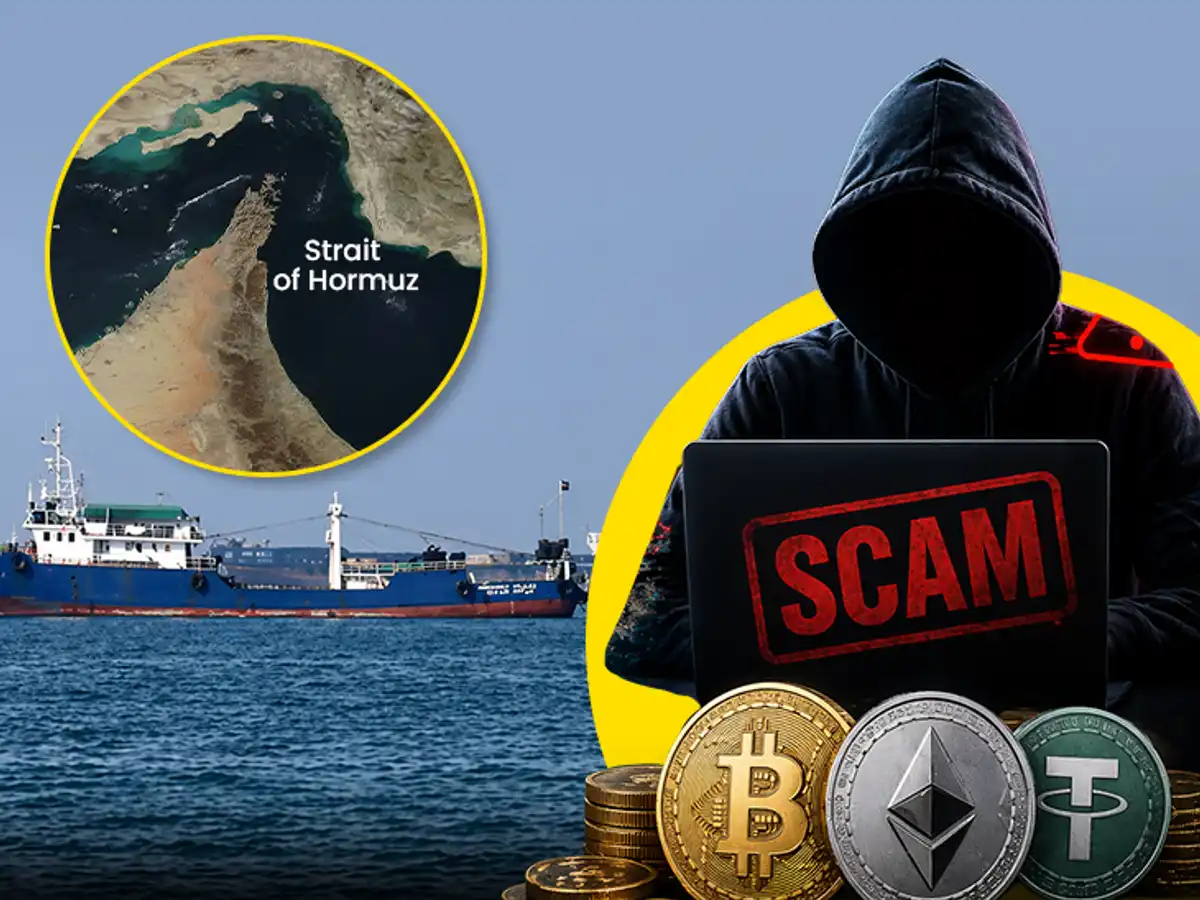
Iran announced it would collect transit fees in Bitcoin, and within two weeks, scammers turned this narrative into a weapon.

According to a Reuters report on April 21, the maritime risk management company MARISKS issued a warning: unidentified individuals are posing as Iranian authorities and sending false messages to ships stranded on the western side of the Strait of Hormuz, demanding payment of "transit fees" in BTC or USDT in exchange for safe passage. MARISKS believes that at least one of the vessels fired upon by Iranian Revolutionary Guard Corps speedboats on April 18, when Iran briefly opened the strait, was a victim of this scam.

The absurdity of the incident lies in the entire chain of causality: a sovereign state announces it will collect Bitcoin transit fees, scammers copy this rhetoric to commit fraud, shipowners believe it and pay, and then get shot at by the real Iranian military.

From "National-Level Settlement Tool" to Attack Surface for Scammers

The story begins in early April.

From March 30 to 31, the Iranian parliament passed the "Hormuz Strait Management Plan," formally writing into law the transit fee system that the Islamic Revolutionary Guard Corps had already been implementing since mid-March. According to the Financial Times, Hamid Hosseini, spokesperson for the Iran Oil, Gas, and Petrochemical Products Exporters Union, confirmed that fully loaded tankers are required to pay a fee of $1 per barrel, with payment methods including Bitcoin, USDT, or Chinese yuan. A supertanker carrying 2 million barrels of crude oil could face a single transit fee of up to $2 million.

Upon the news, Bitcoin's price jumped 5%, briefly breaking through $72,700. The crypto community quickly interpreted this as a milestone validation of Bitcoin as a "neutral settlement layer for international trade." Institutions like Bitwise even linked it to predictions of Bitcoin reaching $1 million.

But there were also many skeptics.

Sam Lyman of the Bitcoin Policy Institute pointed out in a report on April 15 that large-scale collection of Bitcoin transit fees with existing technology is "almost impossible." Ari Redbord, global policy head at TRM Labs, told Fortune magazine that on-chain data does not show transit fee payments occurring on a large scale. Chainalysis, in its analysis report, noted that on-chain activities of entities linked to Iran primarily rely on USDT on the Tron network, not Bitcoin.

Scammers don't care about these technical debates. They only need a credible narrative, and the Iranian government has already written the script for them.

Ships That Paid the Fake Fee Got Shot at for Real

According to Reuters and DL News, the wording of the scam messages highly imitates official language. The scammers required shipowners to submit ship documents, claiming they would be assessed by the "Iranian security department." After passing the assessment, payment in BTC or USDT would be required, after which the ship could "safely pass through the strait at the scheduled time."

Approximately 400 ships and about 20,000 crew members are currently stranded in the Persian Gulf. With the U.S. blockading Iranian ports and Iran repeatedly opening and closing the strait for passage, the anxiety of shipowners is understandable. The scammers precisely exploited this anxiety.

On April 18, Iran briefly opened the strait, and some ships attempted to pass. According to the UK Maritime Trade Operations (UKMTO), two Iranian Revolutionary Guard Corps speedboats opened fire on an oil tanker trying to exit the strait, forcing it to turn back. MARISKS believes this tanker had previously paid the cryptocurrency "transit fee" to scammers, thinking it had obtained passage permission.

They paid, but the money didn't go to Iran. The ship was still shot at.

Paying Scammers Could Also Violate Sanctions Laws

Even more ironically, even if shipowners realize they have been scammed, the legal risks won't disappear.

Xue Yin Peh, investigation strategy head at Chainalysis, told Decrypt that regardless of whether the recipient is actually the Iranian authorities, as long as the payer intended to pay a sanctioned regime, it could constitute a violation of OFAC, EU, and UK sanctions regulations. In other words, even if you thought you were paying Iran and the money ended up in a scammer's pocket, regulators could still pursue your "subjective intent."

Isabella Chase, head of policy for Europe, the Middle East, and Africa at TRM Labs, also warned that any wallet addresses associated with such demands should be considered "high-risk," and cryptocurrency payments do not provide any "safe harbor" in terms of sanctions compliance.

This creates a nearly unsolvable dilemma for shipowners: paying Iran violates sanctions, paying scammers might also violate sanctions, and not paying means continuing to drift in the Persian Gulf.

"Bitcoin's Irreversibility" Turns from Advantage to Flaw

The most noteworthy aspect for the crypto industry to reflect on is how Bitcoin's core characteristics performed in this scenario.

Benzinga's report highlighted the key issue: cryptocurrency payments cannot be reversed once sent. Traditional bank transfers at least offer the possibility of freezing and recovery, but once Bitcoin or USDT is transferred, the funds are lost. This feature is called "trustless settlement" in normal commercial contexts but becomes "irrecoverable loss" in the combined scenario of war and fraud.

This might be the most absurd crypto story of 2026... Iran's plan to collect transit fees in Bitcoin may never have been truly implemented, but scammers have already made money from this story, and an oil tanker got shot because of it.


Criptomoedas em alta

Perguntas relacionadas

QWhat did Iran announce regarding the Strait of Hormuz in early April, and what was the proposed payment method?

AIran announced a toll system for oil tankers passing through the Strait of Hormuz, requiring a fee of $1 per barrel of oil. The payment methods included Bitcoin, USDT, or Chinese Yuan.

QHow did scammers exploit Iran's announcement about cryptocurrency toll payments?

AScammers impersonated Iranian authorities and sent fake messages to ships stranded in the Strait of Hormuz, demanding payments in BTC or USDT as 'tolls' for safe passage, capitalizing on the anxiety of shipowners.

QWhat happened to at least one ship that paid the fake toll to scammers?

AAt least one ship that paid the fake toll was fired upon by Iranian Revolutionary Guard Corps boats when it attempted to pass through the strait during a brief opening, forcing it to turn back.

QAccording to chain analysis firms TRM Labs and Chainalysis, was there evidence of large-scale cryptocurrency toll payments to Iran?

ANo, both TRM Labs and Chainalysis stated that there was no on-chain evidence of large-scale cryptocurrency toll payments being made to Iran.

QWhat legal risk do shipowners face even if they pay scammers instead of the actual Iranian authorities?

AShipowners could still be deemed in violation of OFAC, EU, and UK sanctions laws because the intent to pay a sanctioned regime (Iran) is what matters, regardless of whether the funds actually reached Iranian authorities or scammers.

Leituras Relacionadas

Weekly Editor's Picks (0725-0731)

Weekly Editor's Picks (0725-0731) provides a curated selection of deep analysis, filtering out market noise. Key themes from this week include: **Macro & Policy:** The Federal Reserve's upcoming meeting is marked by high uncertainty, balancing cooling inflation data against persistent price pressures. Meanwhile, the U.S. crypto regulatory Clarity Act faces critical political hurdles, with its 2026 passage probability seen as low. **Investing & Crypto:** Analysis suggests long-term crypto success depends on conviction through volatile cycles, focusing on assets like Bitcoin and core smart contract platforms. A trend noted is the increasing similarity between global equity markets (especially tech) and crypto, driven by narrative and leverage. Several major crypto protocols show strong revenue growth, but this isn't always translating to token price appreciation due to sell pressure and structural factors. **AI & Semiconductors:** Nvidia's rising credit default swap rates signal market concern over AI infrastructure financing risks. The storage sector experienced volatility as markets began pricing in potential 2027 oversupply. Despite a record profitable quarter, SK Hynix's results were deemed "below expectations," reflecting heightened investor demands for future growth visibility. **Markets & DeFi:** TradeXYZ demonstrated remarkable accuracy in pre-market pricing for a major A股 listing. The token ONDO saw gains, linked to its growing role in the on-chain tokenized stock ecosystem. **Ethereum:** Post-Pectra upgrade, a major structural shift is underway as Lido begins migrating millions of ETH to new validator architectures designed for capital efficiency. **Also Highlighted:** Butian's bullish stock market move; OpenAI's Altman promising major advances; Samsung and SK Hynix securing large AI chip deals; Apple reaching a $5T market cap; and ongoing discussions around exchange security following Poolin's bankruptcy case.

marsbitHá 7m

Weekly Editor's Picks (0725-0731)

marsbitHá 7m

Low Investment Isn't Apple's Immunity Pass

While Meta and Google face investor scrutiny over ballooning AI capital expenditures, Apple's minimal AI investment has paradoxically become a strength. Its market cap recently reclaimed the global top spot, surpassing $5 trillion. The irony is deep: Apple's own AI efforts have lagged, with "Apple Intelligence" delayed and core talent lost, forcing reliance on partners like Google Gemini and Alibaba's Qianwen. Its Q3 FY2026 (Q2 CY) earnings initially seemed stellar. Revenue hit $109.4B (up 16% YoY), with iPhone and Mac sales, growing 22% and 29% respectively, driving most of the growth. However, the stock fell over 8% post-earnings. The primary concern was a weaker Q4 revenue growth forecast of 9-11%, below expectations, due to looming supply chain constraints. Apple is feeling the indirect cost of the AI boom. Soaring memory and chip prices, fueled by massive data center investments from Microsoft, Amazon, and others, are forcing Apple to raise Mac and iPad prices significantly. The upcoming iPhone launch is also expected to see substantial price hikes. Despite avoiding heavy AI infrastructure spending—its capital expenditures are actually down 28%—Apple cannot escape the industry-wide supply and cost pressures. While Apple's operating cash flow remains robust, its substantial R&D spending (up 32% YoY) has yet to yield major AI breakthroughs. As Tim Cook prepares to step down as CEO, Apple faces a challenging transition: balancing its premium hardware success against the strategic and cost pressures of the AI era it has so far cautiously navigated.

marsbitHá 58m

Low Investment Isn't Apple's Immunity Pass

marsbitHá 58m

PA Graphics Explanation | One Chart to Understand the Major Web3 Events in August 2026

**PANews Crypto Calendar: Key Web3 Events in August 2026** PANews introduces its revamped crypto calendar, featuring comprehensive coverage, flexible filtering, and easy export options. The market in August will be shaped by multiple key events across macroeconomics, regulation, tokenomics, and project developments: * **Macro & Policy:** Key US economic data releases (July Non-Farm Payrolls, CPI), the Federal Reserve meeting minutes, and the Jackson Hole Economic Symposium will be in focus. On the regulatory front, the US Senate plans to release a new draft of the *CLARITY Act*, while the EU's expanded crypto ban against Belarus comes into effect. * **Token Unlocks:** Significant token unlocks are scheduled for assets including ENA, AVAX, CONX, ZRO, and KAITO, which may influence market volatility. * **Project Updates & Shutdowns:** Several services, including Exchange Art, Ctrl Wallet, Zapper, NFTfi, and Summer.fi, are set to cease operations or undergo major adjustments. Users are advised to manage their assets accordingly. * **Corporate Activity:** Q2 earnings reports from companies like SpaceX, Circle, and Nvidia are due. Unitree Robotics will initiate its IPO subscription on the STAR Market, and Moonshot AI plans to begin a Pre-IPO financing round. * **Industry Events:** Major conferences such as Bitcoin Asia 2026 and the 2026 Digital Expo will take place. The overarching market narrative for August will revolve around macroeconomic expectations, regulatory developments, token unlock schedules, and ongoing industry consolidation.

marsbitHá 1h

PA Graphics Explanation | One Chart to Understand the Major Web3 Events in August 2026

marsbitHá 1h

Wall Street's Most Famous 'Cassandra' Now Has His Sights Set on Nvidia

Michael Burry, the famed "Big Short" investor, has once again captured Wall Street's attention with a series of short positions against major tech and semiconductor stocks, most notably Nvidia. In late June and July, through his "Cassandra Unchained" newsletter, Burry disclosed short bets against Nvidia, Tesla, Applied Materials, Caterpillar, the SOXX semiconductor ETF, and later, Micron Technology. His core thesis revolves around potential distortions in the AI infrastructure boom, specifically questioning whether extended depreciation schedules (e.g., 6 years vs. a realistic 2-3 years for AI chips) by cloud giants like Microsoft and Google artificially inflate profits. He also raises concerns about possible "off-balance-sheet circular financing," where chip demand might be propped up by vendor-backed funding to clients. Nvidia's stock experienced volatility following these disclosures, briefly dipping but largely holding near Burry's reported entry points, leaving his positions roughly flat or slightly underwater as of late July. This move is part of a pattern for Burry, whose track record since his legendary 2008 bet is mixed. He has faced notable losses, such as on Tesla in 2021, while scoring on broader market turns like the 2020 pandemic crash. His methodology focuses intensely on free cash flow and scrutinizing original financial documents to spot overvaluation and structural risks, but it often struggles with timing the market. The article contrasts Burry's stance with other prominent investors. Steve Eisman, another "Big Short" figure, is not shorting Nvidia, citing strong fundamentals but expressing nervousness about sustainability. Jim Chanos agrees with the broad "accounting mismatch" concern—comparing it to the dot-com bubble—but targets financial leverage in private equity firms rather than the chip stocks themselves. While Nvidia's short interest remains relatively low at 1.3-1.4% of float, the massive stock size means absolute short losses have been significant, exceeding $5 billion earlier this year. The piece concludes that for ordinary investors, the key takeaway is not replicating specific short bets but learning from the critical frameworks these investors use: questioning rosy accounting, identifying structural vulnerabilities, and maintaining skepticism during market euphoria, even if pinpointing the exact catalyst for a downturn remains elusive.

marsbitHá 1h

Wall Street's Most Famous 'Cassandra' Now Has His Sights Set on Nvidia

marsbitHá 1h

Weekly Selection丨Epic Stock Market Volatility, Changxin Tech's IPO Reshapes Storage Landscape, Saylor Aims to Re-Anchor STRC Around September 8th

PANews Weekly Digest: Market Turmoil, Tech Breakthroughs, and Crypto Developments. The week saw significant volatility across global markets. South Korea's KOSPI index experienced extreme turbulence, including multiple trading halts, largely driven by sharp declines in AI hardware stocks like SK Hynix. In contrast, China's Changxin Xinqiao (CXC) achieved a landmark IPO with a market cap surpassing 4 trillion yuan, marking a major success for the domestic DRAM industry after a decade of losses. In the crypto and Web3 space, several key narratives emerged. AI is driving demand for new infrastructure, with projects like AI agent wallets and programmable payments gaining traction, attracting interest from firms like Coinbase. The Bitcoin mining sector is pivoting, with companies like MARA focusing on energy management as electricity becomes a core AI-era asset. Meanwhile, the RWA (Real World Assets) sector faces a "utilization puzzle," with hundreds of billions in on-chain assets remaining dormant. Notable market movements included a historic single-day surge of over 17% for the KOSPI index and a significant migration of $16.5 billion in staked ETH within the Lido ecosystem. Michael Saylor announced a target to re-peg the STRC stablecoin around September 8th. Other highlights include discussions on Ethereum's ambitious 2030 roadmap for scaling and privacy, analysis showing high protocol revenues not always translating to token price gains, and warnings from Citi about potential extreme commodity price shocks by late 2026.

marsbitHá 1h

Weekly Selection丨Epic Stock Market Volatility, Changxin Tech's IPO Reshapes Storage Landscape, Saylor Aims to Re-Anchor STRC Around September 8th

marsbitHá 1h

Trading

Spot

Artigos em Destaque

Como comprar IR

Bem-vindo à HTX.com!Tornámos a compra de Infrared Finance (IR) simples e conveniente.Segue o nosso guia passo a passo para iniciar a tua jornada no mundo das criptos.Passo 1: cria a tua conta HTXUtiliza o teu e-mail ou número de telefone para te inscreveres numa conta gratuita na HTX.Desfruta de um processo de inscrição sem complicações e desbloqueia todas as funcionalidades.Obter a minha contaPasso 2: vai para Comprar Cripto e escolhe o teu método de pagamentoCartão de crédito/débito: usa o teu visa ou mastercard para comprar Infrared Finance (IR) instantaneamente.Saldo: usa os fundos da tua conta HTX para transacionar sem problemas.Terceiros: adicionamos métodos de pagamento populares, como Google Pay e Apple Pay, para aumentar a conveniência.P2P: transaciona diretamente com outros utilizadores na HTX.Mercado de balcão (OTC): oferecemos serviços personalizados e taxas de câmbio competitivas para os traders.Passo 3: armazena teu Infrared Finance (IR)Depois de comprar o teu Infrared Finance (IR), armazena-o na tua conta HTX.Alternativamente, podes enviá-lo para outro lugar através de transferência blockchain ou usá-lo para transacionar outras criptomoedas.Passo 4: transaciona Infrared Finance (IR)Transaciona facilmente Infrared Finance (IR) no mercado à vista da HTX.Acede simplesmente à tua conta, seleciona o teu par de trading, executa as tuas transações e monitoriza em tempo real.Oferecemos uma experiência de fácil utilização tanto para principiantes como para traders experientes.

390 Visualizações TotaisPublicado em {updateTime}Atualizado em 2026.06.02

Como comprar IR

Discussões

Bem-vindo à Comunidade HTX. Aqui, pode manter-se informado sobre os mais recentes desenvolvimentos da plataforma e obter acesso a análises profissionais de mercado. As opiniões dos utilizadores sobre o preço de IR (IR) são apresentadas abaixo.

活动图片












