$40B Crypto Crash: Jane Street Sued Over Terra Insider Trading

bitcoinistPublicado em 2026-02-24Última atualização em 2026-02-24

Resumo

Crypto firm Terraform Labs' wind-down administrator, Todd R. Snyder, has sued trading firm Jane Street and several individuals, including Bryce Pratt, for alleged insider trading, fraud, and market manipulation. The complaint, filed in Manhattan federal court, centers on trading activity around the May 2022 collapse of TerraUSD (UST) and Luna. It alleges Pratt, who moved from a Terraform internship to Jane Street, maintained a confidential back channel with Terraform insiders and shared material non-public information. The suit claims a specific 85 million UST trade by Jane Street "precipitated a steep sell off" and helped trigger the broader $40 billion ecosystem collapse. It cites private messages to argue Jane Street had an informational edge and was in direct contact with Terraform leadership during the crisis. Jane Street is expected to contest the allegations.

Crypto firm Terraform Labs’ wind-down administrator has sued Jane Street in Manhattan federal court, alleging the trading firm used material non-public information from Terraform insiders to trade around the May 2022 collapse of TerraUSD (UST) and Luna.

The complaint was filed by Todd R. Snyder, the administrator overseeing recoveries tied to Terraform’s bankruptcy wind-down. It names Jane Street entities and several individuals, including Bryce Pratt, and accuses the defendants of insider trading, fraud, and market manipulation tied to trading during the depeg crisis. The suit seeks damages and disgorgement, with any recovery intended to support creditor distributions.

Did Jane Street Cause The $40 Billion Crypto Crash?

A central part of the case is the role of Pratt, who allegedly moved from an internship at Terraform to a position at Jane Street while maintaining contact with Terraform personnel. The complaint claims he kept a confidential back channel with Terraform’s head of research and passed along sensitive information.

The filing quotes messages that, according to the plaintiff, show both the existence of confidential communications and an understanding that the information should not be shared. One message allegedly included the phrase “don’t share pls.” The complaint also claims Terraform personnel asked Pratt what Jane Street was discussing internally.

That point is critical to the plaintiff’s theory. The case is not framed as Jane Street simply trading aggressively during a volatile market event. It is framed as a claim that Jane Street had a private informational edge at a moment when the market was relying on public signals and deteriorating liquidity.

The lawsuit’s market narrative centers on the early phase of the UST depeg and liquidity movements on Curve. Snyder alleges that after Terraform adjusted liquidity in Curve’s 3pool, a Jane Street-linked 85 million UST trade hit the pool and became “the largest single swap on the Curve 3pool.”

The complaint goes further, alleging that this trade “precipitated a steep sell off in UST” and helped trigger the broader collapse of the Terra ecosystem. It also describes how conditions worsened over May 8 and 9, with UST trading volume surging and the token falling below $0.80 as Terraform attempted to defend the peg.

This sequence matters because the plaintiff is trying to connect alleged access to non-public information with a specific trading action and then link that action to damages suffered during the unwind.

The suit also cites direct communications during the meltdown. In one May 9 message referenced in the complaint, Pratt allegedly wrote to Do Kwon: “Hey Do Kwon, just wanted to express our interest in bidding on either BTC or LUNA.”

According to the filing, Kwon responded that “Bill from Jump” should have contacted Jane Street regarding a Terraform fundraise. The plaintiff uses that exchange to argue that Jane Street was not just an outside trading firm reacting to market prices, but was in direct communication with Terraform leadership while emergency options were being discussed.

Jane Street has pushed back on the allegations and is expected to contest the claims aggressively. As in other post-Terra litigation, key issues will likely include whether the information was truly material and non-public, whether the trades were causally connected to the collapse, and whether the plaintiff can prove intent.

At press time, the total crypto market cap stood at $2.17 trillion.
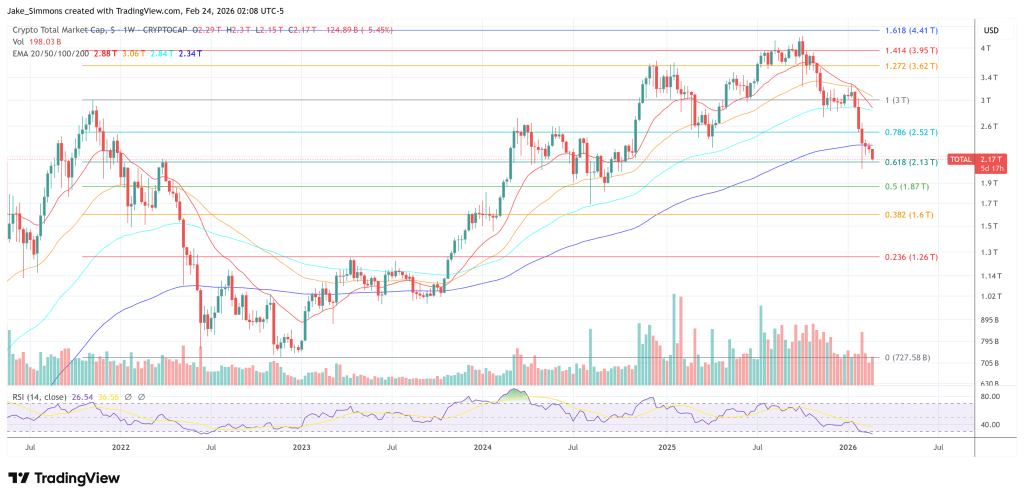
Total crypto market cap falls below the 200-week EMA, 1-week chart | Source: TOTAL on TradingView.com

Perguntas relacionadas

QWhat is the main allegation against Jane Street in the lawsuit filed by Terraform Labs' wind-down administrator?

AThe lawsuit alleges that Jane Street used material non-public information from Terraform insiders to trade around the May 2022 collapse of TerraUSD (UST) and Luna, engaging in insider trading, fraud, and market manipulation.

QWho is Bryce Pratt and what role does he allegedly play in this case?

ABryce Pratt is an individual named in the complaint who allegedly moved from an internship at Terraform to a position at Jane Street while maintaining a confidential back channel with Terraform's head of research and passing along sensitive, non-public information.

QWhat specific trade is alleged to have 'precipitated a steep sell off in UST' and where did it occur?

AThe complaint alleges that a Jane Street-linked 85 million UST trade on the Curve's 3pool liquidity pool was 'the largest single swap on the Curve 3pool' and that it precipitated a steep sell off in UST.

QWhat key piece of evidence is cited to show Jane Street was in direct communication with Terraform leadership during the crisis?

AThe complaint cites a May 9 message where Bryce Pratt allegedly wrote to Terraform co-founder Do Kwon expressing interest in bidding on BTC or LUNA, and Kwon's response referencing 'Bill from Jump' contacting them about a fundraise.

QWhat are some of the key legal defenses Jane Street is expected to raise against these allegations?

AJane Street is expected to contest the claims by challenging whether the information was truly material and non-public, whether their trades were causally connected to the collapse, and whether the plaintiff can prove intent.

Leituras Relacionadas

Apple Finally Admits, Siri Is Getting Old

In a significant shift, Apple has rebranded Siri to "Siri AI" at WWDC 2026, acknowledging the assistant's limitations after years of stagnation. The company announced a deep partnership with Google, leveraging Gemini's model capabilities to train its new Apple Foundation Models. This collaboration extends Apple's Private Cloud Compute to Google Cloud and Nvidia GPUs for the first time. The article traces Siri's history from its groundbreaking 2011 debut to its subsequent confinement within Apple's closed ecosystem, prioritizing control and privacy over expansive functionality. While Apple integrated AI into its hardware and systems over the years (e.g., Neural Engine, Core ML), it missed the paradigm shift brought by generative AI models like ChatGPT. Facing pressure, Apple restructured its AI leadership and opted to license Google's Gemini technology—reportedly paying around $1 billion annually—to power the revamped Siri. The strategy involves "distilling" knowledge from the large Gemini model into smaller, on-device models. Apple also plans to use Google Cloud's Nvidia GPUs for complex cloud inference tasks. The core vision for "Apple Intelligence" is a system-level assistant that reduces cognitive load: summarizing notifications and emails, drafting context-aware replies, and retrieving relevant information across apps. Siri gains a dedicated app with memory and cross-device sync. However, this AI push comes with hardware requirements, potentially excluding older iPhones. A major challenge is China, where Apple Intelligence will likely be a different product due to local regulations, requiring partnership with a domestic AI provider. The article concludes by questioning the future of personal AI, noting that true understanding involves more than data access—it requires knowing where to stop. Apple's partnership marks a humble beginning in its quest to build a genuinely helpful, yet respectful, personal assistant.

marsbitHá 5m

Apple Finally Admits, Siri Is Getting Old

marsbitHá 5m

When Doing Cryptocurrency Payment, the First Thing is Licenses, What is the Second?

When launching a crypto payment business, obtaining the necessary licenses is the crucial first step. However, the second, and arguably more critical, step is designing a comprehensive operational framework that forms a coherent business loop. This loop must be clearly understood and executable by all stakeholders: banks, payment partners, exchanges, on-chain analytics providers, regulators, and your internal team. Many projects mistakenly believe a single license permits all operations. Licenses merely grant entry; they don't define how the specific business functions. The real challenge lies in detailing every aspect of the workflow. This involves clarifying the customer base, the flow of fiat and crypto assets, the settlement process, and establishing clear lines of responsibility for risks like AML compliance, sanctions screening, chargebacks, and regulatory inquiries. A robust framework must answer seven core questions: Who are the clients and merchants? Who collects fiat and crypto? Who handles conversion and custody? And who is ultimately accountable for compliance and risk management? Projects often fail not from a lack of licensing, but during due diligence when they cannot convincingly explain these operational details. Therefore, beyond securing licenses, the priority must be constructing a closed-loop system. This system ensures the business model is transparent, risks are managed, responsibilities are delineated, contracts are aligned, and the entire process is comprehensible to partners and regulators. The true competitive edge in crypto payments lies not in acquiring a license quickly, but in integrating licensing, banking, compliance, and operations into a sustainable and executable whole.

marsbitHá 50m

When Doing Cryptocurrency Payment, the First Thing is Licenses, What is the Second?

marsbitHá 50m

Arthur Hayes Analysis: AI Bubble Nears Burst, Crypto Market Faces Short-Term Pressure

Arthur Hayes argues that the current AI market is a bubble poised to burst, which will exert downward pressure on the crypto market in the near term. The core trigger is rising oil prices due to the US-Iran conflict and a blockade of the Strait of Hormuz. Higher energy costs directly increase the operational expenses of AI data centers, squeezing profit margins for companies like Google, Anthropic, and OpenAI. Hayes predicts that persistent inflation from high oil prices will force Trump, in a bid to win the November election, to turn public sentiment against the AI industry. He may propose regulations and taxes on data centers and AI companies to appeal to voters concerned about costs and job displacement. Such political rhetoric could shatter market confidence. Furthermore, the market is unlikely to healthily absorb the massive concurrent IPOs of SpaceX, Anthropic, and OpenAI, which together seek valuations in the trillions. The combination of soaring energy costs, overwhelming equity supply, and negative political pressure will puncture the AI bubble. Hayes notes that nearly all new USD liquidity since 2022 has flowed into AI, leaving crypto like Bitcoin behind. When the AI bubble bursts, liquidity will contract sharply, pulling down all risk assets, including cryptocurrencies. In response, Hayes's fund, Maelstrom, has sold all AI-related stocks and non-core cryptocurrencies. It maintains core positions in Bitcoin and Ethereum while increasing exposure to energy sector equities, betting on rising oil and gas prices. He expects Bitcoin to bottom after the AI-led market decline, before rallying again with future monetary easing.

Foresight NewsHá 1h

Arthur Hayes Analysis: AI Bubble Nears Burst, Crypto Market Faces Short-Term Pressure

Foresight NewsHá 1h

Trading

Spot
Futuros
活动图片





