Qubic Starts Dogecoin Mining Phase 2, Shifting Rewards Away From XMR

bitcoinistPublicado em 2026-04-16Última atualização em 2026-04-16

Resumo

Qubic has entered phase 2 of its Dogecoin mining rollout, shifting miner rewards from Monero (XMR) to DOGE-based incentives. Starting with epoch 209, computors can operate in either XMR or DOGE mode, with only the higher-yielding contribution counted per index—effectively phasing out XMR if DOGE is more profitable. All block rewards are used for QUBIC buybacks, which are then distributed proportionally based on Dogecoin shares submitted. This transition, part of a three-phase plan announced in March, aims to fully migrate from XMR to DOGE, allowing parallel operation of DOGE mining (via Scrypt ASICs) and AI training (on CPUs/GPUs). Phase 2 introduces weekly reward windows, aligning with Qubic’s goal of scaling toward full-capacity dual-workstream operations.

Qubic has moved its Dogecoin mining rollout into phase 2, a step that begins redirecting miner economics away from Monero and toward DOGE-linked rewards. For Qubic, the change matters because phase 2 is where the migration stops being a live test and starts becoming a real incentive shift.

In an April 15 Discord update shared on X by community member Rayyan, Qubic tech lead Joetom said phase 2 began with epoch 209 and that, from this point, “each computor can operate in either legacy XMR mode or Doge mode.” He added: “For every computor index, only one contribution is counted: max(XMR, DOGE). This effectively replaces XMR participation if Doge yields a higher contribution. No dual counting.”

Qubic Activates Dogecoin Phase 2

The move lines up with the transition plan Qubic published ahead of launch. In its March 27 rollout note, the team described a three-phase migration from XMR to DOGE. Phase 1 was a testing period in which XMR revenue remained intact while Dogecoin mining ran on mainnet in a non-rewarded validation mode.

Phase 2 was framed as the decision point, where computors could opt into DOGE rewards while XMR began phasing out. Phase 3 is the end state: XMR removed, DOGE running at full production, and Qubic’s CPU and GPU resources returned to full-time AI training.

That broader architecture is central to Qubic’s pitch. Under the old model, the network alternated between Monero hashing and AI-related work. With Dogecoin, Qubic says the jobs can run in parallel because DOGE mining relies on Scrypt ASICs, while the network’s AI training stack runs on CPUs and GPUs. The result, in Qubic’s telling, is a cleaner division of labor and a path toward running both workstreams at full capacity rather than splitting general-purpose compute between them.

Joetom’s April 15 message also clarified how rewards are now being routed. “All block rewards are used for Qubic buybacks,” he wrote. “The acquired Qubic is distributed proportionally based on delivered Doge shares.”

He then outlined how accounting will evolve as the system scales: “Target state is a daily reward window from 12:00 to 12:00 UTC. All blocks mined within a window are allocated to shares submitted within the same window. Phase 2 starts with a weekly window aligned to epochs.”

That mechanism fits the buyback structure Qubic had already outlined publicly. The network has said DOGE mined through its system is sold, the proceeds are used to buy back QUBIC, and those tokens are then distributed to participants based on contribution.

The timing also tracks the roadmap. Qubic launched Dogecoin mining on April 1 and said the full migration from Monero would likely play out across roughly four weeks, with phase lengths flexible depending on stability and network conditions. Phase 2 arriving in mid-April suggests that schedule is broadly holding, even if reward windows and other parameters remain adjustable.

At press time, DOGE traded at $0.09618.
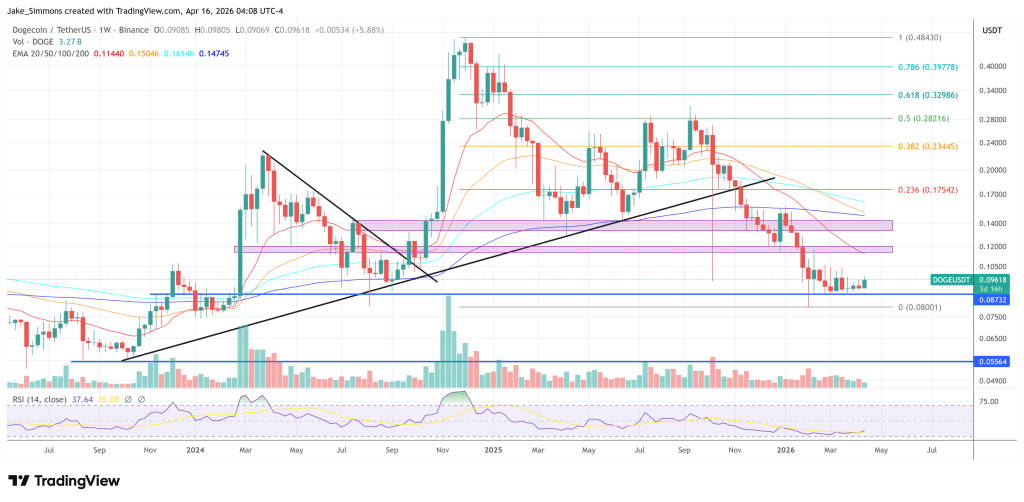
DOGE holds above key support, 1-month chart | Source: DOGEUSDT on TradingView.com

Perguntas relacionadas

QWhat is the main change introduced in Qubic's Dogecoin mining phase 2?

APhase 2 begins redirecting miner economics away from Monero (XMR) and toward DOGE-linked rewards, allowing computors to operate in either legacy XMR mode or Doge mode, with only the higher-yielding contribution being counted.

QHow does Qubic's reward distribution mechanism work in the new Dogecoin mining system?

AAll Dogecoin block rewards are used for Qubic buybacks. The acquired QUBIC tokens are then distributed proportionally to participants based on the Doge shares they delivered.

QWhat is the stated benefit of switching from Monero to Dogecoin mining for the Qubic network?

AThe switch allows Dogecoin mining (which relies on Scrypt ASICs) and AI training (which runs on CPUs and GPUs) to operate in parallel, creating a cleaner division of labor and enabling both workstreams to run at full capacity instead of splitting general-purpose compute between them.

QWhat are the three phases of Qubic's migration from XMR to DOGE mining?

APhase 1 was a testing period with XMR revenue intact. Phase 2 is the decision point where computors can opt into DOGE rewards while XMR phases out. Phase 3 is the end state with XMR completely removed and DOGE running at full production.

QHow does the reward window system work in the target state of phase 2?

AThe target state is a daily reward window from 12:00 to 12:00 UTC. All blocks mined within a window are allocated to shares submitted within that same window, though phase 2 starts with a weekly window aligned to epochs.

Leituras Relacionadas

M&A Deals in the Crypto Market Are Unusually Active

Title: M&A Activity in Crypto Market Becomes Unusually Active A rare signal is emerging in the crypto primary market: mergers and acquisitions (M&A) are nearing half of all financing deals. According to RootData, this month, M&A cases in the crypto industry reached 10, while financing rounds numbered only 14, meaning M&A accounts for approximately 42% of primary market transactions—the highest level in history. This does not signal a sudden industry boom. Instead, the rapid rise in M&A share primarily reflects the continued downturn in the financing market. Since November 2024, monthly crypto M&A deals have remained between 10-20, while financing deals have plummeted from around 100 to about 50, possibly hitting a new low this month. For project teams, this means the traditional path of relying on narratives, token expectations, and ecosystem subsidies to maintain valuations is narrowing. For leading companies, it presents a rare window to acquire teams, licenses, technology, liquidity, and market access at lower prices, with less competition and stronger bargaining power. Key active buyers include Coinbase, Kraken, Ripple, MoonPay, Polymarket, Kaiko, Sol Strategies, GSR, Keyrock, Jupiter, Paxos, and Ondo Finance. Their M&A logic is consistent: acquiring key capabilities at lower costs during the industry downturn. This is driven by more attractive valuations, reduced time and trial-and-error costs, the acquisition of licenses and compliance resources, and the integration of industry upstream and downstream segments. Current M&A focuses are concentrated in four areas: trading infrastructure (e.g., Coinbase acquiring Deribit, Kraken acquiring NinjaTrader), payments and stablecoins (e.g., MoonPay, Ripple expanding payment networks), compliance licenses, and asset issuance/distribution (e.g., acquisitions related to RWA and token issuance platforms like Coinbase's purchases of Liquifi and Echo). The rise in M&A is altering the primary market's exit logic. It provides an alternative path to the token-dependent model, encouraging teams to build tangible products, revenue, and strategic value that can be integrated. This could inject confidence into the market, showing that asset buyers and exit possibilities still exist, albeit with a stricter focus on real utility. However, this trend also indicates the crypto industry is becoming more centralized. As asset issuance, trading, market-making, custody, payments, and data gradually consolidate in the hands of a few major players, the industry's initial emphasis on openness and anti-monopoly is being reshaped by commercial realities. Coupled with rising compliance barriers, this signals the end of the low-barrier era for crypto entrepreneurship.

链捕手Há 7m

M&A Deals in the Crypto Market Are Unusually Active

链捕手Há 7m

M&A Deals Are Exceptionally Active in the Crypto Market

Mergers and acquisitions (M&A) activity in the cryptocurrency primary market has reached a historic high, accounting for approximately 42% of total deals in the current month, nearly matching the number of financing rounds. This shift does not signal a new boom cycle but rather reflects a severe contraction in the venture capital funding environment. As financing dwindles, established industry giants—including major exchanges, payment firms, and infrastructure providers—are seizing the opportunity to acquire strategic assets at lower valuations. Key drivers behind the surge in M&A include depressed project valuations, the need to quickly acquire talent and technology to capture short market windows, the pursuit of crucial regulatory licenses, and the strategic expansion into adjacent business verticals such as derivatives, payments, stablecoins, and real-world asset (RWA) issuance. Major acquisitions, like Coinbase's purchase of Deribit and Kraken's acquisition of NinjaTrader, exemplify the push to expand into high-margin areas like derivatives and multi-asset trading. This trend is reshaping the industry's exit landscape, offering an alternative to token-based exits and incentivizing startups to build tangible products and revenue streams with inherent strategic value for acquisition. However, it also points toward increasing centralization, as critical functions—trading, custody, payments, compliance—become concentrated within a few large, well-capitalized platforms, potentially raising barriers to entry for new ventures.

marsbitHá 8m

M&A Deals Are Exceptionally Active in the Crypto Market

marsbitHá 8m

Solana Privacy Ecosystem Panorama: A Complete Privacy Stack from Compute to AI

**Title: The Solana Privacy Ecosystem: A Full-Stack View from Compute to AI** **Summary:** This article provides a comprehensive overview of the emerging privacy landscape on the Solana blockchain, characterizing it as still in early development. It identifies two primary verticals—Neobanks and Private DeFi—as key drivers, while noting gaps in tooling and user experience. The discussion centers on two main approaches to private computation: Arcium, which utilizes Multi-Party Computation (MPC) networks (Multi-Party eXecution Environments) to process encrypted data with final settlement on Solana; and Magic Block, which leverages Trusted Execution Environments (TEEs) via its Private Ephemeral Rollup (PER). Both enable confidential applications like dark pools and private DeFi with minimal code changes. Building on this infrastructure, projects are creating privacy-focused applications. Umbra, built on Arcium, offers Encrypted Token Accounts (ETAs) for private balances, transfers, and selective disclosure for compliance. Other wallets like Privacy Cash and Hush provide mixer-like functionality for SOL. For private trading, encifherio uses TEEs to encrypt swap details routed through Jupiter, while VanishTrade and Darklake focus on shielding transaction intent and liquidity routing, with Darklake introducing a "blind slippage pool" to prevent front-running. Further applications include private prediction markets (e.g., Melee Markets using Arcium's encrypted order books) and private AI. Loyal exemplifies the latter, using both Magic Block and Arcium to enable decentralized AI agents that store user data, conversations, and transactions confidentially on-chain. The article concludes by framing privacy not as a single technology but as an evolving "ultimate privacy stack," with experts like Helius's Mert envisioning a future combination of Fully Homomorphic Encryption (FHE) and Zero-Knowledge proofs (ZK). Helius Privacy itself is developing a ZK-based UTXO privacy layer for Solana.

Foresight NewsHá 13m

Solana Privacy Ecosystem Panorama: A Complete Privacy Stack from Compute to AI

Foresight NewsHá 13m

7 Key Questions Regarding 'DeepSeek Completes Over 50 Billion Yuan in Financing'

DeepSeek, the prominent Chinese AI company, has reportedly completed its first external funding round, raising over 50 billion RMB (approximately $6.9 billion USD), according to foreign media reports. This financing values the company at over $50 billion USD, a significant increase from a $10 billion valuation when the round began in April 2026. Founder Liang Wenfeng personally contributed 20 billion RMB, with other investors including Tencent, CATL (Contemporary Amperex Technology), JD.com, NetEase, and IDG Capital. Notably, the National Artificial Intelligence Industry Investment Fund also participated with a direct investment of 1 billion RMB. The funding round is distinctive for its structure. Most investors' capital is channeled into a limited partnership controlled by CEO Liang Wenfeng, rather than directly into DeepSeek. These investors face a five-year lock-up period, have no voting rights, but receive priority financial information and future investment rights. This arrangement is seen as a measure to ensure Liang's absolute control over the company's direction, aligning with its stated principles of prioritizing groundbreaking AGI (Artificial General Intelligence) research over short-term profitability. The report highlights strategic reasons for key investors. Tencent's involvement is viewed as a strategic alignment, building on existing collaborations. CATL's investment is linked to the critical energy and power infrastructure needed for AI data centers, a key growth area for the battery giant. The participation of a state-backed fund underscores the national strategic importance of AI development. Post-funding, DeepSeek is expected to accelerate infrastructure development, including building its own data centers, hire more talent, and release new model versions with enhanced capabilities like image and audio support. While this marks a major step, the company's long-term journey towards AGI remains a challenging path that will require balancing its foundational ideals with the expectations of its new investors.

marsbitHá 59m

7 Key Questions Regarding 'DeepSeek Completes Over 50 Billion Yuan in Financing'

marsbitHá 59m

Trading

Spot
Futuros

Artigos em Destaque

Como comprar XMR

Bem-vindo à HTX.com!Tornámos a compra de Monero (XMR) simples e conveniente.Segue o nosso guia passo a passo para iniciar a tua jornada no mundo das criptos.Passo 1: cria a tua conta HTXUtiliza o teu e-mail ou número de telefone para te inscreveres numa conta gratuita na HTX.Desfruta de um processo de inscrição sem complicações e desbloqueia todas as funcionalidades.Obter a minha contaPasso 2: vai para Comprar Cripto e escolhe o teu método de pagamentoCartão de crédito/débito: usa o teu visa ou mastercard para comprar Monero (XMR) instantaneamente.Saldo: usa os fundos da tua conta HTX para transacionar sem problemas.Terceiros: adicionamos métodos de pagamento populares, como Google Pay e Apple Pay, para aumentar a conveniência.P2P: transaciona diretamente com outros utilizadores na HTX.Mercado de balcão (OTC): oferecemos serviços personalizados e taxas de câmbio competitivas para os traders.Passo 3: armazena teu Monero (XMR)Depois de comprar o teu Monero (XMR), armazena-o na tua conta HTX.Alternativamente, podes enviá-lo para outro lugar através de transferência blockchain ou usá-lo para transacionar outras criptomoedas.Passo 4: transaciona Monero (XMR)Transaciona facilmente Monero (XMR) no mercado à vista da HTX.Acede simplesmente à tua conta, seleciona o teu par de trading, executa as tuas transações e monitoriza em tempo real.Oferecemos uma experiência de fácil utilização tanto para principiantes como para traders experientes.

353 Visualizações TotaisPublicado em {updateTime}Atualizado em 2026.06.02

Como comprar XMR

Discussões

Bem-vindo à Comunidade HTX. Aqui, pode manter-se informado sobre os mais recentes desenvolvimentos da plataforma e obter acesso a análises profissionais de mercado. As opiniões dos utilizadores sobre o preço de XMR (XMR) são apresentadas abaixo.

活动图片