Ethereum traders going long with $4k price target might not know this

AmbcryptoPublicado em 2022-08-17Última atualização em 2022-08-17

Resumo

Ethereum‘s upcoming Merge might just turn out to be the most anticipated event in crypto ever. Enthusiasts from the Ethereum community as well as other networks have showcased interests in the same. But the question is- can the reality meet the expectations?

Ethereum‘s upcoming Merge might just turn out to be the most anticipated event in crypto ever. Enthusiasts from the Ethereum community as well as other networks have showcased interests in the same. But the question is- can the reality meet the expectations?

Betting on you

Cryptocurrency traders’ enthusiasm seems to be turning towards the north after a series of corrections. That is to say, traders’ enthusiasm to sell has subsided, especially as BTC and ETH noted positive gains over the weekend.

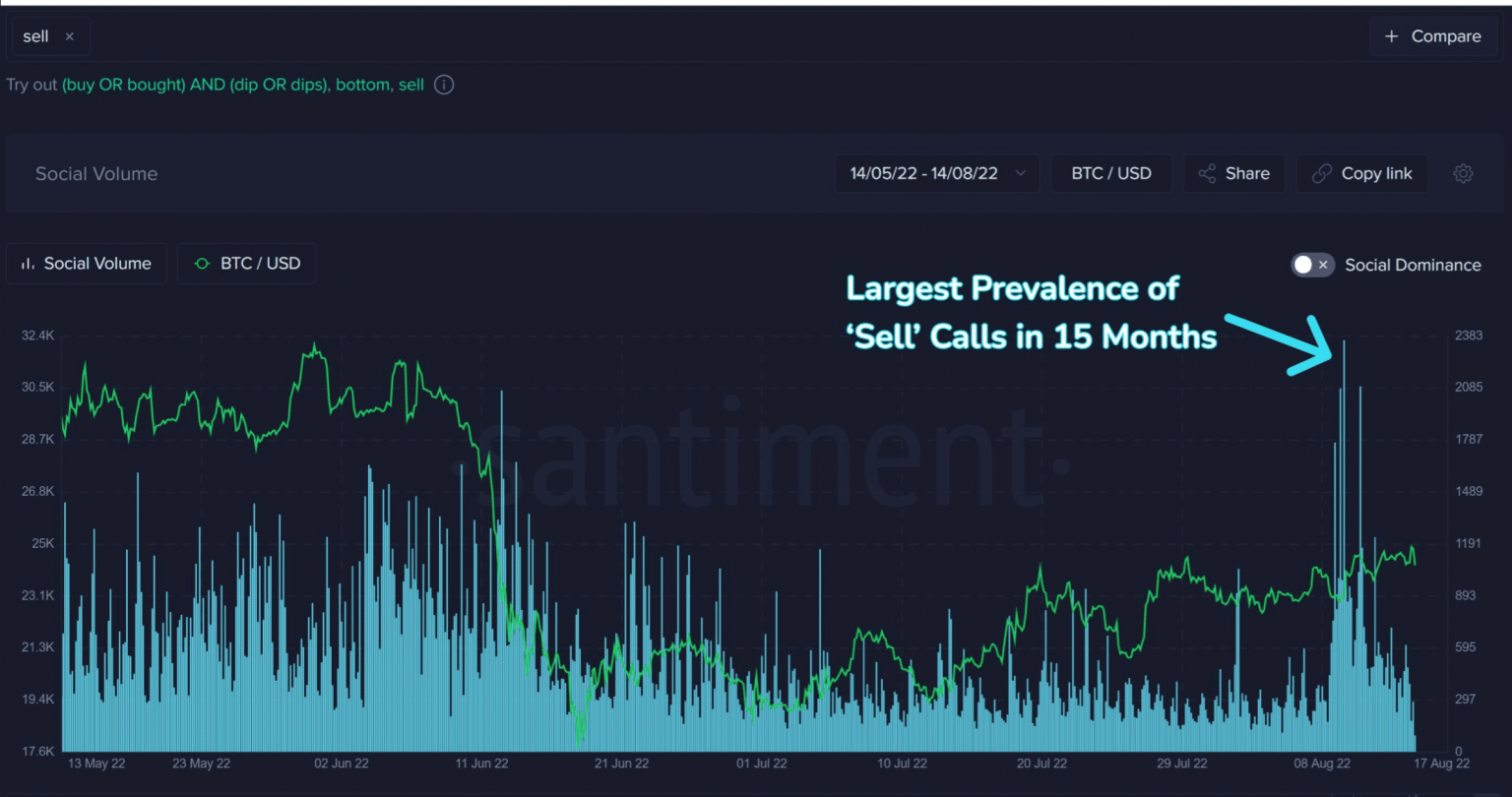
Notably, sell calls on crypto platforms died down considerably after prices continued rising the past week.
Source: Santiment

Ideally, ‘bulls will actually want FUD to stay high, as prices historically flourish when there is doubt,’ Santiment added.

Now, moving on to Ethereum, both spot as well derivative market flows appeared more bullish than ever.

There are a lot more traders interested in trading Ether ahead of the coming Ethereum merge in September. The Merge would see the network becoming a fully ‘proof of stake’ blockchain.

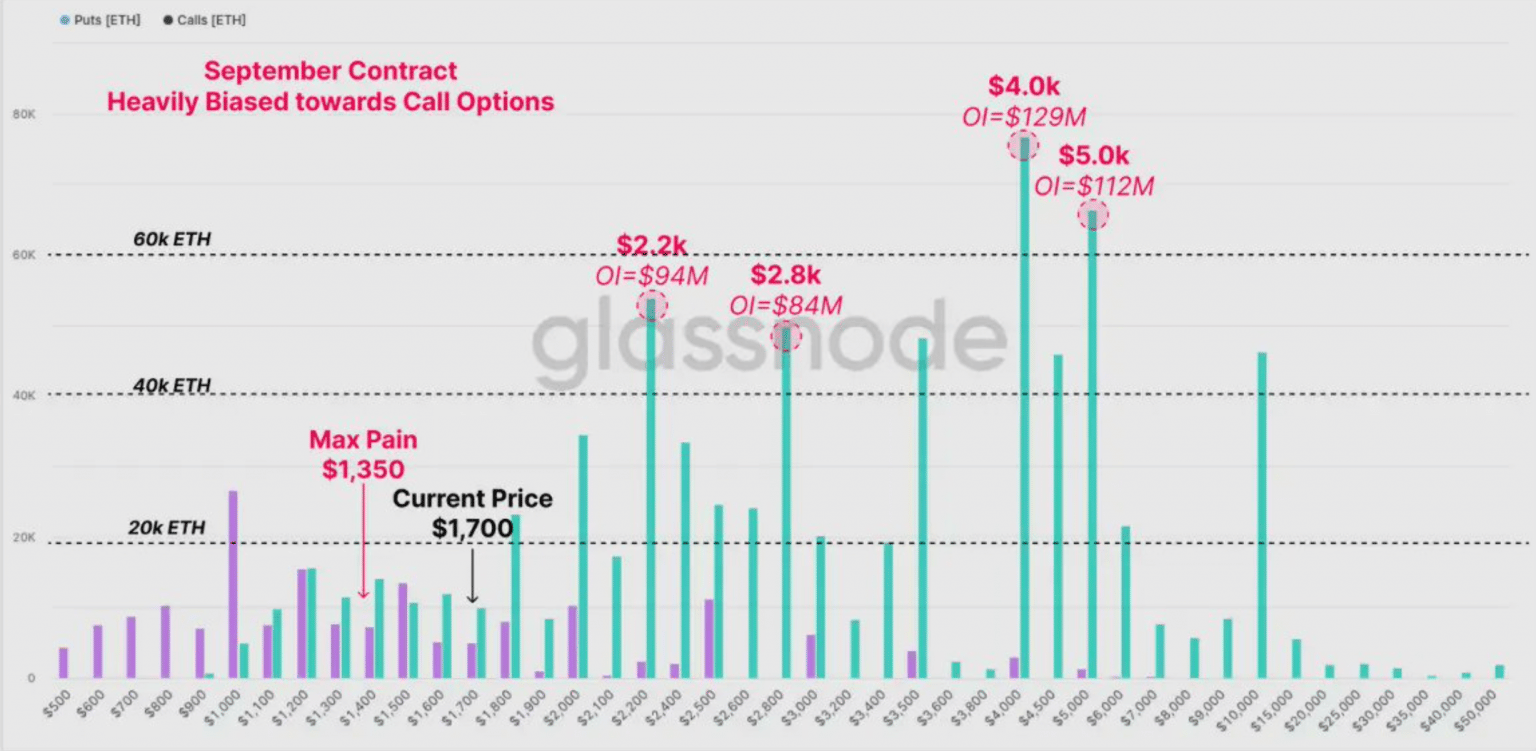
Interestingly, calls for the end of September have the highest volume (129m and $112m) at the $4,000 to $5,000 level respectively. That is a bet that ETH would double in the next six weeks, just for these positions to approach breakeven.
Source: Messari

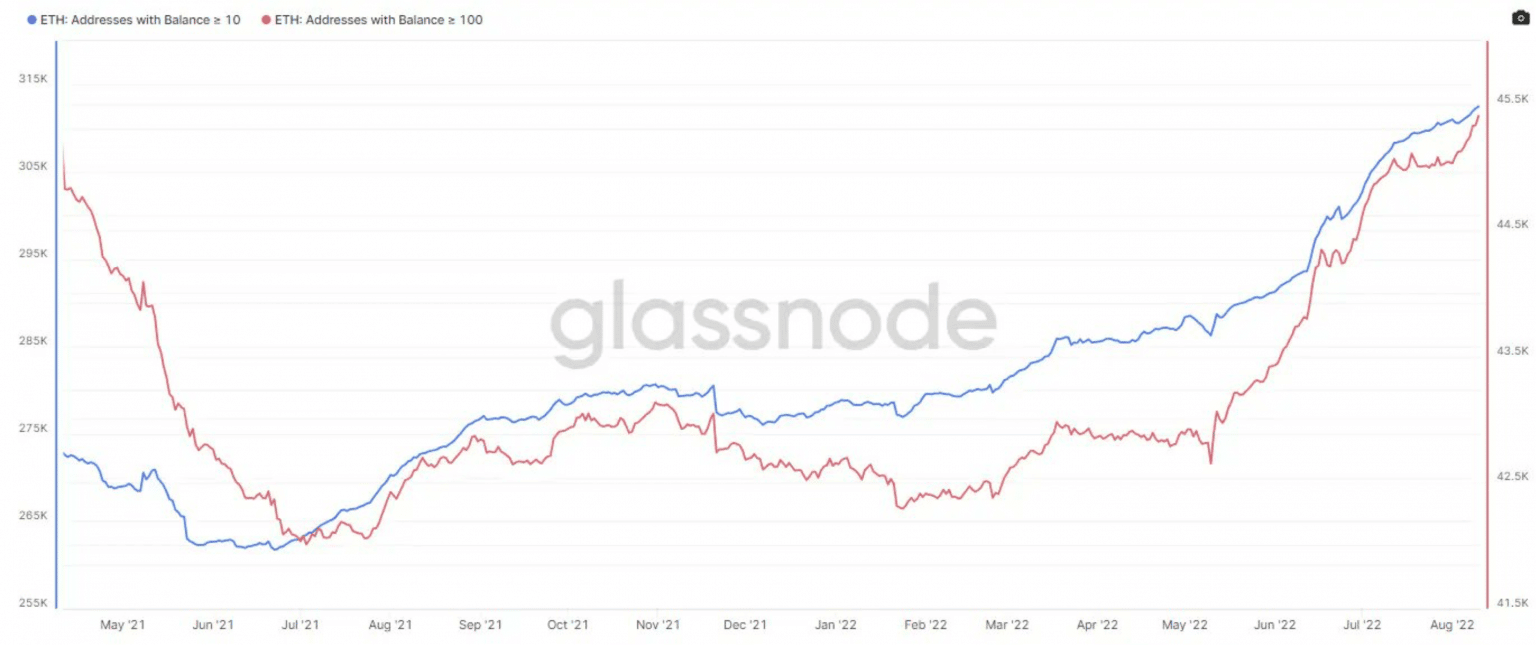
Even in the spot market, the data sets narrated the same picture. It showcased intense accumulation wherein, addresses holding more than 10 and more than 100 ETH ticked up.
Source: Glassnode

Whales too participated in the good cause. Consider this- the richest wallet on the Ethereum network increased in value by almost a billion dollars over the past 30 days on the back of strong ETH rallies.

According to blockchain tracking service Whalestats, the whale known as Naruto went from a balance of just over $1.98 billion on 15 July to more than $2.96 billion at time of writing, a nearly 50% increase.

Analytic website Messari stated, ‘while the spot accumulation may be a sign of conviction in ETH it also could be a play for an ETHW airdrop.’

Countdown to lift off

Well, Ethereum has been witnessing significant traction ahead of Merge. From whales to even countries. Argentina created the latest buzz.

However, for now, the reality isn’t completely bullish. ETH, at press time, did lose the $2k mark as the price continued to slide down.

At the time of writing, ETH revolved around the $1.8k mark after suffering a fresh 3% correction.


Leituras Relacionadas

No Sales Team, $20 Million in Revenue: How Did AI Employee Viktor Win Over 30,000 Companies?

The AI employee Viktor, developed by a team with DeepMind background, has achieved $20 million in annual revenue without a traditional sales team, serving over 30,000 companies. Its core innovation lies in positioning itself as a "Tier 3 AI Coworker" capable of "end-to-end execution and delivery of results," moving beyond the "draft and wait for human completion" model of typical AI assistants. Users can simply mention Viktor in Slack or Microsoft Teams using natural language commands, and it autonomously performs tasks like pulling sales data from a CRM, generating reports, or even cross-tool operations like creating board meeting PPTs by aggregating data from six different sources. Key to its growth is a pure Product-Led Growth (PLG) model, eliminating complex implementation cycles and per-seat licensing. Instead, it charges based on task credits or consumption, lowering the trial barrier with a $100 free credit offer and no credit card required. This enabled viral, bottom-up adoption within organizations. Viktor's interaction paradigm removes the barrier of prompt engineering, allowing non-technical employees to delegate complex workflows seamlessly. It also features proactive, automated task execution (e.g., overnight bookkeeping, scheduled reports) based on triggers, effectively embedding AI as an automated "process layer" within business operations. However, its expansion into Microsoft Teams—a platform with 320 million users—highlights challenges. Large enterprises require stringent IT compliance, security reviews (e.g., SOC 2), and governance, potentially hindering the frictionless, user-driven adoption that succeeded in Slack. Additionally, the "black box" nature of its autonomous decision-making raises concerns about operational risks, data integrity, and the need for robust audit logs and permission controls. Balancing efficiency gains with security and trust remains a critical hurdle for Viktor and similar AI agents aiming to become core enterprise infrastructure.

marsbitHá 58m

No Sales Team, $20 Million in Revenue: How Did AI Employee Viktor Win Over 30,000 Companies?

marsbitHá 58m

Manus Buyback Plan Emerges: Chinese Investors Plan to Repurchase Equity with $2 Billion, Path to Hong Kong IPO Becomes Clearer

According to a report by The Information, early Chinese investors of Manus, including Tencent, Sequoia Capital China, and ZhenFund, are planning to repurchase the company from Meta for $2 billion—the same price Meta paid in its acquisition last December. This move is a direct response to the Chinese government's prohibition of the foreign acquisition in April. As part of the repurchase plan, Manus is considering establishing a Sino-foreign joint venture within China. This structure is seen as a way to ensure regulatory compliance for its Chinese investors and to pave the way for a future IPO in Hong Kong. Notably, U.S. investor Benchmark will not participate in the buyback, which will concentrate ownership even more among Chinese capital. Since its acquisition by Meta, Manus's business has grown rapidly, with its annualized revenue run rate reportedly increasing four-to-fivefold to $400-$500 million in roughly six months. This strong growth underpins the investors' willingness to repurchase at the original price. Financially, the forced unwinding of the deal may benefit the early investors, allowing them to regain equity at a cost far below the company's current implied valuation, with the added prospect of an independent future listing. However, specific terms of the repurchase, including funding proportions and the joint venture's equity structure, are still under negotiation. This "repurchase-joint venture-Hong Kong IPO" approach could serve as a reference model for other Chinese AI startups navigating cross-border M&A regulations.

marsbitHá 1h

Manus Buyback Plan Emerges: Chinese Investors Plan to Repurchase Equity with $2 Billion, Path to Hong Kong IPO Becomes Clearer

marsbitHá 1h

STRC Loses Peg by 11%, Can Strategy's Perpetual Motion Machine Keep Running?

The article discusses the significant and concerning depegging of MicroStrategy's (MSTR) preferred stock, STRC. Designed to trade near its $100 target par value, STRC has recently fallen sharply, reaching a low of $83.26 and closing at $88.59, representing an over 11% discount. STRC is a core component of MicroStrategy's financial strategy. As a perpetual preferred stock, it allows the company to raise capital through an "at-the-market" (ATM) issuance program without diluting common shareholders (MSTR). This capital is primarily used to purchase Bitcoin, creating a "capital flywheel": issuing STRC → raising cash → buying BTC → increasing net assets → supporting STRC's value. The flywheel's operation depends on STRC maintaining its $100 price. To enforce this, MicroStrategy employs a dynamic dividend mechanism, recently raising the rate to 11.5% and increasing payout frequency. However, this has failed to halt the depegging, indicating market concerns extend beyond yield. Analysts cite two main reasons. First, technical factors like forced liquidations from leveraged arbitrage trades may have exacerbated the sell-off. Second, and more fundamentally, is waning confidence in MicroStrategy's financial resilience. A JPMorgan report highlighted the company's limited cash relative to its ~$1.7 billion annual dividend obligation, raising liquidity concerns. While MicroStrategy counters that its massive Bitcoin holdings provide decades of coverage, this argument relies on the potential need to sell BTC—a departure from its long-standing "never sell" narrative. The company's recent sale of a small amount of Bitcoin for "testing," despite being framed as minor, has intensified these fears. The persistent depegging threatens to cripple MicroStrategy's primary funding channel. If STRC remains discounted, the company's ability to fund further Bitcoin purchases weakens. Should cash reserves dwindle while financing is constrained, the market may increasingly price in the risk of MicroStrategy becoming a forced seller of Bitcoin to meet obligations. This shift from a major marginal buyer to a potential seller could pose significant downside risk to the broader Bitcoin market.

链捕手Há 1h

STRC Loses Peg by 11%, Can Strategy's Perpetual Motion Machine Keep Running?

链捕手Há 1h

Trading

Spot
Futuros
活动图片