Circle Giảm Giá, Có Đáng Để Mua Vào?

marsbitPublicado em 2026-04-04Última atualização em 2026-04-04

Resumo

Vòng tròn (Circle), công ty phát hành stablecoin USDC lớn thứ hai thế giới, đang trong quá trình chuyển đổi từ một công ty phụ thuộc vào lãi suất sang một mạng lưới cơ sở hạ tầng kỹ thuật số. Bài viết phân tích liệu sự chuyển đổi này có đang diễn ra và tiềm năng định giá. Doanh thu chính của Circle hiện nay (95%) đến từ lãi suất thu được trên tài sản dự trữ (chủ yếu là trái phiếu kho bạc Mỹ) hỗ trợ cho USDC. Tuy nhiên, dữ liệu cho thấy USDC đang được sử dụng tích cực để thanh toán hơn là chỉ nắm giữ: khối lượng giao dịch trên chuỗi tăng 247% trong năm 2025, và USDC chiếm 64% khối lượng thanh toán thực tế (theo Visa), dù vốn hóa thị trường chỉ bằng một nửa USDT. Circle đang phát triển ba lớp doanh mới: Mạng lưới thanh toán (CPN) cho chuyển tiền xuyên biên giới, Giao thức chuyển chuỗi chéo (CCTP) và một blockchain riêng cho các tổ chức (Arc). Doanh thu không từ lãi suất ("Other Revenue") đang tăng trưởng mạnh, đạt 37 triệu USD/quý. Các rủi ro chính bao gồm lãi suất giảm nhanh hơn tốc độ tăng trưởng USDC, sự cạnh tranh từ các stablecoin mới và khả năng Tether (USDT) trở nên tuân thủ hơn. Kết luận, giá trị hiện tại của Circle chủ yếu phản ánh doanh thu từ lãi suất. Tiềm năng tăng trưởng 5-10 lần phụ thuộc vào thành công của việc mở rộng USDC, cải thiện tỷ suất lợi nhuận và phát triển các dòng doanh thu phi lãi suất mới. Cần theo dõi ba chỉ số chính: lượng USDC lưu hành, tỷ lệ giao dịch thực tế và doanh thu không từ lãi suất.

Tác giả: Leo Z

I. Circle là gì

Circle là đơn vị phát hành USDC. USDC là stablecoin lớn thứ hai toàn cầu, với lượng lưu thông khoảng 770 tỷ USD, mỗi đồng USDC đều được hỗ trợ bởi tài sản USD tương đương (chủ yếu là trái phiếu kho bạc ngắn hạn Mỹ) làm dự trữ.

Nguồn thu nhập của Circle rất đơn giản: họ đầu tư các khoản dự trữ này vào trái phiếu kho bạc Mỹ để kiếm chênh lệch lãi suất. Tổng doanh thu năm tài chính 2025 (FY2025) là 27,5 tỷ USD, trong đó 95% đến từ lãi dự trữ. Họ lên sàn vào tháng 6 năm 2025, vốn hóa thị trường hiện tại khoảng 150-200 tỷ USD.

Định giá thị trường cho Circle về cơ bản bằng "Lượng lưu thông USDC × Lãi suất × Bội số bảo thủ". Điều này có nghĩa là: nếu bạn cho rằng Circle chỉ là một công ty kiếm lãi, thì định giá hiện tại về cơ bản là hợp lý. Nếu bạn cho rằng nó đang trở thành một mạng lưới cơ sở hạ tầng đô la kỹ thuật số dựa trên phí, thì giá hiện tại còn lâu mới phản ánh được phần giá trị đó.

Bài viết này sẽ trả lời câu hỏi: Sự chuyển đổi có đang diễn ra không? Có bao nhiêu bằng chứng? Giá trị bao nhiêu?

II. Vấn đề cốt lõi: USDC đang được "Nắm giữ" hay được "Sử dụng"?

Trước khi thảo luận về định giá, hãy trả lời một câu hỏi quan trọng hơn bất kỳ mô hình tài chính nào.

Cùng là 770 tỷ USD USDC, nếu nó chỉ được các tổ chức giữ để kiếm chênh lệch lãi suất, thì Circle là một công ty tài chính nhạy cảm với lãi suất, định giá 10-15x. Nếu nó đang được sử dụng thường xuyên để thanh toán, quyết toán, chuyển tiền xuyên biên giới và các nhà phát triển gọi, thì Circle đang trở thành một mạng lưới cơ sở hạ tầng dựa trên phí, định giá 25-30x.

Hai điểm dữ liệu quan trọng có thể giúp bạn đánh giá:

Thứ nhất, tốc độ tăng khối lượng giao dịch trên chuỗi của USDC vượt xa tốc độ tăng lượng lưu thông. FY2025, lượng lưu thông USDC tăng 72%, nhưng khối lượng giao dịch trên chuỗi tăng 247%. Điều này có nghĩa là mỗi đô la USDC đang được sử dụng thường xuyên hơn. Đây không phải là "lượng tồn kho lớn hơn" mà là "tốc độ luân chuyển nhanh hơn".

Thứ hai, USDC đã vượt qua USDT để trở thành tài sản quyết toán lớn nhất. Visa Onchain Analytics loại bỏ khoảng 85% nhiễu trên chuỗi (bot, chuyển khoản nội bộ sàn giao dịch, arbitrage tần suất cao). Sau khi điều chỉnh, USDC chiếm 64% khối lượng quyết toán kinh tế thực (Mizuho, tháng 2/2026), trong khi USDT chỉ chiếm khoảng 28% — mặc dù lượng lưu thông của USDT gấp 2,4 lần USDC.

Khoảng cách này tự nó là tín hiệu mạnh nhất: USDC đang chuyển từ "tài sản mọi người nắm giữ" thành "mạng lưới mọi người sử dụng". Nhưng sự chuyển đổi này vẫn chưa hoàn tất — phần sau sẽ nói về những điều kiện cần để xác nhận.

III. Cấu trúc thu nhập ba tầng

Thu nhập của Circle chia làm ba tầng. Thị trường hiện tại hầu như chỉ định giá cho tầng đầu tiên.

Tầng 1: Thu nhập lãi từ USDC — Circle kiếm tiền như thế nào ngày hôm nay

USDC là điểm khởi đầu của Circle, và cũng là nguồn của 95% thu nhập hiện tại. Tính đến cuối năm 2025, lượng lưu thông USDC là 753 tỷ USD, tăng 72% so với cùng kỳ, vượt xa mục tiêu tăng trưởng hàng năm 40% của chính Circle.

Logic thu nhập rất đơn giản: Khoảng 80% dự trữ USDC được đầu tư vào trái phiếu kho bạc ngắn hạn Mỹ (thông qua quỹ USDXX do BlackRock quản lý), kiếm chênh lệch lãi suất.

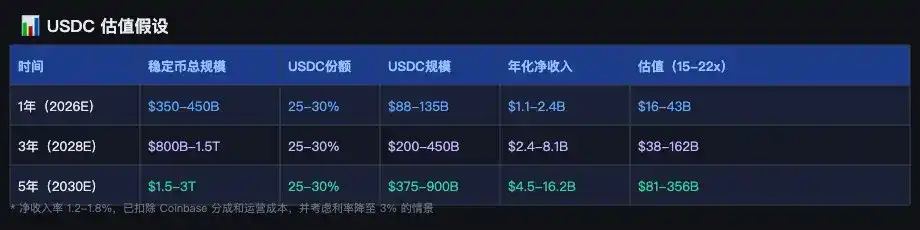
Thu nhập lãi ≈ Lượng lưu thông USDC trung bình × Tỷ suất lợi nhuận dự trữ

Tỷ suất lợi nhuận dự trữ Q4 2025 là 3,81%, giảm 68 điểm cơ bản so với quý trước. Điều này phơi bày mâu thuẫn cốt lõu: Lượng lưu thông đang tăng trưởng nhanh, nhưng lãi suất đang giảm, cả hai đang đối trọng nhau. Nếu lãi suất mục tiêu của Fed giảm xuống 3%, Circle cần USDC tăng trưởng lên trên 1500 tỷ USD để duy trì mức thu nhập hiện tại.

Vấn đề cấu trúc: Coinbase lấy đi phần lớn thu nhập. Theo thỏa thuận chia sẻ ký năm 2023, lãi USDC trên nền tảng Coinbase 100% thuộc về Coinbase, lãi ngoài nền tảng Coinbase lấy 50%. FY2025, cứ mỗi 1 đô la lãi Circle kiếm được, khoảng 60 cent được chia cho các đối tác phân phối.

Tin tốt là tỷ suất lợi nhuận đang được cải thiện. Tỷ suất lợi nhuận RLDC (Doanh thu trừ Chi phí Phân phối) tăng từ 30,0% trong Q4 2024 lên 40,1% trong Q4 2025. Tỷ lệ thu nhập ròng 1,2-1,8%, đã trừ đi phần chia cho Coinbase và chi phí vận hành.
Tầng 2: Thu nhập Thanh toán & Giao dịch — Doanh nghiệp mới đang phát triển

Đây là chìa khóa quyết định Circle có thể thoát khỏi nhãn "công ty lãi suất" hay không.

CPN (Circle Payments Network) ra mắt vào tháng 5 năm 2025, cung cấp dịch vụ quyết toán xuyên biên giới 7×24 dựa trên USDC cho ngân hàng, công ty thanh toán và doanh nghiệp. Tính đến tháng 2 năm 2026, TPV hàng năm đạt 57 tỷ USD, tăng khoảng 100 lần kể từ khi ra mắt. 55 tổ chức đã kết nối, 74 tổ chức đang trong quá trình xét duyệt, 500+ trong pipeline. Bao phủ 14 thị trường bao gồm Brazil, Canada, Hong Kong, Ấn Độ, Mexico, Nigeria, Mỹ, v.v.

Nhưng 57 tỷ USD so với thị trường thanh toán xuyên biên giới toàn cầu 16 nghìn tỷ USD, vẫn chưa đến 0,04%. Giá trị của CPN không nằm ở quy mô ngày hôm nay, mà ở khả năng tăng trưởng có thể duy trì hay không. Nếu nó chiếm được 1% thị phần thị trường xuyên biên giới, đó sẽ là khối lượng giao dịch hàng năm 1600 tỷ USD — phí phát sinh có thể gần bằng hoặc thậm chí vượt quá thu nhập từ lãi, và không bị ảnh hưởng bởi lãi suất.

CCTP (Giao thức Chuyển Chuỗi Chéo) thực hiện chuyển USDC nguyên bản xuyên chuỗi thông qua "hủy-đúc". Q4 2025 xử lý 413 tỷ USD, tăng 3,7 lần so với cùng kỳ. Thị phần USDC chuyển chuỗi tăng từ 25% cuối năm 2024 lên 62% vào tháng 1 năm 2026, bao phủ 30 chuỗi. CCTP V2 giới thiệu phí Fast Transfer — một nguồn thu mới.

Other Revenue (Thu nhập phi lãi) là bằng chứng trực tiếp nhất về "sự chuyển đổi". FY2025 tăng vọt từ 3 triệu USD/quý lên 37 triệu USD/quý, bao gồm dịch vụ đăng ký 24,7 triệu USD, thu nhập giao dịch 12,2 triệu USD, thu nhập nút xác thực Canton Network 7 triệu USD. Ban lãnh đạo hướng dẫn 150-170 triệu USD cho năm 2026.

Phần thu nhập này không bị ảnh hưởng bởi lãi suất và cũng không cần chia cho Coinbase. Khi nó vượt quá 10% tổng doanh thu, thị trường có thể bắt đầu nhìn Circle bằng phương pháp định giá khác. Hiện tại khoảng 4%.

Tầng 3: Nền tảng Quyết toán — Khả năng dài hạn

Arc là chuỗi quyết toán cấp tổ chức mà Circle dự định ra mắt mainnet vào năm 2026, với USDC là token gas nguyên bản. Hiện testnet đã xử lý hơn 166 triệu giao dịch, thời gian xác nhận 0,5 giây, 100+ tổ chức tham gia (bao gồm Goldman Sachs và Mastercard).

Lộ trình của Arc chia làm bốn giai đoạn:

M1 Public Testnet (Đã hoàn thành) → M2 Đưa tiền thật lên chuỗi (2026) → M3 Kịch bản ký quỹ/tài sản thế chấp/quyết toán triển khai (2027-28) → M4 Viết vào Quy trình Vận hành Tiêu chuẩn của tổ chức (2029-30)

Trước M2, giá trị của Arc bằng không. Nhưng nếu cuối cùng nó trở thành tiêu chuẩn quyết toán cấp tổ chức, giá trị của Circle sẽ không còn là "công ty thu phí", mà là "công ty nền tảng". Đây là điều kiện cần thiết cho lợi nhuận 10x trở lên.

IV. Đánh giá liệu sự chuyển đổi có đang diễn ra: Bảy chiều kích

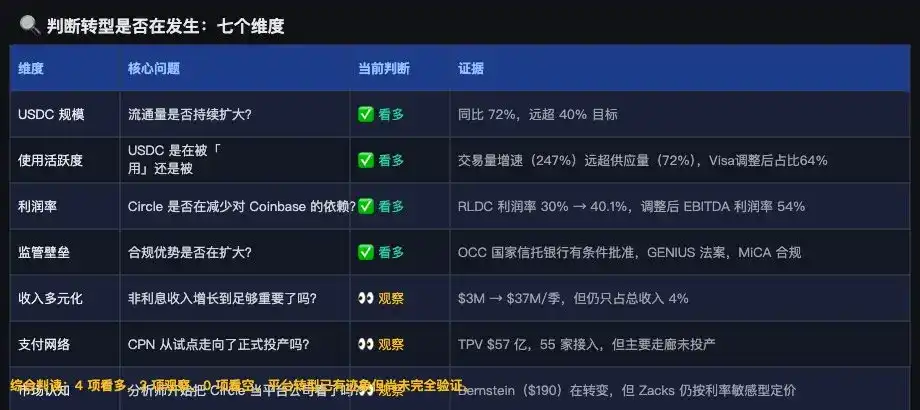
Chỉ nhìn vào một chỉ số duy nhất dễ đánh giá sai. Điều quan trọng là xem nhiều chiều kích có đồng thời cải thiện hay không — khi quy mô, mức độ hoạt động, tỷ suất lợi nhuận, thu nhập mới, tăng trưởng người dùng đều hướng về cùng một hướng, thì sự chuyển đổi đang diễn ra.
V. Ba chỉ số theo dõi quan trọng nhất

1 Lượng lưu thông USDC (Xem hàng ngày)

Cơ sở thu nhập của Circle. Lượng lưu thông × Tỷ suất lợi nhuận dự trữ = Thu nhập lãi. Nên theo dõi "Lượng lưu thông trung bình quý" thay vì ảnh chụp cuối kỳ. Hiện tại khoảng 770 tỷ USD.

Nguồn dữ liệu: defillama.com/stablecoin/usd-coin (cập nhật hàng ngày), circle.com/transparency (chứng minh dự trữ hàng tuần)

2 Tỷ trọng USDC trong khối lượng giao dịch đã điều chỉnh của Visa (Xem hàng tuần)

Trả lời câu hỏi cốt lõi: USDC đang được sử dụng hay được nắm giữ. Lượng cung chỉ chiếm 25%, nhưng khối lượng giao dịch đã điều chỉnh chiếm 64% — mỗi đô la USDC làm nhiều việc hơn USDT 2-3 lần.

Nguồn dữ liệu: visaonchainanalytics.com → Lọc theo Stablecoin → Nhấp "Show % of Total" → Đọc đường USDC

3 Other Revenue - Thu nhập phi lãi (Xem hàng quý)

Chỉ số duy nhất chứng minh trực tiếp Circle kiếm được tiền ngoài lãi. Không bị ảnh hưởng bởi lãi suất, không cần chia cho Coinbase. Hiện tại 37 triệu USD/quý, hướng dẫn 150-170 triệu USD (năm 2026). Khi vượt quá 10% tổng doanh thu, phương pháp định giá sẽ thay đổi.

Nguồn dữ liệu: circle.com/pressroom (báo cáo tài chính hàng quý), SEC EDGAR tìm kiếm Circle Internet Group

VI. Chất xúc tác gần đây

Thỏa thuận chia sẻ với Coinbase hết hạn (Tháng 8 năm 2026)

Đây là chất xúc tác đơn lẻ lớn nhất trong vòng 24 tháng tới. Hiện tại Circle chia khoảng 60% doanh thu cho các đối tác phân phối. Nếu sau khi đàm phán lại, tỷ suất lợi nhuận RLDC tăng từ 40% lên 50-55%, hiệu ứng tương đương với việc tăng lợi nhuận ngay lập tức 25-35%. Nhưng Coinbase không có động lực nhượng bộ đáng kể — việc phân phối USDC trên nền tảng Coinbase vẫn là động cơ tăng trưởng lớn nhất của Circle. Kết quả không chắc chắn, nhưng khả năng hướng đi tốt hơn hiện trạng là lớn hơn.

Giấy phép Ngân hàng Ủy thác Quốc gia OCC

Được phê duyệt có điều kiện vào tháng 12 năm 2025. Phê duyệt đầy đủ có nghĩa là: có thể trực tiếp mở tài khoản chính tại Fed (kiếm lãi suất IORB, loại bỏ rủi ro đối tác), xử lý luồng đúc/đổi hàng năm 4830 tỷ USD mà không cần thông qua ngân hàng thương mại, xây dựng rào cản tin cậy không thể vượt qua cho việc doanh nghiệp và chính phủ áp dụng USDC. Không có đơn vị phát hành stablecoin nào khác có điều này.

x402 Foundation (Thành lập tháng 4 năm 2026)

Coinbase đóng góp giao thức thanh toán x402 cho Linux Foundation. x402 kích hoạt mã trạng thái HTTP 402 thành lớp thanh toán nguyên bản của internet, cho phép AI agent, API và ứng dụng có thể quyết toán trực tiếp trong tương tác HTTP — mặc định sử dụng USDC.

Các bên tham gia: Google, AWS, Stripe, Visa, Mastercard, Amex, Shopify, Microsoft, Cloudflare, Circle. Nếu x402 trở thành tiêu chuẩn thanh toán cho AI agent, mỗi giao dịch vi mô máy-máy sẽ đẩy cao mức sử dụng (velocity) của USDC mà không cần tăng lượng nắm giữ (supply).

Lưu ý: x402 do Coinbase dẫn dắt, không phải do Circle dẫn dắt. Tác động đến CRCL: Có phần tích cực, mở rộng các trường hợp sử dụng USDC, nhưng không thay đổi quy mô cơ bản.

VII. Điều kiện cho lợi nhuận 5-10 lần

3-5x (Độ tin cậy cao) — Chỉ dựa vào tăng trưởng USDC

USDC theo CAGR 40% đến năm 2028 khoảng 200-300 tỷ USD. Ngay cả khi lãi suất giảm xuống 3%, 250 tỷ USD × 1,5% chênh lệch lãi ròng = 37,5 tỷ USD thu nhập ròng. Định giá 20x, vốn hóa 750 tỷ USD. Từ mức 150-200 tỷ USD hiện tại lên 750 tỷ USD, khoảng 4x. Không cần CPN hoặc Arc đóng góp bất kỳ điều gì.

10x (Cần nhiều điều kiện đồng thời thành hiện thực)

Từ 15-20 tỷ USD lên 150-200 tỷ USD, phải đồng thời xảy ra:

1. CPN TPV trong 2-3 năm vượt 1000 tỷ USD, ít nhất một hành lang chính thức đi vào vận hành sản xuất

2. Thỏa thuận chia sẻ với Coinbase được cải thiện, tỷ suất lợi nhuận RLDC đạt 50%+

3. Other Revenue vượt quá 10% tổng doanh thu, chứng minh có thu nhập phi lãi suất có thể mở rộng quy mô

4. Arc ít nhất đạt đến giai đoạn M2 (đưa tiền thật lên chuỗi), bắt đầu được thị trường định giá

Bốn điều kiện này hiện chỉ có điều thứ hai (tỷ suất lợi nhuận) đang được cải thiện rõ ràng. 10x là một vị thế mà bạn "kiếm được", không phải là vị thế bạn "đánh cược".

VIII. Rủi ro chính

Lãi suất giảm nhanh hơn tốc độ tăng trưởng USDC

Q4 2025 đã xuất hiện tín hiệu này: lãi suất giảm 68bps, phần nào bù đắp cho 100% tăng trưởng lượng lưu thông. Nếu Fed giảm xuống 2,5-3% trong năm 2026-2027, có thể xuất hiện cửa sổ 1-2 quý lợi nhuận thấp hơn dự kiến.

Tether tuân thủ

Lợi thế khác biệt lớn nhất của USDC là tuân thủ. Nhưng Tether trong 9 tháng đầu năm 2025 đã kiếm được 100 tỷ USD, đang đàm phán kiểm toán toàn diện với Big Four. Nếu Tether có được vị thế tuân thủ trong vòng 2-3 năm tới, lợi thế khác biệt của USDC sẽ bị suy yếu đáng kể. USDT hiện chiếm hơn 60% thị phần, vốn hóa 1830 tỷ USD — nó có đủ nguồn lực.

Cạnh tranh từ stablecoin mới có lợi tức & các gã khổng lồ thanh toán như Stripe

Ethena (USDe), Sky và các stablecoin mới khác đang giành thị phần bằng cách trả lợi tức trực tiếp cho người nắm giữ. Circle bị hạn chế bởi vị thế tuân thủ quy định, hiện không thể trả lãi trực tiếp cho người nắm giữ USDC.

Stripe là thành viên sáng lập của x402 Foundation, đồng thời cũng đang xây dựng hệ thống thanh toán stablecoin riêng. Chiến lược của Stripe là kết nối với tất cả các tiêu chuẩn có thể thắng — việc tham gia của nó không đại diện cho sự hỗ trợ độc quyền cho USDC, và cũng không loại trừ khả năng Stripe ra mắt stablecoin riêng hoặc tích hợp sâu USDT trong tương lai.

IX. Kết luận

Circle không phải là một công ty "chắc chắn sẽ trở thành nghìn tỷ". Nhưng nó có thể là một trong số ít công ty fintech hiện nay có điều kiện cấu trúc để chạm tới trần nhà đó.
Định giá hiện tại hầu như chỉ phản ánh thu nhập lãi từ USDC. Thị trường đang hỏi: Circle rốt cuộc là một công ty tài chính dựa vào lãi suất, hay là một cơ sở hạ tầng đô la kỹ thuật số dựa trên phí? Câu trả lời vẫn chưa xác định — nhưng dữ liệu đang nghiêng về khả năng sau.

Theo dõi cốt lõi là ba việc: Lượng lưu thông USDC có đang tăng hay không, mỗi đô la USDC có đang được sử dụng thường xuyên hơn hay không, thu nhập ngoài lãi có đang lớn hơn hay không. Khi cả ba cùng cải thiện, sự chuyển đổi đang diễn ra.

Nguồn dữ liệu: Circle IR, SEC EDGAR, DefiLlama, Visa Onchain Analytics, Artemis Terminal, CoinDesk, Mizuho Research

Miễn trừ trách nhiệm: Bài viết này không cấu thành lời khuyên đầu tư. Tất cả dữ liệu tính đến tháng 4 năm 2026.


Perguntas relacionadas

QCircle là gì và nguồn thu nhập chính của họ đến từ đâu?

ACircle là công ty phát hành USDC, stablecoin lớn thứ hai toàn cầu với lượng lưu thông khoảng 770 tỷ USD. Nguồn thu chính của Circle (95% tổng doanh thu năm tài chính 2025) đến từ việc đầu tư tài sản dự trữ hỗ trợ USDC (chủ yếu là trái phiếu kho bạc Mỹ ngắn hạn) để kiếm chênh lệch lãi suất.

QDữ liệu nào cho thấy USDC đang chuyển từ một tài sản để 'nắm giữ' sang một mạng lưới để 'sử dụng'?

AHai điểm dữ liệu quan trọng: 1) Khối lượng giao dịch trên chuỗi của USDC (tăng 247% trong FY2025) tăng nhanh hơn nhiều so với tốc độ tăng lượng lưu thông (72%). 2) Theo Visa Onchain Analytics (đã điều chỉnh loại bỏ nhiễu), USDC chiếm 64% khối lượng thanh toán kinh tế thực, so với 28% của USDT, mặc dù lượng lưu thông của USDT lớn hơn 2.4 lần. Điều này cho thấy mỗi đô la USDC đang được sử dụng tích cực hơn cho các giao dịch thực.

QBa lớp cấu trúc doanh thu của Circle là gì?

A1) Lớp 1: Thu nhập từ lãi USDC - nguồn thu chính hiện tại. 2) Lớp 2: Thu nhập từ thanh toán và giao dịch - bao gồm Mạng lưới Thanh toán Circle (CPN) và Giao thức Chuyển tiền Liên chuỗi (CCTP), đại diện cho các dòng doanh thu mới không phụ thuộc vào lãi suất. 3) Lớp 3: Nền tảng định cư (Arc) - một cơ hội dài hạn để trở thành tiêu chuẩn cơ sở hạ tầng cho các giao dịch thể chế.

QCác chất xúc tác gần đây quan trọng cho Circle là gì?

ACác chất xúc tác chính bao gồm: 1) Thỏa thuận chia sẻ doanh thu với Coinbase hết hạn vào tháng 8/2026, có khả năng cải thiện tỷ suất lợi nhuận. 2) Giấy phép Ngân hàng Ủy thác Quốc gia từ OCC, nâng cao uy tín và hiệu quả. 3) Sự ra mắt của x402 Foundation, thúc đẩy việc sử dụng USDC như một phương tiện thanh toán gốc cho Internet và AI.

QNhững rủi ro chính đối với Circle và USDC là gì?

ACác rủi ro chính bao gồm: 1) Lãi suất giảm nhanh hơn tốc độ tăng trưởng của USDC, ảnh hưởng đến thu nhập lãi. 2) Khả năng Tether (USDT) trở nên tuân thủ quy định hơn, làm giảm lợi thế cạnh tranh của USDC. 3) Sự cạnh tranh từ các stablecoin mới trả lợi tức cho người nắm giữ và từ các gã khổng lồ thanh toán như Stripe.

Leituras Relacionadas

Dalio's Latest Warning: Don't Get Carried Away by AI, Real Returns on US Stocks in the Next 5-10 Years Could Be -5% to -10%

Ray Dalio, founder of Bridgewater Associates, warns investors against excessive concentration in AI stocks. He argues the current market, dominated by a few AI giants, mirrors historical patterns where revolutionary new technologies lead to high risk, volatility, and uncertainty. While acknowledging AI's transformative potential, Dalio emphasizes that most investors fail at this stage of the cycle by over-concentrating in a handful of leading companies. He cites inherent risks: companies cannot accurately forecast investment needs or external shocks (e.g., monetary policy, geopolitics, taxes), face potential disruption from future technologies and international competition (notably from China), and experience significant price swings. Dalio's core advice is diversification, calling it his "Holy Grail of Investing." He presents a mathematical case that a well-diversified portfolio of 15-20 uncorrelated, good bets offers a superior risk-adjusted return compared to a concentrated position. Dalio also offers a cautious outlook, suggesting U.S. stocks may deliver real returns of -5% to -10% over the next 5-10 years based on valuation and bubble indicators. He concludes that in the face of high uncertainty, the prudent strategy is not to avoid betting entirely, but to avoid large, concentrated bets where one lacks sufficient informational edge. Instead, investors should build a strategically balanced, diversified portfolio.

marsbitHá 1h

Dalio's Latest Warning: Don't Get Carried Away by AI, Real Returns on US Stocks in the Next 5-10 Years Could Be -5% to -10%

marsbitHá 1h

Rain Valuation Approaches $20 Billion: The Battle for U-Cards Extends to Rewards Systems

Rain, a stablecoin payments infrastructure company, is shifting the competitive focus for U Cards from simple issuance to user retention and repeated usage. On June 15, Rain launched "Rain Rewards," an embedded loyalty program capability within its card-issuing infrastructure. This allows partner businesses—like fintech platforms and neobanks—to configure branded loyalty points, earning rules, redemptions, and merchant promotions directly within their card products. The system, built from the 2025 acquisition of Uptop, ensures points are only issued upon final transaction settlement, preventing liabilities from refunds. Trials, such as with Avalanche Card, reportedly boosted spending by 25% among enrolled users. Founded by Farooq Malik and Charles Yoo-Naut, Rain evolved from a tool for managing Web3 company expenses into a full-stack enterprise platform. It is a Principal Member of Visa and Mastercard, enabling partners to issue stablecoin-backed cards and wallets while leveraging traditional payment networks. Notably, the popular U Card Plasma One is issued by Rain under Visa's authority. Rain also integrates with Visa's stablecoin settlement pilot, using USDC for network settlement. Rain's rapid funding reflects growing institutional interest in stablecoin payment infrastructure. It raised a $245 million Series A in March 2025, a $58 million Series B in August 2025, and a $250 million Series C in January of this year, reaching a $19.5 billion valuation. Annualized transaction volume exceeds $3 billion, serving over 200 partners including Western Union and Nuvei. Beyond cards, Rain is expanding into programmable payments. Its June 2026 "Agent Control Layer" allows businesses to set spending rules—like merchant categories, amounts, and frequency—for AI agents before transactions occur. This positions Rain not as a single product but as an operating system for stablecoin payments, handling everything from card issuance and wallet management to rewards, on/off-ramps, and automated compliance. The goal is to enable seamless, often invisible, real-world spending of on-chain assets.

Foresight NewsHá 1h

Rain Valuation Approaches $20 Billion: The Battle for U-Cards Extends to Rewards Systems

Foresight NewsHá 1h

Google TPU Shipments Revised Up by 50%

Recent industry research indicates a significant upward revision in the shipments of Google's TPU (Tensor Processing Unit) chips. Previous expectations for 2027 were set at around 10 million units, but new estimates now point to 15 million units, a 50% increase. This substantial boost directly translates to higher demand across the entire supporting supply chain. Google's TPU clusters utilize a standardized all-optical interconnect architecture. Consequently, key hardware components are deeply integrated and scaled in fixed ratios with the chips. The 15 million TPU target will drive corresponding demand increases for NPO optical engines (roughly a 1:1 match), 1.6T optical modules, OCS optical switches, high-end server power supplies, fiber optics & MPO connectors, and liquid cooling solutions. Among these, liquid cooling is highlighted as the sector experiencing the most significant transformation and offering the most stable potential for excess returns. As next-generation TPU chips reach power levels where traditional air cooling is insufficient, liquid cooling becomes essential. 2026 is forecasted as the first year of substantial adoption for Google's liquid cooling solutions. This shift, coupled with delivery and capacity bottlenecks faced by incumbent overseas manufacturers, is creating a prime window for domestic Chinese suppliers to enter and secure Google's core supply chain. The market size for Google-specific liquid cooling is projected to potentially triple from a baseline of hundreds of billions to around 300 billion units by 2028. The logic for the fiber optic sector is also being rewritten. Once considered a cyclical commodity tied to telecom operator procurement, fiber is now a strategic and scarce resource for AI Data Centers (AIDC). A severe supply-demand imbalance, driven by the long lead time for preform production (18-24 months) and surging demand from cloud giants, is supporting strong performance. Chinese fiber manufacturers are well-positioned to capture a significant share of global AIDC demand, with exports potentially reaching 200-300 million core kilometers in 2026. Overall, the investment focus within the AI computing industry is shifting from pure "chip performance speculation" towards the more certain incremental growth in computing infrastructure and its supporting ecosystem. The upward revision in Google TPU shipments, along with the potential for further doubling by 2028, is seen as solidifying performance visibility for the entire supporting supply chain over the next two years.

marsbitHá 2h

Google TPU Shipments Revised Up by 50%

marsbitHá 2h

Trading

Spot
Futuros

Artigos em Destaque

O que é USDC(WORMHOLE)

USD Coin (Wormhole): Uma Visão Abrangente Introdução No mundo em rápida evolução das criptomoedas, o USD Coin (Wormhole), referido como $USDC(Wormhole), destaca-se como uma solução pioneira no panorama DeFi (Finanças Descentralizadas). Operando em várias plataformas de blockchain, incluindo Solana, o USD Coin (Wormhole) é mais do que apenas uma representação digital do dólar americano. Ele incorpora o espírito inovador das finanças modernas, permitindo transações intercadeias sem problemas e uma maior interoperabilidade entre diversos ecossistemas de blockchain através do avançado protocolo Wormhole. O que é o USD Coin (Wormhole)? O USD Coin (Wormhole) é uma versão tokenizada do dólar americano, projetada para facilitar transações sem atritos entre diferentes redes de blockchain. O seu objetivo principal é aumentar a liquidez e melhorar a funcionalidade do ecossistema DeFi. Ao aproveitar o protocolo Wormhole, que estabelece uma rede robusta de comunicação intercadeias, os utilizadores podem transferir tokens USDC sem esforço entre várias plataformas. Esta capacidade intercadeias marca um avanço significativo no uso de criptomoedas, promovendo um ecossistema mais interconectado e eficiente, onde os ativos podem fluir livremente entre diferentes blockchains. A proposta de valor do USD Coin (Wormhole) reside não apenas na sua estabilidade, estando atrelado ao dólar americano, mas também na sua capacidade de preencher lacunas entre ambientes de blockchain díspares. Esta abordagem inovadora promove um maior nível de participação entre utilizadores e desenvolvedores, pavimentando o caminho para novas e emocionantes aplicações nas finanças descentralizadas. Quem é o criador do USD Coin (Wormhole)? As origens do USD Coin (Wormhole) estão intrinsecamente ligadas à rede Wormhole, que foi desenvolvida pela Jump Crypto. Embora criadores individuais específicos não sejam documentados de forma proeminente, a Jump Crypto é notável pelo seu envolvimento no avanço da tecnologia blockchain e no suporte às suas aplicações nas finanças. Ao criar a rede Wormhole, a Jump Crypto desempenhou um papel vital na promoção de transferências de ativos intercadeias, aumentando a eficiência e diversidade do uso de criptomoedas. Quem são os investidores do USD Coin (Wormhole)? O sucesso do USD Coin (Wormhole) é apoiado por investimentos de vários fundos e organizações notáveis dentro do reino das criptomoedas. Os principais investidores incluem: Coinbase Ventures: Um relevante braço de capital de risco apoiado por uma das principais exchanges de criptomoedas da indústria, a Coinbase Ventures fornece capital essencial e suporte estratégico a projetos promissores de blockchain. Arrington XRP Capital: Especializando-se em ativos digitais, a Arrington XRP Capital reconhece o potencial de projetos inovadores como o USD Coin (Wormhole) e investiu de acordo para apoiar o seu desenvolvimento. Jump Trading: Como a organização-mãe da Jump Crypto, a Jump Trading traz não apenas investimento, mas uma vasta experiência em tecnologia de negociação e dinâmicas de mercado para fortalecer o projeto Wormhole. Como Funciona o USD Coin (Wormhole)? A estrutura operacional do USD Coin (Wormhole) é cuidadosamente projetada para facilitar transações intercadeias eficazes, maximizando a segurança e a eficiência. Aqui está uma visão simplificada de como funciona: Bloqueio de Ativos: Quando um utilizador deseja transferir USDC de uma blockchain para outra, ele primeiro bloqueia os seus tokens na blockchain de origem. Este processo assegura que os ativos estejam seguros e que sejam queimados ou movidos mais tarde. Mintagem de Tokens: Após os tokens serem bloqueados, uma quantidade equivalente de USDC é criada na blockchain de destino. Isso proporciona ao utilizador acesso aos seus fundos em uma nova plataforma, refletindo a flexibilidade que o protocolo Wormhole permite. Transferência Intercadeias: O protocolo Wormhole facilita de forma eficiente todo o processo de transferência. Ele assegura que, uma vez que o USDC é criado na cadeia de destino, os tokens equivalentes sejam queimados na cadeia de origem. O resultado é uma transferência de valor sem interrupções entre dois ambientes distintos de blockchain. Esta metodologia intercadeias assegura que as transações permaneçam seguras e transparentes, melhorando significativamente a liquidez dentro dos diferentes ecossistemas DeFi. Linha do Tempo do USD Coin (Wormhole) Compreender a evolução do USD Coin (Wormhole) fornece um contexto vital para a sua importância na arena das criptomoedas. Aqui está uma linha do tempo destacando marcos importantes na história do projeto: 2021: O projeto Wormhole é lançado, estabelecendo uma estrutura para transferências de ativos intercadeias e preparando o caminho para o desenvolvimento do USD Coin (Wormhole). 2022: A rede Wormhole enfrenta um desafio significativo com uma violação de segurança que resulta no roubo de 325 milhões de dólares. No entanto, o incidente é posteriormente tratado e reembolsado pela Jump Crypto, demonstrando o compromisso do projeto com a segurança e a transparência. 2023: O USD Coin (Wormhole) integra-se com o Protocolo de Transferência Intercadeias da Circle (CCTP), aprimorando suas capacidades para transferências intercadeias e solidificando ainda mais a sua posição dentro do ecossistema DeFi. 2024: O desenvolvimento contínuo e a expansão da rede Wormhole prosseguem, visando aumentar a utilidade e o alcance do USD Coin (Wormhole) e aprimorar sua estrutura operacional. Características Principais O sucesso do USD Coin (Wormhole) pode ser atribuído a várias características principais que o diferenciam de outras ofertas de criptomoedas: Interoperabilidade Intercadeias No cerne do USD Coin (Wormhole) está a sua capacidade de facilitar transferências sem problemas entre várias redes de blockchain. Esta interoperabilidade serve como um pilar para as finanças descentralizadas, permitindo que várias plataformas interajam entre si, acelerando assim a evolução dos serviços financeiros. Segurança Wormhole utiliza uma Rede de Guardiões bem projetada, composta por validadores de nós que garantem transações intercadeias seguras. Esta supervisão coletiva minimiza o risco de fraudes e proporciona aos utilizadores a confiança de que os seus ativos estão protegidos durante as transferências intercadeias. Aumento da Liquidez Ao permitir que o USDC circule livremente entre diferentes blockchains, o USD Coin (Wormhole) aumenta a liquidez no ecossistema DeFi. Esta liquidez aumentada pode promover uma negociação mais eficiente, contribuir para melhores estratégias de preços e melhorar a dinâmica geral do mercado que abrange vários ativos digitais. Conclusão O USD Coin (Wormhole) é uma inovação crucial no espaço blockchain, reforçando as capacidades das finanças descentralizadas (DeFi) e estabelecendo um ecossistema financeiro mais conectado. Com sua estrutura robusta para transações intercadeias, características de segurança e forte apoio de investidores respeitáveis, o USD Coin (Wormhole) está posicionado para desempenhar um papel fundamental no futuro das criptomoedas. À medida que o panorama das finanças digitais continua a evoluir, o USD Coin (Wormhole) não apenas abraça o futuro da interconectividade entre redes de blockchain, mas também reafirma o poder da tokenização e da tecnologia blockchain na transformação de como percebemos e utilizamos o valor em um mundo digital. Ao navegar pelas complexidades da funcionalidade intercadeias, demonstra uma abordagem sofisticada para capacitar a inclusão financeira e a inovação no mundo das criptomoedas.

86 Visualizações TotaisPublicado em {updateTime}Atualizado em 2024.12.03

O que é USDC(WORMHOLE)

O que é $USDC

Classic USDC: Uma Visão Abrangente Introdução ao Classic USDC No panorama em rápida evolução do mercado de criptomoedas, as stablecoins surgiram como componentes críticos, especialmente na provisão de estabilidade em meio à volatilidade que caracteriza os ativos digitais. Um desses projetos é o Classic USDC, uma iniciativa de moeda digital que visa oferecer um meio de troca estável e fiável. Ao manter uma paridade de 1:1 com o dólar dos EUA, o Classic USDC esforça-se por oferecer aos utilizadores um ativo digital de confiança, adequado para várias aplicações dentro dos ecossistemas web3 e de criptomoedas. O que é o Classic USDC? Classic USDC é fundamentalmente uma stablecoin, que é um tipo de criptomoeda projetada para minimizar a volatilidade de preços normalmente vista no mercado de ativos digitais. Especificamente, o Classic USDC aspira a representar de perto o valor do dólar dos EUA, garantindo que os utilizadores possam leverage esta moeda digital para transações, poupanças e outras atividades financeiras sem o receio de flutuações súbitas de preços que podem afetar muitas criptomoedas. O objetivo principal do Classic USDC é fornecer um equivalente digital fiável e digno de confiança do dólar dos EUA, projetado para integração perfeita em uma ampla gama de aplicações web3, plataformas de finanças descentralizadas (DeFi) e outros sistemas financeiros relacionados com cripto. Ao fornecer uma moeda digital estável, o Classic USDC procura facilitar o comércio cotidiano, tornar a tecnologia blockchain mais amigável para o utilizador e incentivar a adoção de criptomoedas para uso mainstream. Criador do Classic USDC A identidade do criador ou da equipa de desenvolvimento por trás do Classic USDC permanece largamente desconhecida, e a falta de transparência levou a um certo grau de incerteza em relação às origens do projeto. Enquanto muitas iniciativas de criptomoedas destacam proeminentemente seus fundadores e equipas de desenvolvimento, o Classic USDC não fornece informações claras sobre os seus criadores, o que levanta desafios para potenciais utilizadores ou investidores que ponderam a credibilidade e fiabilidade do projeto. Investidores do Classic USDC Além da ambiguidade em torno dos seus criadores, o Classic USDC também carece de especificidade em relação aos seus investidores. O apoio financeiro a um projeto pode frequentemente conferir-lhe credibilidade e estabilizar suas operações; no entanto, a ausência de fundações ou organizações de investimento documentadas que apoiem o Classic USDC levanta questões sobre sua estrutura de financiamento. Esta falta de clareza pode potencialmente dificultar a confiança dos stakeholders no projeto. Como Funciona o Classic USDC? A mecânica operacional do Classic USDC depende fortemente do seu sistema de reservas, que é fundamental para as bases de qualquer stablecoin. O Classic USDC compromete-se a manter uma reserva de ativos que correspondem diretamente ao valor da moeda digital em circulação. Especificamente, para cada token Classic USDC emitido, uma quantidade equivalente de ativos de apoio é retida em reserva, seja em dinheiro ou equivalentes de quase dinheiro. Esta estratégia é projetada para manter o valor do Classic USDC, oferecendo segurança aos utilizadores de que a troca dos seus tokens por dólares dos EUA é viável a qualquer momento. Esta estrutura de reserva tem como objetivo melhorar a estabilidade e fiabilidade do Classic USDC, posicionando-o como uma alternativa segura no mercado de criptomoedas. Ao garantir que o valor do Classic USDC está consistentemente correlacionado com o dólar dos EUA, o projeto aspira a gerar confiança entre os utilizadores que podem estar cautelosos em relação às dinâmicas mais amplas do mercado. Linha do Tempo do Classic USDC A história do Classic USDC é marcada por vários marcos-chave que refletem sua jornada e evolução dentro do ecossistema de criptomoedas: 2021: A invenção do Classic USDC é notada, introduzindo uma nova opção de moeda digital projetada para estabilidade. Durante este ano, os primeiros registros da atividade do token surgiram e os seus níveis de preço iniciais foram estabelecidos. 2024: O Classic USDC começa a experienciar flutuações notáveis de preço, à medida que o mercado de cripto no geral enfrenta várias tendências e a percepção dos utilizadores. Previsões sobre seu potencial futuro surgem, indicando um forte interesse por parte de observadores e analistas do mercado que vislumbram oportunidades de crescimento. Projeções Futuras Especialistas especulam que o Classic USDC pode alcançar níveis mais elevados de adoção e estabilidade nos próximos anos, com potenciais desenvolvimentos adicionais antecipados para 2025 e 2026. No entanto, estas projeções devem ser abordadas com otimismo cauteloso, pois o mercado de criptomoedas é inerentemente imprevisível, e vários fatores externos podem influenciar a trajetória do Classic USDC. Pontos Chave Sobre o Classic USDC Estabilidade: A proposta central do Classic USDC gira em torno da provisão de uma moeda digital que paralelize o valor do dólar dos EUA, garantindo assim estabilidade em um mercado frequentemente volátil. Sistema de Reserva: O compromisso do projeto em manter uma reserva de ativos para respaldar o seu valor sublinha a sua fiabilidade e solidez operacional. Integração Web3 e Cripto: O Classic USDC é projetado para facilitar uma fácil integração em várias aplicações, visando melhorar a experiência do utilizador e ampliar a aceitação de criptomoedas em transações do dia a dia. Poteial de Crescimento Futuro: Embora ainda esteja em emergente, o Classic USDC possui avenidas prospectivas para crescimento à medida que a consciência e a utilização de stablecoins aumentam nos contextos web3 e cripto. Conclusão O Classic USDC apresenta-se como uma iniciativa notável de stablecoin dentro da esfera das criptomoedas, esforçando-se por fornecer aos utilizadores uma moeda digital fiável que incorpore a estabilidade do dólar dos EUA. Apesar das incertezas em torno dos seus criadores e suporte financeiro, os princípios subjacentes do Classic USDC—centrados em garantias apoiadas por reservas—procuram posicioná-lo como uma opção confiável para indivíduos e empresas que navegam na economia digital. Com um olhar voltado para o futuro, os analistas de mercado estão ansiosos para observar como o Classic USDC evolui em resposta às dinâmicas mutáveis do panorama das criptomoedas, potencialmente estabelecendo-se como um jogador significativo no reino das stablecoins.

62 Visualizações TotaisPublicado em {updateTime}Atualizado em 2024.12.03

O que é $USDC

Como comprar USDC

Bem-vindo à HTX.com!Tornámos a compra de USD Coin (USDC) simples e conveniente.Segue o nosso guia passo a passo para iniciar a tua jornada no mundo das criptos.Passo 1: cria a tua conta HTXUtiliza o teu e-mail ou número de telefone para te inscreveres numa conta gratuita na HTX.Desfruta de um processo de inscrição sem complicações e desbloqueia todas as funcionalidades.Obter a minha contaPasso 2: vai para Comprar Cripto e escolhe o teu método de pagamentoCartão de crédito/débito: usa o teu visa ou mastercard para comprar USD Coin (USDC) instantaneamente.Saldo: usa os fundos da tua conta HTX para transacionar sem problemas.Terceiros: adicionamos métodos de pagamento populares, como Google Pay e Apple Pay, para aumentar a conveniência.P2P: transaciona diretamente com outros utilizadores na HTX.Mercado de balcão (OTC): oferecemos serviços personalizados e taxas de câmbio competitivas para os traders.Passo 3: armazena teu USD Coin (USDC)Depois de comprar o teu USD Coin (USDC), armazena-o na tua conta HTX.Alternativamente, podes enviá-lo para outro lugar através de transferência blockchain ou usá-lo para transacionar outras criptomoedas.Passo 4: transaciona USD Coin (USDC)Transaciona facilmente USD Coin (USDC) no mercado à vista da HTX.Acede simplesmente à tua conta, seleciona o teu par de trading, executa as tuas transações e monitoriza em tempo real.Oferecemos uma experiência de fácil utilização tanto para principiantes como para traders experientes.

308 Visualizações TotaisPublicado em {updateTime}Atualizado em 2026.06.02

Como comprar USDC

Discussões

Bem-vindo à Comunidade HTX. Aqui, pode manter-se informado sobre os mais recentes desenvolvimentos da plataforma e obter acesso a análises profissionais de mercado. As opiniões dos utilizadores sobre o preço de USDC (USDC) são apresentadas abaixo.

活动图片