Nearly $300 Million Aimed at U.S. Midterm Elections, Tether Executive Takes Helm of Crypto Industry's Second-Largest Political Fund

marsbitPublicado em 2026-04-02Última atualização em 2026-04-02

Resumo

A crypto super PAC named Fellowship, which claims to have raised over $100 million but has yet to spend any funds, has named Jesse Spiro, Tether’s VP of Regulatory Affairs, as its chairman. This marks the first official public link between Tether and the PAC. Meanwhile, another major crypto PAC, Fairshake—backed by Coinbase, Ripple, and a16z—has amassed $193 million. Combined, the two PACs are directing nearly $300 million toward the upcoming U.S. midterm elections. Fellowship, formed in August 2025, had previously drawn speculation over its undisclosed donors and lack of activity. Federal Election Commission records show no reported donations or expenditures as of December 2023. Spiro’s appointment signals a more public role for the group, which plans to soon announce its first candidate endorsements. The move comes amid a legislative standoff in the Senate over the CLARITY Act, which includes contentious provisions on stablecoin yield payments—a key issue for Tether, the issuer of USDT. With critical crypto legislation at stake and the White House’s top digital assets adviser role now vacant, the industry is ramping up political spending to influence regulatory outcomes.

Author: Deep Tide TechFlow

Deep Tide Guide: Fellowship, a crypto super PAC that was established seven months ago and claimed to have raised over $100 million but has yet to spend a single dollar, announced on Wednesday the appointment of Jesse Spiro, Vice President of Regulatory Affairs at Tether US, as its chairman. This marks the first official and public connection between Tether and the PAC. Meanwhile, Fairshake, another major crypto PAC, has amassed a war chest of $193 million. Combined, the two PACs are targeting the November midterm elections with nearly $300 million in political funds, while legislative battles over stablecoin yields in Congress remain unresolved.

The political arms race in the crypto industry is escalating.

According to a Cointelegraph report on April 1, Fellowship PAC announced on Wednesday that Jesse Spiro, Vice President of Regulatory Affairs at Tether US, will assume the role of chairman, leading the organization's next phase of expansion. The PAC will announce its first batch of candidate endorsements in the coming days. Fellowship is a super PAC founded in August 2025, which claimed in September of last year to have raised "over $100 million" from undisclosed donors aligned with the crypto industry.

Spiro stated in the announcement: "This is a critical moment for American innovation. We have the opportunity to ensure that the United States continues to be the global hub for builders, entrepreneurs, and technological progress. Fellowship PAC is committed to supporting leaders who understand the stakes and are willing to take action."
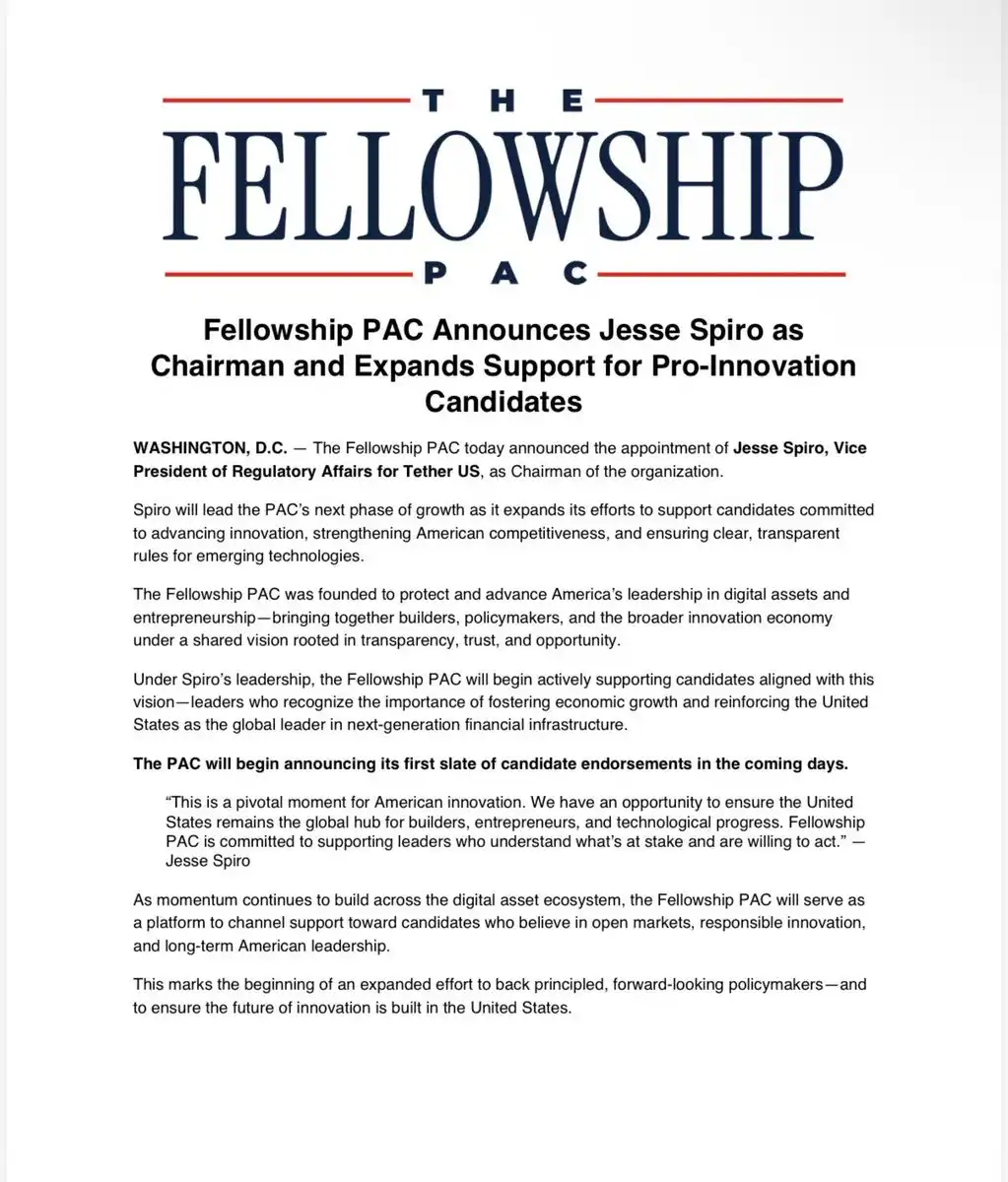
From 'Denying Ties' to 'Executive Leadership,' Tether's Relationship with Fellowship Comes to Light

Since its high-profile debut last September, the identity of Fellowship PAC's backers has been one of the industry's biggest mysteries.

At its inception, the PAC did not disclose any management personnel, donors, or key employees. Early reports listed Tether as an expected supporter, but Tether International subsequently formally denied any connection to the PAC. According to a CoinDesk report in February, a Tether International spokesperson explicitly stated that "Tether International has no affiliation whatsoever with Fellowship."

But FEC records tell a different story. Fellowship's registered treasurer, Mitchell Nobel, is an executive at Cantor Fitzgerald, the custodian institution managing Tether's multi-billion dollar reserves. The PAC's registered address is in Bethesda, Maryland.

Now, with a current Tether US executive officially taking the helm as PAC chairman, the previous rumors have finally materialized into public record. According to BeInCrypto, this marks the first formal, public association between Fellowship PAC and Tether officially.

Spiro joined Tether in 2024 as Head of Government Affairs. Prior to that, he was responsible for blockchain and digital asset regulatory relations at PayPal, and earlier held a leadership role in government affairs at the on-chain analytics company Chainalysis.

$100 Million 'War Chest' Yet to Fire a Single Shot, FEC Records Show Zero Expenditures

Despite Fellowship's claim of holding $100 million in funds, FEC records show that as of December 31 last year, the PAC reported no donation income or expenditures. Since its announcement last September, Fellowship has posted only three public statements on platform X, operating almost "invisibly."

This discrepancy has raised widespread questions. A CoinDesk investigative report on February 25 pointed out that Fellowship had "never shown up" in the seven months since its founding, with its promised $100 million showing no trace in Federal Election Commission disclosures.

Spiro's appointment is seen as a signal of Fellowship's return to the public eye from its period of dormancy. The PAC stated it will announce its first batch of candidate endorsements in the coming days, with just over seven months remaining until the November midterm elections.

Bo Hines, Executive Director of the White House Digital Asset Advisory Council, expressed support for the appointment on platform X, posting: "The fight for American innovation needs serious advocates. Looking forward to seeing leaders elected who truly understand the stakes."

Crypto PAC Arms Race: Fairshake Holds $193 Million, Already Spent $8.6 Million in Illinois

Fellowship is not the crypto industry's only political funding machine. The Fairshake PAC and its affiliated organizations, backed by Coinbase, Ripple, and a16z, reported holding $193 million in cash as of January this year, making it the crypto industry's largest super PAC by funding size currently.

Fairshake has already begun taking action. According to Cointelegraph, the PAC and its affiliates have spent approximately $8.6 million on a congressional race in Illinois, six times its spending in the state in 2024. In the Illinois primary in March, some candidates supported by Fairshake did not win, but there is still a seven-month window until the midterm elections.
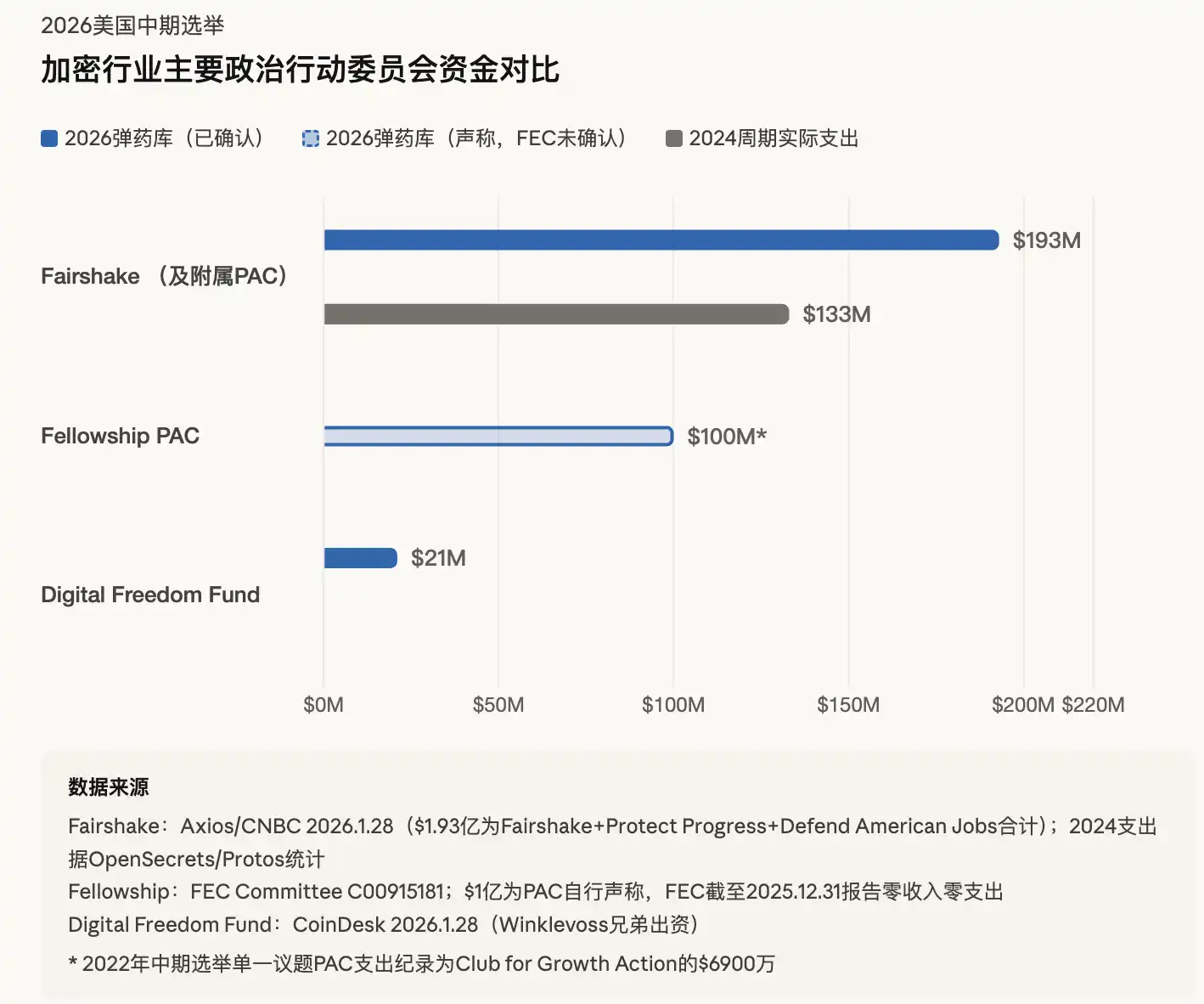
During the 2024 election cycle, Fairshake spent over $130 million on media placements, with the majority of the more than 50 candidates it supported successfully elected. According to statistics from the non-profit oversight organization Public Citizen, nearly half of all corporate money flowing into the 2024 elections came from the crypto industry.

Now, with the combined nearly $300 million war chest of Fellowship and Fairshake, plus other political donation forces within the crypto industry, the 2026 midterm elections are expected to set a new record for industry political spending.

Legislative Battle: Stablecoin Yield Dispute Stalls CLARITY Act, Tether's Interests at Stake

The timing of Spiro's appointment is not coincidental. The Clarity Act for Digital Asset Markets (CLARITY Act), the crypto industry's most core legislative priority, is currently stalled in the Senate, with one of the points of contention being stablecoin yields, which directly affects Tether's business model.

The CLARITY Act passed the House of Representatives in July 2025 by a vote of 294 to 134 and passed review in the Senate Agriculture Committee in January this year. However, at the Senate Banking Committee level, a fierce battle is underway between the banking industry and the crypto industry over whether stablecoins can pay yields to users.

On March 20, Senators Thom Tillis and Angela Alsobrooks reached a principled compromise on stablecoin yields: prohibiting passive yield payments based on holding balances, but allowing reward programs based on transaction activity. According to CoinDesk, after crypto industry representatives reviewed the latest text behind closed doors on Capitol Hill on March 23, they found the language too narrow and ambiguous. Coinbase has stated twice that it does not support the current draft.

The markup in the Senate Banking Committee is currently scheduled for after the Easter recess in late April. Senator Bernie Moreno warned that if the bill does not advance by May, crypto legislation may not receive serious consideration again during the midterm election cycle.

Compounding the issue, White House AI and Crypto Czar David Sacks confirmed on March 26 that his 130-day term had expired and the administration would not appoint a successor. The crypto industry's most critical legislative sprint will proceed without its chief advocate in the White House.

Tether's USDT is the world's largest stablecoin, with a market capitalization of approximately $184 billion, but it is not available to U.S. residents. Tether launched a compliant stablecoin for the U.S. market, USAT, last year. The final outcome of the stablecoin yield provisions will directly determine the operating space for Tether and its competitors in the U.S. market.

Against this backdrop, Tether's move to have an executive assume the chairmanship of a PAC shifts its political influence building from behind the scenes to the forefront, sending a clear signal: during the critical window of legislative博弈 (game theory/contest), using political funds to protect industry interests.


Criptomoedas em alta

Perguntas relacionadas

QWho was appointed as the new chairman of the crypto super PAC Fellowship, and what is his role at Tether?

AJesse Spiro, the Regulatory Affairs Vice President at Tether US, was appointed as the chairman of Fellowship PAC.

QHow much combined political funding do the crypto PACs Fellowship and Fairshake have for the midterm elections?

AFellowship and Fairshake have a combined political funding of nearly $300 million for the midterm elections.

QWhat is the current status of the CLARITY Act in the U.S. Senate, and what is a major point of contention?

AThe CLARITY Act is currently stalled in the Senate Banking Committee, with a major point of contention being whether stablecoins can pay yields to users.

QDespite claiming to have raised over $100 million, what does FEC records show about Fellowship PAC's financial activity?

AFEC records show that Fellowship PAC has reported zero donations and zero expenditures as of December 31st.

QWhat significant action has the other major crypto PAC, Fairshake, already taken in the 2026 election cycle?

AFairshake and its affiliates have already spent approximately $8.6 million on a congressional race in Illinois.

Leituras Relacionadas

Must-Watch Events Next Week|CLARITY Act Could Face Senate Vote; SpaceX, Circle to Report Earnings (8.3-8.9)

**Summary: Key Events and Developments to Watch (August 3-9)** The upcoming week is marked by significant financial disclosures, key legislative deadlines, and notable product updates. **Major Financial Events:** Several companies are scheduled to release their Q2 2026 earnings. American Bitcoin (ABTC) will report on August 3, followed by SpaceX and Hut 8 Mining Corp. on August 4, and Circle on August 5. Notably, a significant portion of SpaceX shares (up to 12% of total shares) will be unlocked on August 6 following their earnings release. **Key Legislative Deadline:** The U.S. Senate faces an August 7 deadline to secure 60 votes for the CLARITY Act, a bipartisan bill aiming to establish a federal regulatory framework for cryptocurrencies. The Senate may hold a full vote on the bill during the week. **Economic Data:** The U.S. July Non-Farm Payrolls report will be released on August 7, providing crucial labor market data. **Technology & Product Updates:** * **Shutdowns:** DeFi portfolio tracker Zapper and wallet app Ctrl Wallet will cease operations on August 3. * **Upgrades:** LayerZero will deprecate its v1 relayers on August 3. XRP Ledger's new version 3.3.0, featuring five new functions, is expected next week. * **AI:** Elon Musk announced that the advanced Grok 4.6 AI model is set for release around August 7. * **Bitcoin:** The BIP-110 forced signaling for a potential Bitcoin network change is scheduled to begin around August 8. **Other Notable Events:** Chinese robotics firm Unitree Tech has set its preliminary price inquiry for its IPO for August 5. South Korean exchange Upbit will delist AQT and AERGO tokens on August 3.

marsbitHá 30m

Must-Watch Events Next Week|CLARITY Act Could Face Senate Vote; SpaceX, Circle to Report Earnings (8.3-8.9)

marsbitHá 30m

Stocks Are Plummeting More Sharply Than Cryptocurrencies. Where Has the Money Gone?

Stock Markets Plunge Deeper Than Cryptocurrencies: Where Did the Money Go? In late July, Seoul's Kospi index triggered circuit breakers for two consecutive days, plummeting over 40% from its June high. The collapse was led by heavyweight stocks like SK Hynix, whose record profits still disappointed investors, and devastating leveraged ETFs, with one major product losing over 83% of its value. This signaled a global, forced deleveraging targeting the most crowded trades. Interestingly, while stocks exhibited extreme volatility akin to crypto markets, Bitcoin rose nearly 15% in July after a prior steep drop. Analysis shows the money fleeing equities did not flow into Bitcoin. Instead, Bitcoin had already absorbed its sell-off in May-June, when U.S. spot Bitcoin ETFs saw historic outflows. The true safe-haven beneficiary was gold, whose price rose over 20% year-on-year, highlighting a decoupling between Bitcoin and gold as "digital gold." The sell-off was a targeted unwinding of leveraged positions in tech and semiconductors, accelerated by broker-dealer risk management and shifts in the AI narrative, including new competition from Chinese memory chipmakers. The retreat path was clear: from high-valuation tech stocks to cash and U.S. Treasuries, then to gold. For Bitcoin to attract sustained institutional inflows, conditions like eased global liquidity pressure, a "soft-landing" Fed rate cut, and U.S. regulatory clarity via legislation like the stalled CLARITY Act are needed. Currently, Bitcoin is not a safe haven but an already-cleared asset. Its low correlation with tech stocks, however, makes it a potential diversification play for institutional portfolios once the storm passes. The money isn't here yet, but the positioning is underway.

marsbitHá 30m

Stocks Are Plummeting More Sharply Than Cryptocurrencies. Where Has the Money Gone?

marsbitHá 30m

In Conversation with Ray Dalio: We Are Currently in an AI Bubble, with 1% of My Portfolio in Bitcoin

Ray Dalio, founder of Bridgewater Associates, warns in an interview that the current AI boom shows classic bubble characteristics, which could lead to significant economic downturns as seen in past cycles like 1929 or 2000. He explains that speculative enthusiasm, fueled by debt and overvaluation, often precedes a crash when rising rates or taxation force asset sales, causing widespread losses and recession. Dalio also outlines his "Big Cycle" theory, describing an approximate 80-year pattern where widening wealth gaps, massive government deficits, and shifting geopolitical power (like China's rise) create internal conflict and global instability. He emphasizes that we are in a late-cycle, transitional phase where traditional powers like the US and UK face decline. For personal wealth protection, Dalio advises diversification beyond cash into assets like stocks, bonds, real estate, and particularly gold, which he prefers over Bitcoin. While he holds about 1% of his portfolio in Bitcoin as a non-printable hard asset, he views gold as more secure from technological or governmental threats. Regarding AI's impact, Dalio believes it will disproportionately benefit capital owners, worsening inequality by replacing both physical and cognitive labor. He suggests that human intuition and emotional intelligence, combined with AI, will be key for future workers. On taxation, Dalio argues that wealth taxes are impractical and risk triggering asset sell-offs, reducing productive investment. He points to the UK as a cautionary example of debt, low productivity, and political strife. Geopolitically, Dalio foresees a more regionalized world, with the US showing weakness in prolonged conflicts like with Iran, akin to past imperial declines. The ideal outcome, he suggests, is coexisting powerful blocs (e.g., Americas, China-Asia Pacific) without major war.

marsbitHá 4h

In Conversation with Ray Dalio: We Are Currently in an AI Bubble, with 1% of My Portfolio in Bitcoin

marsbitHá 4h

Daily 7.2 Trillion KRW: Foreign Capital's Record Net Buying on Friday! Wall Street Says Headwinds for Korean Stock Fund Flows Have Subsided

South Korean stock market sees a dramatic shift in fund flows. On July 31, foreign investors made a record net purchase of approximately KRW 7.2 trillion in KOSPI stocks, marking a fundamental reversal from the persistent large-scale net outflows seen in previous months. This contributed to a significant narrowing of foreign net selling in July to KRW 9.8 trillion, down sharply from KRW 48.4 trillion in June and KRW 44.5 trillion in May. Simultaneously, domestic institutional pressure eased. South Korean pension funds and asset managers turned to a net buying position in July, purchasing KRW 1.0 trillion worth of KOSPI shares, contrasting with net sales in May and June. Market volatility is expected to be dampened by new financial regulations. Effective July 31, the Financial Services Commission tightened access for retail investors to single-stock leveraged ETFs by raising the minimum cash deposit requirement. Trading volumes for these products subsequently dropped to about 50% of their monthly average. Citigroup Research maintains its year-end KOSPI target of 10,000 points. The firm cites several supportive factors: the substantial easing of headwinds from capital outflows, a robust fundamental outlook for the semiconductor sector, historically low market valuations, strong economic fundamentals, and the potential for policy support from financial authorities if needed.

marsbitHá 4h

Daily 7.2 Trillion KRW: Foreign Capital's Record Net Buying on Friday! Wall Street Says Headwinds for Korean Stock Fund Flows Have Subsided

marsbitHá 4h

Trading

Spot

Artigos em Destaque

Como comprar SUPER

Bem-vindo à HTX.com!Tornámos a compra de SuperFarm (SUPER) simples e conveniente.Segue o nosso guia passo a passo para iniciar a tua jornada no mundo das criptos.Passo 1: cria a tua conta HTXUtiliza o teu e-mail ou número de telefone para te inscreveres numa conta gratuita na HTX.Desfruta de um processo de inscrição sem complicações e desbloqueia todas as funcionalidades.Obter a minha contaPasso 2: vai para Comprar Cripto e escolhe o teu método de pagamentoCartão de crédito/débito: usa o teu visa ou mastercard para comprar SuperFarm (SUPER) instantaneamente.Saldo: usa os fundos da tua conta HTX para transacionar sem problemas.Terceiros: adicionamos métodos de pagamento populares, como Google Pay e Apple Pay, para aumentar a conveniência.P2P: transaciona diretamente com outros utilizadores na HTX.Mercado de balcão (OTC): oferecemos serviços personalizados e taxas de câmbio competitivas para os traders.Passo 3: armazena teu SuperFarm (SUPER)Depois de comprar o teu SuperFarm (SUPER), armazena-o na tua conta HTX.Alternativamente, podes enviá-lo para outro lugar através de transferência blockchain ou usá-lo para transacionar outras criptomoedas.Passo 4: transaciona SuperFarm (SUPER)Transaciona facilmente SuperFarm (SUPER) no mercado à vista da HTX.Acede simplesmente à tua conta, seleciona o teu par de trading, executa as tuas transações e monitoriza em tempo real.Oferecemos uma experiência de fácil utilização tanto para principiantes como para traders experientes.

247 Visualizações TotaisPublicado em {updateTime}Atualizado em 2026.06.02

Como comprar SUPER

Discussões

Bem-vindo à Comunidade HTX. Aqui, pode manter-se informado sobre os mais recentes desenvolvimentos da plataforma e obter acesso a análises profissionais de mercado. As opiniões dos utilizadores sobre o preço de SUPER (SUPER) são apresentadas abaixo.

活动图片












