比特币价格59,000美元是分水岭,以下是您需要了解的内容

bitcoinistPublicado em 2026-03-30Última atualização em 2026-03-30

Resumo

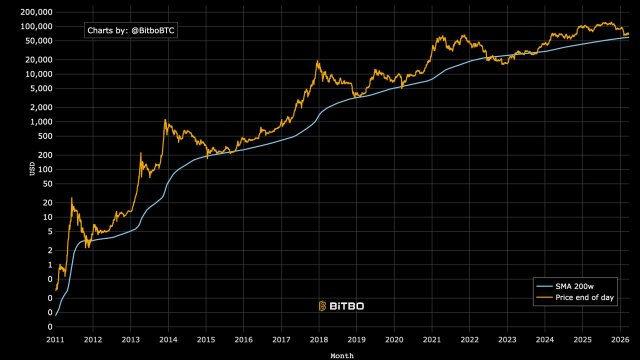
比特币价格在59,000美元处形成关键支撑线,这一水平被视为牛熊分界线。分析师Crypto Patel指出,比特币目前仍位于200周移动平均线(约59,000美元)上方,从历史数据看,这一位置对长期走势至关重要。2015年、2019年和2023年比特币均守住了该均线,随后分别出现了大幅上涨行情。 若价格能持续高于59,000美元,则短期下跌可视为买入机会,宏观结构依然看涨,预计2028年可能创下历史高点。但若跌破这一支撑,则可能正式进入熊市,引发进一步下跌风险。当前市场方向将取决于比特币能否守住这一“底线”。

过去几周,比特币价格在60,000美元至74,000美元之间反复震荡,表明价格突破该区间的方向可能决定整个市场的下一步走向。在已经下跌超过45%之后,所有人的注意力现已转向这一先驱加密货币何时会触底。截至目前,多头出人意料地坚守阵地,但价格仍有一条不可逾越的'分界线'。

比特币宏观结构仍看涨

目前,比特币价格仍远高于200周移动平均线,据加密货币分析师Crypto Patel称,这对价格非常利好。其原因可追溯至过去的市场周期,200周移动平均线一直是需要守住或突破的关键水平。

深入研究过去的周期,Crypto Patel解释说,比特币价格在2015年曾成功保持在200周移动平均线之上。其结果是一轮大幅上涨,在随后的牛市中比特币价格飙升至20,000美元。

随后在2019年,同样的200周移动平均线坚守阵地, resulting bull market led to the 2021 peak of $69,000. 即使在2023年第三次,尽管价格曾暴跌至20,000美元以下,比特币仍设法保持在200周移动平均线之上,多头因此获得回报,价格在2025年达到126,000美元。

来源:X

鉴于这一趋势,比特币价格高于200周移动平均线显然是看涨的,同样,跌破该水平则是看跌的。这就是为什么多头必须坚守这一水平的重要性。

BTC价格绝不能跌破59,000美元

根据分析师的帖子,比特币当前的200周移动平均线位于59,000美元。这立即使其成为多头需要捍卫的水平。正如Crypto Patel所解释的,只要比特币价格保持在该水平之上,那么'每一次下跌都是一份礼物'。这意味着这可能是买入的机会。

如果历史趋势值得尊重,守住200周移动平均线将意味着比特币价格将在2028年的某个时候创下历史新高。分析师警告说:'宏观结构仍然看涨。不要让短期恐惧动摇你的信心。'

反之,跌破这一200周移动平均线对比特币来说可能是灾难性的,因为这将意味着该加密货币现已正式进入熊市 territory。它还可能带来更多下跌的预兆,使加密货币进一步走低,然后才确立底部。

BTC多头开始再次推高价格 | 来源:Tradingview.com上的BTCUSD

Perguntas relacionadas

Q根据文章,比特币价格目前的关键支撑位是多少?

A根据文章,比特币价格目前的关键支撑位是59,000美元,这是200周移动平均线所在的位置。

Q为什么分析师认为比特币的宏观结构仍然看涨?

A分析师认为比特币的宏观结构仍然看涨,因为价格目前仍保持在200周移动平均线之上,而历史数据显示,守住这一水平通常会导致后续的牛市行情。

Q文章中提到比特币历史上哪些年份成功守住了200周移动平均线?

A文章提到比特币在2015年、2019年和2023年都成功守住了200周移动平均线,并随后出现了显著的上涨行情。

Q如果比特币价格跌破59,000美元,可能会发生什么?

A如果比特币价格跌破59,000美元的200周移动平均线,可能意味着正式进入熊市,并可能引发进一步的下跌,直到找到新的底部。

Q分析师对投资者的建议是什么?

A分析师建议投资者不要被短期恐惧动摇,只要比特币价格保持在200周移动平均线之上,每一次下跌都是买入的机会,宏观结构仍然看涨。

Leituras Relacionadas

Fed's Internal Doves Flock to Hawkish Stance, Warsh's Debut "Between a Rock and a Hard Place"

U.S. Federal Reserve officials who previously advocated for rate cuts, including Governor Christopher Waller, have recently shifted their stance, with many now not ruling out the possibility of future rate hikes. This sets a challenging stage for new Fed Chair Kevin Warsh's first policy meeting. Appointed by President Trump based on his dovish views, Warsh now faces a committee where the debate has pivoted from "when to cut" to "whether to hike," driven by persistent inflation above 3%, a strong labor market, and supply-side pressures from AI infrastructure demands and geopolitical tensions. Key figures illustrate the shift. Governor Waller, once concerned about employment, now says data has pushed him toward considering rate increases. Even moderate voices like Governor Lisa Cook, while expecting inflation to ease, have indicated readiness to hike if it fails to do so. Long-time hawks such as regional Fed presidents Beth Hammack, Lorie Logan, and Neel Kashkari have grown more vocal, arguing that the real policy rate is effectively falling and that action may soon be needed. The upcoming Fed meeting is expected to keep rates steady but will likely remove the "easing bias" from its statement, signaling a neutral stance between cuts and hikes. The quarterly "dot plot" is anticipated to show most officials projecting no cuts this year, with some potentially indicating hikes. Chair Warsh, a critic of the Fed's reliance on forward guidance like the dot plot, must navigate communicating this pivot using tools he has questioned, all while steering policy in a direction counter to the preferences of the president who appointed him. The consensus suggests the Fed's next move could well be a rate increase.

marsbitHá 8m

Fed's Internal Doves Flock to Hawkish Stance, Warsh's Debut "Between a Rock and a Hard Place"

marsbitHá 8m

The Trillion-Yuan Market Cap 'Yi Zhong Tian': Who is the True Value King?

The article analyzes the three leading Chinese optical module companies, collectively nicknamed "Yi Zhong Tian": Xinyisheng, Zhongji Innolight, and TFC Optical Communication. It evaluates their "cost-performance" not by current stock price, but through three lenses: PEG ratio (growth vs. valuation), earnings quality, and premium/discount for certainty. Xinyisheng shows the most attractive PEG ratio and high profitability, but its valuation reflects discounts for risks like high customer concentration and reliance on overseas markets. Zhongji Innolight, the most expensive, commands a premium for its market leadership, dominant share in key products like 800G/1.6T modules, and higher earnings certainty, though it faces geopolitical risks. TFC Optical, as an upstream component supplier ("water seller"), has the highest gross margin and bets on the long-term CPO/NPO architecture trend, but trades at a high valuation with more stable, less explosive growth. The core argument is that while these companies dominate module assembly, the true profit pool and technological moat lie upstream in laser and switch chips, currently controlled by U.S. firms like Lumentum and Coherent. The long-term "cost-performance" for these Chinese leaders hinges on whether the domestic industry, exemplified by companies like Yuanjie Technology, can successfully move up the value chain into high-power laser chips. Otherwise, their high growth may remain confined to the lower-margin assembly segment.

marsbitHá 18m

The Trillion-Yuan Market Cap 'Yi Zhong Tian': Who is the True Value King?

marsbitHá 18m

Has the Crypto Market Bottomed? Here's What Institutions Think

The crypto market is in a period of significant debate, with leading institutions offering differing views on whether a bottom has been reached. Three prominent firms have published detailed analyses: * **Galaxy Digital** argues Bitcoin has **not yet bottomed**. Their analysis of 13 historical indicators across six dimensions (valuation, profit-taking, miner pressure, etc.) shows only four are fully met. They project a potential bottom range between $30k and $54k. * **NYDIG** states a bottom is **possible but not likely**. While metrics are close to historic bear market extremes, they note the absence of a classic panic-selling event. They also suggest increased institutional adoption may have structurally altered the market cycle, potentially leading to a shallower downturn. * **Standard Chartered Bank** asserts the **bottom has already occurred** at around $59k. They cite two key factors: potential US-Iran diplomatic progress and the anticipated SpaceX IPO, which they believe absorbed capital and caused ETF selling pressure that is now subsiding. They forecast a year-end price target of $100k. Despite the surface-level disagreement, the reports share critical common ground more valuable for long-term investors: 1. All three believe the market bottom will form **within this year**. 2. All agree the current price is **closer to the bottom than to previous highs**. 3. All maintain a **bullish long-term outlook** for Bitcoin and a new cycle. The core takeaway is that while the exact bottom price ($40k, $50k, or $60k) is debated, the consensus is that a bottom is imminent. For long-term holders, the primary focus should not be pinpointing the absolute low, but on the future potential for prices to reach $100k, $200k, or higher. The fundamental thesis for Bitcoin—sovereign debt accumulation, inflation, declining trust in centralized institutions, global digitization, and improved accessibility—remains intact and is arguably strengthening. The overall landscape is viewed as more favorable than in previous crypto winters.

marsbitHá 28m

Has the Crypto Market Bottomed? Here's What Institutions Think

marsbitHá 28m

The 'Chip' Challenge and Breakthroughs in China's Optical Industry Chain

China's Photonics Industry: Bottlenecks and Breakthroughs In the global AI race, computing chips dominate the narrative, but the underlying bottleneck increasingly defining the scale of AI clusters is light—or more specifically, optical connectivity. Optical modules, which translate electrical signals to light and vice versa, are crucial for connecting thousands of GPUs in AI data centers, preventing data congestion and ensuring efficient model training. High-speed modules (800G, 1.6T) are now standard, with performance hinging on advanced DSP (Digital Signal Processor) chips. This is where a critical dependency lies. Two US giants—Marvell and Broadcom—collectively dominate over 90% of the high-end DSP chip market. Chinese optical module leaders like Zhongji Innolight and Eoptolink rely on these chips to manufacture modules for overseas AI customers, primarily in North America. While this creates a supply chain vulnerability, complete decoupling is difficult. Marvell derives over half its revenue from Greater China, and the US firms depend on Chinese partners for chip packaging and optical components. The risk from laser chips (e.g., from Lumentum), another key component, is considered more manageable due to multiple global suppliers and faster progress in domestic alternatives from companies like YOFC and Accelink. To mitigate risks, China's industry is pursuing a multi-pronged strategy: diversifying supply chains and locking in long-term orders; fostering a domestic market ecosystem to adopt homegrown DSPs from firms like Huawei HiSilicon and CETC; accelerating R&D in high-speed DSPs and advanced packaging; and investing in next-gen technologies like silicon photonics and Co-Packaged Optics (CPO) to reduce reliance on discrete DSPs. The ultimate solution lies not in short-term博弈 but in persistent advancement of domestic high-end chip R&D and manufacturing. While challenges remain in performance, certification, and ecosystem building, China's vast domestic market and manufacturing base provide a crucial buffer, buying time for the industry to achieve greater technological independence.

marsbitHá 42m

The 'Chip' Challenge and Breakthroughs in China's Optical Industry Chain

marsbitHá 42m

Behind SpaceX's $2 Trillion Market Cap: Why Does Musk Always Have the Next Move Planned?

On June 12th, SpaceX debuted on the Nasdaq, reaching a valuation that briefly touched $2 trillion. This marked the culmination of a 24-year journey from its founding in 2002, driven by Elon Musk's frustration at the high cost of buying rockets. The company's path was defined by early failures, with its first three Falcon 1 launches ending in explosions before a successful 2008 flight opened the era of commercial spaceflight. Key to its model was a fixed-price NASA contract, incentivizing cost reduction. SpaceX mastered rocket reusability, first achieving a Falcon 9 landing in 2015, which drastically cut launch costs. This enabled its profitable Starlink satellite internet constellation, envisioned years before reusability was proven, to create an internal market for frequent launches. Similarly, the next-generation Starship rocket was in development long before its first flight, with its business case evolving from Mars colonization to supporting the emerging concept of in-orbit data centers for AI—a story now central to its valuation. The company's recent IPO, a reversal of its long-standing "no IPO" stance, is funding this ambitious "space-based compute" vision. While major tech players like Google, Blue Origin, and others are investing heavily, significant technical and cost hurdles remain. Ultimately, SpaceX's history is one of creating its own demand: first with Starlink and now with space-based AI compute, betting that its next rocket will enable its next giant market.

marsbitHá 45m

Behind SpaceX's $2 Trillion Market Cap: Why Does Musk Always Have the Next Move Planned?

marsbitHá 45m

Trading

Spot
Futuros

Artigos em Destaque

Como comprar SAND

Bem-vindo à HTX.com!Tornámos a compra de The Sandbox (SAND) simples e conveniente.Segue o nosso guia passo a passo para iniciar a tua jornada no mundo das criptos.Passo 1: cria a tua conta HTXUtiliza o teu e-mail ou número de telefone para te inscreveres numa conta gratuita na HTX.Desfruta de um processo de inscrição sem complicações e desbloqueia todas as funcionalidades.Obter a minha contaPasso 2: vai para Comprar Cripto e escolhe o teu método de pagamentoCartão de crédito/débito: usa o teu visa ou mastercard para comprar The Sandbox (SAND) instantaneamente.Saldo: usa os fundos da tua conta HTX para transacionar sem problemas.Terceiros: adicionamos métodos de pagamento populares, como Google Pay e Apple Pay, para aumentar a conveniência.P2P: transaciona diretamente com outros utilizadores na HTX.Mercado de balcão (OTC): oferecemos serviços personalizados e taxas de câmbio competitivas para os traders.Passo 3: armazena teu The Sandbox (SAND)Depois de comprar o teu The Sandbox (SAND), armazena-o na tua conta HTX.Alternativamente, podes enviá-lo para outro lugar através de transferência blockchain ou usá-lo para transacionar outras criptomoedas.Passo 4: transaciona The Sandbox (SAND)Transaciona facilmente The Sandbox (SAND) no mercado à vista da HTX.Acede simplesmente à tua conta, seleciona o teu par de trading, executa as tuas transações e monitoriza em tempo real.Oferecemos uma experiência de fácil utilização tanto para principiantes como para traders experientes.

333 Visualizações TotaisPublicado em {updateTime}Atualizado em 2026.06.02

Como comprar SAND

Discussões

Bem-vindo à Comunidade HTX. Aqui, pode manter-se informado sobre os mais recentes desenvolvimentos da plataforma e obter acesso a análises profissionais de mercado. As opiniões dos utilizadores sobre o preço de SAND (SAND) são apresentadas abaixo.

活动图片