Ethena struggles as revenue falls 32% – Can demand save ENA at $0.089?

ambcryptoPublicado em 2026-03-28Última atualização em 2026-03-28

Resumo

Ethena's (ENA) financial performance weakened significantly in Q1 2026, with its price dropping to $0.089. Key metrics show a 32% decline in Gross Protocol Revenue to $65.06 million, attributed to reduced minting activity and staking rewards. Total Value Locked (TVL) also fell by approximately $130 million since March, indicating sustained capital outflows and declining user activity, which hit a low of around 1,200 daily active users. Despite a slight improvement in gross profit, it remains substantially lower than previous quarters. However, spot market data shows consistent accumulation, with $3.41 million in net inflows over three days, suggesting investor demand may provide some price support. Without a recovery in core fundamentals, significant upside potential remains limited.

Ethena’s [ENA] price now appears to be aligning with its weakening financial performance. Over the past 24 hours, the asset has recorded a double-digit decline, dropping to $0.089 at press time.

While the numbers reflect mounting pressure, a broader evaluation of market conditions is necessary to determine whether this decline marks the start of a deeper correction or a temporary adjustment.

Ethena’s momentum weakens across key metrics

On-chain data shows that ENA has underperformed across multiple fronts since the start of Q1 2026, particularly when compared to its performance in the previous two quarters.

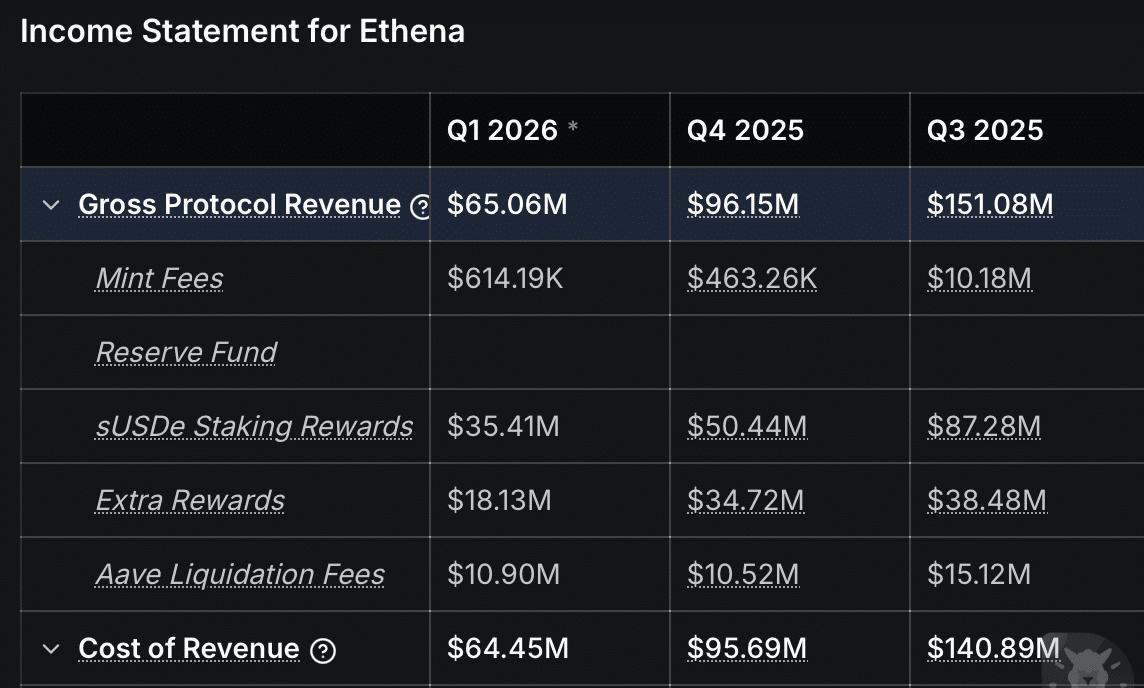
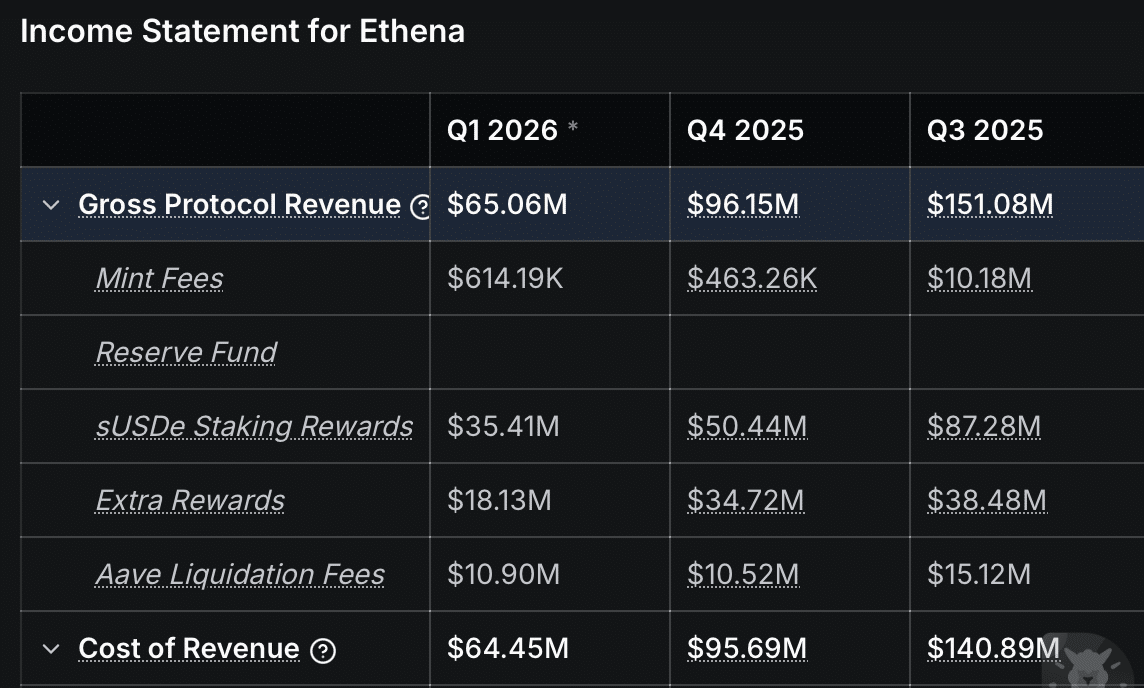
A key area of concern is revenue efficiency. Gross Protocol Revenue fell to $65.06 million, down from $96.15 million in Q4 2025, representing a 32% decline. The drop becomes even more pronounced when compared to Q3 2025.

This contraction points to weaker minting activity and reduced staking rewards, both of which suggest declining on-chain participation.
Source: DeFiLlama

In a market that has remained relatively stable compared to the October–December 2025 cycle, this underperformance raises concerns about weakening user demand rather than external pressure.

Liquidity conditions reinforce this trend. Total Value Locked (TVL), a core indicator of protocol health and user commitment, has continued to decline steadily.

Since the start of March 2026, TVL has fallen by approximately $130 million, bringing it to around $6.66 billion at the time of writing. Within the last 24 hours alone, roughly $16 million has been unstaked, signaling sustained capital exit from the protocol.

Can profit alone sustain user interest?

Despite the broader slowdown, Ethena has recorded a slight improvement in gross profitability.

In Q1 2026, the protocol has generated $614,190 in gross profit, compared to $463,200 in Q4 2025. While this reflects a marginal increase, it does little to offset the sharp decline from earlier performance levels.

For context, Q3 2025 saw $10.18 million in gross profit, roughly 16.5 times higher than current figures. This gap highlights a structural decline in earning potential, even as short-term profitability shows minor improvement.

The implication is clear, as modest profit growth alone may not be sufficient to retain users, especially in a competitive DeFi environment where capital quickly rotates toward higher-yield opportunities.

User activity data supports this view. According to Artemis, Daily Active Users have dropped to around 1,200, the lowest level recorded since December.

Spot demand offers a counter-signal

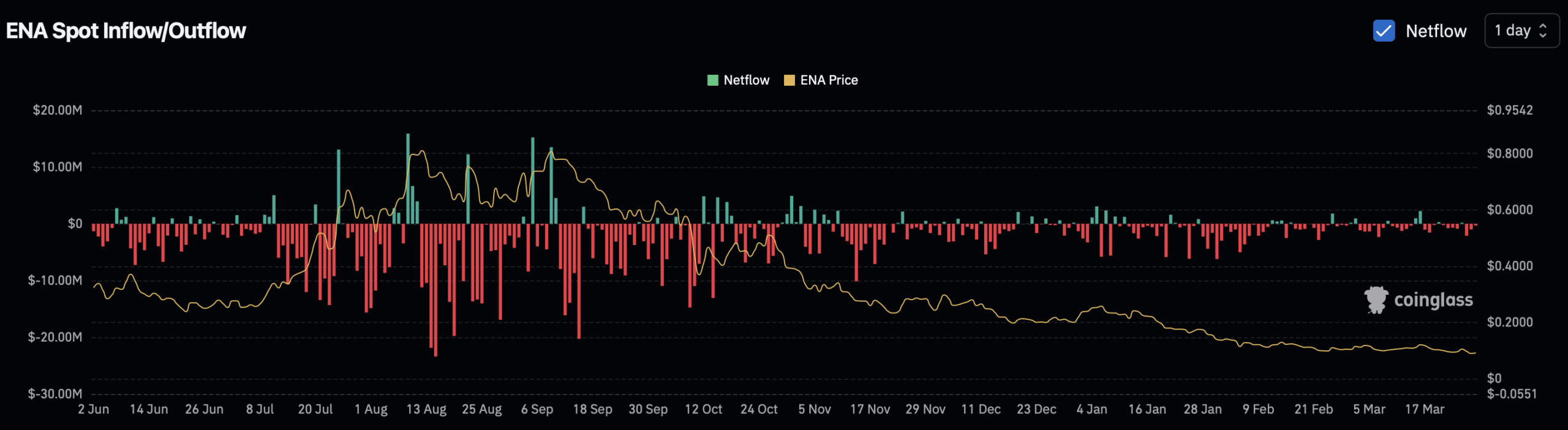
Despite weakening fundamentals and declining liquidity, spot market activity presents a more resilient picture. Exchange netflow data indicates that buying pressure has increased recently. Over the past 24 hours, net inflows into spot positions reached approximately $303,000.

More notably, this is not an isolated event. Over the past three days, cumulative purchases have climbed to around $3.41 million, suggesting consistent accumulation.
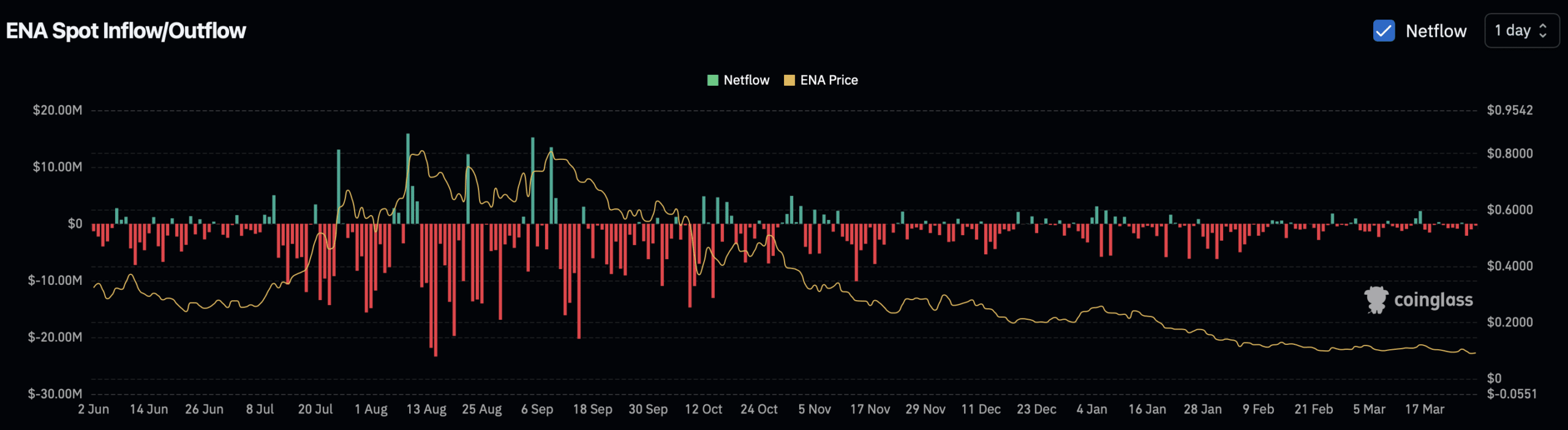
Source: CoinGlass

Such a sustained demand indicates that investors continue to absorb sell-side pressure, even as capital exits the protocol layer.

If this accumulation trend holds, it could limit further downside and support price stabilization. However, without a recovery in core fundamentals, particularly user activity and revenue generation, any upside may remain constrained within a narrow range.


Final Summary

  • Ethena’s protocol performance deteriorated in Q1 2026, even as broader market conditions remained relatively stable.
  • Spot investors continue to accumulate, despite rising liquidity outflows and declining TVL.

Perguntas relacionadas

QWhat is the current price of ENA and how much has it declined in the last 24 hours?

AThe current price of ENA is $0.089, and it has recorded a double-digit decline over the past 24 hours.

QBy what percentage did Ethena's Gross Protocol Revenue fall in Q1 2026 compared to Q4 2025?

AEthena's Gross Protocol Revenue fell by 32%, dropping from $96.15 million in Q4 2025 to $65.06 million in Q1 2026.

QWhat does the decline in Total Value Locked (TVL) and the unstaking of funds indicate about the Ethena protocol?

AThe decline in TVL, including $16 million unstaked in 24 hours, signals sustained capital exit from the protocol, indicating weakening user commitment and health.

QDespite the broader slowdown, which financial metric showed a marginal improvement for Ethena in Q1 2026?

AGross profitability showed a marginal improvement, increasing to $614,190 in Q1 2026 from $463,200 in Q4 2025.

QWhat counter-signal does spot market activity provide against the weakening fundamentals?

ASpot market activity shows increased buying pressure, with net inflows of $303,000 in 24 hours and cumulative purchases of $3.41 million over three days, suggesting consistent accumulation by investors.

Leituras Relacionadas

Dalio's Latest Warning: Don't Get Carried Away by AI, Real Returns on US Stocks in the Next 5-10 Years Could Be -5% to -10%

Ray Dalio, founder of Bridgewater Associates, warns investors against excessive concentration in AI stocks. He argues the current market, dominated by a few AI giants, mirrors historical patterns where revolutionary new technologies lead to high risk, volatility, and uncertainty. While acknowledging AI's transformative potential, Dalio emphasizes that most investors fail at this stage of the cycle by over-concentrating in a handful of leading companies. He cites inherent risks: companies cannot accurately forecast investment needs or external shocks (e.g., monetary policy, geopolitics, taxes), face potential disruption from future technologies and international competition (notably from China), and experience significant price swings. Dalio's core advice is diversification, calling it his "Holy Grail of Investing." He presents a mathematical case that a well-diversified portfolio of 15-20 uncorrelated, good bets offers a superior risk-adjusted return compared to a concentrated position. Dalio also offers a cautious outlook, suggesting U.S. stocks may deliver real returns of -5% to -10% over the next 5-10 years based on valuation and bubble indicators. He concludes that in the face of high uncertainty, the prudent strategy is not to avoid betting entirely, but to avoid large, concentrated bets where one lacks sufficient informational edge. Instead, investors should build a strategically balanced, diversified portfolio.

marsbitHá 1h

Dalio's Latest Warning: Don't Get Carried Away by AI, Real Returns on US Stocks in the Next 5-10 Years Could Be -5% to -10%

marsbitHá 1h

Rain Valuation Approaches $20 Billion: The Battle for U-Cards Extends to Rewards Systems

Rain, a stablecoin payments infrastructure company, is shifting the competitive focus for U Cards from simple issuance to user retention and repeated usage. On June 15, Rain launched "Rain Rewards," an embedded loyalty program capability within its card-issuing infrastructure. This allows partner businesses—like fintech platforms and neobanks—to configure branded loyalty points, earning rules, redemptions, and merchant promotions directly within their card products. The system, built from the 2025 acquisition of Uptop, ensures points are only issued upon final transaction settlement, preventing liabilities from refunds. Trials, such as with Avalanche Card, reportedly boosted spending by 25% among enrolled users. Founded by Farooq Malik and Charles Yoo-Naut, Rain evolved from a tool for managing Web3 company expenses into a full-stack enterprise platform. It is a Principal Member of Visa and Mastercard, enabling partners to issue stablecoin-backed cards and wallets while leveraging traditional payment networks. Notably, the popular U Card Plasma One is issued by Rain under Visa's authority. Rain also integrates with Visa's stablecoin settlement pilot, using USDC for network settlement. Rain's rapid funding reflects growing institutional interest in stablecoin payment infrastructure. It raised a $245 million Series A in March 2025, a $58 million Series B in August 2025, and a $250 million Series C in January of this year, reaching a $19.5 billion valuation. Annualized transaction volume exceeds $3 billion, serving over 200 partners including Western Union and Nuvei. Beyond cards, Rain is expanding into programmable payments. Its June 2026 "Agent Control Layer" allows businesses to set spending rules—like merchant categories, amounts, and frequency—for AI agents before transactions occur. This positions Rain not as a single product but as an operating system for stablecoin payments, handling everything from card issuance and wallet management to rewards, on/off-ramps, and automated compliance. The goal is to enable seamless, often invisible, real-world spending of on-chain assets.

Foresight NewsHá 1h

Rain Valuation Approaches $20 Billion: The Battle for U-Cards Extends to Rewards Systems

Foresight NewsHá 1h

Google TPU Shipments Revised Up by 50%

Recent industry research indicates a significant upward revision in the shipments of Google's TPU (Tensor Processing Unit) chips. Previous expectations for 2027 were set at around 10 million units, but new estimates now point to 15 million units, a 50% increase. This substantial boost directly translates to higher demand across the entire supporting supply chain. Google's TPU clusters utilize a standardized all-optical interconnect architecture. Consequently, key hardware components are deeply integrated and scaled in fixed ratios with the chips. The 15 million TPU target will drive corresponding demand increases for NPO optical engines (roughly a 1:1 match), 1.6T optical modules, OCS optical switches, high-end server power supplies, fiber optics & MPO connectors, and liquid cooling solutions. Among these, liquid cooling is highlighted as the sector experiencing the most significant transformation and offering the most stable potential for excess returns. As next-generation TPU chips reach power levels where traditional air cooling is insufficient, liquid cooling becomes essential. 2026 is forecasted as the first year of substantial adoption for Google's liquid cooling solutions. This shift, coupled with delivery and capacity bottlenecks faced by incumbent overseas manufacturers, is creating a prime window for domestic Chinese suppliers to enter and secure Google's core supply chain. The market size for Google-specific liquid cooling is projected to potentially triple from a baseline of hundreds of billions to around 300 billion units by 2028. The logic for the fiber optic sector is also being rewritten. Once considered a cyclical commodity tied to telecom operator procurement, fiber is now a strategic and scarce resource for AI Data Centers (AIDC). A severe supply-demand imbalance, driven by the long lead time for preform production (18-24 months) and surging demand from cloud giants, is supporting strong performance. Chinese fiber manufacturers are well-positioned to capture a significant share of global AIDC demand, with exports potentially reaching 200-300 million core kilometers in 2026. Overall, the investment focus within the AI computing industry is shifting from pure "chip performance speculation" towards the more certain incremental growth in computing infrastructure and its supporting ecosystem. The upward revision in Google TPU shipments, along with the potential for further doubling by 2028, is seen as solidifying performance visibility for the entire supporting supply chain over the next two years.

marsbitHá 2h

Google TPU Shipments Revised Up by 50%

marsbitHá 2h

Trading

Spot
Futuros

Artigos em Destaque

Como comprar ENA

Bem-vindo à HTX.com!Tornámos a compra de Ethena (ENA) simples e conveniente.Segue o nosso guia passo a passo para iniciar a tua jornada no mundo das criptos.Passo 1: cria a tua conta HTXUtiliza o teu e-mail ou número de telefone para te inscreveres numa conta gratuita na HTX.Desfruta de um processo de inscrição sem complicações e desbloqueia todas as funcionalidades.Obter a minha contaPasso 2: vai para Comprar Cripto e escolhe o teu método de pagamentoCartão de crédito/débito: usa o teu visa ou mastercard para comprar Ethena (ENA) instantaneamente.Saldo: usa os fundos da tua conta HTX para transacionar sem problemas.Terceiros: adicionamos métodos de pagamento populares, como Google Pay e Apple Pay, para aumentar a conveniência.P2P: transaciona diretamente com outros utilizadores na HTX.Mercado de balcão (OTC): oferecemos serviços personalizados e taxas de câmbio competitivas para os traders.Passo 3: armazena teu Ethena (ENA)Depois de comprar o teu Ethena (ENA), armazena-o na tua conta HTX.Alternativamente, podes enviá-lo para outro lugar através de transferência blockchain ou usá-lo para transacionar outras criptomoedas.Passo 4: transaciona Ethena (ENA)Transaciona facilmente Ethena (ENA) no mercado à vista da HTX.Acede simplesmente à tua conta, seleciona o teu par de trading, executa as tuas transações e monitoriza em tempo real.Oferecemos uma experiência de fácil utilização tanto para principiantes como para traders experientes.

247 Visualizações TotaisPublicado em {updateTime}Atualizado em 2026.06.02

Como comprar ENA

Discussões

Bem-vindo à Comunidade HTX. Aqui, pode manter-se informado sobre os mais recentes desenvolvimentos da plataforma e obter acesso a análises profissionais de mercado. As opiniões dos utilizadores sobre o preço de ENA (ENA) são apresentadas abaixo.

活动图片