3B Small Model's Programming Scores Rival Opus 4.5, Mysterious Model Sparks Heated Discussion, Turns Out to be Domestic

marsbitPublicado em 2026-06-18Última atualização em 2026-06-18

Resumo

A 3B parameter dense reasoning model named VibeThinker-3B has gained significant attention for achieving performance comparable to leading models like Gemini 3 Pro, GPT-5 high, and Claude Opus 4.5 in verifiable reasoning tasks such as programming, mathematics, and STEM problem-solving, despite its significantly smaller size. Developed by Sina Weibo's team, the model is built upon Qwen2.5-Coder-3B. Its training employs an upgraded Spectrum-to-Signal pipeline, featuring a curriculum-based two-stage supervised fine-tuning (SFT), multi-domain reinforcement learning (RL) inspired by MGPO, offline self-distillation, and instruction RL to enhance controllability. A key innovation is the Claim-Level Reliability (CLR) assessment, a test-time scaling strategy that further boosts performance on math benchmarks. The model excels in specific, verifiable domains, scoring highly on tests like AIME26 (94.3/97.1 with CLR) and LiveCodeBench v6 (80.2 Pass@1). However, it performs less impressively in areas requiring broad general knowledge. The authors propose a "parameter compression coverage hypothesis," suggesting that verifiable reasoning abilities—reliant on multi-step logic and feedback—are highly compressible, while open-domain knowledge depends more on large-scale parameters. VibeThinker-3B demonstrates that small models, when specialized for tasks with clear verification signals, can reach frontier performance, offering a complementary research path to scaling model size. The model ...

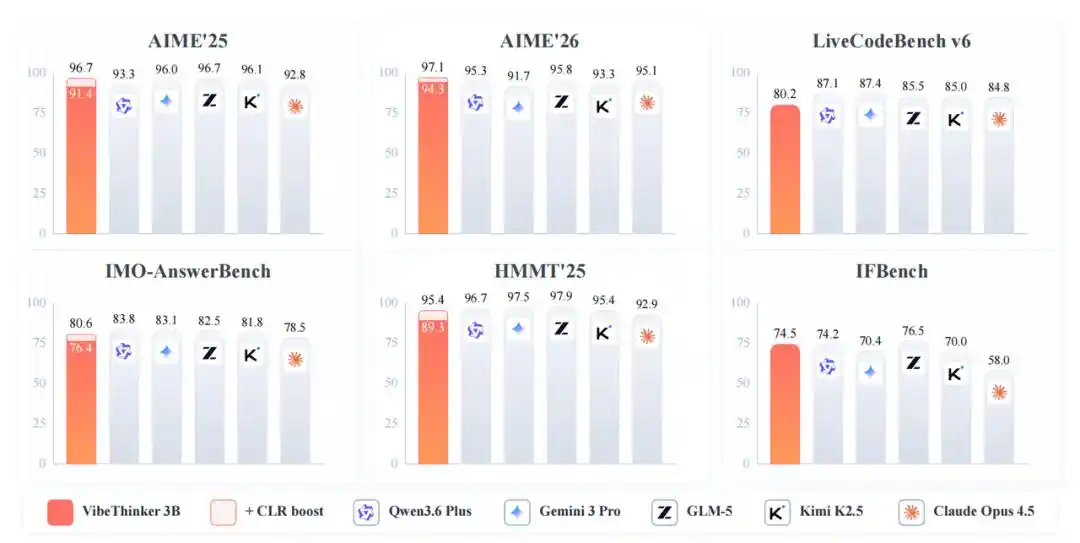
In recent days, a 3B small model has gained popularity on X because in some difficulty-verifiable reasoning tasks (like programming), it has entered the performance range of frontier models like Gemini 3 Pro, GPT-5 high, Claude Opus 4.5, GLM-5, and Kimi K2.5, while its size is far smaller than these models.

This model is named VibeThinker-3B, a dense reasoning model with 3 billion parameters, aiming to explore how far verifiable reasoning capability can be pushed under strictly small model scale constraints.

After the model's release, many were amazed by its results and expressed a desire to try it out.
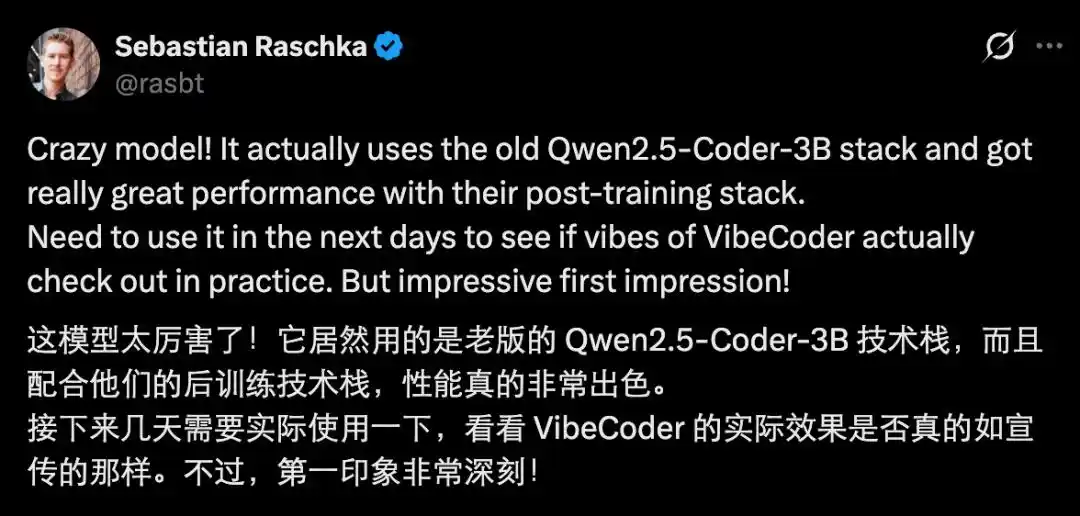
Notably, it is also a domestic model, coming from the Sina Weibo team.
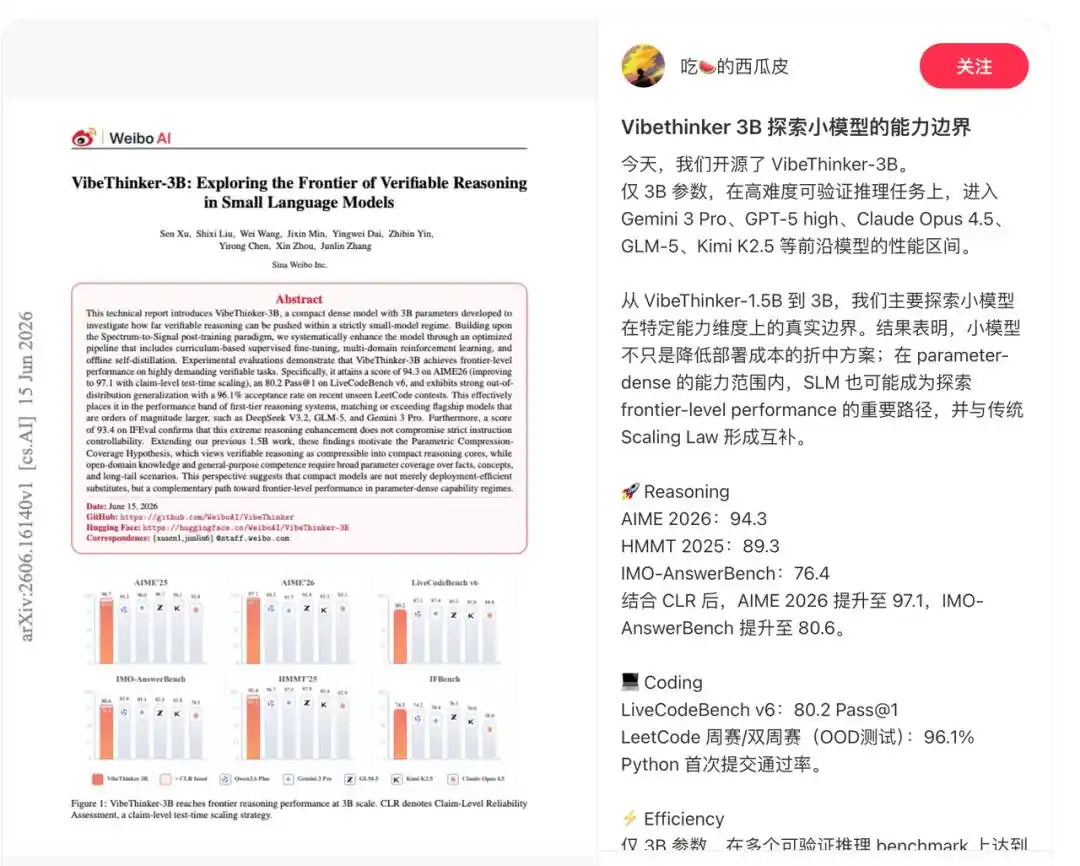
The technical report shows that this model is designed specifically for tasks with reliable verification signals, including mathematical reasoning, competitive programming, STEM reasoning, and instruction execution with clear constraints.

Therefore, it performs exceptionally well in various benchmark tests. It scored 94.3 on the AIME26 test, 89.3 on the HMMT25 test, 80.2 on the LiveCodeBench v6 test (Pass@1), and achieved a 96.1% pass rate in the latest unpublished weekly and biweekly LeetCode contests between April 25 and May 31, 2026.
How was this model trained? The technical report reveals some details.

First, it is built upon Qwen2.5-Coder-3B and undergoes post-training using an upgraded Spectrum-to-Signal process. This process strengthens data synthesis, quality filtering, and curriculum learning in Supervised Fine-Tuning (SFT), extends MGPO-style reinforcement learning to multiple verifiable domains, preserves complete long-context reasoning trajectories, and consolidates various capabilities through offline self-distillation and instruction reinforcement learning (Instruct RL).
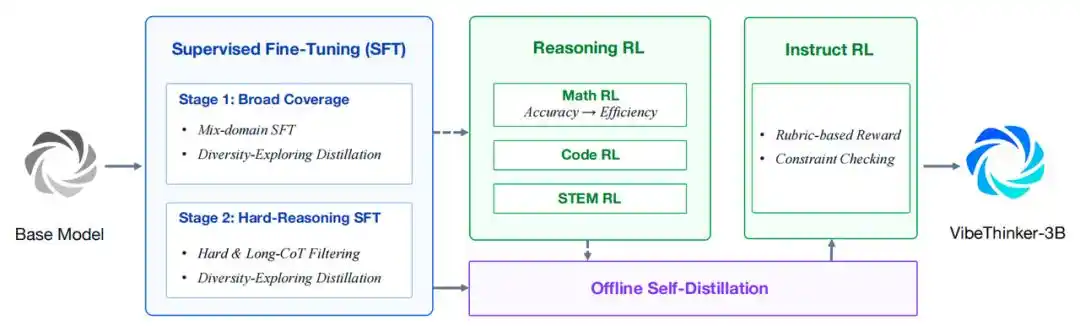
Overall training pipeline of VibeThinker-3B
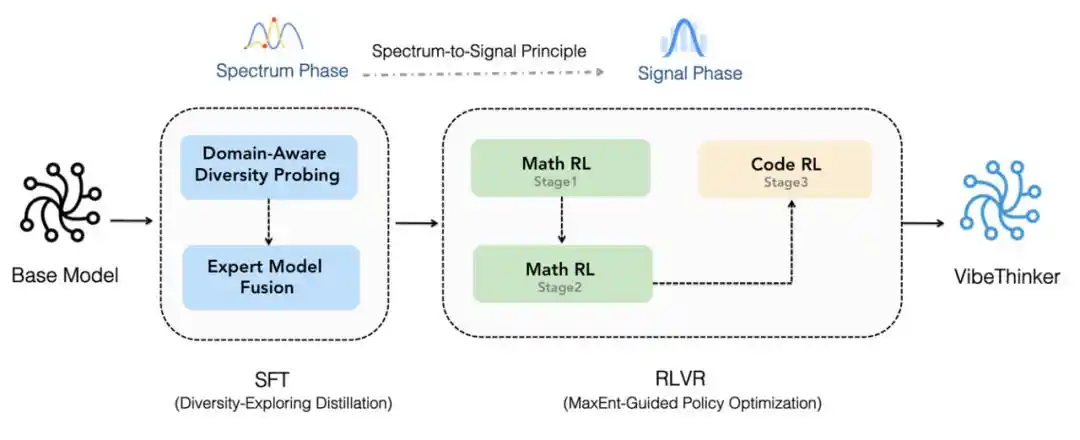
Spectrum-to-Signal pipeline.

Furthermore, VibeThinker-3B introduces Claim-Level Reliability (CLR) assessment, a test-time scaling strategy for answer-verifiable reasoning. CLR further improves performance on mathematical benchmarks, raising AIME26 from 94.3 to 97.1, HMMT25 from 89.3 to 95.4, and BruMO25 to 99.2.
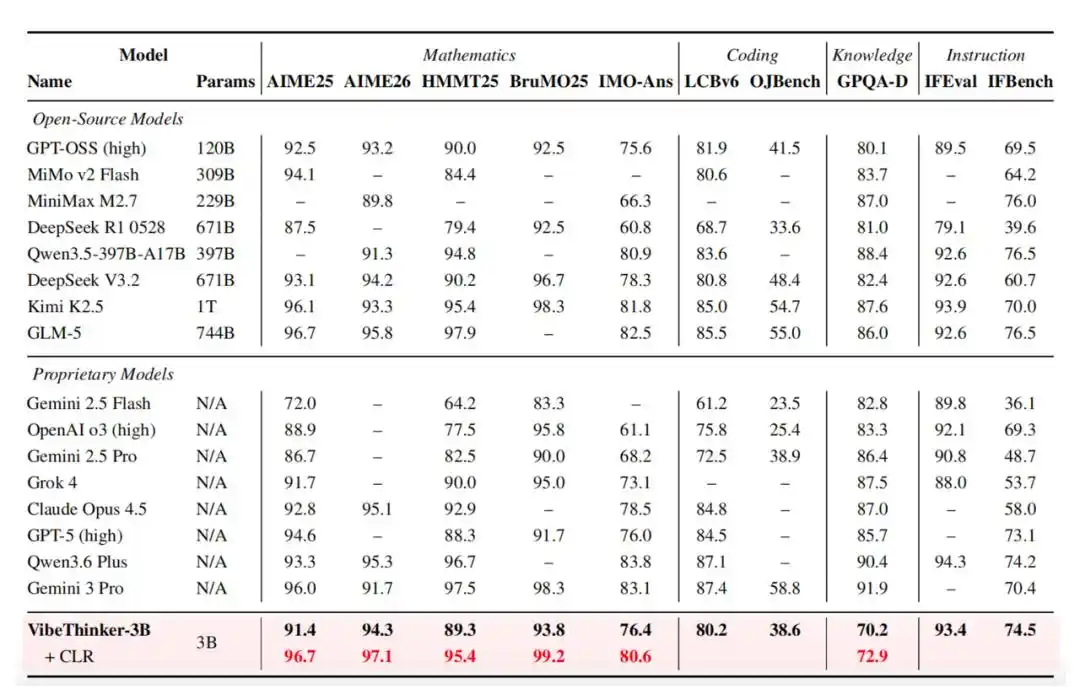
The specific training pipeline is as follows:

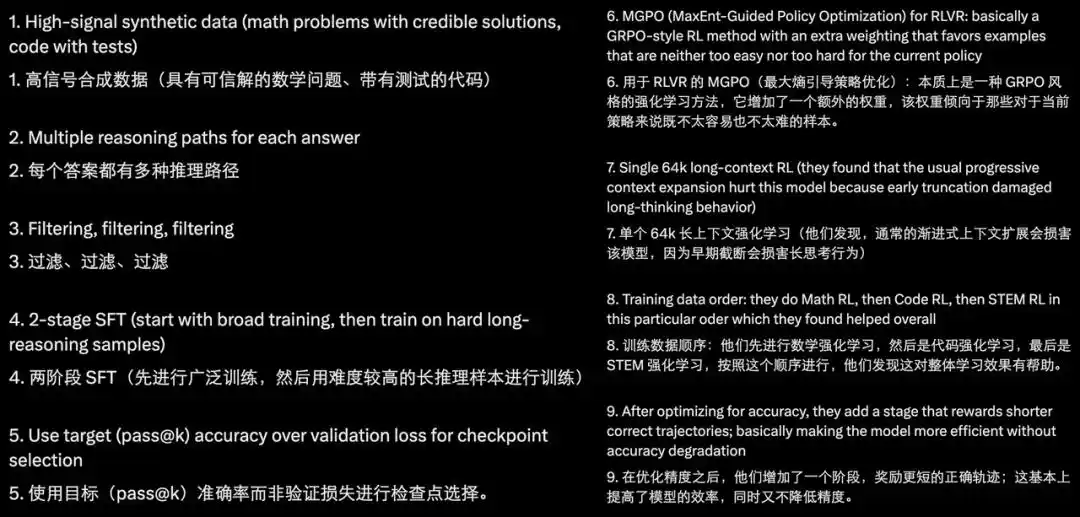
  • Curriculum-based two-stage SFT. The first stage focuses on broad capability coverage in mathematics, programming, STEM reasoning, general conversation, and instruction following. The second stage shifts to more difficult, broader-scope reasoning samples. Diversity-Exploring Distillation is used to preserve multiple valid solution paths.
  • Multi-domain reasoning reinforcement learning. VibeThinker-3B reuses MGPO. Reinforcement learning is applied sequentially to mathematical, programming, and STEM reasoning tasks. Training uses a single 64K long-context window to preserve complete long-horizon reasoning trajectories.
  • Offline self-distillation. High-quality trajectories are filtered and distilled from the mathematical, programming, and STEM RL checkpoints, ultimately forming a unified student model. Learning Potential Scoring is used to prioritize trajectories that are correct but not yet well imitated by the student.
  • Instruct RL. The final stage improves the controllability for user-facing prompts. For format-sensitive and open-ended instructional data, rule-based verifiers and rubric-based reward models are employed.

In a recent post, well-known AI researcher and blogger Sebastian Raschka systematically summarized key points disclosed in the VibeThinker-3B technical report, including the following:
If you are interested in this content, you can delve into their technical report. Currently, the model is also publicly available for download.
Report Title: VibeThinker-3B: Exploring the Frontier of Verifiable Reasoning in Small Language Models

Report Link: https://arxiv.org/pdf/2606.16140

HuggingFace Link: https://huggingface.co/WeiboAI/VibeThinker-3B

However, the model's applicable scope has clear limitations, as it does not perform well in domains requiring general knowledge.
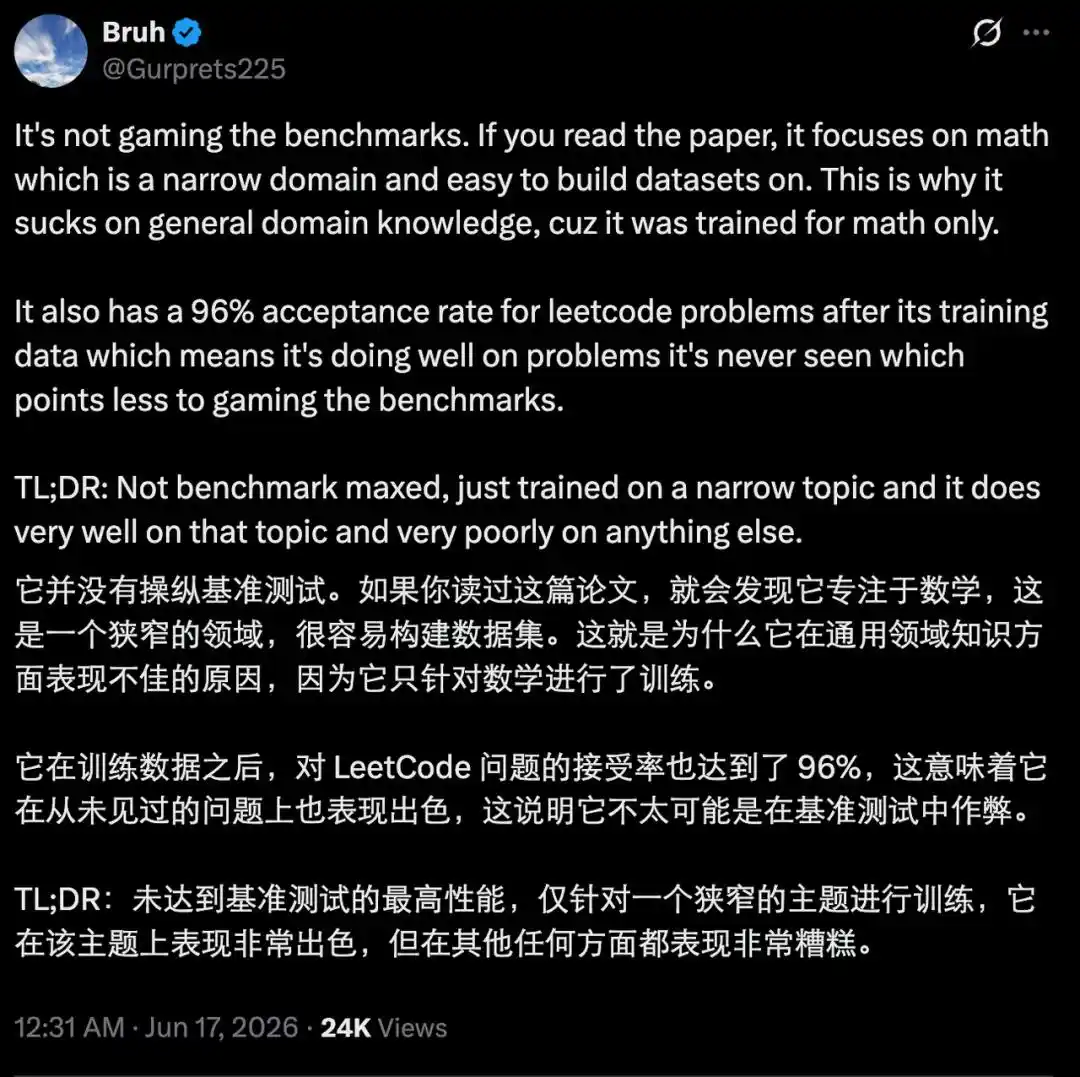
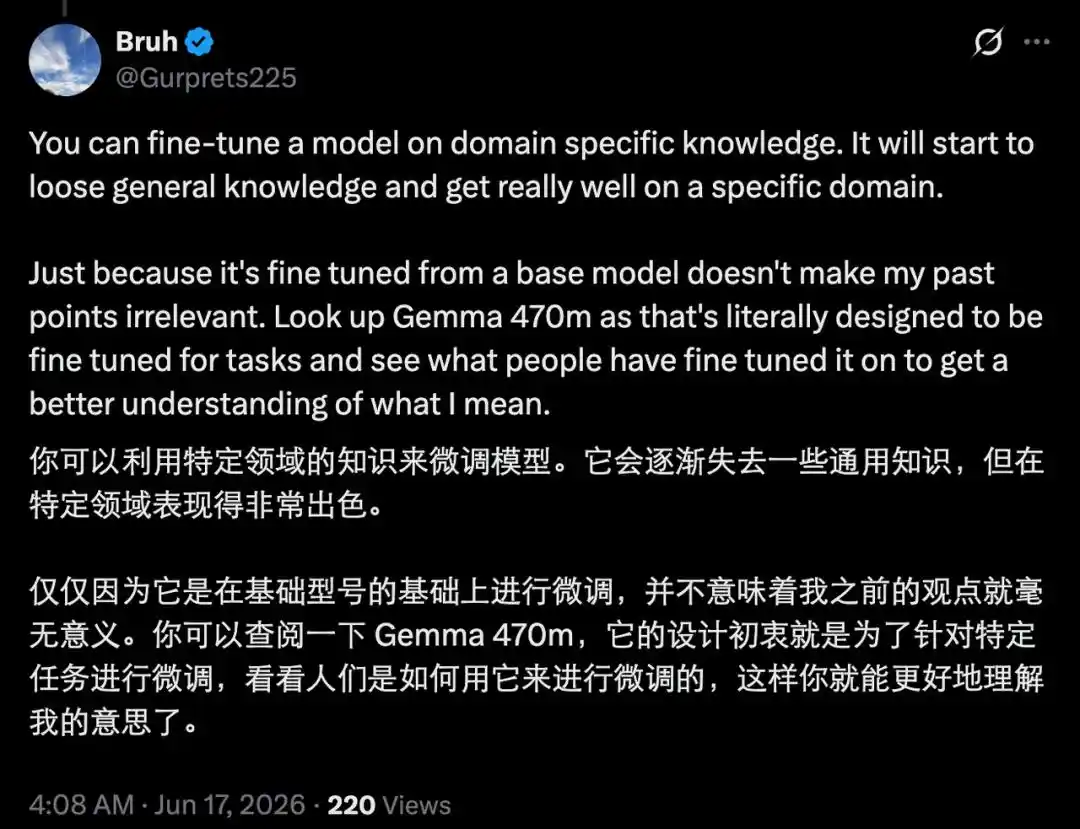
The developers also explicitly point this out and propose the "Parameter Compression Coverage Hypothesis": Different capabilities rely on model parameters in drastically different ways. Verifiable reasoning is closer to a highly compressible, parameter-dense ability whose core lies in multi-step reasoning, constraint satisfaction, self-correction, and answer verification. When the task space structure is clear enough and feedback signals are sufficiently reliable, compact models can also possess near-state-of-the-art reasoning capabilities. In contrast, open-domain knowledge, general conversation, and long-tail scenario understanding rely more on large-scale parameters to extensively cover facts, concepts, and world knowledge. This hypothesis is very insightful. VentureBeat wrote in its report: "It reveals a partial decoupling between reasoning capability and factual knowledge, and that the former can be compressed more efficiently than previously thought — an insight that has profound implications for how the industry thinks about model design, deployment costs, and the accessibility of advanced AI capabilities."
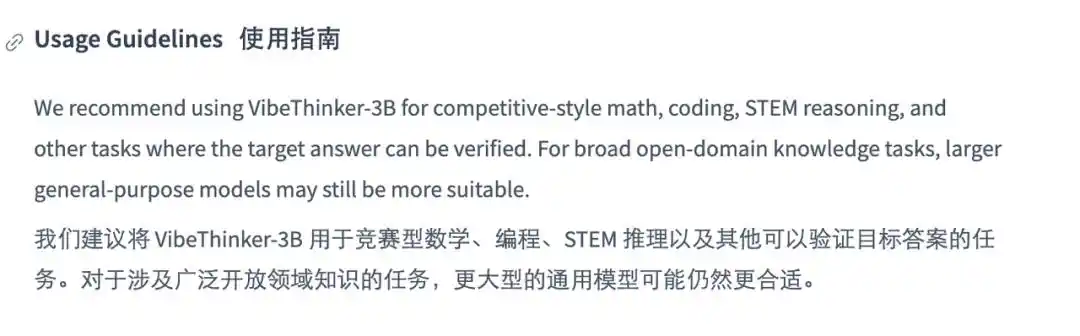
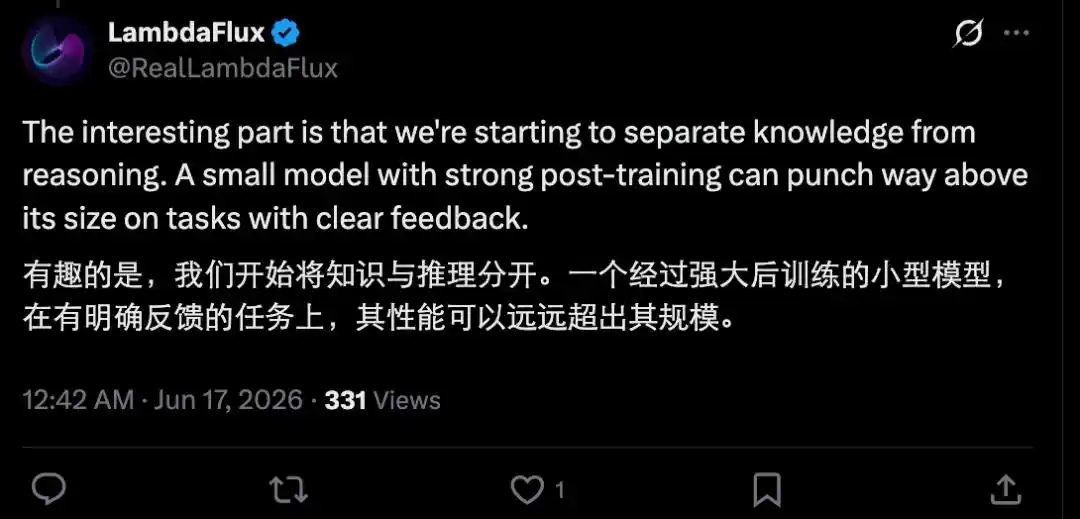
The authors state that their goal is not to create a small model to replace large-scale models, but to examine the true boundaries of small models along specific capability dimensions. With VibeThinker-3B, they hope to demonstrate that small models should not merely be seen as a compromise to reduce deployment costs. In capability domains with clear feedback and verification mechanisms, small language models are revealing a promising research path, potentially achieving frontier-level performance and forming a fundamentally complementary relationship with the traditional paradigm of parameter scaling.

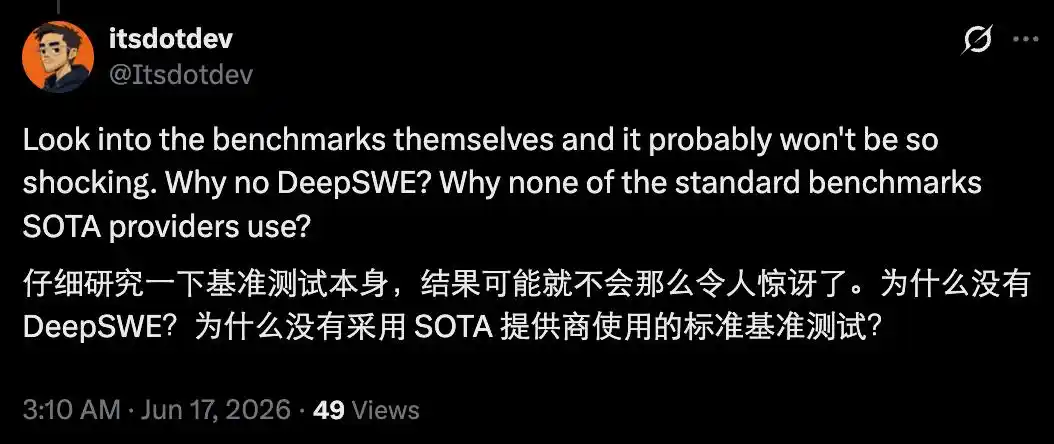
Currently, the model still faces some skepticism within the community. If you are interested in this model, you might want to try it out for yourself.
Reference Links:

https://x.com/orcus108/status/2066876960073281582

This article is from the WeChat public account "Machine Heart" (ID: almosthuman2014), author: Zhang Qian


Perguntas relacionadas

QWhat is the name and key characteristic of the small AI model discussed in the article?

AThe model is called VibeThinker-3B. Its key characteristic is that despite being a small model with only 3 billion parameters, it achieves reasoning performance on verifiable tasks like programming that is comparable to much larger frontier models.

QWhich company or team developed the VibeThinker-3B model?

AThe VibeThinker-3B model was developed by the Sina Weibo (microblog) team, making it a domestic Chinese model.

QWhat is the core hypothesis proposed by the creators of VibeThinker-3B regarding model capabilities?

AThe core hypothesis is the 'Parameter-Compression Coverage Hypothesis'. It suggests that different capabilities depend on model parameters in distinct ways. Verifiable reasoning (multi-step reasoning, constraint satisfaction) is highly compressible and parameter-dense. In contrast, open-domain knowledge and understanding rely more on large-scale parameters for broad factual coverage.

QOn which specific benchmark tasks did VibeThinker-3B demonstrate exceptional performance?

AVibeThinker-3B demonstrated exceptional performance on verifiable reasoning benchmarks such as AIME26 (97.1 with CLR), HMMT25 (95.4 with CLR), LiveCodeBench v6 (80.2 Pass@1), and recent private LeetCode contests (96.1% pass rate).

QWhat are the main limitations or scope of application for the VibeThinker-3B model as stated in the article?

AThe model's applicability is limited. It excels in domains with clear verification signals (math, programming, STEM) but does not perform well in areas requiring general world knowledge, open-domain dialogue, or understanding of long-tail scenarios, as these rely on broader parametric coverage.

Leituras Relacionadas

Must-Watch Events Next Week|CLARITY Act Could Face Senate Vote; SpaceX, Circle to Report Earnings (8.3-8.9)

**Summary: Key Events and Developments to Watch (August 3-9)** The upcoming week is marked by significant financial disclosures, key legislative deadlines, and notable product updates. **Major Financial Events:** Several companies are scheduled to release their Q2 2026 earnings. American Bitcoin (ABTC) will report on August 3, followed by SpaceX and Hut 8 Mining Corp. on August 4, and Circle on August 5. Notably, a significant portion of SpaceX shares (up to 12% of total shares) will be unlocked on August 6 following their earnings release. **Key Legislative Deadline:** The U.S. Senate faces an August 7 deadline to secure 60 votes for the CLARITY Act, a bipartisan bill aiming to establish a federal regulatory framework for cryptocurrencies. The Senate may hold a full vote on the bill during the week. **Economic Data:** The U.S. July Non-Farm Payrolls report will be released on August 7, providing crucial labor market data. **Technology & Product Updates:** * **Shutdowns:** DeFi portfolio tracker Zapper and wallet app Ctrl Wallet will cease operations on August 3. * **Upgrades:** LayerZero will deprecate its v1 relayers on August 3. XRP Ledger's new version 3.3.0, featuring five new functions, is expected next week. * **AI:** Elon Musk announced that the advanced Grok 4.6 AI model is set for release around August 7. * **Bitcoin:** The BIP-110 forced signaling for a potential Bitcoin network change is scheduled to begin around August 8. **Other Notable Events:** Chinese robotics firm Unitree Tech has set its preliminary price inquiry for its IPO for August 5. South Korean exchange Upbit will delist AQT and AERGO tokens on August 3.

marsbitHá 1h

Must-Watch Events Next Week|CLARITY Act Could Face Senate Vote; SpaceX, Circle to Report Earnings (8.3-8.9)

marsbitHá 1h

Stocks Are Plummeting More Sharply Than Cryptocurrencies. Where Has the Money Gone?

Stock Markets Plunge Deeper Than Cryptocurrencies: Where Did the Money Go? In late July, Seoul's Kospi index triggered circuit breakers for two consecutive days, plummeting over 40% from its June high. The collapse was led by heavyweight stocks like SK Hynix, whose record profits still disappointed investors, and devastating leveraged ETFs, with one major product losing over 83% of its value. This signaled a global, forced deleveraging targeting the most crowded trades. Interestingly, while stocks exhibited extreme volatility akin to crypto markets, Bitcoin rose nearly 15% in July after a prior steep drop. Analysis shows the money fleeing equities did not flow into Bitcoin. Instead, Bitcoin had already absorbed its sell-off in May-June, when U.S. spot Bitcoin ETFs saw historic outflows. The true safe-haven beneficiary was gold, whose price rose over 20% year-on-year, highlighting a decoupling between Bitcoin and gold as "digital gold." The sell-off was a targeted unwinding of leveraged positions in tech and semiconductors, accelerated by broker-dealer risk management and shifts in the AI narrative, including new competition from Chinese memory chipmakers. The retreat path was clear: from high-valuation tech stocks to cash and U.S. Treasuries, then to gold. For Bitcoin to attract sustained institutional inflows, conditions like eased global liquidity pressure, a "soft-landing" Fed rate cut, and U.S. regulatory clarity via legislation like the stalled CLARITY Act are needed. Currently, Bitcoin is not a safe haven but an already-cleared asset. Its low correlation with tech stocks, however, makes it a potential diversification play for institutional portfolios once the storm passes. The money isn't here yet, but the positioning is underway.

marsbitHá 1h

Stocks Are Plummeting More Sharply Than Cryptocurrencies. Where Has the Money Gone?

marsbitHá 1h

In Conversation with Ray Dalio: We Are Currently in an AI Bubble, with 1% of My Portfolio in Bitcoin

Ray Dalio, founder of Bridgewater Associates, warns in an interview that the current AI boom shows classic bubble characteristics, which could lead to significant economic downturns as seen in past cycles like 1929 or 2000. He explains that speculative enthusiasm, fueled by debt and overvaluation, often precedes a crash when rising rates or taxation force asset sales, causing widespread losses and recession. Dalio also outlines his "Big Cycle" theory, describing an approximate 80-year pattern where widening wealth gaps, massive government deficits, and shifting geopolitical power (like China's rise) create internal conflict and global instability. He emphasizes that we are in a late-cycle, transitional phase where traditional powers like the US and UK face decline. For personal wealth protection, Dalio advises diversification beyond cash into assets like stocks, bonds, real estate, and particularly gold, which he prefers over Bitcoin. While he holds about 1% of his portfolio in Bitcoin as a non-printable hard asset, he views gold as more secure from technological or governmental threats. Regarding AI's impact, Dalio believes it will disproportionately benefit capital owners, worsening inequality by replacing both physical and cognitive labor. He suggests that human intuition and emotional intelligence, combined with AI, will be key for future workers. On taxation, Dalio argues that wealth taxes are impractical and risk triggering asset sell-offs, reducing productive investment. He points to the UK as a cautionary example of debt, low productivity, and political strife. Geopolitically, Dalio foresees a more regionalized world, with the US showing weakness in prolonged conflicts like with Iran, akin to past imperial declines. The ideal outcome, he suggests, is coexisting powerful blocs (e.g., Americas, China-Asia Pacific) without major war.

marsbitHá 5h

In Conversation with Ray Dalio: We Are Currently in an AI Bubble, with 1% of My Portfolio in Bitcoin

marsbitHá 5h

Trading

Spot
活动图片