Institutional Investors Are Increasingly Using Crypto Options Trading to Hedge Their Bets in Bear Market

CoinDeskPublicado em 2022-08-13Última atualização em 2022-08-13

Resumo

Options trading volume has risen on crypto exchanges, and even miners are using options strategies to muddle through the current, uncertain environment.

In the current bear market, crypto options trading has been a rare bright spot, building momentum even as crypto prices have plunged.

A number of crypto exchanges have noted rising trading volume after reaching lows earlier this year. Options strategies have figured prominently among institutional investors and even miners as they try to weather crypto’s usual volatility and a downturn that could last for months, or longer, despite recent hopeful macroeconomic signs.

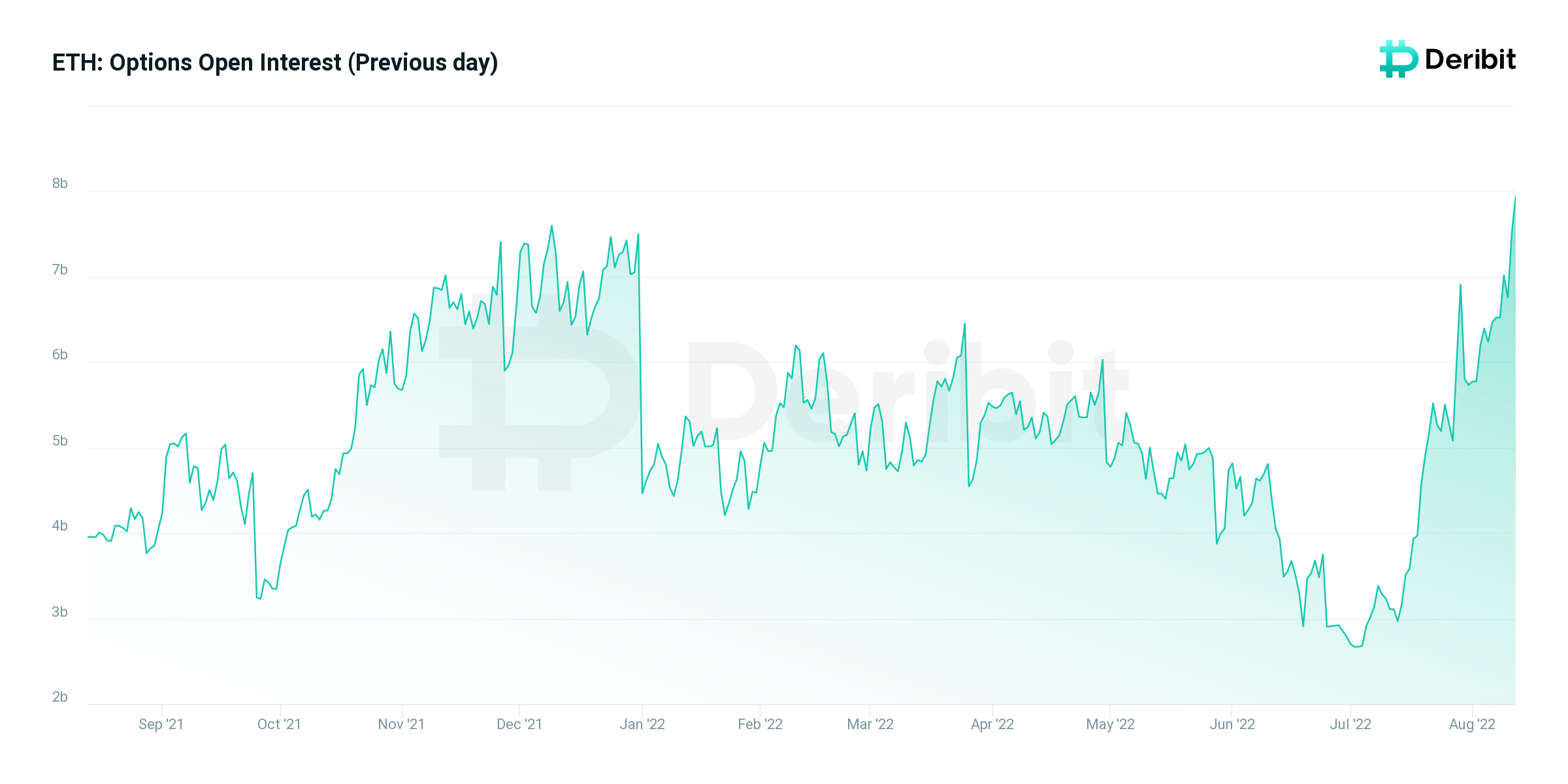
More recently, traders have been using the crypto options market to bet on ether (ETH) and hedge positions as the Ethereum blockchain’s hotly anticipated Merge approaches. Panama-based derivatives platform Deribit, which is among the world’s largest exchanges for crypto options trading volume, told CoinDesk demand is surging ahead of the Merge.
Earlier this week, in a disappointing second-quarter earnings report, crypto exchange giant Coinbase (COIN) even alluded to traders migrating to derivatives-focused platforms as a reason for declining trading volume. Coinbase’s dipping volume led to a 30% decline in the company’s revenues – below most analysts’ estimates.

“A larger amount of trading volume took place at offshore exchanges in Q2,” Coinbase said in its report, adding: “The sequential decline in Q2 institutional trading volume was primarily driven by lower market maker volume on our trading platform. These market participants gravitate towards products such as derivatives and financing products, which are areas we’re continuing to invest in but we don’t currently have product parity with offshore exchanges.”

A young market?

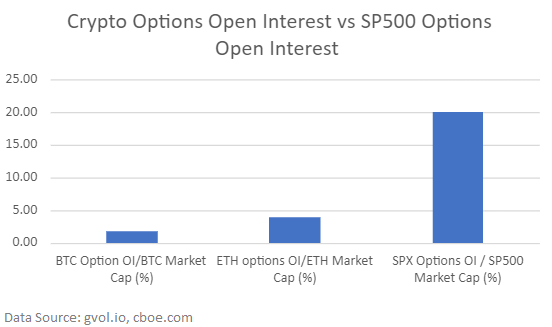
Bitcoin options trading accounts for only 2% of open derivatives contracts across exchanges trading the cryptocurrency, whose market cap is about $462 billion, according to structure product provider Enhanced Digital Group (EDG).

By comparison, traditional options trading of stocks accounts for 20% of the market cap of the S&P 500 at the Chicago Board Options Exchange (CBOE), EDG said. “When you think of all the other [S&P 500]-like products including [exchange-traded funds], SP Minis, etc., you can see that bitcoin options have multifold growth ahead of it,” EDG’s quant developer, Marcin Maksymiuk, told CoinDesk.

Sudden market shocks, technological improvements and a maturing futures market will all contribute to the growth of options, according to Delta Exchange CEO Pankaj Balani.

Delta generates over $200 million in options trading volume per day, and Balani said that “options provide a way for people to get engaged with the market even in a sideways environment.” He foresees options eventually accounting for 60% of the crypto trading market.

Peter Wisniewski, managing partner of crypto-focused alternative investment fund Europa Partners, told CoinDesk the firm expects “the market to continue to mature with greater price efficiency and liquidity.” Wisniewski said the markets will likely tie options to a widening range of digital assets.

“Currently, the only crypto derivatives markets with significant liquidity are priced to bitcoin and ether, but we expect to see a continual increase of derivative instruments priced to other types of digital assets, reducing volatility and driving more investment into the space,” Wisniewski added.
Miners

In recent months, cryptocurrency miners, who have been hit hard by bitcoin’s plunge, have used derivative strategies to hedge price exposure and limit their downside risk. Miner Argo Blockchain even hired an in-house derivatives trader in July to weather the market rout and determine hedging strategies going forward.

Crypto financial services firm Galaxy Digital, which has a division dedicated to lending and risk management for miners, avoided miner-related losses during the second quarter through the use of derivative strategies, according to CEO Michael Novogratz during the company’s earnings call this week.

Novogratz said that he expects to expand these offerings for miners and other clients.

How fast crypto options trading evolves remains uncertain, even as firms add exposure and pinpoint the products and services that can help them manage risk. EDG CEO Chris Bae noted that miner and institutional platforms’ use of derivative strategies remain in an early stage and that crypto options trading volumes "have yet to hit their j-curve when it comes to their adoption and growth.”

“We are seeing our partners use this sell off to hire option and derivative talent to staff for the opportunity,” Bae said.

Leituras Relacionadas

A Guide to Grayscale’s ‘Bottom Fishing’: Using Cash Flow to Assess Cryptocurrency Value

**Title:** Grayscale's Guide to Bottom-Fishing: Valuing Cryptoassets Using Cash Flows **Summary:** This report by Grayscale Research presents a fundamental valuation framework for cryptocurrency assets, moving beyond pure speculation to analyze those with underlying cash flows. It distinguishes between "commodity-like" assets (e.g., Bitcoin) and "cash-flow" assets, primarily within DeFi. Using the leading decentralized lending protocol Aave as a case study, the analysis applies traditional financial methodologies like Discounted Cash Flow (DCF) and Price-to-Earnings (P/E) multiples. Key findings indicate that AAVE tokens are currently undervalued. Despite recent challenges, the protocol's strong revenue growth, ~50% net profit margin, and diversified treasury support a fundamental valuation range of $80-$100 per token (compared to a ~$75 market price at the time of writing). In a base-case scenario driven by stablecoin adoption and regulatory clarity, the fair value could rise to around $175 within a year. The report emphasizes that protocol success does not automatically translate to token value. It critically examines the "value capture" mechanisms—such as buybacks, burns, and staking rewards—that channel protocol profits to token holders. Furthermore, it addresses the legal and governance complexities of Decentralized Autonomous Organizations (DAOs), noting their difference from traditional corporate equity but highlighting how robust, transparent governance can align protocol economics with holder interests. The conclusion is that the crypto market is maturing, with capital increasingly flowing towards projects with demonstrable fundamentals, real adoption, and disciplined capital allocation, creating opportunities for value-based investors.

marsbitHá 48m

A Guide to Grayscale’s ‘Bottom Fishing’: Using Cash Flow to Assess Cryptocurrency Value

marsbitHá 48m

After semiconductors lead the gains, are funds buying into AI orders or a macroeconomic rebound?

After US-Iran talks led to a temporary ceasefire and framework for reopening the strategic Strait of Hormuz, U.S. stocks rose on June 18, with the Nasdaq gaining 1.9%. The semiconductor and AI hardware sectors outperformed. This rally stemmed primarily from reduced geopolitical risk, which lowered oil prices and inflation expectations, easing discount rate pressure on high-valuation growth stocks like tech. The key question is not whether tech rebounded, but the nature of the rebound. The market appears to be selectively repricing AI infrastructure plays rather than broadly chasing AI narratives. Gains were concentrated in chips, optical interconnects, memory, and domestic manufacturing—segments tied to tangible data center build-outs and capital expenditure. Intel's ~10% surge, fueled by a Trump statement about potential Apple collaboration, exemplifies this mixed dynamic. It reflects policy catalysts and domestic manufacturing sentiment more than confirmed fundamentals. Meanwhile, strong earnings from companies like Astera Labs (revenue up 93% YoY) provided concrete evidence of AI-driven demand in hardware. In essence, the rally represents a risk-premium recalibration. Lower Middle East tensions opened a valuation repair window, and capital flowed first into AI infrastructure segments with visible near-term revenue streams. The sustainability of this move hinges on upcoming Q2 earnings, specifically continued strength in cloud provider capex, AI server orders, and hardware company guidance. Policy hopes alone are insufficient; the cycle needs validation from orders and financials.

marsbitHá 53m

After semiconductors lead the gains, are funds buying into AI orders or a macroeconomic rebound?

marsbitHá 53m

The Entire Internet Hails Noam's Joining, But OpenAI's Loss Bill Just Got Thicker

While the AI community celebrates Noam Shazeer, co-author of the "Attention Is All You Need" paper, joining OpenAI as Head of Architectural Research, the company's audited financials reveal a starkly different reality. In 2025, OpenAI reported $13.07 billion in revenue but a massive $20.92 billion operating loss. Even excluding a one-time accounting charge, the cash burn is severe, with $3.7 billion consumed in Q1 2026 alone. This high-profile hiring occurs against a backdrop of significant internal research talent drain, with key founders and researchers departing as the company's focus shifts from exploratory research to product iteration. Meanwhile, OpenAI's fundamental business model faces a deep crisis. It paid Microsoft $10.59 billion for compute in 2025, while its vast user base of 9 billion weekly actives includes only 50 million paying customers, making growth a direct driver of escalating costs. The article argues Shazeer's recruitment is less about technical necessity and more about crafting a compelling narrative for OpenAI's upcoming IPO, aiming to justify a rumored $1 trillion valuation to future public market investors. It contrasts OpenAI's strategy with Anthropic's reported path to profitability, which relies on a strong enterprise customer base and cost control, rather than star-powered narratives. Ultimately, the piece concludes that while Shazeer's architectural work may take 1-2 years to materialize, OpenAI's financial clock is ticking much faster, with its massive losses undercutting the celebratory headlines.

marsbitHá 2h

The Entire Internet Hails Noam's Joining, But OpenAI's Loss Bill Just Got Thicker

marsbitHá 2h

Trading

Spot
Futuros
活动图片