Arthur Hayes achète 72 000 $ d'ETHFI 5 heures avant la cotation sur Upbit : Le marché prend note

ambcryptoPublicado em 2026-03-19Última atualização em 2026-03-19

Resumo

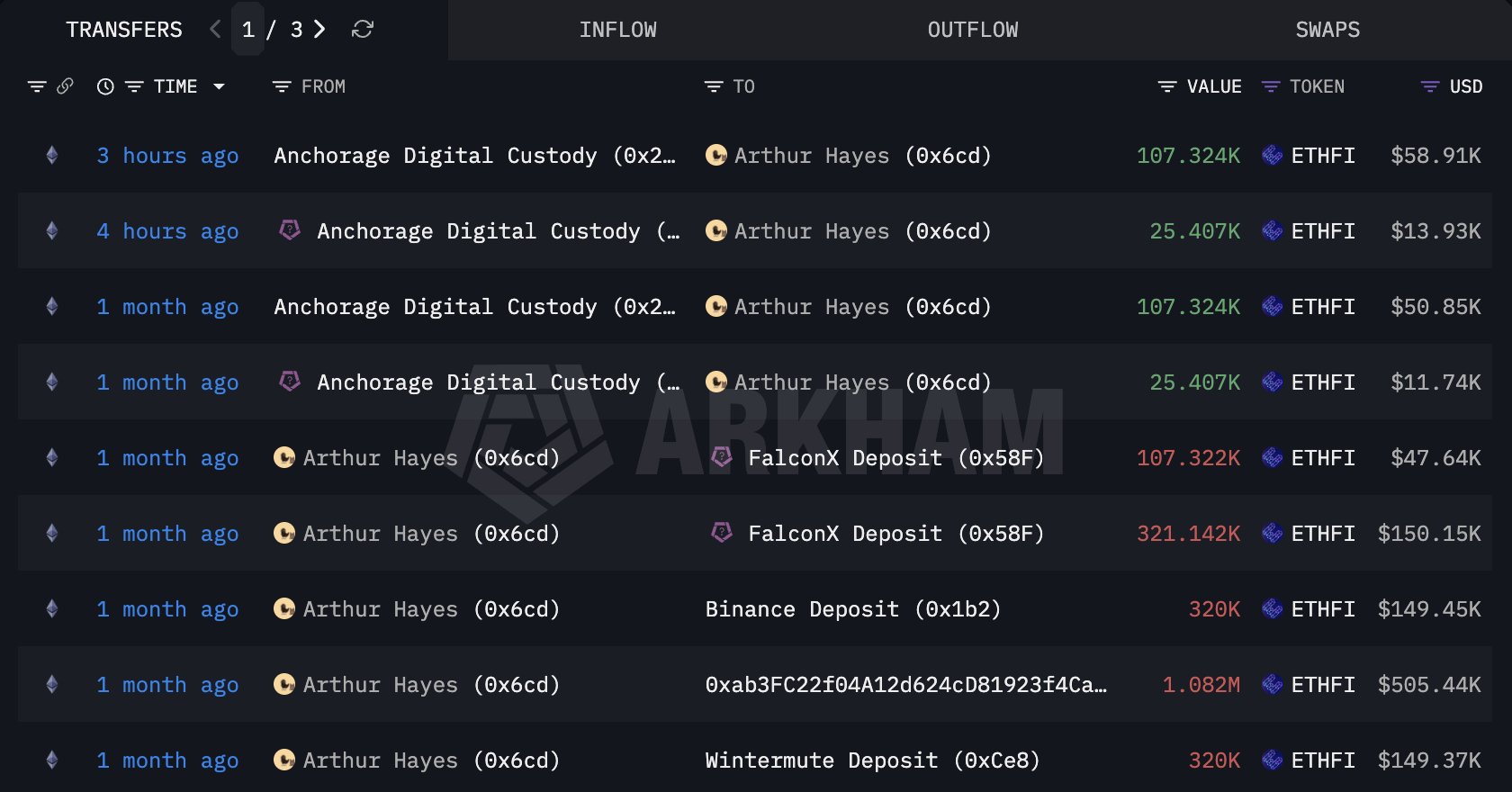
Arthur Hayes, co-fondateur de BitMEX, a acheté pour 72 800 dollars de jetons ETHFI (EthereumFi) environ cinq heures avant que la plus grande bourse sud-coréenne, Upbit, n'annonce son inscription. Cette acquisition, effectuée via Anchorage Digital à un prix d'environ 0,55 dollar par jeton, a suscité des allégations de délit d'initié en raison de son timing. Le listing sur Upbit est un événement majeur étant donné la forte participation des investisseurs particuliers sud-coréens sur le marché des altcoins. Hayes avait déjà déployé plus de 3,4 millions de dollars dans plusieurs jetons DeFi, dont l'ETHFI, un mois auparavant. Upbit a temporairement restreint les ordres d'achat et imposé le trading à cours limité lors de l'annonce.

EthereumFi [ETHFi] attire l'attention après une cotation majeure sur une grande plateforme et une transaction opportunément chronométrée.

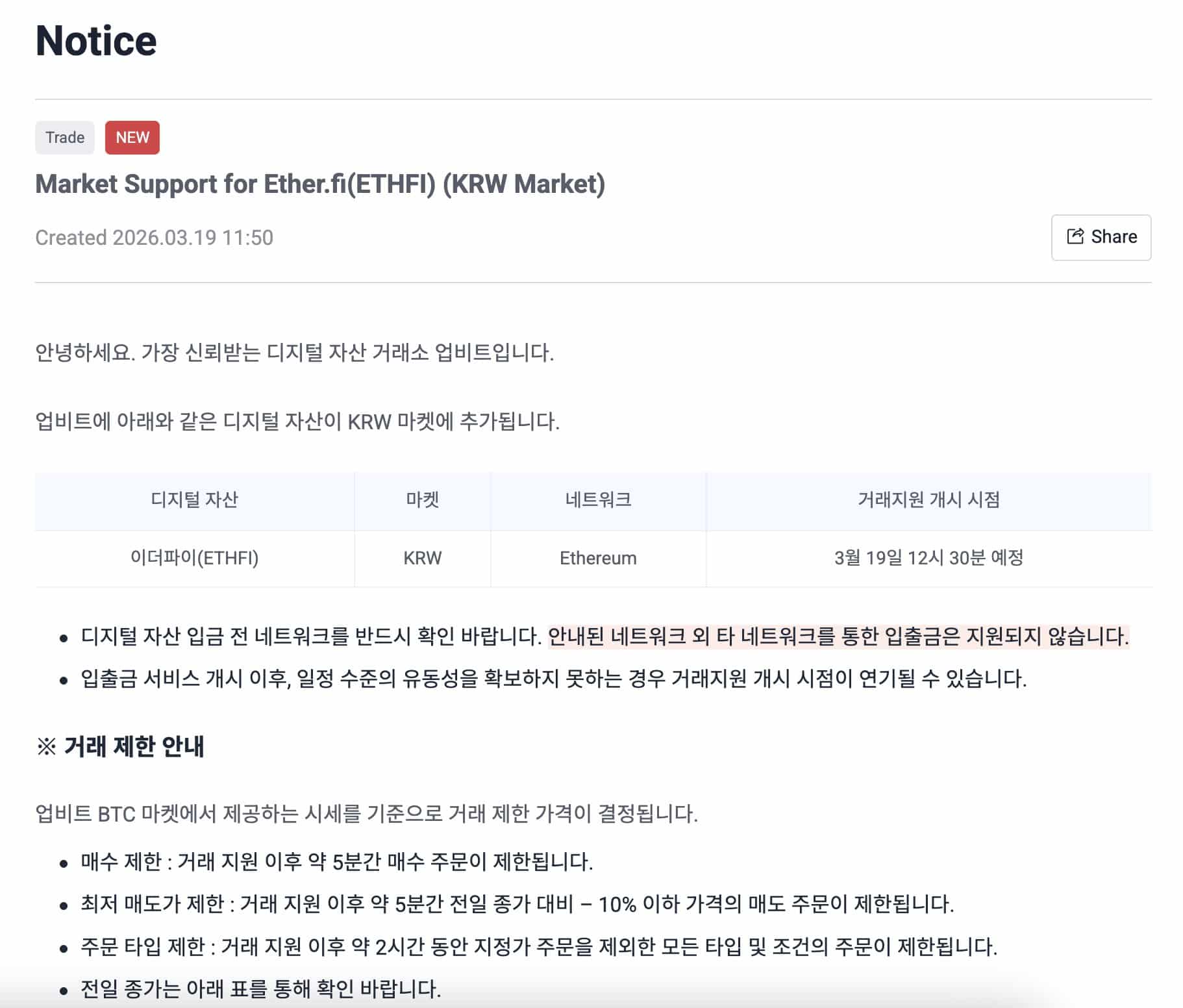
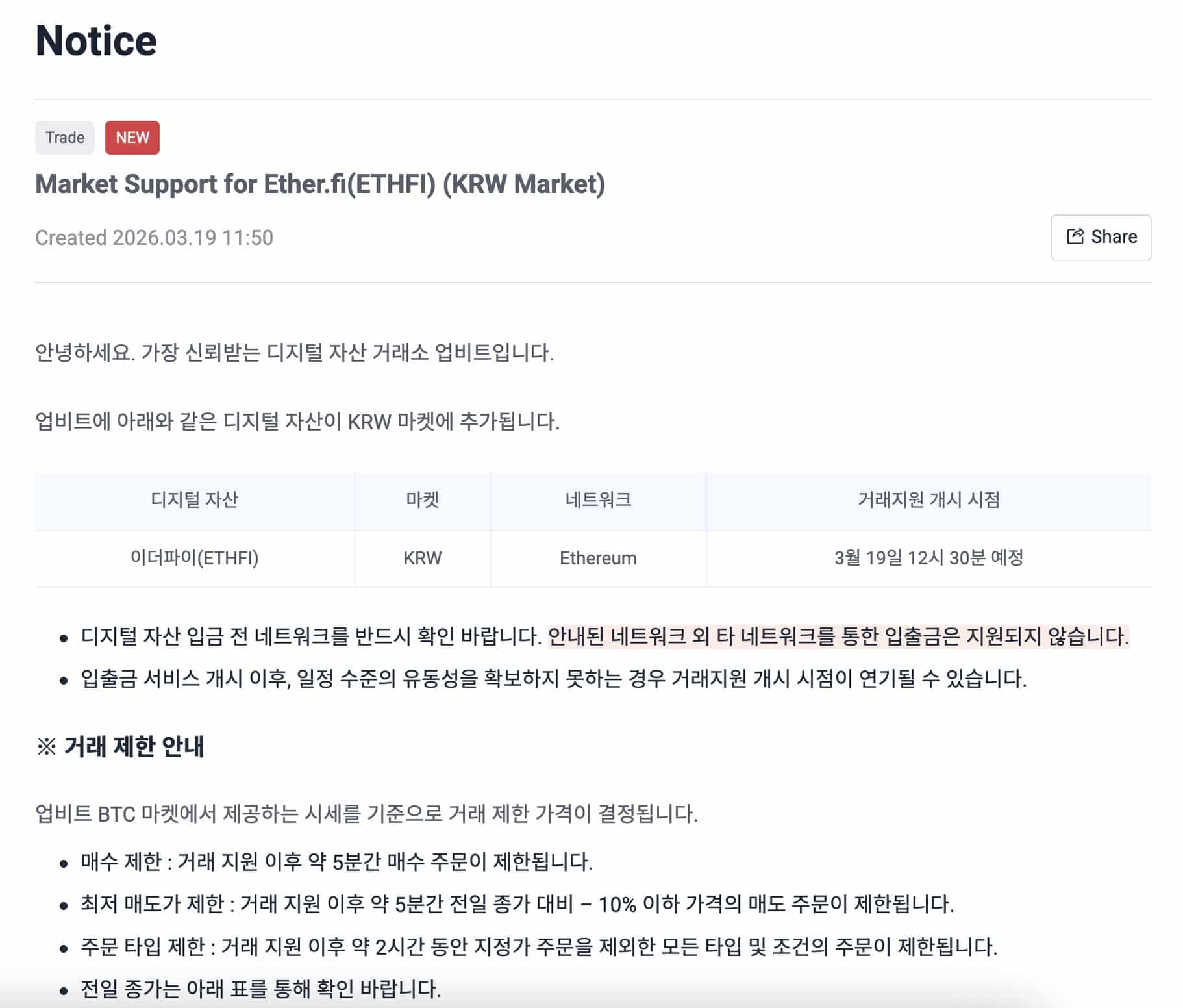
Quelques heures seulement avant que la plateforme sud-coréenne Upbit n'annonce la cotation d'ETHFi, Arthur Hayes a été aperçu en train d'acheter le jeton. Pour contextualiser, cette cotation est assez significative, étant donné la forte participation des investisseurs particuliers en Corée du Sud et leur préférence pour les altcoins.

Hayes et les allégations de délit d'initié

Arthur Hayes, co-fondateur de BitMEX et CIO de Maelstrom, a accumulé de l'ETHFI peu de temps avant une cotation clé sur la plus grande plateforme de crypto-monnaies de Corée du Sud, Upbit.
Source : X

Selon les données de Lookonchain, Hayes a reçu 132 730 ETHFI (environ 72 800 $) d'Anchorage Digital environ cinq heures avant que la plateforme ne confirme l'ajout du jeton à son marché KRW.

Le timing, bien sûr, a jeté de l'huile sur le feu du récit de délit d'initié.
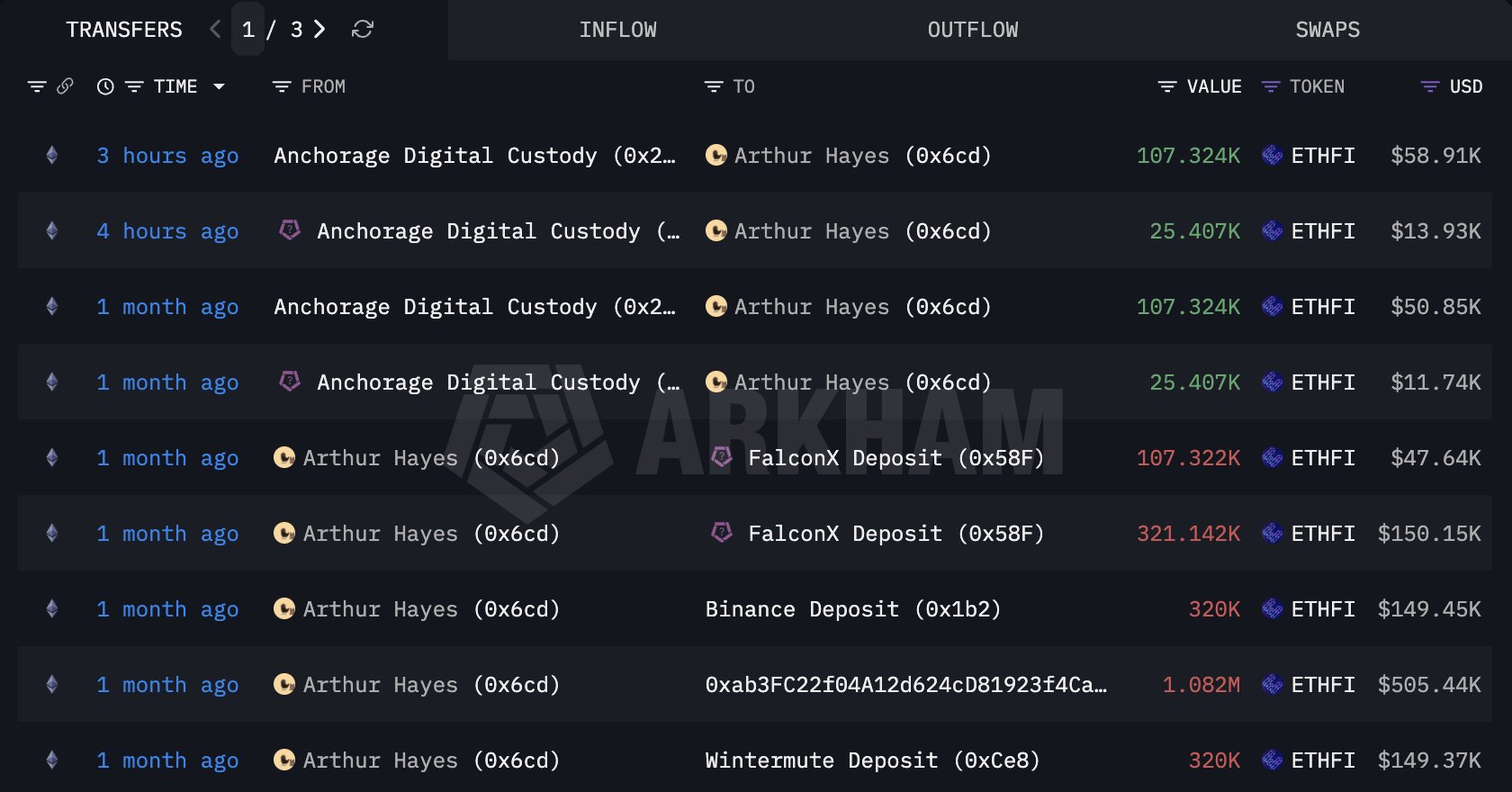
Source : X

Plus tôt cette année, il a déployé plus de 3,4 millions de dollars sur plusieurs jetons DeFi, y compris ETHFI. Les données ont également révélé qu'environ un mois auparavant, Hayes avait déplacé 2,15 millions d'ETHFI à environ 0,47 $, ce qui pourrait être une activité de distribution antérieure.

La dernière acquisition s'est produite à environ 0,55 $ par jeton.

Il est à noter que, dans le cadre des contrôles standard de cotation, Upbit a temporairement restreint les ordres. Cela comprenait un gel temporaire des achats et des limites sur les ordres de vente à bas prix, tout en imposant un trading uniquement à cours limité pendant la phase initiale.


Un regard sur la situation globale

Criptomoedas em alta

Perguntas relacionadas

QQui est Arthur Hayes et quelle action a-t-il entreprise concernant ETHFI ?

AArthur Hayes, co-fondateur de BitMEX et CIO de Maelstrom, a acheté 132 730 ETHFI (d'une valeur d'environ 72 800 $) environ cinq heures avant l'annonce du listing sur Upbit.

QQuel événement a déclenché l'attention du marché sur l'achat d'ETHFI par Hayes ?

AL'attention du marché a été attirée car son achat a eu lieu juste avant l'annonce du listing de l'ETHFI sur Upbit, la plus grande bourse de cryptomonnaies de Corée du Sud.

QPourquoi le listing sur Upbit est-il considéré comme significatif pour ETHFI ?

ALe listing sur Upbit est significatif en raison de la forte participation des investisseurs particuliers en Corée du Sud et de leur préférence marquée pour les altcoins, ce qui peut générer un volume et une volatilité importants.

QQuelles allégations ont émergé suite au timing de l'achat d'Arthur Hayes ?

ALe timing de l'achat, juste avant une annonce majeure, a ajouté du crédit aux allégations de délit d'initié (insider trading).

QQuelles étaient les conditions de trading initiales imposées par Upbit pour le listing d'ETHFI ?

AUpbit a temporairement restreint les ordres dans le cadre de ses contrôles de listing standard, notamment un gel temporaire des achats et des limites sur les ordres de vente à bas prix, en n'autorisant que le trading à ordre limité pendant la phase initiale.

Leituras Relacionadas

STRC Hits Historic Low, Saylor's Perpetual Motion Machine Grinds to a Halt

STRC, the perpetual preferred stock issued by MicroStrategy to fund its Bitcoin purchases, hit a historic low of $85.32, a 17% discount to its $100 par value. Designed as a "digital credit engine" to trade stably near par and enable continuous share issuance for buying Bitcoin, its plunge signals a breakdown in this model. Three key factors drove the decline: 1. Bitcoin's price fell over 50% from its peak, trading around $63,000 amid hawkish Fed signals. 2. MicroStrategy's cash reserves were depleted after a $1.5 billion convertible note repayment, slashing the dividend coverage for STRC's 11.5% yield to ~7 months. The company then sold 32 BTC to cover dividends—Michael Saylor's first Bitcoin sale since 2022—damaging the "never sell" narrative. 3. A competing Bitcoin-backed preferred stock, Strive's SATA, offers a higher yield (~13%) and daily dividends, drawing investors away from STRC. The drop triggers a negative cycle: STRC below par halts ATM share issuances, cutting off a key funding source for Bitcoin buys and potentially forcing more BTC sales for dividends, further eroding confidence. While Saylor argues the model is mathematically sound—needing only 2.3% annual Bitcoin growth to sustain itself—the market is testing the resilience of the leveraged Bitcoin treasury strategy in a bear market. The STRC price now reflects rising skepticism about this financial machinery's durability during downturns.

marsbitHá 18m

STRC Hits Historic Low, Saylor's Perpetual Motion Machine Grinds to a Halt

marsbitHá 18m

A Guide to Grayscale’s ‘Bottom Fishing’: Using Cash Flow to Assess Cryptocurrency Value

**Title:** Grayscale's Guide to Bottom-Fishing: Valuing Cryptoassets Using Cash Flows **Summary:** This report by Grayscale Research presents a fundamental valuation framework for cryptocurrency assets, moving beyond pure speculation to analyze those with underlying cash flows. It distinguishes between "commodity-like" assets (e.g., Bitcoin) and "cash-flow" assets, primarily within DeFi. Using the leading decentralized lending protocol Aave as a case study, the analysis applies traditional financial methodologies like Discounted Cash Flow (DCF) and Price-to-Earnings (P/E) multiples. Key findings indicate that AAVE tokens are currently undervalued. Despite recent challenges, the protocol's strong revenue growth, ~50% net profit margin, and diversified treasury support a fundamental valuation range of $80-$100 per token (compared to a ~$75 market price at the time of writing). In a base-case scenario driven by stablecoin adoption and regulatory clarity, the fair value could rise to around $175 within a year. The report emphasizes that protocol success does not automatically translate to token value. It critically examines the "value capture" mechanisms—such as buybacks, burns, and staking rewards—that channel protocol profits to token holders. Furthermore, it addresses the legal and governance complexities of Decentralized Autonomous Organizations (DAOs), noting their difference from traditional corporate equity but highlighting how robust, transparent governance can align protocol economics with holder interests. The conclusion is that the crypto market is maturing, with capital increasingly flowing towards projects with demonstrable fundamentals, real adoption, and disciplined capital allocation, creating opportunities for value-based investors.

marsbitHá 1h

A Guide to Grayscale’s ‘Bottom Fishing’: Using Cash Flow to Assess Cryptocurrency Value

marsbitHá 1h

After semiconductors lead the gains, are funds buying into AI orders or a macroeconomic rebound?

After US-Iran talks led to a temporary ceasefire and framework for reopening the strategic Strait of Hormuz, U.S. stocks rose on June 18, with the Nasdaq gaining 1.9%. The semiconductor and AI hardware sectors outperformed. This rally stemmed primarily from reduced geopolitical risk, which lowered oil prices and inflation expectations, easing discount rate pressure on high-valuation growth stocks like tech. The key question is not whether tech rebounded, but the nature of the rebound. The market appears to be selectively repricing AI infrastructure plays rather than broadly chasing AI narratives. Gains were concentrated in chips, optical interconnects, memory, and domestic manufacturing—segments tied to tangible data center build-outs and capital expenditure. Intel's ~10% surge, fueled by a Trump statement about potential Apple collaboration, exemplifies this mixed dynamic. It reflects policy catalysts and domestic manufacturing sentiment more than confirmed fundamentals. Meanwhile, strong earnings from companies like Astera Labs (revenue up 93% YoY) provided concrete evidence of AI-driven demand in hardware. In essence, the rally represents a risk-premium recalibration. Lower Middle East tensions opened a valuation repair window, and capital flowed first into AI infrastructure segments with visible near-term revenue streams. The sustainability of this move hinges on upcoming Q2 earnings, specifically continued strength in cloud provider capex, AI server orders, and hardware company guidance. Policy hopes alone are insufficient; the cycle needs validation from orders and financials.

marsbitHá 1h

After semiconductors lead the gains, are funds buying into AI orders or a macroeconomic rebound?

marsbitHá 1h

Trading

Spot
Futuros

Artigos em Destaque

Como comprar ETHFI

Bem-vindo à HTX.com!Tornámos a compra de ether.fi (ETHFI) simples e conveniente.Segue o nosso guia passo a passo para iniciar a tua jornada no mundo das criptos.Passo 1: cria a tua conta HTXUtiliza o teu e-mail ou número de telefone para te inscreveres numa conta gratuita na HTX.Desfruta de um processo de inscrição sem complicações e desbloqueia todas as funcionalidades.Obter a minha contaPasso 2: vai para Comprar Cripto e escolhe o teu método de pagamentoCartão de crédito/débito: usa o teu visa ou mastercard para comprar ether.fi (ETHFI) instantaneamente.Saldo: usa os fundos da tua conta HTX para transacionar sem problemas.Terceiros: adicionamos métodos de pagamento populares, como Google Pay e Apple Pay, para aumentar a conveniência.P2P: transaciona diretamente com outros utilizadores na HTX.Mercado de balcão (OTC): oferecemos serviços personalizados e taxas de câmbio competitivas para os traders.Passo 3: armazena teu ether.fi (ETHFI)Depois de comprar o teu ether.fi (ETHFI), armazena-o na tua conta HTX.Alternativamente, podes enviá-lo para outro lugar através de transferência blockchain ou usá-lo para transacionar outras criptomoedas.Passo 4: transaciona ether.fi (ETHFI)Transaciona facilmente ether.fi (ETHFI) no mercado à vista da HTX.Acede simplesmente à tua conta, seleciona o teu par de trading, executa as tuas transações e monitoriza em tempo real.Oferecemos uma experiência de fácil utilização tanto para principiantes como para traders experientes.

114 Visualizações TotaisPublicado em {updateTime}Atualizado em 2026.06.02

Como comprar ETHFI

Discussões

Bem-vindo à Comunidade HTX. Aqui, pode manter-se informado sobre os mais recentes desenvolvimentos da plataforma e obter acesso a análises profissionais de mercado. As opiniões dos utilizadores sobre o preço de ETHFI (ETHFI) são apresentadas abaixo.

活动图片