
CryptoDickbutts Ethereum NFTs Surge 690% in Daily Sales Volume

DecryptPublicado em 2022-08-08Última atualização em 2022-08-08

Resumo

The floor price of Series 3 CryptoDickButts climbed as prominent influencers shilled their Dickbutt bags and praised the CDB community.

CryptoDickbutts surged on Sunday, leapfrogging a handful of other notable NFT collections on elevated volume.

Daily trading volume for the Ethereum-based NFTs on OpenSea is up 690% at the time of writing to 290 ETH (roughly $495,000), catapulting Dickbutts to the No. 6 ranking for the day, above established projects like Goblintown, Cool Cats, and Art Blocks. Volume is up 135% in the past week.
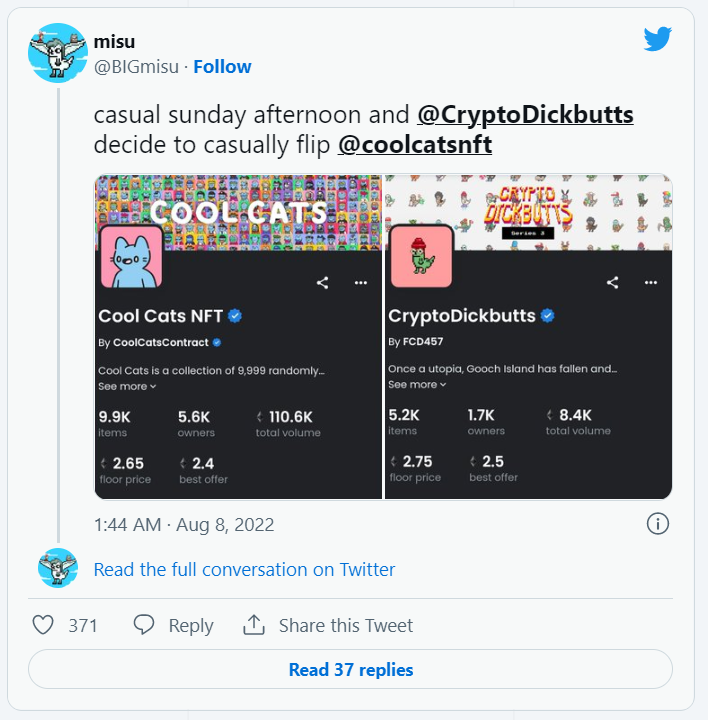
Created by comic book artist K.C. Green in 2006, the Dickbutts became a recognizable part of internet culture as they were shared for years in countless memes on social media platforms like Reddit. A collection of 161 NFTs on Ethereum, later named the OG collection, launched in March of 2021, and was followed up with a Series 3 of 5,200 NFTs in August last year.

The cheapest CryptoDickbutt from Series 3 currently sells for 3 ETH or just over $5,100 at the time of writing, up 31% within the past 24 hours. That is the highest the Dickbutts floor price has ever been; it's up 163% in the past month.

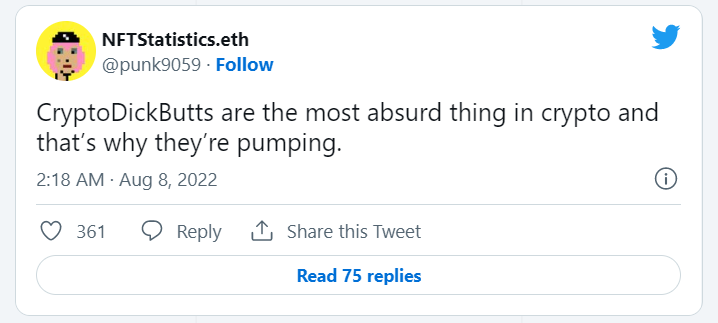
It is still just the No. 34 NFT project in terms of floor price, according to NFT Price Floor. But the steady rise of CryptoDickbutts is reflective of an underlying enthusiasm backing the community and continued demand for it, driven in part by meme culture. While some NFT projects fade out of popularity as quickly as they start trending, CryptoDickbutts has proven to be resilient in terms of interest.

The project has no set road map and is governed by the CryptoDickbutt DAO, which includes notable names like Steve Aoki, Blondish, and ProbCause.
It's unclear exactly why the price is pumping today, but flag-waving by Meltem Demirors, Chief Strategy Officer of CoinShares and a prominent Bitcoiner with a quarter of a million followers, may have been the spark. Demirors hosted an "emergency" Twitter Spaces on Sunday to talk up “the prophecy and the epic bang."
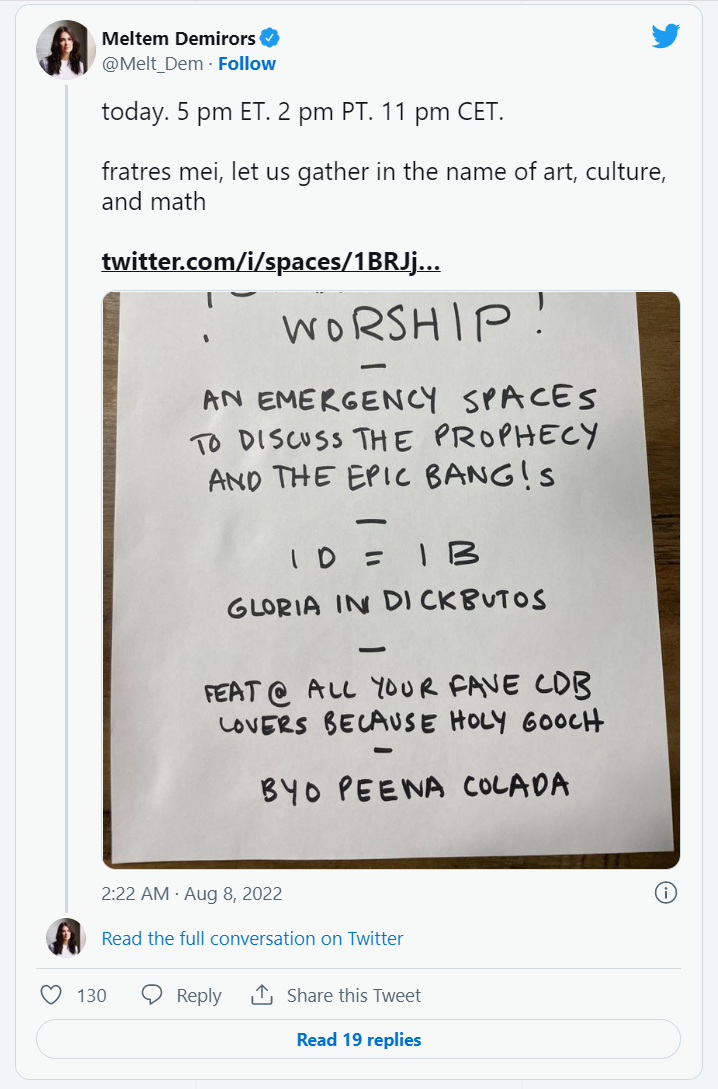
In the Twitter Spaces, Demirors declared, "The Dickbutt community has always been about one thing and one thing only, and that is the universal truth of one D equals one B... I also think that commenting on prices defeats from the overall objective here. Dickbutts are not about investing. Dickbutts are a culture."
Leituras Relacionadas

A Guide to Grayscale’s ‘Bottom Fishing’: Using Cash Flow to Assess Cryptocurrency Value

**Title:** Grayscale's Guide to Bottom-Fishing: Valuing Cryptoassets Using Cash Flows **Summary:** This report by Grayscale Research presents a fundamental valuation framework for cryptocurrency assets, moving beyond pure speculation to analyze those with underlying cash flows. It distinguishes between "commodity-like" assets (e.g., Bitcoin) and "cash-flow" assets, primarily within DeFi. Using the leading decentralized lending protocol Aave as a case study, the analysis applies traditional financial methodologies like Discounted Cash Flow (DCF) and Price-to-Earnings (P/E) multiples. Key findings indicate that AAVE tokens are currently undervalued. Despite recent challenges, the protocol's strong revenue growth, ~50% net profit margin, and diversified treasury support a fundamental valuation range of $80-$100 per token (compared to a ~$75 market price at the time of writing). In a base-case scenario driven by stablecoin adoption and regulatory clarity, the fair value could rise to around $175 within a year. The report emphasizes that protocol success does not automatically translate to token value. It critically examines the "value capture" mechanisms—such as buybacks, burns, and staking rewards—that channel protocol profits to token holders. Furthermore, it addresses the legal and governance complexities of Decentralized Autonomous Organizations (DAOs), noting their difference from traditional corporate equity but highlighting how robust, transparent governance can align protocol economics with holder interests. The conclusion is that the crypto market is maturing, with capital increasingly flowing towards projects with demonstrable fundamentals, real adoption, and disciplined capital allocation, creating opportunities for value-based investors.

marsbitHá 43m

A Guide to Grayscale’s ‘Bottom Fishing’: Using Cash Flow to Assess Cryptocurrency Value

marsbitHá 43m

After semiconductors lead the gains, are funds buying into AI orders or a macroeconomic rebound?

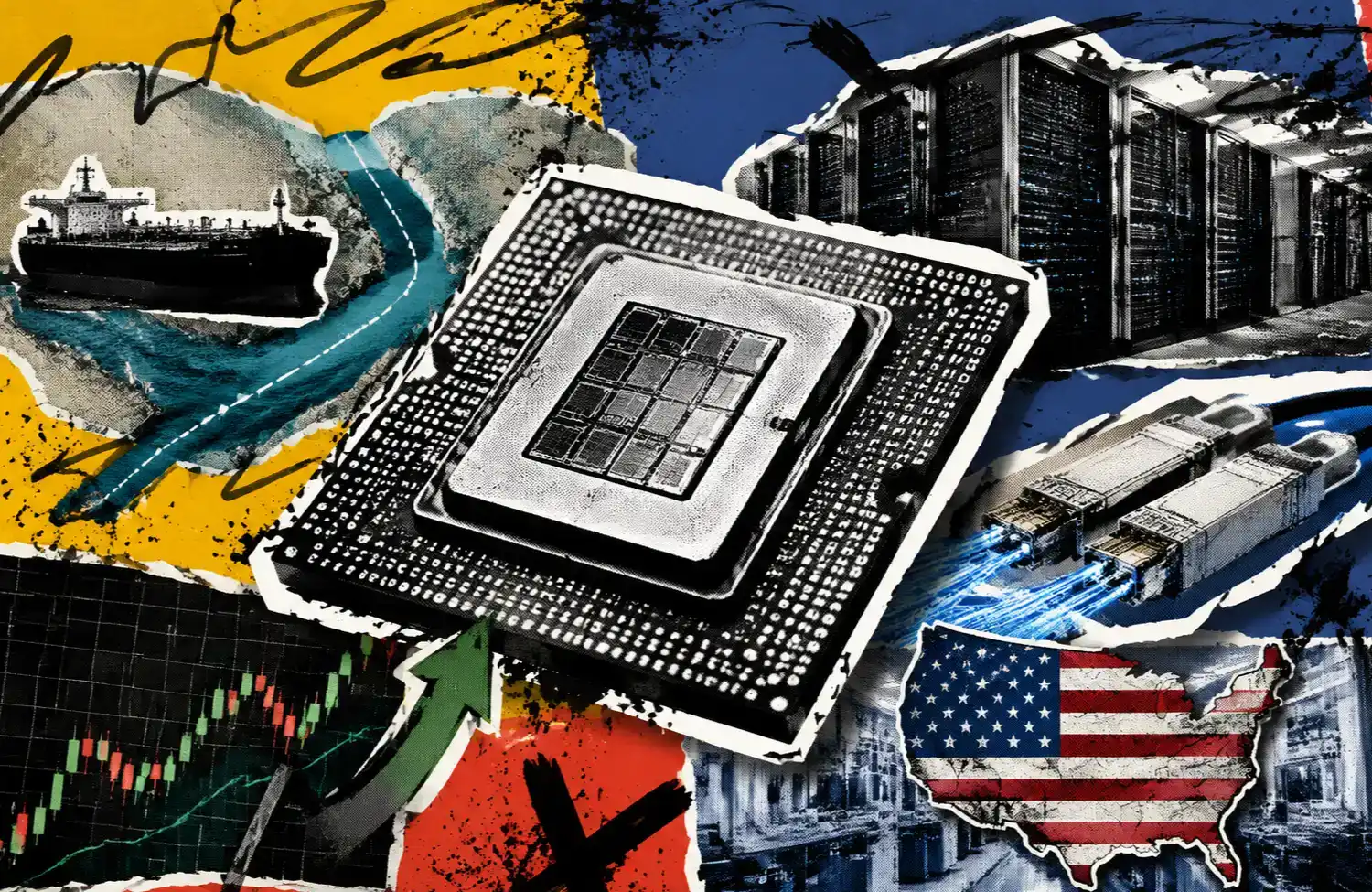
After US-Iran talks led to a temporary ceasefire and framework for reopening the strategic Strait of Hormuz, U.S. stocks rose on June 18, with the Nasdaq gaining 1.9%. The semiconductor and AI hardware sectors outperformed. This rally stemmed primarily from reduced geopolitical risk, which lowered oil prices and inflation expectations, easing discount rate pressure on high-valuation growth stocks like tech. The key question is not whether tech rebounded, but the nature of the rebound. The market appears to be selectively repricing AI infrastructure plays rather than broadly chasing AI narratives. Gains were concentrated in chips, optical interconnects, memory, and domestic manufacturing—segments tied to tangible data center build-outs and capital expenditure. Intel's ~10% surge, fueled by a Trump statement about potential Apple collaboration, exemplifies this mixed dynamic. It reflects policy catalysts and domestic manufacturing sentiment more than confirmed fundamentals. Meanwhile, strong earnings from companies like Astera Labs (revenue up 93% YoY) provided concrete evidence of AI-driven demand in hardware. In essence, the rally represents a risk-premium recalibration. Lower Middle East tensions opened a valuation repair window, and capital flowed first into AI infrastructure segments with visible near-term revenue streams. The sustainability of this move hinges on upcoming Q2 earnings, specifically continued strength in cloud provider capex, AI server orders, and hardware company guidance. Policy hopes alone are insufficient; the cycle needs validation from orders and financials.

marsbitHá 48m

After semiconductors lead the gains, are funds buying into AI orders or a macroeconomic rebound?

marsbitHá 48m

The Entire Internet Hails Noam's Joining, But OpenAI's Loss Bill Just Got Thicker

While the AI community celebrates Noam Shazeer, co-author of the "Attention Is All You Need" paper, joining OpenAI as Head of Architectural Research, the company's audited financials reveal a starkly different reality. In 2025, OpenAI reported $13.07 billion in revenue but a massive $20.92 billion operating loss. Even excluding a one-time accounting charge, the cash burn is severe, with $3.7 billion consumed in Q1 2026 alone. This high-profile hiring occurs against a backdrop of significant internal research talent drain, with key founders and researchers departing as the company's focus shifts from exploratory research to product iteration. Meanwhile, OpenAI's fundamental business model faces a deep crisis. It paid Microsoft $10.59 billion for compute in 2025, while its vast user base of 9 billion weekly actives includes only 50 million paying customers, making growth a direct driver of escalating costs. The article argues Shazeer's recruitment is less about technical necessity and more about crafting a compelling narrative for OpenAI's upcoming IPO, aiming to justify a rumored $1 trillion valuation to future public market investors. It contrasts OpenAI's strategy with Anthropic's reported path to profitability, which relies on a strong enterprise customer base and cost control, rather than star-powered narratives. Ultimately, the piece concludes that while Shazeer's architectural work may take 1-2 years to materialize, OpenAI's financial clock is ticking much faster, with its massive losses undercutting the celebratory headlines.

marsbitHá 2h

The Entire Internet Hails Noam's Joining, But OpenAI's Loss Bill Just Got Thicker

marsbitHá 2h

Trading

Spot
Futuros
活动图片