Ethereum 2026: Decoding EF's Latest Protocol Roadmap, Officially Entering the Era of 'Engineering Upgrades'?

marsbitPublicado em 2026-02-26Última atualização em 2026-02-26

Resumo

Ethereum Foundation's 2026 protocol roadmap signals a major shift toward predictable, engineering-driven upgrades, moving from fragmented EIP-focused updates to a structured tri-annual hard fork schedule. Following successful dual upgrades (Pectra and Fusaka) in 2025, the 2026 plan—centered on Glamsterdam and Hegotá—prioritizes three core pillars: Scale, Improve UX, and Harden the L1. Scale focuses on parallel execution via Block-level Access Lists and ePBS integration to boost throughput, with gas limits potentially doubling. Improve UX aims to eliminate cross-chain fragmentation through intent-based architectures (Open Intents Framework) and native account abstraction, streamlining user interactions. Harden the L1 strengthens security with anti-censorship measures like FOCIL and quantum-resistant cryptography research. This structured, collaborative approach marks Ethereum’s transition from a research-oriented project to a mature, institutional-grade platform, emphasizing security and usability while targeting global adoption as a foundational financial layer.

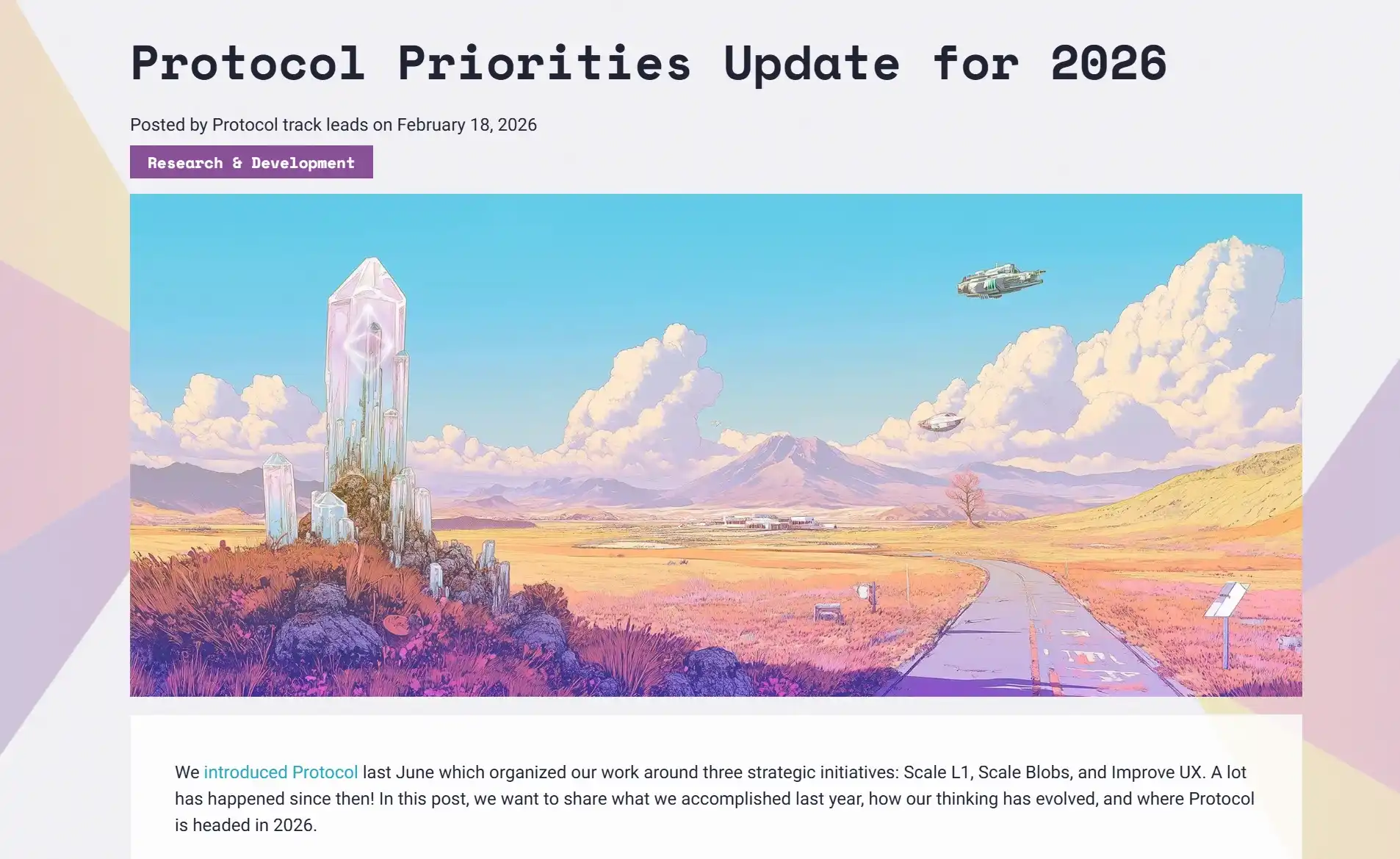
On February 18, the Ethereum Foundation (EF) released the "Protocol Priorities Update for 2026." Compared to the previous fragmented updates centered around EIPs, this roadmap more closely resembles a strategic schedule, clarifying the upgrade cadence, priority allocation, and the three main themes that the protocol layer will revolve around in the coming year: Scale, Improve UX, and Harden the L1.

Behind this, from the successful delivery of two hard forks (Pectra/Fusaka) in 2025 to the advanced planning of the dual mainlines for 2026, Glamsterdam and Hegotá, we are also witnessing a deeper shift in Ethereum development towards "predictable engineering delivery." And this might be the most important protocol layer signal in recent years.
I. Ethereum of 2025: Turmoil and Institutionalization in Parallel

If you have been following Ethereum consistently, you would know that 2025 was a year of intertwined contradictions for this protocol. While the ETH price might have hovered at low levels, the protocol layer underwent unprecedented intensive changes.

Especially in early 2025, Ethereum went through a rather awkward period. The EF was once at the center of a public opinion storm—community criticism surged, with some even calling for the introduction of a so-called "wartime CEO" to drive change. Eventually, a series of internal struggles became public, forcing the highest-level power restructuring since the EF's founding:

  • In February, Executive Director Aya Miyaguchi was promoted to President, and Vitalik Buterin promised to restructure the leadership;
  • Subsequently, Hsiao-Wei Wang and Tomasz K. Stańczak were appointed as Co-Executive Directors;
  • Furthermore, the new marketing agency Etherealize, led by former researcher Danny Ryan, was established;
  • Simultaneously, the EF further restructured its board of directors, clarifying its cypherpunk value orientation;
  • By mid-year, the Foundation also restructured its R&D department, integrating teams and making personnel adjustments to ensure a focus on core protocol priorities;

As it turned out, this combination of measures significantly hardened Ethereum's execution capability. Particularly, just 7 months after the Pectra upgrade in May, the Fusaka upgrade at the end of the year was successfully deployed, proving that the EF, despite undergoing major leadership changes, still has the ability to drive significant updates. This also marks Ethereum's official entry into an accelerated development rhythm of "two hard forks per year."

After all, since the network transitioned to PoS via The Merge in September 2022, the Ethereum network has basically aimed for only one major upgrade per year, such as the Shapella upgrade in April 2023 and the Dencun upgrade in March 2024: the former opened staking withdrawals, completing a key part of the PoS transition; the latter launched EIP-4844, formally opening the Blob data channel, which significantly reduced L2 costs.

In contrast, 2025 saw the completion of two important hard fork upgrades, Pectra and Fusaka. More crucially, 2025 saw the first systematic planning of named upgrades for the next two years, namely Glamsterdam and Hegotá.

Although not formally stipulated, interestingly, at the end of last year, The Block cited sources from Consensys stating that since The Merge, Ethereum researchers had aimed for one major upgrade per year, but they were now planning to "accelerate the pace of hard fork releases to once every six months," and explicitly stated that Fusaka initiated Ethereum's twice-yearly upgrade cycle.
It can be said that this "institutional" change regarding the upgrade cadence is quite milestone. The reason is simple: the previous release rhythm depended more on R&D readiness. For developers and infrastructure providers, the expected window was not stable, and as those familiar know, delays were not uncommon.

This also means that the successful delivery of two major upgrades in 2025 validated the feasibility of "upgrades every six months." The first systematic planning of two named upgrades (Glamsterdam and Hegotá) for 2026, with three development tracks arranging priorities around these two nodes, is a further step towards institutionalized implementation.

Theoretically, it's somewhat similar to the release rhythm of Apple or Android systems, aiming to reduce uncertainty for developers and is expected to bring three positive impacts: Enhanced predictability for L2s, for example, Rollups can plan parameter adjustments and protocol adaptations in advance; Clear adaptation windows for wallets and infrastructure, allowing product teams to plan compatibility and feature releases according to the rhythm; Stable risk assessment periods for institutions, as upgrades are no longer sudden events but an engineering norm.

This structured rhythm is essentially a manifestation of engineering management and also highlights, from the side, Ethereum's transition from scientific exploration to engineering delivery.

II. The "Three Legs" of 2026 Protocol Development

Looking closely at the 2026 protocol priority update plan, one will also find that the EF no longer simply lists scattered EIPs, but has reorganized protocol development into three strategic directions: Scale, Improve UX, and Harden the L1.

First is Scale, which merges the previous "Scale L1" and "Scale blobs," as the EF realized that scaling the L1 execution layer and widening the data availability layer are two sides of the same coin.

Therefore, in the upcoming Glamsterdam upgrade in the first half of the year, the most eye-catching technology is "Block-level Access Lists," aimed at fundamentally changing Ethereum's current transaction execution model—it can be understood as changing from a sequentially processed "single lane" to a parallel processed "multi-lane":

Block producers will pre-calculate and mark which transactions can run simultaneously without conflict, and clients can accordingly distribute transactions to multiple CPU cores for parallel processing, greatly improving efficiency; Meanwhile, ePBS (enshrined proposer-builder separation) will also be included in the upgrade. It embeds the MEV-Boost process, which currently relies on external relays, into the protocol itself, not only reducing centralization risks but also reserving a more ample time window for validators to verify ZK proofs.

Alongside these underlying optimizations, the race for the Gas limit will intensify in 2026. The EF has clearly stated the goal is to "move towards 100 million and above." More radical predictions suggest that after ePBS, the Gas limit could potentially double to 200 million or even higher. For L2s, the increase in blob count is equally crucial, with the number of data blobs per block expected to increase to 72 or more, supporting L2 networks processing hundreds of thousands of transactions per second.

Second is Improve UX, aimed at eliminating cross-chain barriers and popularizing cross-chain interoperability and native account abstraction. As mentioned earlier, the EF believes the core to solving L2 fragmentation is making Ethereum "feel like one chain again." This vision relies on the maturation of the intent architecture.

For example, the Open Intents Framework, launched by the EF jointly with several teams, is becoming a universal standard. It allows users to simply declare the "desired outcome" when transferring assets between L2s, while the complex path calculation is completed by a solver network behind the scenes (Extended reading: When "Intents" Become the Standard: How OIF Ends Cross-Chain Fragmentation and Returns Web3 to User Intuition?); Going further, the Ethereum Interoperability Layer (EIL) attempts to build a trustless transport layer, aiming to give cross-L2 transactions an experience indistinguishable from single-chain transactions (Extended reading: Ethereum Interop Roadmap: How to Unlock the 'Last Mile' of Mass Adoption).

At the wallet level, native account abstraction will still be a key focus this year. Following the first step with EIP-7702 in the 2025 Pectra upgrade, the EF plans to promote proposals like EIP-7701 or EIP-8141 in 2026, with the ultimate goal of making every wallet on Ethereum a smart contract wallet by default, completely abolishing complex EOA wallets and additional Gas payment intermediaries.

Furthermore, the implementation of L1 fast confirmation rules will drastically reduce confirmation times from the current 13-19 minutes to 15-30 seconds. This will directly benefit all cross-chain applications relying on L1 finality, which is significant for cross-chain bridges, stablecoin settlements, and RWA asset trading.

Finally, Harden the L1, aiming at a trillion-dollar security defense line. This is also thanks to the fact that as the value locked in the Ethereum ecosystem continues to grow, the security resilience of the L1 layer has been elevated to a strategic height.

Regarding anti-censorship, FOCIL (Fork Choice Inclusion List, EIP-7805) is becoming a core solution. It grants multiple validators the power to强制要求 specific transactions be included in a block. Even if a block producer attempts censorship, as long as part of the network is honest, the user's transaction will eventually be included on-chain.

Facing the long-term threat of quantum computing, the EF formed a new Post-Quantum (PQ) research team at the beginning of the year. The work in 2026 will focus on researching quantum-resistant signature algorithms and beginning to consider how to seamlessly migrate them to the Ethereum mainnet, ensuring the security of future tens of billions of dollars in assets is not threatened by quantum algorithm cracking.

III. A More "Collaborative" Ethereum is Here

Overall, if one word were to summarize Ethereum in 2026, it might be "collaboration."

Upgrades no longer revolve around a single explosive innovation but around the collaborative advancement of three main lines: Scale handles throughput and cost; Improve UX handles usability and adoption; Harden the L1 handles security and neutrality. These three together determine whether Ethereum can support the on-chain economy of the next decade.

At the same time, more noteworthy than the technical roadmap is the strategic shift reflected behind this "three-track" structure.

As mentioned above, when the Fusaka upgrade was successfully completed at the end of 2025 and the rhythm of two hard forks per year was established, Ethereum actually completed a "institutionalized" leap in its development model. The priority update released at the beginning of 2026 further extends this institutionalization to the planning level of technical directions—in the past, Ethereum upgrades often revolved around a certain "star proposal" (like EIP-1559, The Merge, EIP-4844). Now, upgrades are no longer defined by a single proposal but by the collaborative advancement of three tracks.

From a more macro perspective, 2026 is also a crucial year for the重构 (reconstruction/reframing) of Ethereum's "value narrative." In the past few years, the market's pricing of Ethereum revolved more around "fee growth brought by L2 scaling." As the mainnet performance improves and the positioning of L2s shifts from "shards" to a "trust spectrum," Ethereum's core value is being re-anchored to the irreplaceable position of "the world's most secure settlement layer."

What does this mean? Simply put, Ethereum is transitioning from a platform relying on "transaction fee revenue" to an asset anchor relying on a "security premium." The profound impact of this转变 (transition/change) may gradually manifest in the coming years—when stablecoin issuers, RWA tokenization institutions, and sovereign wealth funds choose a settlement layer, they are not choosing the cheapest network, but the most secure one.

Ethereum is tangibly evolving from a "technology testing ground" to an "engineering delivery platform." The institutionalization of Ethereum protocol governance may truly mature in 2026.

And we might be at a奇妙 (wonderful/peculiar) node: the underlying technology is becoming increasingly complex (like parallel execution, PQ algorithms), but the user experience is becoming simpler. The maturation of account abstraction and intent frameworks is pushing Ethereum towards that ideal endpoint—returning Web3 to user intuition.

If it can truly achieve this, the Ethereum of 2026 might indeed transform from a blockchain testing ground into a global financial base layer capable of supporting trillions of dollars in assets, where users don't need to understand the underlying protocol.


Perguntas relacionadas

QWhat are the three main strategic priorities for Ethereum's protocol development in 2026 as outlined by the Ethereum Foundation?

AThe three main strategic priorities for Ethereum's protocol development in 2026 are Scale, Improve UX, and Harden the L1.

QWhat significant change in Ethereum's development cadence was established in 2025 and is set to continue in 2026?

AIn 2025, Ethereum successfully delivered two hard forks (Pectra and Fusaka), establishing a new 'twice-yearly hard fork' upgrade cadence. This accelerated, predictable schedule is set to continue in 2026 with the planned Glamsterdam and Hegotá upgrades.

QWhat is the primary goal of the 'Improve UX' track, and what key technologies is it focusing on?

AThe primary goal of the 'Improve UX' track is to eliminate cross-chain fragmentation and popularize cross-chain interoperability and native account abstraction. It focuses on key technologies like the Open Intents Framework, the Ethereum Interoperability Layer (EIL), and proposals for native account abstraction such as EIP-7701 or EIP-8141.

QHow does the 'Block-level Access Lists' feature in the Glamsterdam upgrade aim to improve Ethereum's scalability?

AThe 'Block-level Access Lists' feature aims to improve scalability by changing Ethereum's transaction execution model from sequential processing (a 'single lane') to parallel processing ('multiple lanes'). Block producers pre-calculate which transactions can run simultaneously without conflict, allowing clients to distribute them across multiple CPU cores for significantly improved efficiency.

QAccording to the article, how is the core value proposition of Ethereum shifting in its long-term narrative?

AEthereum's core value proposition is shifting from being a platform reliant on 'fee revenue' from transactions to an asset anchor point reliant on a 'security premium.' It is positioning itself as the 'globally most secure settlement layer,' which is an irreplaceable定位 for institutions like stablecoin issuers and RWA tokenization agencies who prioritize security over low cost.

Leituras Relacionadas

Crypto President, or the Yuan Shikai of the Industry?

An article titled "Encryption President or Industry's Yuan Shikai?" draws a historical parallel between former U.S. President Donald Trump and Yuan Shikai, a Chinese general who briefly restored imperial rule in 1915, suggesting that both were initially seen as saviors but ultimately betrayed their supporters' trust. The piece argues that Trump was embraced by the crypto industry during the 2024 election as a pro-crypto leader who would ease regulatory pressures. His administration did take initial friendly steps, such as replacing SEC Chair Gary Gensler and pausing lawsuits against major exchanges, which helped drive Bitcoin to new all-time highs. However, the article claims this support was superficial and self-serving. It highlights that Trump and his family allegedly engaged in lucrative meme coin schemes, with tokens like TRUMP and MELANIA, which reportedly earned the family over $1 billion before crashing and harming retail investors. This behavior is compared to the corruption of President Ulysses S. Grant's administration. Furthermore, the author contends that Trump’s trade war and tariff policies, particularly the escalation against China in October 2025, triggered a massive market crash. On October 11, 2025, Bitcoin plummeted from $126,000 to around $102,000, leading to over $19 billion in liquidations and marking the start of a crypto winter. The article concludes that Trump used crypto for political gain and personal enrichment rather than genuinely supporting technological innovation, ultimately damaging the industry and betraying the trust placed in him. It warns that real progress must come from technological advancement, not political figures.

比推Há 28m

Crypto President, or the Yuan Shikai of the Industry?

比推Há 28m

Trading

Spot
Futuros

Artigos em Destaque

O que é ETH 2.0

ETH 2.0: Uma Nova Era para o Ethereum Introdução ETH 2.0, amplamente conhecido como Ethereum 2.0, marca uma atualização monumental à blockchain do Ethereum. Esta transição não é meramente uma mudança estética; visa melhorar fundamentalmente a escalabilidade, segurança e sustentabilidade da rede. Com uma mudança do mecanismo de consenso em Proof of Work (PoW), intensivo em energia, para um Proof of Stake (PoS) mais eficiente, o ETH 2.0 promete uma abordagem transformadora ao ecossistema blockchain. O que é ETH 2.0? ETH 2.0 é um conjunto de atualizações distintas e interconectadas focadas na otimização das capacidades e desempenho do Ethereum. Esta reformulação foi projetada para abordar desafios críticos que o mecanismo atual do Ethereum enfrentou, particularmente em relação à velocidade das transações e à congestão da rede. Objetivos do ETH 2.0 Os principais objetivos do ETH 2.0 giram em torno da melhoria de três aspectos centrais: Escalabilidade: Com o objetivo de melhorar significativamente o número de transações que a rede pode manejar por segundo, o ETH 2.0 procura ultrapassar a limitação atual de aproximadamente 15 transações por segundo, alcançando potencialmente milhares. Segurança: Medidas de segurança melhoradas são integrais ao ETH 2.0, especialmente através da resistência aprimorada contra ciberataques e da preservação do ethos descentralizado do Ethereum. Sustentabilidade: O novo mecanismo PoS foi projetado não apenas para melhorar a eficiência, mas também para reduzir drasticamente o consumo de energia, alinhando a estrutura operacional do Ethereum com considerações ambientais. Quem é o Criador do ETH 2.0? A criação do ETH 2.0 pode ser atribuída à Ethereum Foundation. Esta organização sem fins lucrativos, que desempenha um papel crucial no apoio ao desenvolvimento do Ethereum, é liderada pelo co-fundador notável Vitalik Buterin. A sua visão de um Ethereum mais escalável e sustentável tem sido a força motriz por trás desta atualização, envolvendo contribuições de uma comunidade global de desenvolvedores e entusiastas dedicados a melhorar o protocolo. Quem são os Investidores do ETH 2.0? Embora os detalhes sobre os investidores do ETH 2.0 não tenham sido tornados públicos, é sabido que a Ethereum Foundation recebe apoio de várias organizações e indivíduos no espaço da blockchain e tecnologia. Esses parceiros incluem firmas de capital de risco, empresas de tecnologia e organizações filantrópicas que compartilham um interesse mútuo em apoiar o desenvolvimento de tecnologias descentralizadas e infraestrutura de blockchain. Como Funciona o ETH 2.0? ETH 2.0 é notável por introduzir uma série de características chave que o diferenciam do seu predecessor. Proof of Stake (PoS) A transição para um mecanismo de consenso PoS é uma das mudanças de destaque do ETH 2.0. Ao contrário do PoW, que depende da mineração intensiva em energia para a verificação de transações, o PoS permite que os utilizadores validem transações e criem novos blocos de acordo com a quantidade de ETH que apostam na rede. Isso leva a uma maior eficiência energética, reduzindo o consumo em aproximadamente 99,95%, tornando o Ethereum 2.0 uma alternativa consideravelmente mais ecológica. Shard Chains As shard chains são outra inovação crítica do ETH 2.0. Estas cadeias menores operam em paralelo com a cadeia principal do Ethereum, permitindo que várias transações sejam processadas simultaneamente. Esta abordagem melhora a capacidade geral da rede, abordando preocupações de escalabilidade que têm atormentado o Ethereum. Beacon Chain No coração do ETH 2.0 está a Beacon Chain, que coordena a rede e gere o protocolo PoS. Ela atua como uma espécie de organizador: supervisiona os validadores, garante que as shards permaneçam conectadas à rede e monitora a saúde geral do ecossistema blockchain. Linha do Tempo do ETH 2.0 A jornada do ETH 2.0 tem sido marcada por vários marcos chave que traçam a evolução desta atualização significativa: Dezembro de 2020: O lançamento da Beacon Chain marcou a introdução do PoS, preparando o caminho para a migração para o ETH 2.0. Setembro de 2022: A conclusão de “The Merge” representa um momento crucial em que a rede Ethereum fez a transição com sucesso de um quadro PoW para um PoS, anunciando uma nova era para o Ethereum. 2023: O lançamento esperado das shard chains visa melhorar ainda mais a escalabilidade da rede Ethereum, solidificando o ETH 2.0 como uma plataforma robusta para aplicações e serviços descentralizados. Características Chave e Benefícios Escalabilidade Melhorada Uma das vantagens mais significativas do ETH 2.0 é a sua escalabilidade melhorada. A combinação de PoS e shard chains permite que a rede expanda a sua capacidade, permitindo que acomode um volume de transações muito maior em comparação com o sistema legado. Eficiência Energética A implementação do PoS representa um enorme passo em direção à eficiência energética na tecnologia blockchain. Ao reduzir drasticamente o consumo de energia, o ETH 2.0 não só reduz os custos operacionais, mas também se alinha mais estreitamente com os objetivos globais de sustentabilidade. Segurança Aprimorada Os mecanismos atualizados do ETH 2.0 contribuem para uma segurança melhorada em toda a rede. O uso do PoS, juntamente com medidas de controle inovadoras estabelecidas através das shard chains e da Beacon Chain, assegura um maior grau de proteção contra potenciais ameaças. Custos Mais Baixos para os Utilizadores À medida que a escalabilidade melhora, os efeitos sobre os custos de transação também serão evidentes. Aumentada a capacidade e reduzida a congestão, espera-se que isso se traduza em taxas mais baixas para os utilizadores, tornando o Ethereum mais acessível para transações do dia a dia. Conclusão ETH 2.0 marca uma evolução significativa no ecossistema da blockchain do Ethereum. Ao abordar questões fundamentais como a escalabilidade, o consumo de energia, a eficiência das transações e a segurança geral, a importância desta atualização não pode ser subestimada. A transição para o Proof of Stake, a introdução das shard chains e o trabalho fundamental da Beacon Chain são indicativos de um futuro em que o Ethereum pode atender à crescente demanda do mercado descentralizado. Em uma indústria movida pela inovação e progresso, o ETH 2.0 representa um testemunho das capacidades da tecnologia blockchain em pavimentar o caminho para uma economia digital mais sustentável e eficiente.

100 Visualizações TotaisPublicado em {updateTime}Atualizado em 2024.12.03

O que é ETH 2.0

O que é ETH 3.0

ETH3.0 e $eth 3.0: Uma Análise Profunda do Futuro do Ethereum Introdução No ambiente em rápida evolução da criptomoeda e da tecnologia blockchain, o ETH3.0, frequentemente denotado como $eth 3.0, emergiu como um tema de considerável interesse e especulação. O termo abrange dois conceitos principais que merecem esclarecimento: Ethereum 3.0: Esta representa uma potencial atualização futura destinada a aumentar as capacidades da atual blockchain do Ethereum, focando especialmente na melhoria da escalabilidade e desempenho. ETH3.0 Meme Token: Este distinto projeto de criptomoeda procura aproveitar a blockchain do Ethereum na criação de um ecossistema centrado em memes, promovendo o envolvimento na comunidade de criptomoedas. Compreender esses aspectos do ETH3.0 é essencial não apenas para entusiastas de criptomoedas, mas também para aqueles que observam as tendências tecnológicas mais amplas no espaço digital. O que é ETH3.0? Ethereum 3.0 Ethereum 3.0 é promovido como uma atualização proposta para a rede Ethereum já estabelecida, que tem sido a espinha dorsal de muitas aplicações descentralizadas (dApps) e contratos inteligentes desde a sua criação. As melhorias vislumbradas concentram-se principalmente na escalabilidade—integrando tecnologias avançadas como sharding e provas de conhecimento zero (zk-proofs). Essas inovações tecnológicas visam facilitar um número sem precedentes de transações por segundo (TPS), potencialmente alcançando milhões, abordando assim uma das limitações mais significativas enfrentadas pela tecnologia blockchain atual. A melhoria não é meramente técnica, mas também estratégica; visa preparar a rede Ethereum para uma adoção generalizada e utilidade em um futuro marcado por uma maior demanda por soluções descentralizadas. ETH3.0 Meme Token Em contraste com o Ethereum 3.0, o ETH3.0 Meme Token aventura-se por um domínio mais leve e divertido, combinando a cultura dos memes da internet com a dinâmica das criptomoedas. Este projeto permite que os usuários comprem, vendam e negociem memes na blockchain do Ethereum, proporcionando uma plataforma que fomenta o envolvimento da comunidade através da criatividade e interesses compartilhados. O ETH3.0 Meme Token visa demonstrar como a tecnologia blockchain pode interseccionar com a cultura digital, criando casos de uso que são tanto divertidos quanto financeiramente viáveis. Quem é o Criador do ETH3.0? Ethereum 3.0 A iniciativa em direção ao Ethereum 3.0 é impulsionada principalmente por um consórcio de desenvolvedores e pesquisadores dentro da comunidade Ethereum, notavelmente incluindo Justin Drake. Conhecido por suas percepções e contribuições para a evolução do Ethereum, Drake tem sido uma figura proeminente nas discussões sobre a transição do Ethereum para uma nova camada de consenso, referida como “Beam Chain”. Esta abordagem colaborativa ao desenvolvimento significa que o Ethereum 3.0 não é fruto de um único criador, mas sim uma manifestação da engenhosidade coletiva focada no avanço da tecnologia blockchain. ETH3.0 Meme Token Os detalhes sobre o criador do ETH3.0 Meme Token são atualmente indetectáveis. A natureza dos tokens de meme frequentemente leva a uma estrutura mais descentralizada e impulsionada pela comunidade, o que poderia explicar a falta de atribuição específica. Isso alinha-se com a ethos da comunidade de criptomoedas mais ampla, onde a inovação geralmente surge de esforços colaborativos em vez de esforços individuais. Quem são os Investidores do ETH3.0? Ethereum 3.0 O apoio ao Ethereum 3.0 provém principalmente da Fundação Ethereum, juntamente com uma comunidade entusiástica de desenvolvedores e investidores. Esta associação fundacional proporciona um grau significativo de legitimidade e melhora as perspectivas de uma implementação bem-sucedida, uma vez que aproveita a confiança e credibilidade construída ao longo de anos de operações de rede. Em um clima em rápida mudança no mundo das criptomoedas, o apoio da comunidade desempenha um papel crucial no impulso ao desenvolvimento e adoção, posicionando o Ethereum 3.0 como um sério candidato a futuros avanços na blockchain. ETH3.0 Meme Token Embora as fontes atualmente disponíveis não forneçam informações explícitas sobre as fundações ou organizações de investimento que apoiam o ETH3.0 Meme Token, é indicativo do modelo típico de financiamento para tokens de meme, que frequentemente depende de apoio base e engajamento da comunidade. Os investidores em tais projetos costumam consistir em indivíduos motivados pelo potencial de inovação impulsionada pela comunidade e pelo espírito de cooperação encontrado dentro da comunidade cripto. Como Funciona o ETH3.0? Ethereum 3.0 As características distintivas do Ethereum 3.0 residem em sua proposta de implementação de sharding e tecnologia zk-proof. Sharding é um método de partição da blockchain em partes menores e gerenciáveis ou “shards”, que podem processar transações simultaneamente em vez de sequencialmente. Esta descentralização do processamento ajuda a prevenir congestionamentos e garante que a rede permaneça responsiva mesmo sob carga pesada. A tecnologia de prova de conhecimento zero (zk-proof) contribui com outra camada de sofisticação ao permitir a validação de transações sem revelar os dados subjacentes envolvidos. Este aspecto não apenas melhora a privacidade, mas também aumenta a eficiência geral da rede. Há também conversas sobre a incorporação de uma Máquina Virtual Ethereum de conhecimento zero (zkEVM) nesta atualização, amplificando ainda mais as capacidades e utilidade da rede. ETH3.0 Meme Token O ETH3.0 Meme Token distingue-se ao capitalizar sobre a popularidade da cultura dos memes. Estabelece um mercado para que os usuários participem da negociação de memes, não apenas para entretenimento, mas também para potencial ganho econômico. Ao integrar recursos como staking, provisão de liquidez e mecanismos de governança, o projeto fomenta um ambiente que incentiva a interação e participação da comunidade. Ao oferecer uma mistura única de entretenimento e oportunidade econômica, o ETH3.0 Meme Token visa atrair um público diversificado, variando de entusiastas de criptomoedas a conhecedores casuais de memes. Cronologia do ETH3.0 Ethereum 3.0 11 de novembro de 2024: Justin Drake sugere a próxima atualização do ETH 3.0, centrada nas melhorias de escalabilidade. Este anúncio sinaliza o início de discussões formais sobre a futura arquitetura do Ethereum. 12 de novembro de 2024: A proposta antecipada para Ethereum 3.0 deve ser revelada no Devcon em Bangkok, preparando o cenário para um feedback mais amplo da comunidade e potenciais próximos passos no desenvolvimento. ETH3.0 Meme Token 21 de março de 2024: O ETH3.0 Meme Token é oficialmente listado no CoinMarketCap, marcando sua entrada no domínio público das criptomoedas e aumentando a visibilidade de seu ecossistema baseado em memes. Pontos Chave Em conclusão, Ethereum 3.0 representa uma evolução significativa dentro da rede Ethereum, focando em superar limitações quanto à escalabilidade e desempenho através de tecnologias avançadas. As atualizações propostas refletem uma abordagem proativa às futuras demandas e usabilidade. Por outro lado, o ETH3.0 Meme Token encapsula a essência da cultura impulsionada pela comunidade no espaço das criptomoedas, aproveitando a cultura dos memes para criar plataformas envolventes que incentivam a criatividade e participação dos usuários. Compreender os distintos propósitos e funcionalidades do ETH3.0 e $eth 3.0 é fundamental para qualquer pessoa interessada nos desenvolvimentos contínuos dentro do espaço cripto. Com ambas as iniciativas a pavimentar caminhos únicos, elas sublinham coletivamente a natureza dinâmica e multifacetada da inovação em blockchain.

98 Visualizações TotaisPublicado em {updateTime}Atualizado em 2024.12.03

O que é ETH 3.0

Como comprar ETH

Bem-vindo à HTX.com!Tornámos a compra de Ethereum (ETH) simples e conveniente.Segue o nosso guia passo a passo para iniciar a tua jornada no mundo das criptos.Passo 1: cria a tua conta HTXUtiliza o teu e-mail ou número de telefone para te inscreveres numa conta gratuita na HTX.Desfruta de um processo de inscrição sem complicações e desbloqueia todas as funcionalidades.Obter a minha contaPasso 2: vai para Comprar Cripto e escolhe o teu método de pagamentoCartão de crédito/débito: usa o teu visa ou mastercard para comprar Ethereum (ETH) instantaneamente.Saldo: usa os fundos da tua conta HTX para transacionar sem problemas.Terceiros: adicionamos métodos de pagamento populares, como Google Pay e Apple Pay, para aumentar a conveniência.P2P: transaciona diretamente com outros utilizadores na HTX.Mercado de balcão (OTC): oferecemos serviços personalizados e taxas de câmbio competitivas para os traders.Passo 3: armazena teu Ethereum (ETH)Depois de comprar o teu Ethereum (ETH), armazena-o na tua conta HTX.Alternativamente, podes enviá-lo para outro lugar através de transferência blockchain ou usá-lo para transacionar outras criptomoedas.Passo 4: transaciona Ethereum (ETH)Transaciona facilmente Ethereum (ETH) no mercado à vista da HTX.Acede simplesmente à tua conta, seleciona o teu par de trading, executa as tuas transações e monitoriza em tempo real.Oferecemos uma experiência de fácil utilização tanto para principiantes como para traders experientes.

2.5k Visualizações TotaisPublicado em {updateTime}Atualizado em 2025.03.21

Como comprar ETH

Discussões

Bem-vindo à Comunidade HTX. Aqui, pode manter-se informado sobre os mais recentes desenvolvimentos da plataforma e obter acesso a análises profissionais de mercado. As opiniões dos utilizadores sobre o preço de ETH (ETH) são apresentadas abaixo.

活动图片