Crypto Morning Brief: New Virtual Currency Regulations Introduced, Major Unlocks for AVAX, APT, STRK, and Other Tokens This Week

marsbitPublicado em 2026-02-09Última atualização em 2026-02-09

Resumo

Cryptocurrency Daily Digest: Key regulatory and market developments occurred. China's central bank and seven other ministries jointly issued a notice explicitly banning all virtual currency transactions and Real World Asset (RWA) tokenization businesses, declaring such activities illegal financial operations. In other news, the White House will hold its next stablecoin policy meeting next Tuesday. Illinois proposed a state-operated Bitcoin reserve program. Michael Saylor hinted at potential Bitcoin purchases by MicroStrategy following his social media post. Significant token unlocks are scheduled this week: AVAX ($15.2M unlock on Feb 11), APT ($12.3M on Feb 10), STRK ($6.3M on Feb 15), among others. Additional updates include: 21Shares filed for an Ondo ETF, Bithumb announced full compensation for a major BTC distribution error, and Li Bin denied rumors about investment and token sales. The Nikkei 225 index surged 4%. Market analysts suggest potential consolidation among Solana treasury firms amid current conditions.

Author: Deep Tide TechFlow

Yesterday's Market Dynamics

Nikkei 225 Index surges 4.00% intraday, now at 56,437.40 points

Nikkei 225 Index surged 4.00% intraday, now at 56,437.40 points.

Crypto Journalist: Next White House Meeting on Stablecoin Revenue Scheduled for Next Tuesday

According to crypto journalist Eleanor Terrett, informed sources stated that the next round of White House discussions on stablecoin revenue is scheduled for next Tuesday. This meeting will still be held at the staff level, and this time bank representatives themselves will attend, along with industry association representatives.

Illinois Proposes "Community Bitcoin Reserve Act" This Week, Aims to Establish State-Operated Bitcoin Reserve Program

According to Bitcoincom News, the state of Illinois proposed the "Community Bitcoin Reserve Act" this week, aiming to establish a state-operated Bitcoin reserve program using multi-signature cold wallet custody, with the first reserve named Altgeld Bitcoin Reserve. The bill stipulates that BTC in the reserve can only be traded or sold after new legislative authorization.

Central Bank and Seven Other Departments Jointly Issue Notice: Comprehensive Ban on Virtual Currency Trading and RWA Tokenization Business

The People's Bank of China, jointly with seven other departments, issued the "Notice on Further Preventing and Disposing of Risks Related to Virtual Currency and Other Activities" (Yin Fa [2026] No. 42) today, clarifying that virtual currency does not have legal tender status and related business activities constitute illegal financial activities.

The notice prohibits virtual currency trading and Real World Asset (RWA) tokenization activities within China. Without approval from relevant departments, domestic entities are not allowed to issue virtual currency or conduct tokenization business overseas.

Financial institutions are prohibited from providing services for related activities, and internet companies are prohibited from providing online venues and promotional services. The notice requires strengthening risk monitoring and industry supervision, and cracking down on related illegal and criminal activities. This notice takes effect from the date of issuance, simultaneously repealing the 2021 relevant regulations.

Bloomberg Analyst: 21Shares Has Filed Ondo ETF Application

Bloomberg Senior ETF Analyst Eric Balchunas disclosed via a post that 21Shares has submitted an Ondo ETF application document.

ETH in Yi Lihua's On-Chain Address Completely Liquidated

According to Arkham data, the on-chain address associated with Yi Lihua transferred the final 534 ETH to Binance. The ETH in his on-chain address has been completely liquidated, currently holding only 0.165 ETH.

Bithumb: To Provide Full Compensation for Customers Affected by "Incorrectly Issuing 620,000 BTC" Incident

According to an official announcement, South Korean cryptocurrency exchange Bithumb released a comprehensive compensation plan for the "incorrect issuance of 620,000 BTC" incident that occurred on February 6th. Bithumb承诺 to provide affected customers with 110% special compensation, with estimated losses around 10 billion KRW.

The announcement stated that Bithumb will strengthen its internal control system, including upgrading the asset verification system, improving multi-level approval processes, enhancing abnormal transaction detection and automatic blocking AI systems, and conducting system audits through global security professional agencies.

Additionally, Bithumb will provide 20,000 KRW compensation to all users who logged in during the incident period, offer zero-fee trading for all users for 7 days, and establish a "Customer Protection Fund" with a scale of 100 billion KRW to ensure the security of customer assets.

Li Lin Responds to Rumors: Not an Investor in LD or Garrett Gin, Did Not Reduce BTC or ETH Holdings During This Market Cycle

Huobi founder Li Lin stated in a post, "I am not an investor in LD or Garrett Gin, and did not reduce my Bitcoin or Ethereum holdings during this market cycle. I have been resting for many years, but almost every year I still need to clarify related rumors."

FWDI CIO: If Industry Faces Funding Shortage, Will Adopt Offensive Strategy and Integrate Other SOL Treasury Companies

According to Coindesk, Ryan Navi, Chief Investment Officer of the largest Solana treasury company Forward Industries (FWDI), stated that market mispricing is creating opportunities. Forward has no debt; if the industry faces a funding shortage, it will adopt an offensive strategy and integrate other SOL treasury companies.

FWDI holds nearly 7 million SOL, making it the listed company with the largest SOL reserves, more than the sum of its next three competitors.

Ryan Navi reiterated, "A leverage-free balance sheet is the true advantage in the crypto treasury market. While others are defending, Forward Industries will maintain an overweight position. The future will also be without leverage, without debt, and we view Solana as a long-term investment in strategic infrastructure, not short-term speculation."

Michael Saylor Again Posts Bitcoin Tracker Information, May Increase Bitcoin Holdings Next Week

MicroStrategy founder and executive chairman Michael Saylor posted information related to the Bitcoin Tracker on platform X again, writing "Orange Dots Matter.".

Based on previous patterns, MicroStrategy always discloses Bitcoin acquisition information the day after related messages are posted.

Major Unlocks for AVAX, APT, STRK, and Other Tokens This Week

Token Unlocks data shows that multiple cryptocurrency projects will undergo token unlocks this week.

CONX will unlock 1.32 million tokens on February 15, worth approximately $15.6 million, 1.56% of circulating supply;

AVAX will unlock 1.67 million tokens on February 11, worth approximately $15.2 million, 0.32% of circulating supply;

APT will unlock 11.31 million tokens on February 10, worth approximately $12.3 million, 0.69% of circulating supply;

STRK will unlock 127 million tokens on February 15, worth approximately $6.3 million, 4.61% of circulating supply;

SEI will unlock 55.56 million tokens on February 15, worth approximately $4.2 million, 1.03% of circulating supply;

MOVE will unlock 164 million tokens on February 9, worth approximately $3.8 million, 5.46% of circulating supply;

ME will unlock approximately 1.48 million tokens on February 9, worth approximately $1.48 million, 2.32% of circulating supply;

LINEA will unlock approximately 4.38 million tokens on February 10, worth approximately $4.38 million, 5.96% of circulating supply.

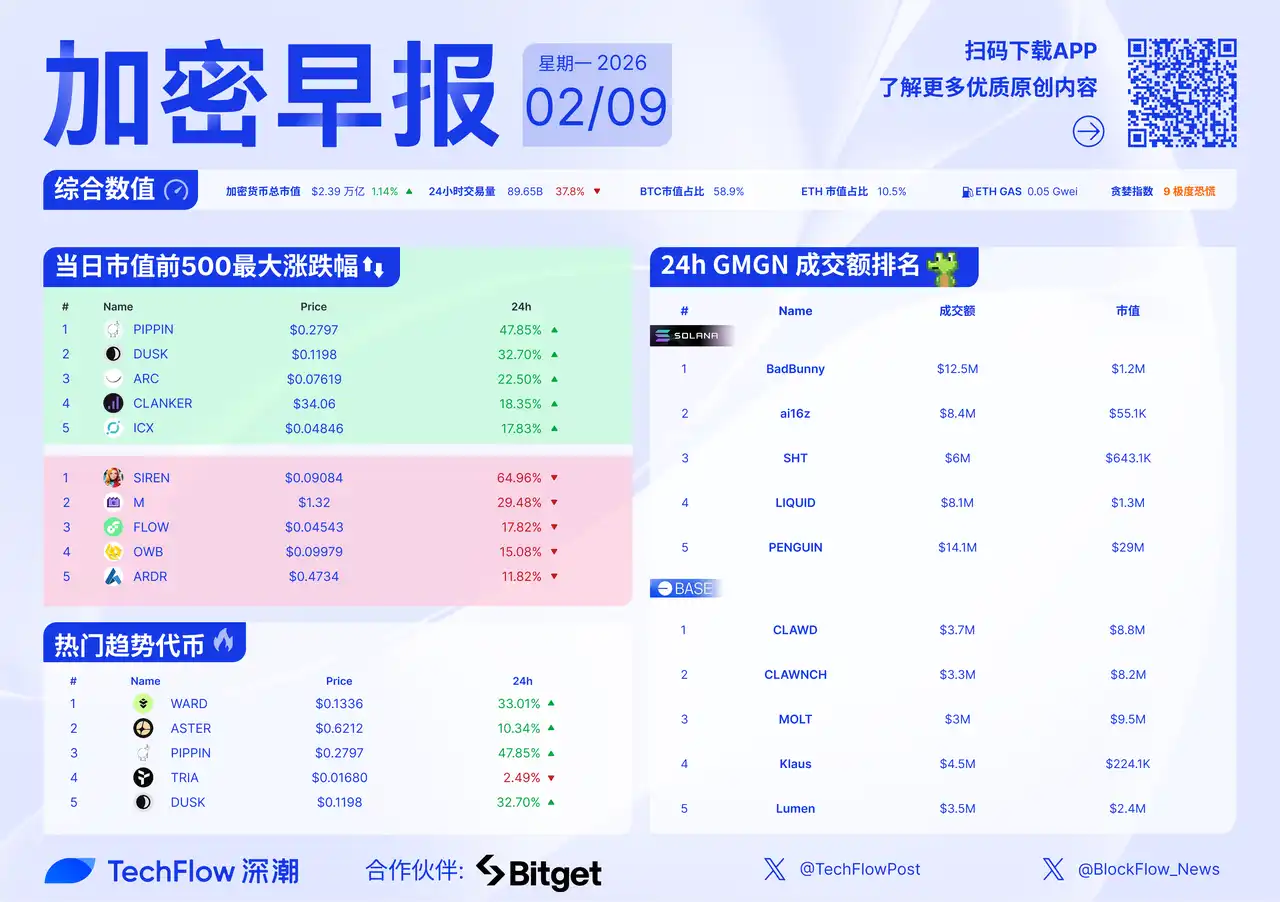
Market Dynamics
Recommended Reading

Dialogue with Jeff Park: We Are in a Bear Market, Quantitative Easing No Longer Effective, Silver Will Crash Like Altcoins

This article explores the current changing trends in the Bitcoin market, fluctuations in the precious metals market, and the future direction of the Federal Reserve and fiscal policy. Through a dialogue format, it provides an in-depth analysis of the relationship between Bitcoin and the global economic environment, and introduces the concept of "positive correlation Bitcoin." The article also discusses the potential of Kevin Warsh as Fed Chair and the current situation and future of the silver market.

Interpreting MicroStrategy's Latest Earnings Report: After a $12.4 Billion Loss, How Long Can the Bitcoin Flywheel Keep Spinning?

This article analyzes the close relationship between MicroStrategy and Bitcoin. The earnings report shows its operating condition heavily relies on Bitcoin price fluctuations. Although its capital operations perform excellently, in the long run, a continuous decline in Bitcoin price may threaten its operational model.

Forbes Editorial, The Most Accurate Short Signal in Crypto?

This article explores the relationship between the cryptocurrency market and Forbes magazine cover figures, pointing out that market frenzies often peak when mainstream media pays attention. It analyzes the logic behind this phenomenon through multiple cases, including the experiences of crypto figures like CZ, SBF, and Michael Saylor.

Bloodbath in US Stocks, Bitcoin, and Silver: A Bizarre Global Asset Massacre

This article discusses the "liquidity black hole" style asset massacre experienced by global markets on February 6th, where multiple asset classes including US stocks, silver, and cryptocurrencies fell sharply simultaneously. Despite no obvious external black swan event, a liquidity crisis became the core reason for this market crash. The article analyzes the causes of this global market turmoil in detail from the perspectives of changes in US stocks, silver, cryptocurrencies, and the Japanese government bond market.

Darkest Hour for Crypto, Real Vision Founder: Hold Firmly, Buy the Dip Boldly

This article describes the current market being in a低迷 state, with investors普遍 feeling panic and confusion, but the author emphasizes holding firmly and buying the dip boldly. It highlights the advantages of long-term holding and分批加仓, pointing out that high market volatility is a price that must be accepted. The author is optimistic about the future market, believing the current market低迷 is a panic sell-off within a bull market, and plans to continue buying the dip on crypto assets.


Criptomoedas em alta

Perguntas relacionadas

QWhat is the key content of the new virtual currency regulation issued by the People's Bank of China and seven other departments?

AThe new regulation explicitly states that virtual currencies do not have legal tender status and related business activities are illegal financial activities. It prohibits virtual currency trading and Real World Asset (RWA) tokenization activities within China. It also mandates that domestic entities cannot issue virtual currencies or conduct tokenization business overseas without approval from relevant departments.

QWhich tokens are scheduled for significant unlocks this week according to the article?

AAccording to the article, the tokens scheduled for significant unlocks this week are: CONX, AVAX, APT, STRK, SEI, MOVE, ME, and LINEA.

QWhat did the US state of Illinois propose regarding Bitcoin this week?

AThe US state of Illinois proposed the 'Community Bitcoin Reserve Act', which aims to establish a state-operated Bitcoin reserve program. The plan involves using multi-signature cold wallets for custody, with the first reserve named the Altgeld Bitcoin Reserve. The legislation stipulates that BTC in the reserve can only be traded or sold after new legislative authorization.

QWhat action did Michael Saylor hint at with his post 'Orange Dots Matter.'?

ABased on previous patterns, Michael Saylor's post 'Orange Dots Matter.' on the X platform, which included Bitcoin Tracker information, is a hint that his company, MicroStrategy, is likely to announce another purchase of Bitcoin the following day.

QWhat was Bithumb's response to the 'misissuance of 620,000 BTC' incident?

ABithumb announced a comprehensive compensation plan for customers affected by the incident. They promised to provide 110% special compensation to affected clients, estimated at a loss of about 10 billion KRW. Additionally, they will offer 20,000 KRW to all users who logged in during the incident period, provide zero-fee trading for all users for 7 days, and establish a 'Customer Protection Fund' with a scale of 100 billion KRW to ensure the safety of customer assets.

Leituras Relacionadas

Long-Divided Must Unite, Long-United Must Divide: When L1 Becomes Its Own Rollup, What Is Ethereum's Endgame?

"The Inevitable Cycle: When L1 Becomes Its Own Rollup – What is Ethereum's Endgame?" For years, the Ethereum community grappled with concerns that L2s were fragmenting the ecosystem and eroding L1's value. While L2s provided cheaper execution, they also splintered liquidity and the unified user experience of a single chain. This has prompted a fundamental reassessment of the relationship between L1 and L2. Ethereum's roadmap is evolving. The "Scale" initiative merges L1 and L2 expansion into a holistic framework. L1 itself is advancing with higher gas limits, statelessness, and zkEVM verification, no longer content to be just a low-throughput settlement layer. Consequently, the primary value proposition of L2s is shifting from merely providing cheap blockspace to offering L1 cannot easily provide: application-specific optimizations, privacy features, and flexible governance models. L2s are becoming a spectrum of execution environments with varying degrees of security inheritance from Ethereum. A critical challenge in this multi-chain future is interoperability. The vision is to make Ethereum "feel like one chain again." This relies on advancements in native account abstraction (like EIP-7702) and intent-based architectures (Open Intents Framework), where users declare desired outcomes, and solvers handle the complex cross-chain execution. Furthermore, shortening Ethereum's finality time from minutes to seconds is crucial, as it underpins trust between chains for bridges, stablecoins, and cross-chain applications. Perhaps the most provocative idea is that Ethereum L1 itself could become a form of "its own Rollup." As zkEVM and proof systems mature, high-performance nodes could execute transactions and generate validity proofs. Regular validators would then verify these proofs instead of re-executing all transactions. This blurs the traditional L1/L2 hierarchy, making "Rollup" more of a general execution-verification architecture. Native Rollup aims to integrate L2 validation more directly into the Ethereum protocol, allowing L2s to inherit L1's security more fully and move away from reliance on security councils. In the end, L2s are not destined to replace L1 or be made obsolete by it. The likely future is a unified system where diverse execution environments—each optimized for specific use cases like DeFi, gaming, or privacy—coexist. They will share a common foundation of security, liquidity, and verifiable state, seamlessly connected to restore a cohesive user experience. The next phase for Ethereum is not just about scaling through separation, but about intelligently reintegrating what was separated back into a coherent whole.

链捕手Há 5m

Long-Divided Must Unite, Long-United Must Divide: When L1 Becomes Its Own Rollup, What Is Ethereum's Endgame?

链捕手Há 5m

Agent Race Ends, Super Workbench Takes Over

The era of fragmented AI agents is ending. Over the past month, China's tech giants—Tencent, Alibaba, and ByteDance—have simultaneously shifted strategy: instead of launching new, standalone AI agents, they are consolidating their various agent projects into unified "super workbenches." Tencent integrated its QClaw teams into WorkBuddy, a strategic product hailed as a potential third flagship after QQ and WeChat. Alibaba is merging its QoderWork, Wukong, and MuleRun agents into a new "Qianwen Office" platform under DingTalk's leadership. ByteDance rebranded its TRAE SOLO coding agent to TRAE Work, signaling a broader focus on workflow collaboration. This convergence marks a pivotal industry consensus. The initial exploration phase, where companies rapidly built numerous overlapping agents for different scenarios, proved costly and inefficient. With open-source tools eroding technical barriers, competition has shifted from agent creation to resource consolidation and cost control. Historically, platform wars are won not by creating more products, but by simplifying them—as seen with browsers unifying web access and super-apps consolidating services. Now, the "super workbench" aims to become the unified AI entry point for work. This reflects a deeper market realization: the primary audience for AI is no longer just programmers (a market in the tens of millions) but all knowledge workers (a market of billions). The real opportunity lies in augmenting everyday tasks—managing emails, documents, data, and meetings—across the entire workday. The core battleground is becoming control over the primary AI entry point that employees use daily. Tencent's WorkBuddy leverages WeChat and Tencent Docs; Alibaba's Qianwen Office taps into DingTalk's organizational data; ByteDance's TRAE Work integrates with Feishu's workflows. Whoever owns this "super workbench" gains strategic control over orchestrating enterprise data and APIs. This shift is redefining enterprise software. Traditional SaaS applications, valued for their user interfaces, will recede into the background. Their core functionalities will be exposed as standardized "Skills" or APIs for the super workbench's agents to invoke. Software value will shift from selling user seats to charging based on API calls and outcomes delivered. The evolution of agents is moving through clear stages: first as novel standalone products, then as consolidated primary work entry points, and finally as pervasive, invisible capabilities embedded into the digital fabric. The recent moves by major tech firms signal the transition from the first stage into the second, accelerating toward the third. In the end, the most successful agent technology may become invisible—like electricity or the HTTP protocol—a fundamental, unnamed infrastructure powering work itself.

marsbitHá 32m

Agent Race Ends, Super Workbench Takes Over

marsbitHá 32m

Michael Saylor: 110 Reasons to Oppose BIP-110

Michael Saylor presents 110 arguments against Bitcoin Improvement Proposal (BIP) 110, a soft fork aimed at restricting certain non-monetary data storage uses (like inscriptions) on the Bitcoin blockchain. He acknowledges the proponents' valid concerns—such as node costs, fee pressure, and preserving Bitcoin's monetary focus—but fundamentally disagrees with the proposed solution. Saylor argues that BIP 110 represents a dangerous precedent of using consensus rules to enforce value judgments on transaction validity, moving away from Bitcoin's core principles of neutrality and permissionless innovation. His key objections are organized into eleven categories: 1) It violates neutrality and hard consensus by banning currently valid transactions. 2) It fails to meet the high burden of proof required for a consensus change, lacking concrete data on the alleged crisis. 3) Its seven bundled technical restrictions are overly broad, targeting generic script functionalities and blocking future upgrade paths. 4) It sacrifices compatibility and future optionality by closing off designed upgrade hooks. 5) Its temporary rules add significant complexity (grandfathering, expiry states) without sufficient justification. 6) The economic and security impacts, particularly on miner revenue and fee markets, are uncertain and unmodeled. 7) Superior, market-based tools (fee markets, relay/mining policies) already exist to manage blockchain load. 8) It stifles innovation by creating a chilling effect for developers. 9) Its modified activation mechanism (55% threshold, forced signaling) is aggressive and risks network splits. 10) The precedent it sets—using consensus to suppress disliked but legal uses—is more dangerous than the problem it aims to solve. 11) A better path exists: improving measurements, refining resource-based policies, and allowing market forces to work. Saylor concludes that Bitcoin's strength lies in its neutral rules, open markets, and hard consensus. Changing these foundational elements to target specific use cases is an unnecessary and risky "iatrogenic" intervention. He advocates for guarding Bitcoin's neutrality rather than acting as its redeemer.

marsbitHá 47m

Michael Saylor: 110 Reasons to Oppose BIP-110

marsbitHá 47m

Trading

Spot

Artigos em Destaque

Como comprar APT

Bem-vindo à HTX.com!Tornámos a compra de Aptos (APT) simples e conveniente.Segue o nosso guia passo a passo para iniciar a tua jornada no mundo das criptos.Passo 1: cria a tua conta HTXUtiliza o teu e-mail ou número de telefone para te inscreveres numa conta gratuita na HTX.Desfruta de um processo de inscrição sem complicações e desbloqueia todas as funcionalidades.Obter a minha contaPasso 2: vai para Comprar Cripto e escolhe o teu método de pagamentoCartão de crédito/débito: usa o teu visa ou mastercard para comprar Aptos (APT) instantaneamente.Saldo: usa os fundos da tua conta HTX para transacionar sem problemas.Terceiros: adicionamos métodos de pagamento populares, como Google Pay e Apple Pay, para aumentar a conveniência.P2P: transaciona diretamente com outros utilizadores na HTX.Mercado de balcão (OTC): oferecemos serviços personalizados e taxas de câmbio competitivas para os traders.Passo 3: armazena teu Aptos (APT)Depois de comprar o teu Aptos (APT), armazena-o na tua conta HTX.Alternativamente, podes enviá-lo para outro lugar através de transferência blockchain ou usá-lo para transacionar outras criptomoedas.Passo 4: transaciona Aptos (APT)Transaciona facilmente Aptos (APT) no mercado à vista da HTX.Acede simplesmente à tua conta, seleciona o teu par de trading, executa as tuas transações e monitoriza em tempo real.Oferecemos uma experiência de fácil utilização tanto para principiantes como para traders experientes.

163 Visualizações TotaisPublicado em {updateTime}Atualizado em 2026.06.02

Como comprar APT

Discussões

Bem-vindo à Comunidade HTX. Aqui, pode manter-se informado sobre os mais recentes desenvolvimentos da plataforma e obter acesso a análises profissionais de mercado. As opiniões dos utilizadores sobre o preço de APT (APT) são apresentadas abaixo.

活动图片










