Desbloqueo de tokens de la semana: STRK desbloquea aproximadamente el 4.6% de la oferta circulante

marsbitPublicado em 2026-02-07Última atualização em 2026-02-07

Resumo

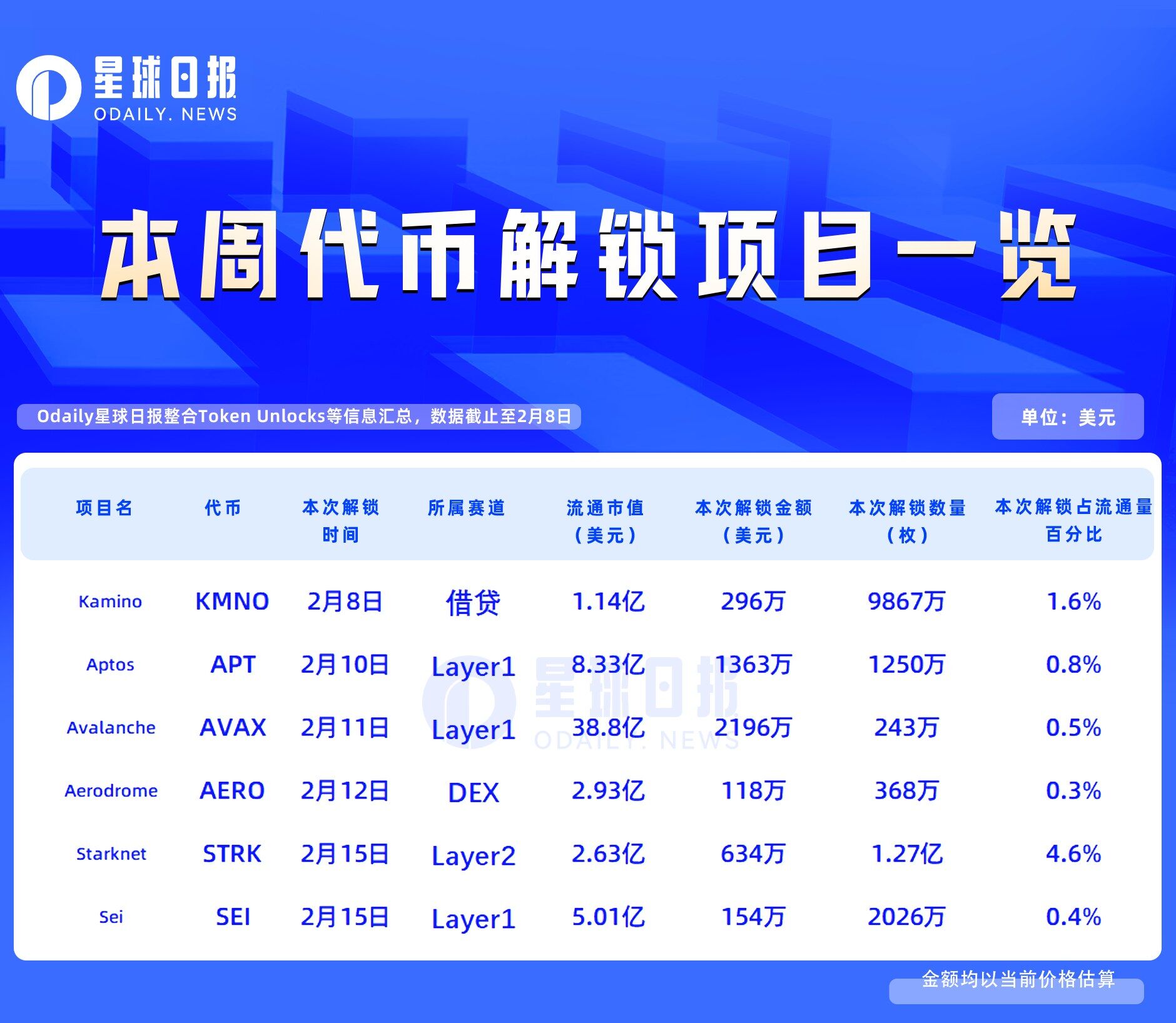
Resumen de desbloqueo de tokens: Esta semana, Starknet (STRK) desbloqueará 127 millones de tokens (4.6% de la oferta circulante), valorados en ~$6.34M. Starknet es una capa 2 de Ethereum que utiliza zk-STARKs para mejorar la velocidad y reducir costos. Además, Kamino desbloqueará 12.5 millones de tokens, valorados en ~$13.63M. Es una solución de liquidez automatizada en Solana que mejora la eficiencia de capital para proveedores de liquidez.

Starknet

Twitter del proyecto: https://twitter.com/Starknet

Sitio web del proyecto: https://starknet.io/

Cantidad desbloqueada esta vez: 127 millones de tokens

Monto desbloqueado esta vez: aproximadamente 6.34 millones de dólares

Starknet es una capa 2 de Ethereum que utiliza tecnología zk-STARKs para hacer que las transacciones en Ethereum sean más rápidas y con tarifas reducidas. La empresa matriz de StarkNet, StarkWare, fue fundada en 2018 y tiene su sede en Israel. Sus principales productos de desarrollo son Starknet y StarkEx. Al utilizar STARK, Starknet verifica transacciones y cálculos sin necesidad de que todos los nodos de la red verifiquen cada operación. Esto reduce significativamente la carga computacional y aumenta el rendimiento de la red blockchain.

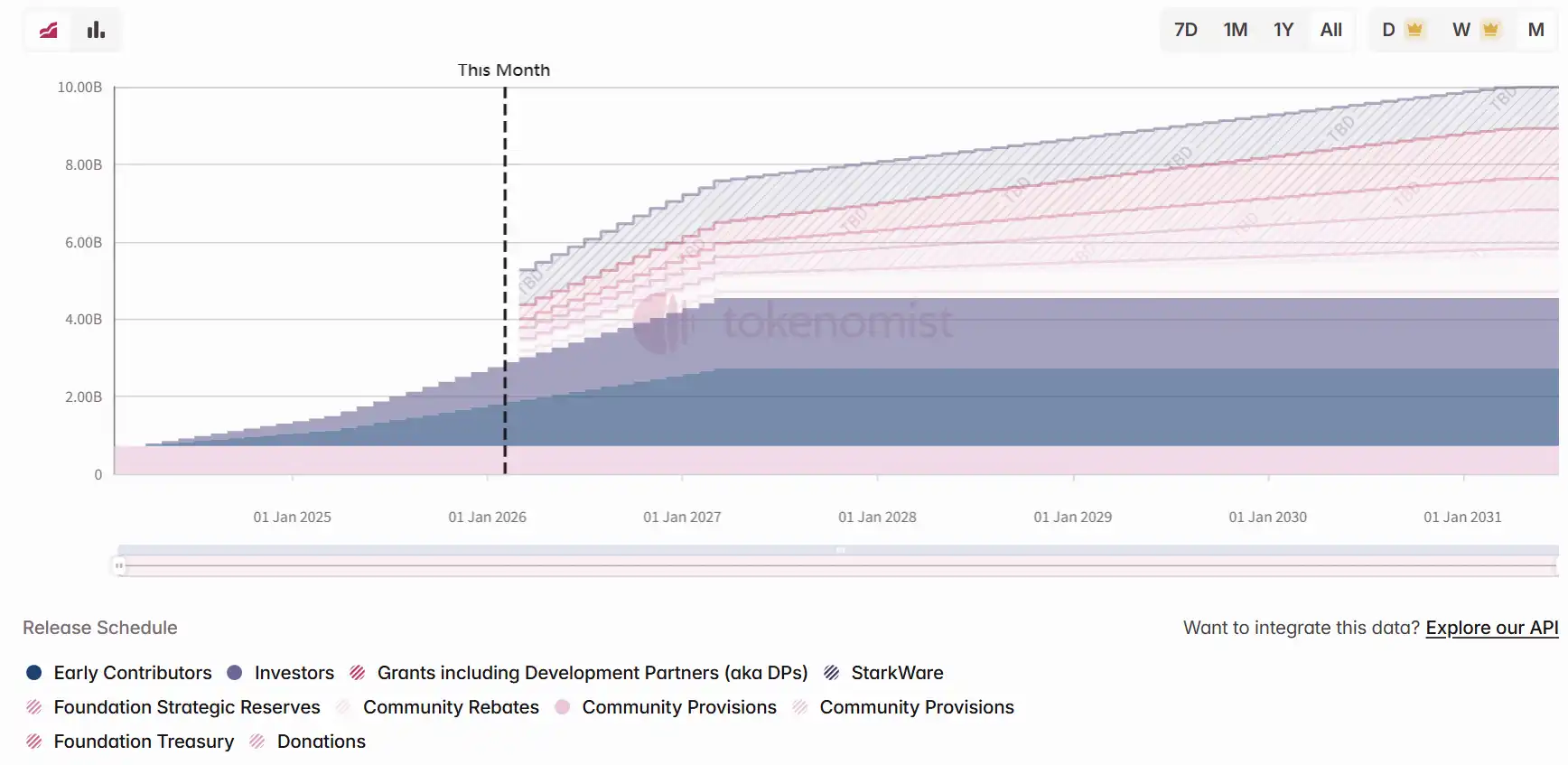
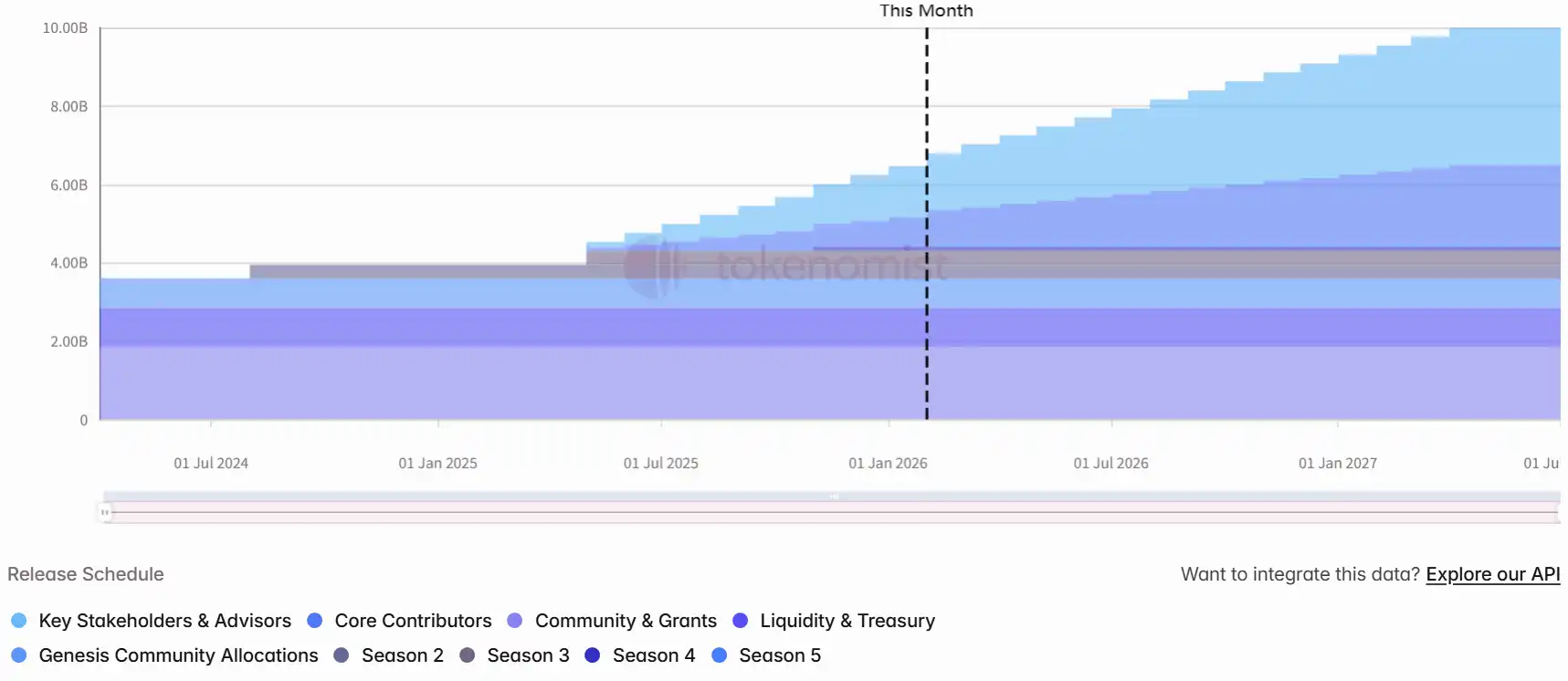
La curva de liberación específica es la siguiente:
Kamino

Twitter del proyecto: https://x.com/kamino

Sitio web del proyecto: https://kamino.finance/

Cantidad desbloqueada esta vez: 12.5 millones de tokens

Monto desbloqueado esta vez: aproximadamente 13.63 millones de dólares

Kamino es una solución de liquidez automatizada basada en el mecanismo de creador de mercado de liquidez concentrada (CLMM). Los proveedores de liquidez (LP) que buscan mejorar la eficiencia del capital pueden utilizar el sistema automatizado de creación de mercado de Kamino para aumentar las tarifas y el rendimiento esperado de los retornos. Kamino fue incubado por Hubble Protocol.

La curva de liberación específica es la siguiente:
Perguntas relacionadas

Q¿Qué cantidad de tokens de STRK se desbloquearán esta semana y qué porcentaje representa de la oferta circulante?

AEsta semana se desbloquearán 127 millones de tokens STRK, lo que representa aproximadamente el 4.6% de su oferta circulante.

Q¿Cuál es el valor estimado en dólares del desbloqueo de tokens de Starknet esta semana?

AEl valor estimado del desbloqueo de tokens de Starknet es de aproximadamente 6.34 millones de dólares.

Q¿Qué tecnología utiliza Starknet para mejorar la escalabilidad de Ethereum y qué beneficios ofrece?

AStarknet utiliza la tecnología zk-STARKs para mejorar la escalabilidad de Ethereum, lo que permite que las transacciones sean más rápidas y con tarifas reducidas al verificar operaciones sin que todos los nodos de la red necesiten validar cada acción.

Q¿Cuántos tokens de Kamino (KMNO) se desbloquearán esta semana y cuál es su valor estimado?

AEsta semana se desbloquearán 12.5 millones de tokens KMNO, con un valor estimado de aproximadamente 13.63 millones de dólares.

Q¿Qué tipo de protocolo es Kamino y qué objetivo principal tiene para los proveedores de liquidez?

AKamino es una solución de liquidez automatizada basada en el mecanismo de creador de mercado de liquidez concentrada (CLMM). Su objetivo principal es que los proveedores de liquidez (LP) mejoren su eficiencia de capital y aumenten sus rendimientos mediante la automatización de la gestión de mercados.

Leituras Relacionadas

Dalio's Latest Warning: Don't Get Carried Away by AI, Real Returns on US Stocks in the Next 5-10 Years Could Be -5% to -10%

Ray Dalio, founder of Bridgewater Associates, warns investors against excessive concentration in AI stocks. He argues the current market, dominated by a few AI giants, mirrors historical patterns where revolutionary new technologies lead to high risk, volatility, and uncertainty. While acknowledging AI's transformative potential, Dalio emphasizes that most investors fail at this stage of the cycle by over-concentrating in a handful of leading companies. He cites inherent risks: companies cannot accurately forecast investment needs or external shocks (e.g., monetary policy, geopolitics, taxes), face potential disruption from future technologies and international competition (notably from China), and experience significant price swings. Dalio's core advice is diversification, calling it his "Holy Grail of Investing." He presents a mathematical case that a well-diversified portfolio of 15-20 uncorrelated, good bets offers a superior risk-adjusted return compared to a concentrated position. Dalio also offers a cautious outlook, suggesting U.S. stocks may deliver real returns of -5% to -10% over the next 5-10 years based on valuation and bubble indicators. He concludes that in the face of high uncertainty, the prudent strategy is not to avoid betting entirely, but to avoid large, concentrated bets where one lacks sufficient informational edge. Instead, investors should build a strategically balanced, diversified portfolio.

marsbitHá 30m

Dalio's Latest Warning: Don't Get Carried Away by AI, Real Returns on US Stocks in the Next 5-10 Years Could Be -5% to -10%

marsbitHá 30m

Rain Valuation Approaches $20 Billion: The Battle for U-Cards Extends to Rewards Systems

Rain, a stablecoin payments infrastructure company, is shifting the competitive focus for U Cards from simple issuance to user retention and repeated usage. On June 15, Rain launched "Rain Rewards," an embedded loyalty program capability within its card-issuing infrastructure. This allows partner businesses—like fintech platforms and neobanks—to configure branded loyalty points, earning rules, redemptions, and merchant promotions directly within their card products. The system, built from the 2025 acquisition of Uptop, ensures points are only issued upon final transaction settlement, preventing liabilities from refunds. Trials, such as with Avalanche Card, reportedly boosted spending by 25% among enrolled users. Founded by Farooq Malik and Charles Yoo-Naut, Rain evolved from a tool for managing Web3 company expenses into a full-stack enterprise platform. It is a Principal Member of Visa and Mastercard, enabling partners to issue stablecoin-backed cards and wallets while leveraging traditional payment networks. Notably, the popular U Card Plasma One is issued by Rain under Visa's authority. Rain also integrates with Visa's stablecoin settlement pilot, using USDC for network settlement. Rain's rapid funding reflects growing institutional interest in stablecoin payment infrastructure. It raised a $245 million Series A in March 2025, a $58 million Series B in August 2025, and a $250 million Series C in January of this year, reaching a $19.5 billion valuation. Annualized transaction volume exceeds $3 billion, serving over 200 partners including Western Union and Nuvei. Beyond cards, Rain is expanding into programmable payments. Its June 2026 "Agent Control Layer" allows businesses to set spending rules—like merchant categories, amounts, and frequency—for AI agents before transactions occur. This positions Rain not as a single product but as an operating system for stablecoin payments, handling everything from card issuance and wallet management to rewards, on/off-ramps, and automated compliance. The goal is to enable seamless, often invisible, real-world spending of on-chain assets.

Foresight NewsHá 33m

Rain Valuation Approaches $20 Billion: The Battle for U-Cards Extends to Rewards Systems

Foresight NewsHá 33m

Google TPU Shipments Revised Up by 50%

Recent industry research indicates a significant upward revision in the shipments of Google's TPU (Tensor Processing Unit) chips. Previous expectations for 2027 were set at around 10 million units, but new estimates now point to 15 million units, a 50% increase. This substantial boost directly translates to higher demand across the entire supporting supply chain. Google's TPU clusters utilize a standardized all-optical interconnect architecture. Consequently, key hardware components are deeply integrated and scaled in fixed ratios with the chips. The 15 million TPU target will drive corresponding demand increases for NPO optical engines (roughly a 1:1 match), 1.6T optical modules, OCS optical switches, high-end server power supplies, fiber optics & MPO connectors, and liquid cooling solutions. Among these, liquid cooling is highlighted as the sector experiencing the most significant transformation and offering the most stable potential for excess returns. As next-generation TPU chips reach power levels where traditional air cooling is insufficient, liquid cooling becomes essential. 2026 is forecasted as the first year of substantial adoption for Google's liquid cooling solutions. This shift, coupled with delivery and capacity bottlenecks faced by incumbent overseas manufacturers, is creating a prime window for domestic Chinese suppliers to enter and secure Google's core supply chain. The market size for Google-specific liquid cooling is projected to potentially triple from a baseline of hundreds of billions to around 300 billion units by 2028. The logic for the fiber optic sector is also being rewritten. Once considered a cyclical commodity tied to telecom operator procurement, fiber is now a strategic and scarce resource for AI Data Centers (AIDC). A severe supply-demand imbalance, driven by the long lead time for preform production (18-24 months) and surging demand from cloud giants, is supporting strong performance. Chinese fiber manufacturers are well-positioned to capture a significant share of global AIDC demand, with exports potentially reaching 200-300 million core kilometers in 2026. Overall, the investment focus within the AI computing industry is shifting from pure "chip performance speculation" towards the more certain incremental growth in computing infrastructure and its supporting ecosystem. The upward revision in Google TPU shipments, along with the potential for further doubling by 2028, is seen as solidifying performance visibility for the entire supporting supply chain over the next two years.

marsbitHá 2h

Google TPU Shipments Revised Up by 50%

marsbitHá 2h

What Wall Street Really Wants After the Crypto Story Recedes

The tide of speculative crypto narratives has receded, revealing Wall Street's true objective: building a controlled, yield-generating, and compliant financial pipeline on distributed ledgers. They are migrating core functions onto blockchains, not for decentralization, but for efficiency and new revenue streams. Key developments include BlackRock's BUIDL fund, a tokenized treasury fund acting as a foundational reserve asset, and the rise of Securitize, which is going public and partnering with the NYSE to build a 24/7 digital securities trading and settlement system. This signals a major shift of securities clearing to blockchain technology. To make volatile assets like Bitcoin palatable for institutional investors, firms like BlackRock and Goldman Sachs are creating "covered call" ETFs (e.g., BITA). These products systematically sell options on Bitcoin holdings, transforming price volatility into stable monthly income, effectively repackaging crypto as a yield-bearing asset. Stablecoins are being positioned not as speculative tools but as efficient payment rails. Companies like Stripe and Mastercard are integrating them for instant, low-cost merchant settlements and cross-border card payments, respectively. Critically, new legislation like the GENIUS Act shapes them as non-interest-bearing, heavily regulated extensions of the US dollar system. In summary, Wall Street is quietly constructing a parallel, blockchain-based financial infrastructure featuring tokenized traditional assets, structured crypto yields, and programmable dollar pipelines—all under its control and fully integrated with existing regulatory and credit frameworks.

marsbitHá 2h

What Wall Street Really Wants After the Crypto Story Recedes

marsbitHá 2h

Trading

Spot
Futuros

Artigos em Destaque

Como comprar STRK

Bem-vindo à HTX.com!Tornámos a compra de Starknet (STRK) simples e conveniente.Segue o nosso guia passo a passo para iniciar a tua jornada no mundo das criptos.Passo 1: cria a tua conta HTXUtiliza o teu e-mail ou número de telefone para te inscreveres numa conta gratuita na HTX.Desfruta de um processo de inscrição sem complicações e desbloqueia todas as funcionalidades.Obter a minha contaPasso 2: vai para Comprar Cripto e escolhe o teu método de pagamentoCartão de crédito/débito: usa o teu visa ou mastercard para comprar Starknet (STRK) instantaneamente.Saldo: usa os fundos da tua conta HTX para transacionar sem problemas.Terceiros: adicionamos métodos de pagamento populares, como Google Pay e Apple Pay, para aumentar a conveniência.P2P: transaciona diretamente com outros utilizadores na HTX.Mercado de balcão (OTC): oferecemos serviços personalizados e taxas de câmbio competitivas para os traders.Passo 3: armazena teu Starknet (STRK)Depois de comprar o teu Starknet (STRK), armazena-o na tua conta HTX.Alternativamente, podes enviá-lo para outro lugar através de transferência blockchain ou usá-lo para transacionar outras criptomoedas.Passo 4: transaciona Starknet (STRK)Transaciona facilmente Starknet (STRK) no mercado à vista da HTX.Acede simplesmente à tua conta, seleciona o teu par de trading, executa as tuas transações e monitoriza em tempo real.Oferecemos uma experiência de fácil utilização tanto para principiantes como para traders experientes.

185 Visualizações TotaisPublicado em {updateTime}Atualizado em 2026.06.02

Como comprar STRK

Discussões

Bem-vindo à Comunidade HTX. Aqui, pode manter-se informado sobre os mais recentes desenvolvimentos da plataforma e obter acesso a análises profissionais de mercado. As opiniões dos utilizadores sobre o preço de STRK (STRK) são apresentadas abaixo.

活动图片