¿12 dólares pueden convertirse en 8300 veces? El mito de una operación en Polymarket se desmorona

比推Publicado em 2026-01-21Última atualização em 2026-01-21

Resumo

Un usuario de Polymarket llamado @ascetic0x afirmó haber multiplicado 12 dólares hasta más de 100.000 mediante apuestas de alto riesgo en mercados de predicción, generando gran atención en redes sociales con más de 4 millones de impresiones. Sin embargo, otro usuario, Moses, reveló que ascetic operaba múltiples cuentas ("granjas Sybil") con fondos iniciales de 10-20 dólares cada una, publicando solo el caso más exitoso tras 7 operaciones. Se le acusó de lavado de operaciones y búsqueda de fama. Ascetic negó las acusaciones, alegando ataques injustos y advirtió sobre los riesgos de su estrategia. El caso expone los peligros de seguir ciegamente a influencers y la ilusión de ganancias extraordinarias en mercados especulativos.

Escrito por: Mahe, Foresight News

Título original: ¿Cómo se siente ganar 8300 veces con 12 dólares en Polymarket?


Los lugares para obtener riqueza a través de la operación ya no se limitan a los exchanges y DEX. Imagina abrir la página de Polymarket, sentarte frente a la computadora y observar el gráfico de precios de Bitcoin. En la pantalla, la interfaz de Polymarket parpadea con el ícono naranja de Bitcoin. Apuestas todo tu capital—solo 12 dólares—a que Bitcoin subirá en un período determinado. Las probabilidades del mercado son altamente inciertas, pero basándote en tu análisis de datos on-chain, noticias y patrones de velas, horas después, el mercado se liquida y ganas. Tu saldo se duplica a 24.31 dólares. Pero esto es solo el comienzo. Respiras hondo y vuelves a apostar todo. Ganas de nuevo, y el saldo se convierte en 40.35 dólares. Así, operando con todo en cada movimiento, acumulas victorias como una bola de nieve.
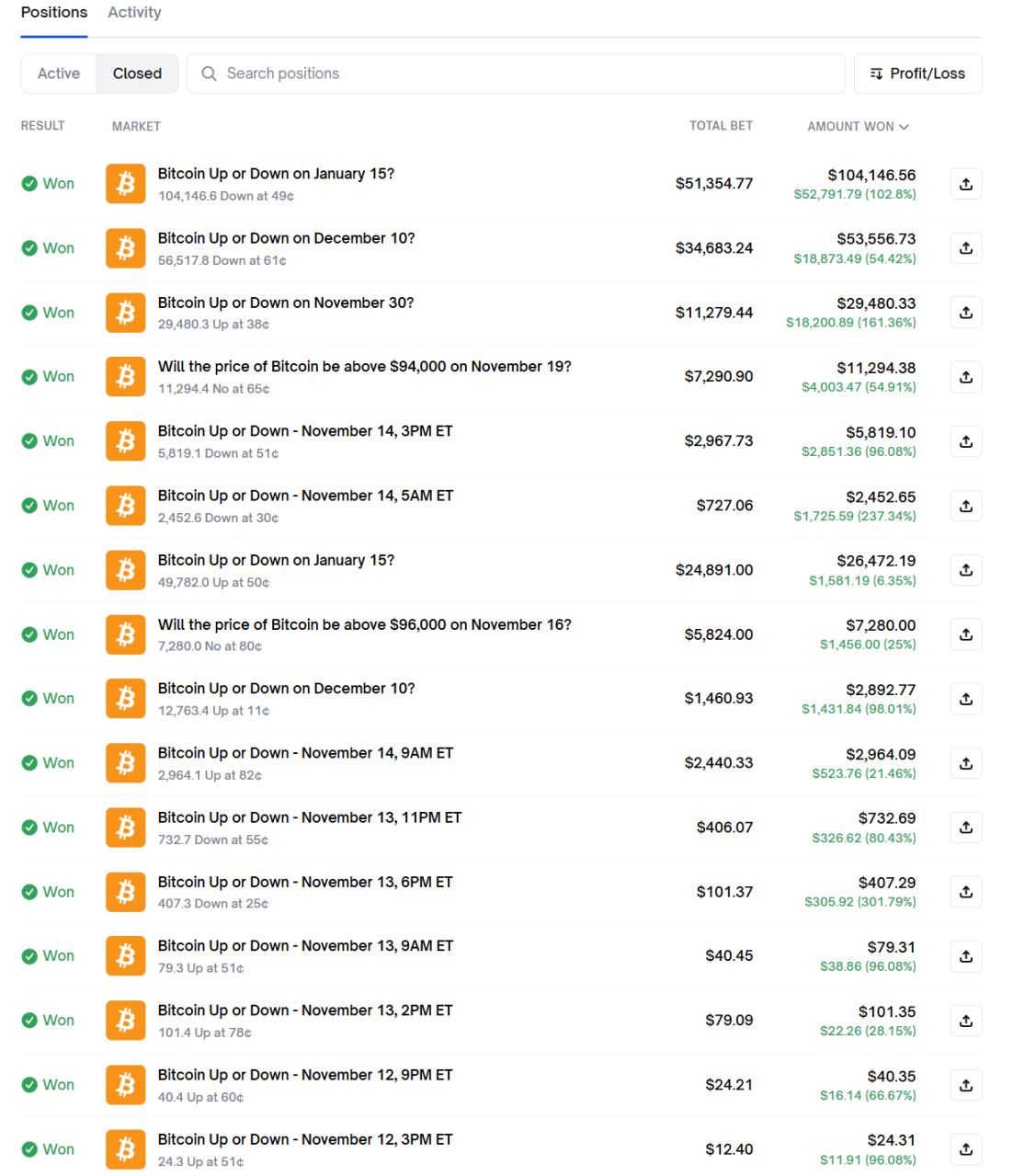
Comenzando con decenas de dólares, apostando todo repetidamente, ganando una y otra vez hasta obtener más de 100,000 dólares. Esto no es un sueño, sino la hazaña del usuario @ascetic0x.

La historia de ascetic se volvió viral rápidamente, con 4.21 millones de lecturas, 13,000 me gusta y 8000 guardados. En los comentarios, algunos gritaban "leyenda", mientras otros exclamaban "solo Polymarket permite a los pequeños inversores dar la vuelta".

Quizás, en el corazón de cada jugador de Polymarket, haya existido el sueño de ganar grande con poco, de enriquecerse rápidamente. La historia de ascetic fue como una inyección de energía, dando esperanza infinita a cada jugador que espera "cambiar su destino".

Pero la verdad de la historia va más allá de la superficie brillante.

Justo un día después de que publicara su tuit triunfal, el usuario de Twitter Moses reveló la verdad: crear múltiples cuentas en Polymarket y luego publicar solo la operación más exitosa.
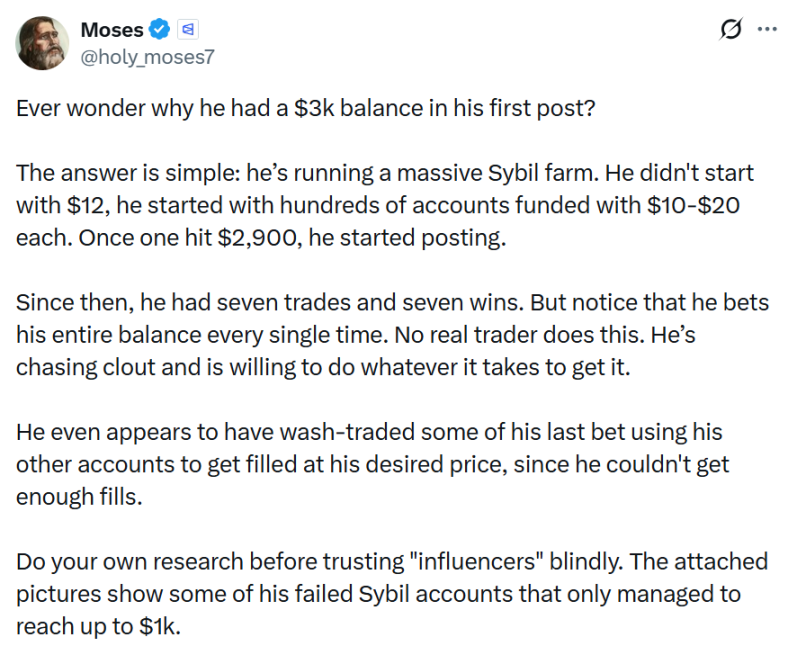
Moses cuestionó: "¿Por qué su primera publicación ya tenía un saldo de 3k? La respuesta es simple: estaba operando una gran cantidad de cuentas sibila. No comenzó con 12 dólares, sino que mantuvo cientos de cuentas, cada una con 10-20 dólares. Cuando una de ellas llegó a 2900 dólares, inmediatamente comenzó a publicar. Desde entonces, hizo 7 operaciones, todas ganadoras. Pero nota: cada vez apostó todo su saldo. Ningún operador real jugaría así.

Moses criticó que solo buscaba tráfico y atención, dispuesto a hacer cualquier cosa por fama. Ascetic incluso疑似 usó otras cuentas pequeñas para lavar operaciones (wash trade) en su última transacción, forzando la compra a su precio deseado, porque las órdenes normales no podían obtener suficiente volumen. Moses pidió no creer ciegamente en estos llamados "influencers", sino investigar por cuenta propia antes de decidir.
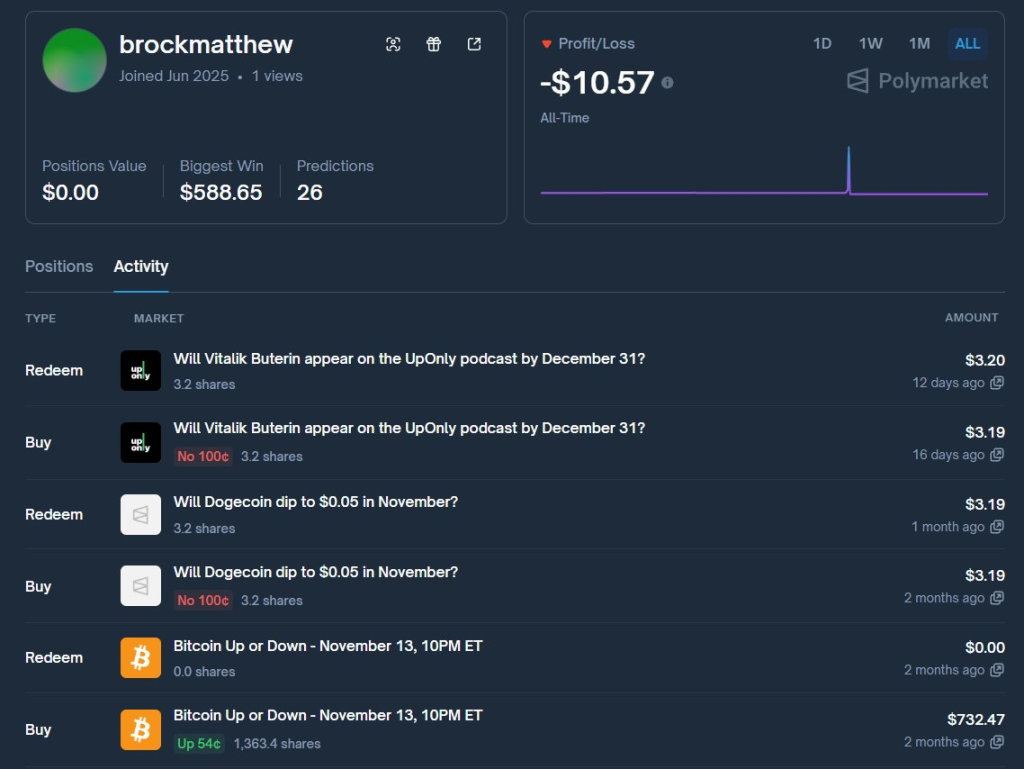
También mostró algunas de las cuentas sibila fallidas de ascetic, que llegaron como máximo a 1000 dólares antes de colapsar.

Estas cuentas se crearon hace 7 meses, primero se vincularon a mercados aleatorios durante 5 meses, y luego hace 2 meses comenzaron simultáneamente a operar con todo en mercados a corto plazo de Bitcoin.
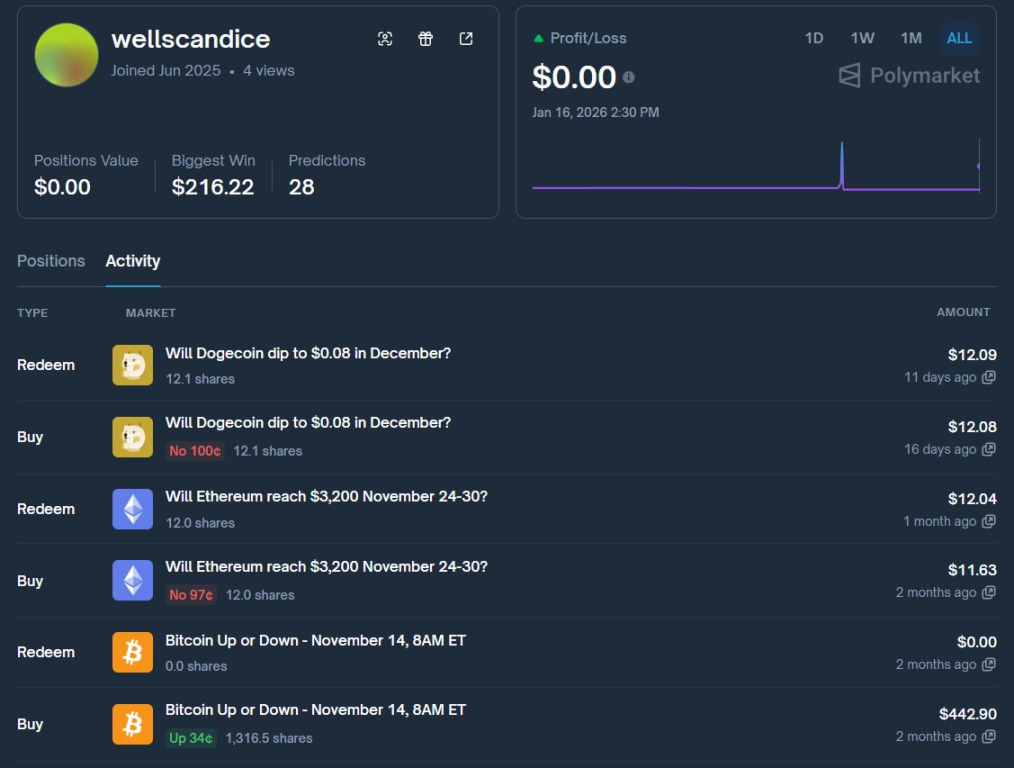
Algunas cuentas perdieron todo rápidamente, algunas alcanzaron cientos o casi 1k dólares, pero solo una "sobrevivió" hasta 2900 dólares y se hizo pública.
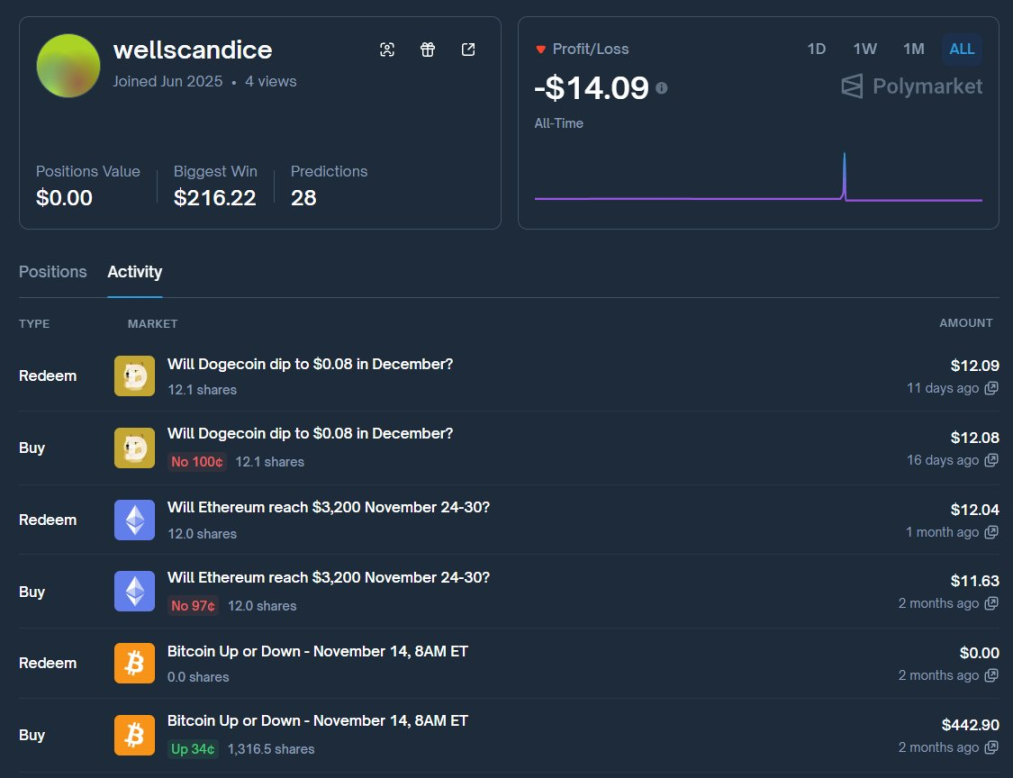
Esta táctica se asemeja a la de algunos analistas de criptomonedas, que abren posiciones largas y cortas, operan con múltiples cuentas, y sin importar cómo fluctúe el mercado, siempre pueden mostrar capturas de pantalla de operaciones ganadoras, obteniendo tráfico y atención entre exclamaciones de "¡otra vez gané!".
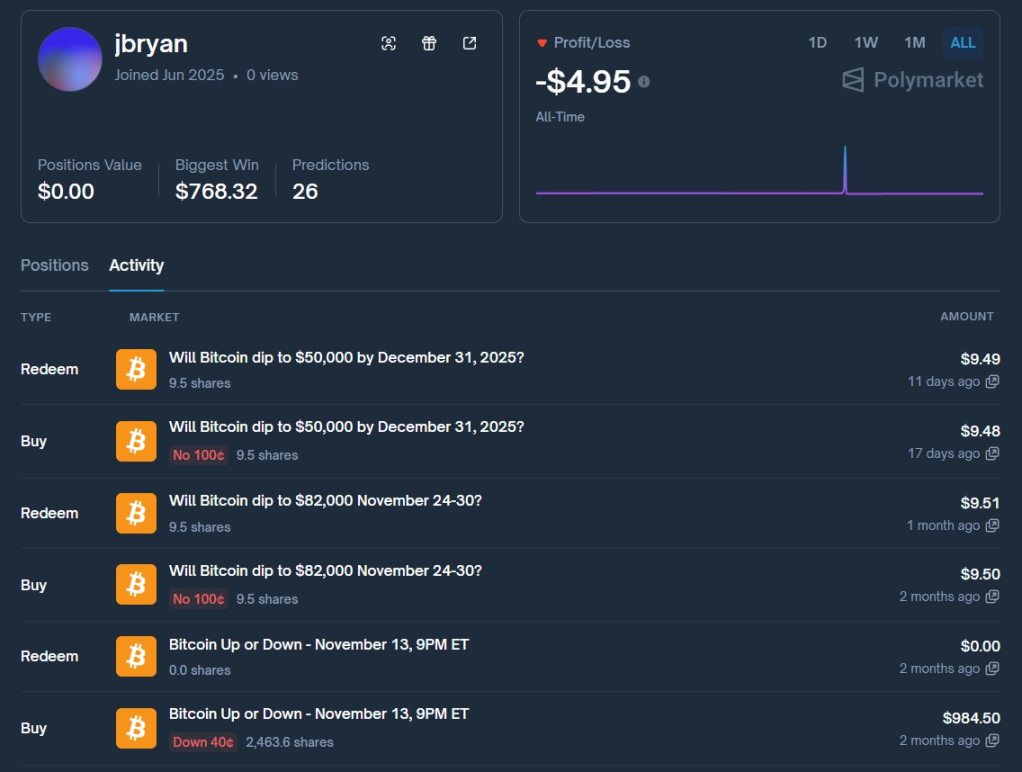
La controversia escaló rápidamente.

El 18 de enero, ascetic, enfrentando una avalancha de dudas, respondió en Twitter: "En las últimas 24 horas, he recibido más odio y amenazas que en toda mi vida. Algunos KOLs, para aprovechar la popularidad y el tráfico, difunden información falsa sobre mí y organizan ataques de odio en mis publicaciones. Otros ni siquiera revisaron mi perfil antes de criticar, sin ver que he estado registrando públicamente mis operaciones en X durante los últimos dos meses. Me acusan de operar múltiples cuentas, pero no pueden mostrar ninguna cuenta ni proveer evidencia de que existieran. No tengo ninguna relación con granjas sibila, eso es pura mentira."

Ascetic también advirtió a los usuarios que no copien sus operaciones, ya que la estrategia es de alto riesgo y operar así a largo plazo casi seguro lleva a la quiebra. Explicó que usa este enfoque agresivo porque cree ser un buen operador y quiere demostrar su habilidad para establecerse en la comunidad de Polymarket Trade.

¿Cuál es la verdad? Quizás sea un misterio difícil de resolver, pero el evento deja una lección profunda para los operadores comunes.

No sigan ciegamente a los KOLs. El éxito ajeno often es difícil de replicar, y no hay grandes expertos en el mercado actuando como bodhisattvas para hacer ricos a los demás. En el mercado de operaciones, la riqueza que crees al alcance de la mano, la mayoría de las veces está lejos de ser real.


Twitter:https://twitter.com/BitpushNewsCN

Grupo de Telegram de Bitpush:https://t.me/BitPushCommunity

Suscripción de Telegram de Bitpush: https://t.me/bitpush

Enlace original:https://www.bitpush.news/articles/7604842

Perguntas relacionadas

Q¿Qué afirmó el usuario Moses sobre la estrategia de ascetic0x en Polymarket?

AMoses afirmó que ascetic0x operaba múltiples cuentas (ataque Sybil) con fondos iniciales de 10-20 dólares cada una, y solo hizo público el único caso exitoso que alcanzó 2900 dólares, ocultando las numerosas cuentas que fracasaron.

Q¿Cómo respondió ascetic0x a las acusaciones de usar cuentas falsas?

Aascetic0x negó tener relación con granjas Sybil, calificó las acusaciones como desinformación y mencionó que recibió numerosas amenazas y críticas injustas sin pruebas concretas.

Q¿Qué lección principal destaca el artículo para los usuarios de plataformas como Polymarket?

AEl artículo advierte no seguir ciegamente a influencers (KOLs), ya que los éxitos aparentes suelen ser irreplicables y muchos ocultan estrategias riesgosas o fraudulentas.

Q¿Qué técnica sospechosa usó ascetic0x según Moses en su última operación?

AMoses sospechó que ascetic0x realizó 'wash trading' (autocomercio) con cuentas secundarias para manipular el precio y ejecutar órdenes que de otro modo no hubieran sido liquidadas.

Q¿Cuál fue el resultado inicial de la estrategia de ascetic0x antes de volverse viral?

ASupuestamente convirtió 12 dólares en 24.31 dólares en su primera operación, luego continuó apostando todo su saldo múltiples veces hasta superar los 100,000 dólares en ganancias.

Leituras Relacionadas

After Three Consecutive Quarters of Decline, Can the Crypto Market Find a Window for Stabilization in Q3?

The cryptocurrency market has just concluded its worst-performing quarter since 2022, with total capitalization dropping 12.6% to $2.1 trillion. All core metrics indicate capital is leaving the sector, not just rotating within it. Bitcoin fell 14.2% and Ethereum dropped 25.4% in Q2, breaking their previous correlation with US tech stocks. A key driver is the reversal in US spot Bitcoin ETF flows, which saw a net outflow of approximately $4.67 billion in Q2, including a record monthly outflow near $4.5 billion in June. While recent data suggests long-term holders are accumulating again, sustained ETF outflows mean continued selling pressure. Market focus is now singularly on the Federal Reserve. The upcoming July FOMC meeting is seen as the most critical event for Q3. A dovish signal could support Bitcoin reclaiming a $68,000-$84,000 range, while a hawkish stance might establish a new trading band around $50,000-$56,000. Additionally, regulatory uncertainty persists, with the progress of the crucial *CLARITY Act* stalling in the Senate, reducing its perceived 2026 passage probability to 40-45%. Despite the broad downturn, a few sectors showed growth. Prediction markets saw nominal volume surge 48.7% year-over-year to $113.8 billion, and tokenized collectibles transaction volume rose 143% quarterly to $1.4 billion. The Real-World Asset (RWA) tokenization sector also continued steady growth, now representing ~$28.1 billion in on-chain value. The market's foundation for an extreme crash appears limited, with Bitcoin price hovering near its 200-week moving average. However, the trading paradigm has shifted from narrative-driven speculation to decisions based on price action, policy developments, and interest rate expectations, making a broad sentiment-driven rally unlikely in the near term.

marsbitHá 23h

After Three Consecutive Quarters of Decline, Can the Crypto Market Find a Window for Stabilization in Q3?

marsbitHá 23h

BIT Trading Moment: BTC Still Suppressed by Weekly 200 EMA, Rejection May Restart Decline; Storage and Semiconductors that Surged Last Night Begin Falling in Evening Trading

**Crypto & Stock Market Wrap: Bitcoin Tests Resistance, Stocks Retreat After AI Surge** Bitcoin consolidates around $66,000, facing key resistance near $68,000—an area seen as a major psychological and technical hurdle where previous rallies have failed. Analysts note the cryptocurrency is caught between its 200-week moving average (~$63,333) and 200-week EMA (~$68,328). A clear break above $68k is needed to signal a stronger bullish trend, while a rejection could lead to a retest of $63k support. Market sentiment remains cautious, with low futures open interest pointing to a low-liquidity rebound rather than a full bull market. Bitcoin spot ETFs saw another $203 million inflow. US stock futures pointed lower after a strong Tuesday session led by a massive rebound in semiconductors and memory stocks. The rally was fueled by renewed optimism about AI-driven hardware demand, with Micron, SanDisk, and SK Hynix surging. However, those gains reversed in pre-market trading. Super Micro Computer (SMCI) soared over 20% after hours on strong guidance and a record backlog. Other standouts included Rocket Lab and nuclear energy plays Oklo and X-Energy. Rising oil prices (Brent above $91) and climbing Treasury yields (10-year near 4.64%), however, are reigniting inflation concerns and acting as a headwind for equities. In Asia, markets were mixed. South Korea's KOSPI pared early gains to close slightly higher as semiconductor stocks like SK Hynix gave back initial surges. Japan's Nikkei edged lower as the yen hit a fresh 38-year low against the dollar, raising fears of potential market intervention. Key events to watch include the Samsung Galaxy launch, AMD's AI event, and a slew of major tech earnings from Alphabet, Tesla, and IBM after the close on Wednesday, followed by the ECB meeting and Intel's earnings on Thursday.

marsbitHá 23h

BIT Trading Moment: BTC Still Suppressed by Weekly 200 EMA, Rejection May Restart Decline; Storage and Semiconductors that Surged Last Night Begin Falling in Evening Trading

marsbitHá 23h

Former CFTC Chairman, Circle President Tarbert: Preaching Long-Termism While Cashing Out $30 Million Himself

Former CFTC Chairman and Circle President Heath Tarbert has consistently advocated for a long-term vision in public, urging patience from investors as Circle’s stock price has fallen significantly from its peak. However, it has been revealed that since Circle’s IPO, Tarbert has continuously sold his CRCL shares through pre-arranged trading plans, cashing out approximately $30 million, without making any public market purchases. This contrast between his public messaging and personal actions has drawn criticism. Tarbert joined Circle in July 2023 as Chief Legal Officer, leveraging his regulatory experience to help guide the company through its IPO and expansion. Despite promoting stablecoins as long-term infrastructure, he established a 10b5-1 trading plan just before Circle went public, leading to substantial stock sales over the following year. In March 2026, he initiated another plan to sell more shares. His career trajectory highlights a pattern of moving between high-level regulatory roles and influential positions in the financial sector. After resigning as CFTC Chairman in early 2021, he joined Citadel Securities as Chief Legal Officer just 27 days later, during a period of intense regulatory scrutiny for the firm. He later joined Circle, aiding its efforts to navigate regulatory challenges for its public listing. While Tarbert's expertise in policy and compliance is valuable to companies like Circle, his actions—advocating long-term confidence while personally divesting—raise questions about the alignment between his public statements and his private financial decisions, leaving investors who followed his advice to bear the market risks.

marsbitOntem 08:06

Former CFTC Chairman, Circle President Tarbert: Preaching Long-Termism While Cashing Out $30 Million Himself

marsbitOntem 08:06

Gate Research Institute: The 'Wall Street-ization' Wave of Crypto Financial Products – Competition or Integration?

The article titled "Gate Research Institute: Are Crypto Financial Products Sparking a 'Wall Street' Wave—Competition or Convergence?" explores the evolving relationship between the crypto ecosystem and traditional finance (TradFi). The piece begins by reflecting on Bitcoin's original 2009 vision of decentralization, disintermediation, and moving away from banks. It then contrasts this with the 2024 landscape, where key crypto assets like Bitcoin are increasingly held through Wall Street products like ETFs issued by giants like BlackRock. The article questions whether this signifies that TradFi is systematically taking over the rights to issue, price, custody, and distribute crypto financial assets. The core argument is that this is not a zero-sum takeover but rather a bidirectional convergence where each side addresses the other's weaknesses. Crypto offers 24/7 global markets, programmable settlement, and open access but lacks compliant channels, institutional-grade custody, deep fiat liquidity, and mainstream distribution. TradFi possesses these but is constrained by legacy systems, limited operating hours, and slow settlement. Two primary convergence paths are highlighted: * **Path A (CEX to TradFi):** Exemplified by Gate, which has progressed from offering tokenized stocks and CFDs to providing direct, real stock trading (US, Hong Kong, South Korea) within its platform, using USDT. * **Path B (TradFi to Crypto):** Exemplified by Robinhood, which has integrated crypto trading, acquired exchanges like Bitstamp, and is moving traditional assets like stocks onto the blockchain via tokenization and its own Layer 2. Both paths are ultimately competing to become the next-generation, unified financial account—a "super account" where users can seamlessly trade cryptocurrencies, stocks, ETFs, RWA (Real World Assets), and tokenized treasury products in one interface. The growth of RWA and tokenized treasuries (e.g., BlackRock's BUIDL) is presented as the asset-layer fusion, providing stable, yield-bearing assets on-chain and acting as a bridge between the two worlds. In conclusion, the "Wall Street-ization" of crypto is framed as a mutual transformation. Decentralized ideals persist in the protocol layer, while at the application layer, a more efficient, global, and accessible unified capital market is emerging from this convergence. The future competition lies not between crypto exchanges and stockbrokers, but between platforms vying to offer the most comprehensive asset coverage, liquidity, and user experience within a single account.

marsbitOntem 08:01

Gate Research Institute: The 'Wall Street-ization' Wave of Crypto Financial Products – Competition or Integration?

marsbitOntem 08:01

Trading

Spot
活动图片





