Bitcoin Price Turns Red, Why BTC Could Extend Losses

newsbtcPublicado em 2022-07-26Última atualização em 2022-07-26

Resumo

Bitcoin started a fresh decline below the $22,000 support against the US Dollar. BTC is declining and might extend losses below the $20,500 support zone.

Bitcoin started a fresh decline below the $22,000 support against the US Dollar. BTC is declining and might extend losses below the $20,500 support zone.

Bitcoin started a fresh decline and traded below the $22,000 level.

The price is now trading below the $22,000 level and the 100 hourly simple moving average.

There is a major bearish trend line forming with resistance near $21,950 on the hourly chart of the BTC/USD pair (data feed from Kraken).

The pair might decline further if there is a clear move below the $20,800 level.

Bitcoin Price Gains Bearish Momentum

Bitcoin price started a fresh decline after it failed to clear the $24,000 resistance zone. There was a steady decline below the $23,500 and $23,000 levels.

The bears gained strength for a move below the $22,500 support level and the 100 hourly simple moving average. Finally, the price traded below the $21,500 support level and even spiked below $21,000. A low is formed near $20,994 and the price is now consolidating losses.

On the upside, bitcoin price could face resistance near the $21,650 level. It is near the 50% Fib retracement level of the recent decline from the $22,250 swing high to $20,994 low.

The next key resistance is near the $22,000 zone. There is also a major bearish trend line forming with resistance near $21,950 on the hourly chart of the BTC/USD pair. The trend line is near the 76.4% Fib retracement level of the recent decline from the $22,250 swing high to $20,994 low.
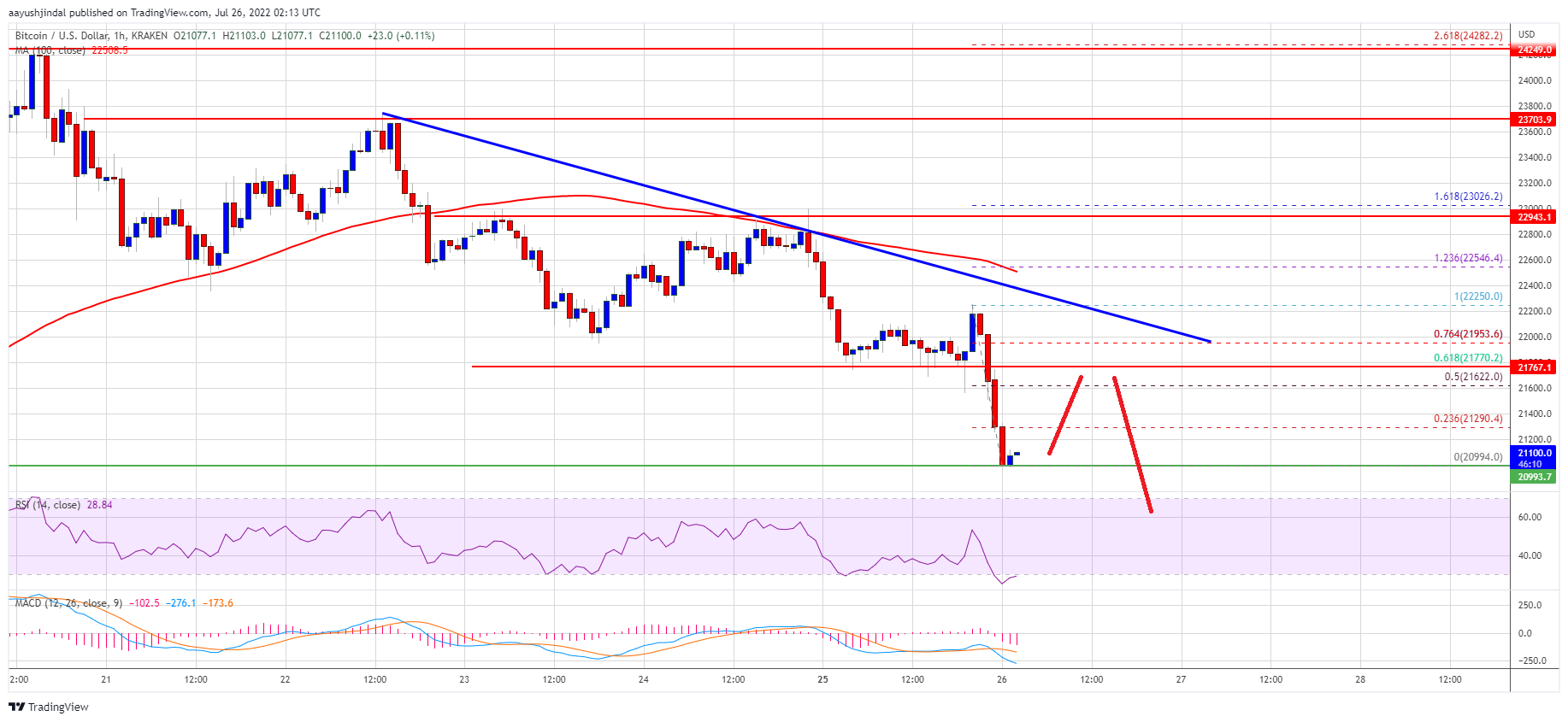
A close above the $22,000 resistance zone could set the pace for more gains. In the stated case, the price may perhaps rise towards the $22,500 level. The next major resistance sits near the $23,000 level.

More Losses in BTC?

If bitcoin fails to start a recovery wave above the $21,650 level, it could continue to move down. An immediate support on the downside is near the $21,000 level.

The next major support now sits near the $20,500 level. A clear break and close below the $20,500 support zone might send the price towards $20,000 in the near term.

Technical indicators:

Hourly MACD – The MACD is now gaining pace in the bearish zone.

Hourly RSI (Relative Strength Index) – The RSI for BTC/USD is well below the 50 level.

Major Support Levels – $21,000, followed by $20,500.

Major Resistance Levels – $21,650, $22,000 and $22,500.

Leituras Relacionadas

Bitcoin Trading Strategy Breakdown: Celebrity Predictions and Classic Models All Fail, Only These Four Indicators Remain

Analysis of Bitcoin Trading Strategies: Why Celebrity Forecasts and Classic Models Fail, Leaving Only These Four Reliable Indicators This analysis examines the failure of common Bitcoin prediction methods and identifies four reliable indicators for constructing a trading strategy. The author reviewed all major BTC prediction approaches from 2017-2025, categorizing them into three groups: celebrity price targets (consistently over-optimistic), analytical models like Stock-to-Flow (broken post-2022), and on-chain signals. The key finding is that more data often creates confusion, not clarity. The strategy discards unreliable elements: celebrity predictions (incentivized to be extreme), pure models (invalidated by post-ETF market changes), and the Fear & Greed Index used alone (too many false signals). Four reliable indicators were selected: 1. **MVRV Z-Score:** Accurately identifies cycle bottoms when entering its green zone (e.g., 2018, 2020, 2022). Note: Its ability to call tops is now ineffective post-2024. 2. **SOPR (28-day MA):** Consistently signals bottoms when below 1.0, indicating holders are selling at a loss. 3. **ETF Net Flow:** A crucial post-2024 metric showing institutional momentum (e.g., sustained inflows = buying). 4. **Macro Liquidity (Fed policy & M2):** Sets the overall directional bias (e.g., bullish during easing cycles). The core strategy involves waiting for a multi-signal共振 (resonance). For example, a bottom signal requires MVRV in the green zone + SOPR < 1.0. A top signal requires overheated on-chain data + sustained ETF outflows. Macro policy sets the overall direction. The Fear & Greed Index is only used as a weighted confirmatory signal, never alone. Action is only taken when three or more indicators align. The author automated this into a monitoring system that sends Telegram alerts only when signals trigger. As of the article's date (April 15, 2026), the system showed a strong bottom signal: extreme fear (F&G=12), MVRV in the buy zone, and SOPR < 1.0. The only contrary signal was weak ETF flows. Historically, such triple on-chain共振 has preceded 100%+ returns. The conclusion emphasizes building a personal framework over relying on external predictions, allowing for iterative improvement and customization based on individual risk tolerance.

marsbitHá 1h

Bitcoin Trading Strategy Breakdown: Celebrity Predictions and Classic Models All Fail, Only These Four Indicators Remain

marsbitHá 1h

Trading

Spot
Futuros
活动图片