Maduro Arrested: A $60 Billion Bitcoin Mystery Surfaces

比推Publicado em 2026-01-06Última atualização em 2026-01-06

Resumo

English Summary: In January 2026, the arrest of Venezuelan President Nicolás Maduro has reignited speculation about a rumored "shadow reserve" of 600,000 to 660,000 Bitcoin (worth $60-67 billion), allegedly accumulated by his regime. The report investigates three primary methods: the failed state-backed "Petro" cryptocurrency, which established a regulatory body later suspected of money laundering; the PDVSA-Crypto scandal involving $21 billion in unaccounted oil revenue potentially converted to crypto via intermediaries and mixers; and military-controlled Bitcoin mining operations using confiscated hardware. However, the existence of this massive Bitcoin holdings remains unverified, lacking concrete on-chain evidence. If real, the keys are likely controlled by a small group (e.g., financier Alex Saab, Maduro's family) using multisig schemes. The uncertainty poses significant market risks—potential massive sell-off if keys are loose, or reduced supply if seized by the US. The story underscores crypto's role in sanctions evasion and the balance between financial freedom and regulatory control.

Author: Cathy, Plain Talk Blockchain

Original Title: Did Maduro Really Hide $60 Billion in BTC?


In the early hours of January 3, 2026, U.S. special forces arrested Venezuelan President Nicolás Maduro in Caracas during a military operation codenamed "Absolute Resolve."

This event has sparked a major question in the crypto world: Did the Maduro regime truly possess the rumored "shadow reserves"?

According to a report from the investigative agency Whale Hunting and multiple intelligence sources, a startling rumor is circulating in the market: the Maduro regime may hold 600,000 to 660,000 Bitcoin. If true, this would be worth a staggering $60-67 billion at early 2026 market prices.

What does this mean?

MicroStrategy (now renamed Strategy), the company known as the "Bitcoin whale," held over 670,000 BTC as of January 2026, valued at approximately $61.3 billion. If the Venezuelan rumor is true, its holdings would be comparable to the world's largest corporate buyer, representing about 3% of Bitcoin's total supply (21 million coins).

But the question is: Does this fortune actually exist? And if so, where is it hidden?

In the crypto world, there's an ironclad rule: "Not your keys, not your coins."

01 How Did the Rumor Originate?

To understand where the rumor of "600,000 BTC" came from, we first need to understand the theoretical avenues through which the Maduro regime could have accumulated Bitcoin. It must be emphasized that the following analysis is based on public reports and intelligence estimates, not proven facts.

Avenue One: The Petro Scam – Paving the Way for Crypto

In February 2018, under heavy pressure from U.S. sanctions, Maduro announced the launch of the world's first "national cryptocurrency" – the Petro. The government claimed it raised $735 million on the first day, with a total fundraising target of $6 billion.

However, multiple investigations revealed serious problems with this ICO from the very beginning.

The Petro was first claimed to be based on Ethereum, then on NEM, and ultimately seemed to run on a private chain that didn't exist. The government claimed the Petro was backed by 5.3 billion barrels of crude oil in the Ayacucho block, but field investigations showed dilapidated infrastructure with no mining activity whatsoever.

The so-called "fundraising" was likely just internal regime assets shifting from one hand to another.

But while the Petro failed, it left a crucial byproduct: Sunacrip (National Superintendency of Crypto Assets). This agency was given the power to regulate all crypto activities, issue mining licenses, and even directly operate national mining pools. It wasn't a regulator; it was a national money laundering center.

In January 2024, Maduro officially shut down the Petro. This wasn't a failure, but a strategic pivot – moving from "issuer" to "holder," fully transitioning to truly globally liquid Bitcoin and USDT.

Avenue Two: The PDVSA-Crypto Scandal – $21 Billion Unaccounted For

Market rumors suggest the core source of the Maduro regime's Bitcoin reserves may have been the diversion of oil export revenues from the state-owned oil company PDVSA.

In 2019, the U.S. imposed comprehensive sanctions on PDVSA, cutting off its access to the global banking system. To survive, PDVSA initiated an "anti-blockade" strategy:

Dark Fleet: Using tankers with transponders turned off to ship crude oil to "teapot refineries" (small, non-state-owned refineries) in Asia.

Intermediary Network: Masking the origin of crude through shell companies registered in the UAE, Russia, and elsewhere. These intermediaries often had no oil trading experience; their only qualification was personal connections to the regime's core figures.

Crypto Settlements: Unable to receive dollar wire transfers, intermediaries were instructed to pay for oil in USDT (Tether).

In March 2023, Venezuela was rocked by the shocking "PDVSA-Crypto" scandal. An internal government audit revealed that approximately $21 billion in accounts receivable from oil exports between 2020 and 2023 was unaccounted for.

Where did this money go? It remains a mystery.

Some intelligence analysts speculate that a portion may have found its way back to regime-controlled wallets via cryptocurrency. Reportedly, Sunacrip established an automated "hop" mechanism:

  • Receive: Intermediaries send USDT to intermediate wallets controlled by Sunacrip

  • Launder: Obfuscate the fund trail through mixers like Tornado Cash

  • Exchange: Convert USDT to Bitcoin at OTC desks in Russia or Eastern Europe

  • Store: Bitcoin transferred to offline-generated cold wallets, with private keys held by the highest levels of the regime

The core designers of this system were Tareck El Aissami (former Oil Minister) and Alex Saab (the regime's "financial diplomat"). El Aissami resigned in March 2023 and was arrested in April 2024 on corruption charges, facing counts of treason, money laundering, and more. The assets he controlled were likely confiscated by the Maduro family.

Saab, however, returned to Venezuela in a prisoner swap with the U.S. in December 2023. Maduro exchanged 10 American prisoners for this financial architect, underscoring his perceived indispensability – an importance likely stemming from his control over the financial lifeline.

Avenue Three: Military Mining – "National Hashrate" from Confiscated Rigs

Beyond oil revenue, another theory suggests the Venezuelan regime may have directly produced Bitcoin by controlling the "means of production."

Venezuela has some of the world's cheapest electricity, primarily from the Guri Dam. This makes Bitcoin mining highly profitable. The Maduro government monopolized this advantage through a military commercial entity – CAMIMPEG (Military Company for Mining, Oil, and Gas).

CAMIMPEG established "Bolivarian Army Digital Asset Production Centers." These military mining farms enjoyed privileges:

  • Guaranteed Power: Priority access during nationwide frequent blackouts

  • Security: Heavily guarded by the National Guard

  • Zero-Cost Operation: With electricity effectively free (state-subsidized), marginal costs were near zero

But where did the equipment for these military farms come from? Largely from the confiscation of private miners.

Starting in 2020, Sunacrip, in conjunction with the military, launched a series of raids on private mining operations:

  • 2020: National Guard seized 315 Antminer S9 units in Bolívar State

  • 2023: Raided the headquarters of the "Tren de Aragua" gang in Tocorón Prison, seizing大量(mining rigs and weapons)

  • 2024: Seized over 2300 Antminer S19J Pro units in a single operation in Maracay

According to intelligence source estimates, between 2020 and 2025, the government may have acquired tens of thousands of mining machines through confiscations from private farms and gang facilities. These devices were not destroyed but redeployed to CAMIMPEG-controlled facilities.

Based on the known thousands of high-performance miners, plus output from state-owned farms, this "zombie army" could have produced tens of thousands of Bitcoin over the past few years.

02 Data Sources and Skepticism Regarding the "600,000 BTC" Rumor

Key Question: Is this number credible?

Based on intelligence reports from Chainalysis, TRM Labs, and the investigative agency "Whale Hunting," the estimated figure circulating in the market is 600,000 to 660,000 BTC. But it must be emphasized:

This figure comes only from intelligence sources, not hard data traceable on the blockchain

No public on-chain evidence supports this number

The Whale Hunting report clearly states: "This estimate is from HUMINT (Human Intelligence), unconfirmed by blockchain analysis"

Nonetheless, the report still provided a hypothetical breakdown:
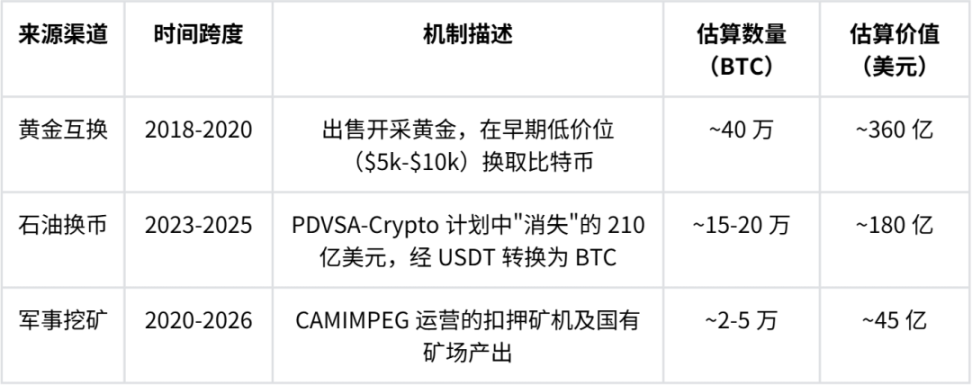
Is this rumor logically plausible?

Supporters' Viewpoints:

MicroStrategy Comparison: MicroStrategy (now Strategy) held over 670,000 BTC as of January 2026. A sovereign nation theoretically has the capacity to reach a similar scale.

Financial Backing: PDVSA had $21 billion unaccounted for in 2020-2023. If 50% of that was converted to Bitcoin, at average prices of the time, it could purchase 300,000-400,000 BTC.

Skeptics' Viewpoints:

  • Lack of On-Chain Evidence: If 600,000 BTC truly existed, traces should be found on the blockchain, but no one has been able to pinpoint specific addresses.

  • Suspiciously Round Number: The figure of 600,000 seems more like an estimate than an actual count and may be significantly overestimated.

  • Questionable Motive: This rumor might be used for political purposes or market manipulation.

Conclusion: In the absence of concrete blockchain evidence, this remains an unverified rumor.

03 If the Rumor is True: Who Would Hold the Private Keys?

Assuming this "shadow reserve" does exist, even Maduro's arrest does not mean the U.S. can control it.

The FBI's primary challenge would be: How to prove the existence of these Bitcoins and find the private keys?

Who might hold the private keys?

If this asset exists, intelligence analysts speculate it is unlikely managed by a single account, but more likely uses a multi-signature (Multisig) or private key sharding scheme.

Theoretical key holders might include:

  • Alex Saab: As the regime's financial architect, Saab not only understands the full picture of fund flows but likely holds the recovery seed phrases or knows the physical location of hardware wallets. His return to Venezuela in the December 2023 prisoner swap – 10 American prisoners for this financial brain – highlights his indispensability to the regime.

  • Nicolasito (Maduro's Son): Named in indictments, he was deeply involved in illegal gold mining and the regime's daily operations, potentially holding a backup of the family's portion of the private keys.

  • Cilia Flores (First Lady): Known as the "First Combatant," she holds a high position within the regime's inner circle. She might control physical access to some cold wallets.

  • Technocrat Layer: Former Sunacrip technicians might be responsible for maintaining the multi-signature technical infrastructure. While they might not know the complete private keys, their cooperation could be crucial for reconstructing wallet access.

Speculated Crypto Architecture

The most likely architecture is an M-of-N signature scheme (e.g., 3/5 or 5/7). This means signatures from 3 out of 5 core individuals would be required to move the funds.

If Maduro, Flores, and Saab were all under U.S. control, theoretically the U.S. could compel them to cooperate in unlocking the funds. But reality is far more complex:

  • Geographic Dispersion: Cold wallets could be stored分散ly in bunkers in Caracas, safes in Russia, or safe houses in Cuba.

  • Dead Man's Switch: The system might include an automatic trigger mechanism. If specific actions aren't performed for a prolonged period (e.g., Maduro goes missing), funds could automatically transfer to irrecoverable addresses or be sent to allies.

  • Ideological Resistance: Even facing life imprisonment, core figures holding the keys might refuse to cooperate. For them, this is not just wealth, but the final weapon against "American imperialism."

04 Market Impact: The Rumor Itself is Uncertainty

Even if this rumor is unverified, it has itself become a "Sword of Damocles" hanging over the crypto market. 600,000 Bitcoin represents 3% of BTC's total supply. If real, the impact would be enormous.

Three Possible Scenarios

Scenario One: Rumor is False

If thorough investigation by the FBI and blockchain analysis firms ultimately proves this "shadow reserve" does not exist or is severely overestimated, the market might breathe a sigh of relief. This means no potential selling pressure, neutral or slightly bullish for price.

Scenario Two: Rumor is True and FBI Gains Control

If this asset exists and the U.S. successfully seizes it, following standard procedure, these Bitcoin would enter judicial freezing, potentially locked for years. This effectively locks up a huge supply, reducing market circulation, which is bullish for price.

This is similar to the FBI's seizure of Silk Road Bitcoin in 2013. Around 170,000 BTC were frozen and eventually auctioned in batches. But during the freeze, these coins exited circulation, objectively reducing market selling pressure.

Scenario Three: Rumor is True but Keys are Lost

This is the most dangerous scenario. If the asset exists but the private keys are not controlled by the U.S., remnants of the fleeing regime might attempt to sell Bitcoin on OTC markets to fund their escape, triggering panic selling.

The German government's sale of just 50,000 BTC in 2024 caused short-term market volatility. 600,000 in selling pressure would be catastrophic.

05 Summary

Maduro's arrest has revealed a glimpse of the Venezuelan regime's use of cryptocurrency to evade sanctions.

From the failed Petro experiment to the $21 billion PDVSA-Crypto scandal, to militarized mining facilities – these are all confirmed facts. But the rumor of a "600,000 BTC shadow reserve" still lacks solid evidence.

What we can confirm: Venezuela did use crypto to evade sanctions, PDVSA did have $21 billion unaccounted for, and the regime did confiscate大量mining equipment.

What we cannot confirm includes: Whether 600,000 BTC were actually accumulated, who holds the private keys (if they exist), and whether these Bitcoin will enter the market.

This indeed raises a尖锐question: When decentralized technology is used to evade sanctions, how do we find a balance between freedom and order?

But until more evidence surfaces, the "$60 billion shadow reserve" remains just an unverified rumor.


Twitter:https://twitter.com/BitpushNewsCN

Bitpush TG Discussion Group:https://t.me/BitPushCommunity

Bitpush TG Subscription: https://t.me/bitpush

Original link:https://www.bitpush.news/articles/7600464

Perguntas relacionadas

QWhat is the alleged value of the Bitcoin 'shadow reserves' linked to the Maduro regime, and how does it compare to MicroStrategy's holdings?

AThe alleged Bitcoin 'shadow reserves' linked to the Maduro regime are estimated to be worth between $60 billion and $67 billion at early 2026 prices. This is comparable to MicroStrategy (now named Strategy), which held over 670,000 BTC worth approximately $61.3 billion at the time.

QWhat were the three primary methods theorized for how the Maduro regime could have accumulated Bitcoin?

AThe three primary theorized methods are: 1) The failed Petro coin ICO, which established the infrastructure for crypto operations. 2) The diversion of an estimated $21 billion in missing oil export receivables from PDVSA, potentially settled in USDT and converted to Bitcoin. 3) The confiscation and state-operated military mining of Bitcoin using seized hardware and subsidized electricity.

QWhat major event in January 2026 is central to this story, and what key question did it raise?

AThe central event was the arrest of Venezuelan President Nicolás Maduro by U.S. special forces in a military operation codenamed 'Absolute Determination' on January 3, 2026. This event raised the key question of whether the Maduro regime truly possessed the rumored massive 'shadow reserve' of Bitcoin.

QAccording to the article, what is the main reason the '600,000 BTC' figure is still considered an unverified rumor?

AThe main reason is a lack of concrete on-chain evidence. The figure is based on human intelligence (HUMINT) reports and estimates, but no specific blockchain addresses or verifiable data have been publicly identified to confirm the existence or the exact amount of these holdings.

QWho are the key individuals speculated to potentially hold the private keys to these alleged Bitcoin reserves?

AThe key individuals speculated to hold the private keys or parts of them include: Alex Saab (the regime's financial architect), Nicolás Maduro's son 'Nicolasito', First Lady Cilia Flores, and possibly former technical staff from the national crypto asset regulator, Sunacrip. The assets were likely secured using a multi-signature scheme requiring cooperation from several of these individuals.

Leituras Relacionadas

Trading

Spot
Futuros

Artigos em Destaque

O que é BITCOIN

Compreender o HarryPotterObamaSonic10Inu (ERC-20) e a Sua Posição no Espaço Cripto Nos últimos anos, o mercado de criptomoedas assistiu a um aumento na popularidade das moedas meme, cativando não apenas os traders, mas também aqueles que procuram envolvimento comunitário e valor de entretenimento. Entre estes tokens únicos está o HarryPotterObamaSonic10Inu (ERC-20), um projeto intrigante que mistura referências culturais no tecido das criptomoedas. Este artigo explora os principais aspetos do HarryPotterObamaSonic10Inu, examinando os seus mecanismos, a sua ética orientada pela comunidade e o seu envolvimento com o vasto panorama cripto. O que é o HarryPotterObamaSonic10Inu (ERC-20)? Como o nome sugere, o HarryPotterObamaSonic10Inu é uma moeda meme construída na blockchain Ethereum, classificada sob o padrão ERC-20. Ao contrário das criptomoedas tradicionais, que podem enfatizar a utilidade prática ou o potencial de investimento, este token prospera no valor de entretenimento e na força da sua comunidade. O projeto visa promover um ambiente onde utilizadores envolvidos possam reunir-se, partilhar ideias e participar em atividades inspiradas por diversos fenómenos culturais. Uma característica notável do HarryPotterObamaSonic10Inu é a zero taxa sobre transações. Este elemento atraente visa encorajar a negociação e o envolvimento da comunidade, isento de encargos adicionais que podem desencorajar os traders de pequena escala. A oferta total da moeda está fixada em mil milhões de tokens, uma cifra que marca a sua intenção de manter uma circulação substancial dentro da comunidade. Criador do HarryPotterObamaSonic10Inu (ERC-20) As origens do HarryPotterObamaSonic10Inu estão um pouco envoltas em mistério; os detalhes sobre o criador permanecem desconhecidos. O desenvolvimento deste token carece de uma equipa identificável ou de um plano explícito, o que não é raro no setor das moedas meme. Em vez disso, o projeto surgiu de forma orgânica, com o seu progresso a depender fortemente do entusiasmo e da participação da sua comunidade. Investidores do HarryPotterObamaSonic10Inu (ERC-20) No que diz respeito a investimentos externos e apoios, o HarryPotterObamaSonic10Inu também permanece ambíguo. O token não lista quaisquer fundações de investimento conhecidas ou apoio organizacional significativo. Em vez disso, o “sangue vital” do projeto é a sua comunidade de base, que informa o seu crescimento e sustentabilidade através da ação coletiva e do envolvimento no espaço cripto. Como Funciona o HarryPotterObamaSonic10Inu (ERC-20)? Como uma moeda meme, o HarryPotterObamaSonic10Inu opera principalmente fora dos quadros tradicionais que muitas vezes governam o valor dos ativos. Existem vários aspetos distintivos que definem como o projeto funciona: Transações Sem Taxas: Sem taxas sobre transações, os utilizadores podem comprar e vender o token livremente, sem a preocupação de custos ocultos. Envolvimento da Comunidade: O projeto prospera na interação da comunidade, aproveitando plataformas de redes sociais para criar entusiasmo e facilitar a participação. Discussões, partilha de conteúdo e envolvimento são elementos cruciais que ajudam a expandir o seu alcance e a fomentar a lealdade entre os apoiantes. Sem Utilidade Prática: Deve ser notado que o HarryPotterObamaSonic10Inu não oferece utilidade concreta dentro do ecossistema financeiro. Em vez disso, é classificado como um token principalmente para entretenimento e atividades comunitárias. Referência Cultural: O token incorpora de forma inteligente elementos da cultura popular para atrair interesse, conectando-se tanto com entusiastas de memes como com seguidores de criptomoedas. HarryPotterObamaSonic10Inu exemplifica como as moedas meme operam de forma diferente de projetos de criptomoedas mais tradicionais, entrando no mercado como construções sociais inovadoras em vez de ativos utilitários. Linha do Tempo do HarryPotterObamaSonic10Inu (ERC-20) A história do HarryPotterObamaSonic10Inu é marcada por vários marcos notáveis: Criação: O token surgiu de um meme viral, capturando a imaginação de muitos entusiastas de criptomoedas. Datas específicas de criação não estão disponíveis, sublinhando a sua ascensão orgânica. Listagem em Exchanges: O HarryPotterObamaSonic10Inu conseguiu entrar em várias exchanges, permitindo um acesso e negociação mais fáceis pela comunidade. Iniciativas de Envolvimento da Comunidade: Atividades contínuas direcionadas a melhorar a interação comunitária, incluindo concursos, campanhas em redes sociais e geração de conteúdo por fãs e defensores. Planos de Expansão Futura: O roteiro do projeto inclui o lançamento de uma coleção de NFTs, mercadorias e um site de eCommerce relacionado aos seus temas culturais, envolvendo ainda mais a comunidade e tentando adicionar mais dimensões ao seu ecossistema. Pontos-Chave sobre o HarryPotterObamaSonic10Inu (ERC-20) Natureza Orientada pela Comunidade: O projeto prioriza a contribuição coletiva e a criatividade, assegurando que o envolvimento dos utilizadores está na vanguarda do seu desenvolvimento. Classificação como Moeda Meme: Representa o epítome da criptomoeda baseada em entretenimento, destacando-se dos veículos de investimento tradicionais. Sem Afiliação Direta com o Bitcoin: Apesar da semelhança no nome do ticker, o HarryPotterObamaSonic10Inu é distinto e não tem qualquer relação com o Bitcoin ou outras criptomoedas estabelecidas. Foco na Colaboração: O HarryPotterObamaSonic10Inu é projetado para criar um espaço de colaboração e partilha de histórias entre os seus detentores, proporcionando uma via para a criatividade e o fortalecimento da comunidade. Perspectivas Futuras: A ambição de expandir além da sua premissa inicial para NFTs e mercadorias delineia um caminho para o projeto potencialmente entrar em avenidas mais mainstream dentro da cultura digital. À medida que as moedas meme continuam a capturar a imaginação da comunidade cripto, HarryPotterObamaSonic10Inu (ERC-20) destaca-se devido aos seus laços culturais e abordagem centrada na comunidade. Embora possa não se encaixar no molde típico de um token orientado para utilidade, a sua essência reside na alegria e camaradagem fomentadas entre os seus apoiantes, destacando a natureza em evolução das criptomoedas em uma era cada vez mais digital. À medida que o projeto continua a desenvolver-se, será importante observar como as dinâmicas comunitárias influenciam a sua trajetória no panorama em constante mudança da tecnologia blockchain.

576 Visualizações TotaisPublicado em {updateTime}Atualizado em 2024.12.03

O que é BITCOIN

Como comprar BTC

Bem-vindo à HTX.com!Tornámos a compra de Bitcoin (BTC) simples e conveniente.Segue o nosso guia passo a passo para iniciar a tua jornada no mundo das criptos.Passo 1: cria a tua conta HTXUtiliza o teu e-mail ou número de telefone para te inscreveres numa conta gratuita na HTX.Desfruta de um processo de inscrição sem complicações e desbloqueia todas as funcionalidades.Obter a minha contaPasso 2: vai para Comprar Cripto e escolhe o teu método de pagamentoCartão de crédito/débito: usa o teu visa ou mastercard para comprar Bitcoin (BTC) instantaneamente.Saldo: usa os fundos da tua conta HTX para transacionar sem problemas.Terceiros: adicionamos métodos de pagamento populares, como Google Pay e Apple Pay, para aumentar a conveniência.P2P: transaciona diretamente com outros utilizadores na HTX.Mercado de balcão (OTC): oferecemos serviços personalizados e taxas de câmbio competitivas para os traders.Passo 3: armazena teu Bitcoin (BTC)Depois de comprar o teu Bitcoin (BTC), armazena-o na tua conta HTX.Alternativamente, podes enviá-lo para outro lugar através de transferência blockchain ou usá-lo para transacionar outras criptomoedas.Passo 4: transaciona Bitcoin (BTC)Transaciona facilmente Bitcoin (BTC) no mercado à vista da HTX.Acede simplesmente à tua conta, seleciona o teu par de trading, executa as tuas transações e monitoriza em tempo real.Oferecemos uma experiência de fácil utilização tanto para principiantes como para traders experientes.

3.2k Visualizações TotaisPublicado em {updateTime}Atualizado em 2025.03.21

Como comprar BTC

O que é $BITCOIN

OURO DIGITAL ($BITCOIN): Uma Análise Abrangente Introdução ao OURO DIGITAL ($BITCOIN) OURO DIGITAL ($BITCOIN) é um projeto baseado em blockchain que opera na rede Solana, com o objetivo de combinar as características dos metais preciosos tradicionais com a inovação das tecnologias descentralizadas. Embora partilhe um nome com o Bitcoin, frequentemente referido como “ouro digital” devido à sua percepção como uma reserva de valor, o OURO DIGITAL é um token separado projetado para criar um ecossistema único dentro da paisagem Web3. O seu objetivo é posicionar-se como um ativo digital alternativo viável, embora os detalhes sobre as suas aplicações e funcionalidades ainda estejam em desenvolvimento. O que é o OURO DIGITAL ($BITCOIN)? OURO DIGITAL ($BITCOIN) é um token de criptomoeda explicitamente projetado para uso na blockchain Solana. Em contraste com o Bitcoin, que fornece um papel amplamente reconhecido como armazenamento de valor, este token parece focar em aplicações e características mais amplas. Aspectos notáveis incluem: Infraestrutura Blockchain: O token é construído na blockchain Solana, conhecida pela sua capacidade de lidar com transações de alta velocidade e baixo custo. Dinâmicas de Oferta: O OURO DIGITAL tem um fornecimento máximo limitado a 100 quatrilhões de tokens (100P $BITCOIN), embora os detalhes sobre o seu fornecimento circulante ainda não tenham sido divulgados. Utilidade: Embora as funcionalidades precisas não estejam explicitamente delineadas, existem indicações de que o token poderia ser utilizado para várias aplicações, potencialmente envolvendo aplicações descentralizadas (dApps) ou estratégias de tokenização de ativos. Quem é o Criador do OURO DIGITAL ($BITCOIN)? Neste momento, a identidade dos criadores e da equipa de desenvolvimento por trás do OURO DIGITAL ($BITCOIN) permanece desconhecida. Esta situação é típica entre muitos projetos inovadores no espaço da blockchain, particularmente aqueles alinhados com finanças descentralizadas e fenómenos de moedas meme. Embora tal anonimato possa fomentar uma cultura orientada pela comunidade, intensifica as preocupações sobre governança e responsabilidade. Quem são os Investidores do OURO DIGITAL ($BITCOIN)? As informações disponíveis indicam que o OURO DIGITAL ($BITCOIN) não tem apoiantes institucionais conhecidos ou investimentos proeminentes de capital de risco. O projeto parece operar num modelo peer-to-peer focado no apoio e adoção da comunidade, em vez de rotas de financiamento tradicionais. A sua atividade e liquidez estão principalmente situadas em exchanges descentralizadas (DEXs), como a PumpSwap, em vez de plataformas de negociação centralizadas estabelecidas, destacando ainda mais a sua abordagem de base. Como Funciona o OURO DIGITAL ($BITCOIN) A mecânica operacional do OURO DIGITAL ($BITCOIN) pode ser elaborada com base no seu design de blockchain e nas características da rede: Mecanismo de Consenso: Ao aproveitar o exclusivo proof-of-history (PoH) da Solana combinado com um modelo de proof-of-stake (PoS), o projeto assegura uma validação eficiente das transações, contribuindo para o alto desempenho da rede. Tokenomics: Embora mecanismos deflacionários específicos não tenham sido extensivamente detalhados, o vasto fornecimento máximo de tokens implica que pode atender a microtransações ou casos de uso de nicho que ainda estão por definir. Interoperabilidade: Existe o potencial para integração com o ecossistema mais amplo da Solana, incluindo várias plataformas de finanças descentralizadas (DeFi). No entanto, os detalhes sobre integrações específicas permanecem não especificados. Cronologia de Eventos Chave Aqui está uma cronologia que destaca marcos significativos relacionados ao OURO DIGITAL ($BITCOIN): 2023: O lançamento inicial do token ocorre na blockchain Solana, marcado pelo seu endereço de contrato. 2024: O OURO DIGITAL ganha visibilidade ao tornar-se disponível para negociação em exchanges descentralizadas como a PumpSwap, permitindo que os utilizadores o negociem contra SOL. 2025: O projeto testemunha atividade de negociação esporádica e potencial interesse em envolvimentos liderados pela comunidade, embora não tenham sido documentadas parcerias ou avanços técnicos notáveis até ao momento. Análise Crítica Forças Escalabilidade: A infraestrutura subjacente da Solana suporta altos volumes de transações, o que pode aumentar a utilidade do $BITCOIN em vários cenários de transação. Acessibilidade: O potencial preço de negociação baixo por token pode atrair investidores de retalho, facilitando uma participação mais ampla devido a oportunidades de propriedade fracionada. Riscos Falta de Transparência: A ausência de apoiantes, desenvolvedores ou um processo de auditoria publicamente conhecidos pode gerar ceticismo em relação à sustentabilidade e confiabilidade do projeto. Volatilidade do Mercado: A atividade de negociação depende fortemente do comportamento especulativo, o que pode resultar em volatilidade significativa dos preços e incerteza para os investidores. Conclusão O OURO DIGITAL ($BITCOIN) surge como um projeto intrigante, mas ambíguo, dentro do ecossistema em rápida evolução da Solana. Embora tente aproveitar a narrativa do “ouro digital”, a sua divergência do papel estabelecido do Bitcoin como reserva de valor sublinha a necessidade de uma diferenciação mais clara da sua utilidade pretendida e estrutura de governança. A aceitação e adoção futuras dependerão provavelmente da abordagem da atual opacidade e da definição mais explícita das suas estratégias operacionais e económicas. Nota: Este relatório abrange informações sintetizadas disponíveis até outubro de 2023, e desenvolvimentos podem ter ocorrido além do período de pesquisa.

92 Visualizações TotaisPublicado em {updateTime}Atualizado em 2025.05.13

O que é $BITCOIN

Discussões

Bem-vindo à Comunidade HTX. Aqui, pode manter-se informado sobre os mais recentes desenvolvimentos da plataforma e obter acesso a análises profissionais de mercado. As opiniões dos utilizadores sobre o preço de BTC (BTC) são apresentadas abaixo.

活动图片