Bitcoin Ends Q4 In The Red, Bear Market May Persist For 2–3 Months

bitcoinistPublished on 2025-12-27Last updated on 2025-12-27

Abstract

Bitcoin concludes Q4 2025 with a 19.15% decline, having fallen 30% from its October high of $126,200 to around $87,400. Analyst GugaOnChain warns the bearish trend may persist for 2-3 months into early 2026, citing multiple negative indicators. Key metrics include SOPR below 1, signaling investors are selling at a loss; MVRV-STH at 0.87, indicating short-term holders are underwater; and 35.66% of Bitcoin supply in loss. The Fear & Greed Index reflects extreme fear at 20. Institutional outflows from US spot ETFs and a negative Coinbase Premium Gap further confirm weak demand. Market cap growth is negative at -11.65%, reinforcing the expectation of continued corrections until capitulation signals ease.

Bitcoin is closing the fourth quarter of 2025 on a weak note, reinforcing concerns that the market’s correction phase is far from over. After peaking at around $126,200 in early October, the flagship cryptocurrency has slipped into a sustained downturn, losing 30% of its market value at press time.

Since that peak, Bitcoin has struggled to decisively reclaim the $92,000 level, with repeated rejection at higher prices highlighting fading demand and growing caution among investors. Notably, crypto analyst GugaOnChain warns that the poor quarterly close could extend downside pressure into early 2026, as both on-chain data and sentiment indicators point to a continuation of bearish conditions.

Capitulation Indicators Signal Market Stress To Remain In 2026

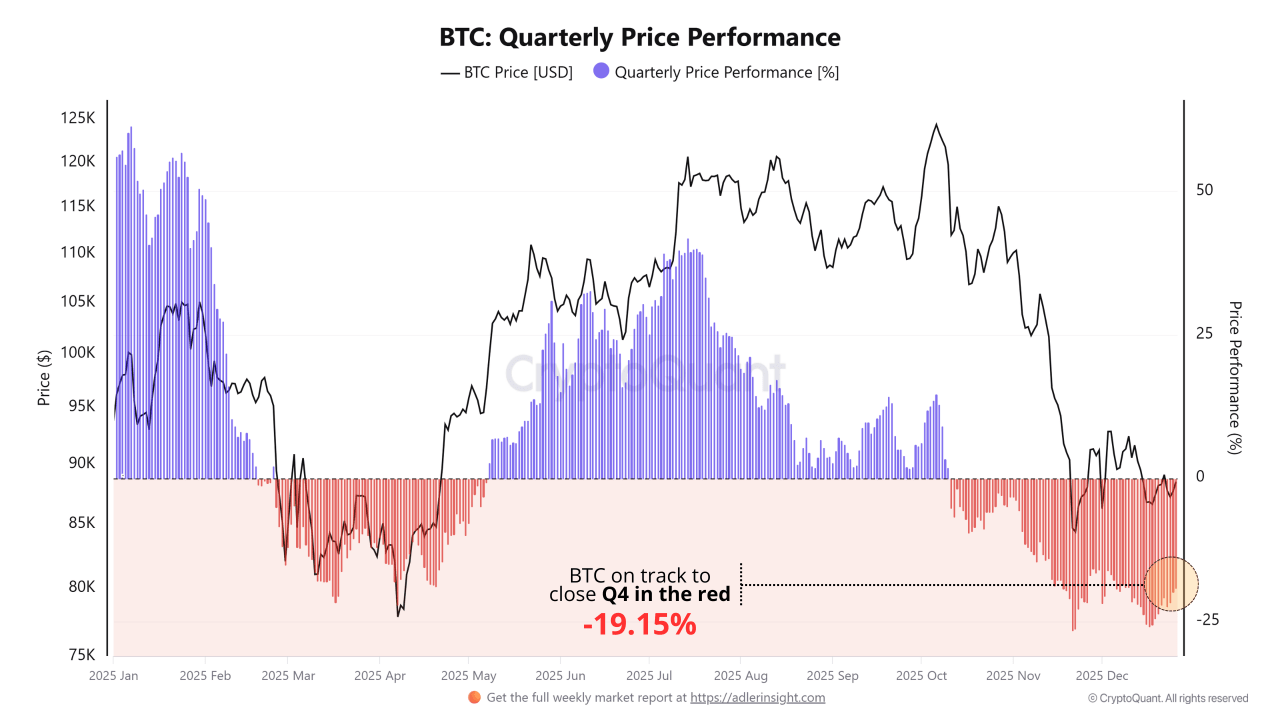
According to GugaOnChain in the QuickTake post on Friday, the BTC: Quarterly Price Performance indicator reports a negative Q4 performance of -19.15%, which serves as the foundation of this bearish outlook. Furthermore, several key capitulation indicators also suggest that the market is unprepared for any form of bullish revival.

For example, the Spent Output Profit Ratio (SOPR) currently sits below 1 at 0.99, indicating that investors are selling Bitcoin at a loss, a common feature of bear market phases. Similarly, the Short-Term Holder MVRV (MVRV-STH) remains below 1 at 0.87, signaling that short-term holders are deeply underwater and more prone to capitulation at the moment.

Further reinforcing this narrative, GugaOnChain points to the elevated percentage of Bitcoin supply in loss, currently standing at 35.66%, pushing more BTC holders into significant loss positions, thereby reducing confidence and driving market stress. In addition to these metrics, the Fear & Greed Index has dropped into the “extreme fear” zone at 20, suggesting widespread pessimism and risk aversion among participants.
Source: CryptoQuant

Bear Market Confirmation Indicators

Beyond capitulation metrics, GugaOnChain highlights additional confirmation indicators that suggest that downside risks will remain dominant in the near term. One of these indicators, the Market Cap Growth Rate, measured by the 30-day versus 365-day moving average gap ratio, is firmly negative at -11.65%, pointing to contracting market growth rather than expansion.

Institutional flows also reflect waning confidence. US Bitcoin spot ETFs recorded $825.7 million in net outflows between December 18 and December 24, 2025, highlighting reduced institutional appetite as the Q4 price struggles persist. Meanwhile, the Coinbase Premium Gap has remained negative at –66.11, signaling weaker demand from US-based investors compared to offshore markets.

In assessing these several metrics together, GugaOnChain concludes the crypto market is likely to remain in a bear phase for the next two to three months. Therefore, investors should anticipate further corrections in the first quarter of 2026 until the capitulation signals ease and demand is stabilized.

At press time, Bitcoin trades at $87,436, reflecting a slight market loss of 0.42% in the last day.


BTC trading at $87,660 on the daily chart | Source: BTCUSDT chart on Tradingview.com

Trending Cryptos

Related Questions

QWhat was Bitcoin's peak price in early October 2025, and what is its current percentage loss from that peak?

ABitcoin peaked at around $126,200 in early October 2025 and has lost 30% of its market value from that peak at press time.

QAccording to GugaOnChain, what is the two key capitulation indicators that signal investors are selling at a loss and are deeply underwater?

AThe two key capitulation indicators are the Spent Output Profit Ratio (SOPR) at 0.99, indicating selling at a loss, and the Short-Term Holder MVRV (MVRV-STH) at 0.87, signaling short-term holders are deeply underwater.

QWhat does the negative Market Cap Growth Rate of -11.65% indicate about the Bitcoin market?

AThe negative Market Cap Growth Rate of -11.65% indicates the market is contracting rather than expanding, pointing to dominant downside risks in the near term.

QHow did US Bitcoin spot ETFs perform in terms of net flows between December 18 and December 24, 2025, and what does this signify?

AUS Bitcoin spot ETFs recorded $825.7 million in net outflows during that period, highlighting reduced institutional appetite as the Q4 price struggles persist.

QWhat is the overall conclusion from the analyst regarding the expected duration of the current bear market phase?

AThe analyst concludes that the crypto market is likely to remain in a bear phase for the next two to three months, with further corrections expected in the first quarter of 2026.

Related Reads

Airwallex Founder "Slaps His Own Face": From Ranting Against Stablecoins to Building His Own Chain

Jack Zhang, co-founder and CEO of Airwallex, publicly dismissed stablecoins in June 2025, saying they could not lower costs and that crypto had solved no real-world problems in 15 years. Just 17 months later, he co-founded Alta, a blockchain company that raised $80 million to build an L1 designed specifically for licensed financial institutions. The turnaround reflects a broader industry shift: Stripe acquired Bridge for $1.1 billion and incubated Tempo, Circle launched Arc, and stablecoin market cap doubled past $300 billion as U.S. and Hong Kong regulation brought institutional certainty. Alta, co-founded with Loong Wang and Catherine Porter, uses recursive zero-knowledge cryptography to combine compliance with privacy, embedding programmable compliance and identity directly into the protocol—features general-purpose chains cannot offer banks. Airwallex serves as Alta's distribution channel, connecting the chain to its network across 200 countries and 90 currencies. Zhang's stated logic is consistent: he never endorsed crypto broadly, but now sees stablecoins as the on-chain form of fiat currency and a new settlement layer. The real battle is over who controls stablecoin settlement infrastructure, with Stripe, Circle, Fireblocks, and Canton Network all racing to build chain-level rails. Zhang's shift is less a conversion than a commercial necessity: as stablecoin settlement becomes standard for enterprise payments, payment companies that do not own the settlement layer risk becoming application-layer interfaces running on someone else's chain.

marsbit1h ago

Airwallex Founder "Slaps His Own Face": From Ranting Against Stablecoins to Building His Own Chain

marsbit1h ago

The Art of the Trade: How They Made Money Arbitraging USDE Stock

Starkiller Capital outlines a arbitrage trade on StablecoinX (Nasdaq: USDE), a crypto treasury company holding about 20% of ENA tokens. At Friday's close, USDE traded at $6.43 per share, with each share backed by 125.48 ENA worth $20.10—meaning investors pay 32 cents per $1 of ENA, or $155M for $485M in tokens. The firm's approach: buy USDE stock while shorting an equal dollar amount of ENA, so if both fall but the stock falls less, short gains offset stock losses. Starkiller first entered in August at 0.18x mNAV, took profits as the discount narrowed to 0.60x, and has rebuilt a larger position at 0.32x. The key new catalyst: Ethena's foundation waived all token lockups effective October 5, letting the company sell ENA to fund an approved share buyback. At current prices, every $1 of ENA sold repurchases shares representing $3.13 of token assets, strongly accretionary to NAV per share. The discount widened recently not because of company fundamentals but because crypto market beta fell—ENA dropped 29% and比特币 7% in October—and because USDE holders exiting ENA exposure sold the illiquid stock; short interest rose 78% to ~15% of float. Risks include: no redemption mechanism forcing convergence (GBTC traded at a discount for two years), the foundation controls the exit path and must approve token sales, a resale S-1 covers over half the A-shares, mNAV has ranged from 0.13x to 0.61x, warrants at $11.50 and $15 strike could dilute upside, and a crypto crash could push mNAV back to lows. Catalysts to watch: the Q3 10-Q filing (due by Nov 16) for buyback details. Starkiller argues the stock should eventually trade around 0.7x mNAV, implying roughly 56% upside on the long leg just from a return to the October 5 level.

marsbit1h ago

The Art of the Trade: How They Made Money Arbitraging USDE Stock

marsbit1h ago

Embedded chip vendors are starting to sell modules directly?

On November 5, Texas Instruments (TI) announced the TICS100MOD, a multi-protocol industrial communication System-on-Module (SoM) supporting EtherCAT, PROFINET, and EtherNet/IP, with volume availability expected by the end of 2026. The module integrates TI's AM2612 real-time MCU—featuring dual Arm Cortex-R5F cores and PRU-ICSS—along with two DP83826AI 100Mbps Ethernet PHYs, protocol stacks, SDK, and development tools in a 30mm × 18mm package. It connects to an external host MCU or MPU via SPI or QSPI, handling industrial Ethernet protocol processing while the host runs device control and applications. The article notes that while MPU-based SoMs are common, MCU-based SoMs are relatively rare, and TI's MCU is powerful and complex enough to justify a module. TI is not the first chip vendor to offer its own SoM products: Microchip has offered SoMs such as the ATSAMA5D27-SOM1 and SAM9X60D1G-SOM, some suitable for surface-mount reflow soldering, while AMD offers the Kria K26 and K24 SoM series. In wireless connectivity, Espressif and Silicon Labs similarly provide chips alongside modules. In China, SoMs are typically called core boards, with vendors including Chuanglong Technology, MYIR Electronics, Forlinx, ZLG, and Alientek, covering TI, NXP, ST, Renesas, and domestic platforms such as Rockchip and Allwinner. TI continues to partner with third-party SoM vendors—including Chuanglong, MYIR, and Alientek around the AM62L processor, and internationally with Toradex, Variscite, Ezurio, and PHYTEC. TI's new TICS100MOD focuses specifically on industrial Ethernet communication, while customers needing complex computing platforms are still served through third-party partners.

marsbit2h ago

Embedded chip vendors are starting to sell modules directly?

marsbit2h ago

Morgan Stanley's "Memory Grim Reaper" Shawn Kim Warns Again: The Real Bomb Is the "2028 Profit Cliff," Broadly Cuts Memory Stock Price Targets

Morgan Stanley analyst Shawn Kim, dubbed Korea's "semiconductor grim reaper," has issued a new warning on the memory sector, targeting a "2028 profit cliff." In a November 9 report, he cut price targets for Samsung Electronics and SK Hynix, naming Samsung as his new top pick over SK Hynix. The core debate has shifted from near-term fundamentals to the "2028 profit cliff," driven by four pressures: (1) faster-than-expected supply response as new capacity ramps up around late 2027, with Chinese suppliers adding pricing pressure; (2) delayed 2028 data center construction—about 5GW of US projects pushed from 2028 to 2029, cutting global data center capacity growth from ~21% to 9% in 2028; (3) BOM cost constraints, with memory now ~60% of AI server costs, forcing buyers to downgrade configurations, while NAND spot prices fell ~20% in two weeks; and (4) narrowing HBM premiums as competition intensifies. Kim slashed SK Hynix's target price by 38% to 1.6 million won and Samsung's by 19% to 309,000 won, driven by lower long-term margin assumptions—SK Hynix's 2029-2035 DRAM operating margin cut to ~32% (near the 31% historical average) and Samsung's to ~39%, with HBM premiums assumed to fade to zero by 2033. Near-term 2026-2028 EPS estimates were raised on buyback-driven share reduction. Despite the warning, Kim is not fully bearish. The SOX forward P/E has halved from 26.3x to 13.4x since June, roughly matching past downturn troughs, while consensus EPS rose 24%. He argues valuation has done its job; the key variable now is earnings. Of 11 SOX downturns since 2000, nine were valuation-driven, with deep earnings cuts only in 2000-2002 and 2007-2008. AI supply chain EPS revision breadth is narrowing but still positive. Samsung is favored for its size, capital strength, and expected HBM share overtake in 2027 (~39% vs. SK Hynix's ~37%), plus diversified businesses. SK Hynix retains its HBM leadership and long-term agreement protection, though its post-2028 excess profit period is seen as shorter.

marsbit2h ago

Morgan Stanley's "Memory Grim Reaper" Shawn Kim Warns Again: The Real Bomb Is the "2028 Profit Cliff," Broadly Cuts Memory Stock Price Targets

marsbit2h ago

Trading

Spot

Hot Articles

What is $BITCOIN

DIGITAL GOLD ($BITCOIN): A Comprehensive Analysis Introduction to DIGITAL GOLD ($BITCOIN) DIGITAL GOLD ($BITCOIN) is a blockchain-based project operating on the Solana network, which aims to combine the characteristics of traditional precious metals with the innovation of decentralized technologies. While it shares a name with Bitcoin, often referred to as “digital gold” due to its perception as a store of value, DIGITAL GOLD is a separate token designed to create a unique ecosystem within the Web3 landscape. Its goal is to position itself as a viable alternative digital asset, although specifics regarding its applications and functionalities are still developing. What is DIGITAL GOLD ($BITCOIN)? DIGITAL GOLD ($BITCOIN) is a cryptocurrency token explicitly designed for use on the Solana blockchain. In contrast to Bitcoin, which provides a widely recognized value storage role, this token appears to focus on broader applications and characteristics. Notable aspects include: Blockchain Infrastructure: The token is built on the Solana blockchain, known for its capacity to handle high-speed and low-cost transactions. Supply Dynamics: DIGITAL GOLD has a maximum supply capped at 100 quadrillion tokens (100P $BITCOIN), although details regarding its circulating supply are currently undisclosed. Utility: While precise functionalities are not explicitly outlined, there are indications that the token could be utilized for various applications, potentially involving decentralized applications (dApps) or asset tokenization strategies. Who is the Creator of DIGITAL GOLD ($BITCOIN)? At present, the identity of the creators and development team behind DIGITAL GOLD ($BITCOIN) remains unknown. This situation is typical among many innovative projects within the blockchain space, particularly those aligning with decentralized finance and meme coin phenomena. While such anonymity may foster a community-driven culture, it intensifies concerns about governance and accountability. Who are the Investors of DIGITAL GOLD ($BITCOIN)? The available information indicates that DIGITAL GOLD ($BITCOIN) does not have any known institutional backers or prominent venture capital investments. The project seems to operate on a peer-to-peer model focused on community support and adoption rather than traditional funding routes. Its activity and liquidity are primarily situated on decentralized exchanges (DEXs), such as PumpSwap, rather than established centralized trading platforms, further highlighting its grassroots approach. How DIGITAL GOLD ($BITCOIN) Works The operational mechanics of DIGITAL GOLD ($BITCOIN) can be elaborated on based on its blockchain design and network attributes: Consensus Mechanism: By leveraging Solana’s unique proof-of-history (PoH) combined with a proof-of-stake (PoS) model, the project ensures efficient transaction validation contributing to the network's high performance. Tokenomics: While specific deflationary mechanisms have not been extensively detailed, the vast maximum token supply implies that it may cater to microtransactions or niche use cases that are still to be defined. Interoperability: There exists the potential for integration with Solana’s broader ecosystem, including various decentralized finance (DeFi) platforms. However, the details regarding specific integrations remain unspecified. Timeline of Key Events Here is a timeline that highlights significant milestones concerning DIGITAL GOLD ($BITCOIN): 2023: The initial deployment of the token occurs on the Solana blockchain, marked by its contract address. 2024: DIGITAL GOLD gains visibility as it becomes available for trading on decentralized exchanges like PumpSwap, allowing users to trade it against SOL. 2025: The project witnesses sporadic trading activity and potential interest in community-led engagements, although no noteworthy partnerships or technical advancements have been documented as of yet. Critical Analysis Strengths Scalability: The underlying Solana infrastructure supports high transaction volumes, which could enhance the utility of $BITCOIN in various transaction scenarios. Accessibility: The potential low trading price per token could attract retail investors, facilitating wider participation due to fractional ownership opportunities. Risks Lack of Transparency: The absence of publicly known backers, developers, or an audit process may yield skepticism regarding the project's sustainability and trustworthiness. Market Volatility: The trading activity is heavily reliant on speculative behavior, which can result in significant price volatility and uncertainty for investors. Conclusion DIGITAL GOLD ($BITCOIN) emerges as an intriguing yet ambiguous project within the rapidly evolving Solana ecosystem. While it attempts to leverage the “digital gold” narrative, its departure from Bitcoin's established role as a store of value underscores the need for a clearer differentiation of its intended utility and governance structure. Future acceptance and adoption will likely depend on addressing the current opacity and defining its operational and economic strategies more explicitly. Note: This report encompasses synthesised information available as of October 2023, and developments may have transpired beyond the research period.

5.0k Total ViewsPublished 2025.05.14Updated 2025.05.14

What is $BITCOIN

Discussions

Welcome to the HTX Community. Here, you can stay informed about the latest platform developments and gain access to professional market insights. Users' opinions on the price of BTC (BTC) are presented below.

活动图片