3.62亿美元去哪了?Hyperliquid反击FUD,一场对账背后的去中心化路线之争

marsbitPublicado em 2025-12-24Última atualização em 2025-12-24

Resumo

2025年12月20日,一篇技术文章《Reverse Engineering Hyperliquid》通过逆向工程指控Hyperliquid存在9项严重问题,包括3.62亿美元资金缺口及“上帝模式后门”,称其是“伪装成区块链的中心化交易平台”。Hyperliquid官方迅速回应,澄清资金缺口实为用户资产从Arbitrum跨链桥迁移至HyperEVM原生链的账面差异,总储备金43.51亿USDC与用户余额完全吻合。 官方部分澄清了技术质疑,如“CoreWriter”权限受限、测试网残留代码已隔离、8个广播地址为抗MEV措施等,但未正面回应治理提案不可查询及跨链桥无强制提款机制的问题。回应中,Hyperliquid还罕见批评竞品Lighter、Aster等依赖“中心化排序器”,强调自身“全状态上链”的透明度优势。 此外,团队承认近期做空HYPE代币的地址属于前员工个人行为,与现团队无关。此次事件凸显了DeFi协议架构复杂化下的审计挑战,也反映出Hyperliquid在去中心化演进中仍需平衡性能、透明与权限分散。

2025 年 12 月 20 日,一篇发布在 blog.can.ac 上的技术文章《Reverse Engineering Hyperliquid》,通过逆向工程直接拆解了 Hyperliquid 的二进制文件,指控其存在从「资不抵债」到「上帝模式后门」等 9 项严重问题。文章直言:

「Hyperliquid 是一个伪装成区块链的中心化交易平台。」

面对 FUD,Hyperliquid 官方发布长文回应,或许这不仅是一次单纯的辟谣,更是一场关于「谁才是真正去中心化交易设施」的路线宣战。虽然官方成功澄清了资金安全问题,但在去中心化的某些敏感地带,仍留下了耐人寻味的「留白」。

3.62 亿美元去哪了?「双账本」下的审计盲区

指控中最具杀伤力的一点是:Hyperliquid 系统内的用户资产比链上储备少了 3.62 亿美元。如果属实,这意味着这是一家部分准备金运行的「链上 FTX」。

但经过核查,这是一个因为「架构升级」导致的信息不对称误读。质疑者的审计逻辑是:Hyperliquid 储备金 = Arbitrum 跨链桥上的 USDC 余额。根据这一逻辑,他查看了跨链桥地址,发现余额确实少于用户总存款。

Hyperliquid 回应称,正在经历从「L2 AppChain」向「独立 L1」的完全体进化。在这个过程中,资产储备变为了双轨制:

指控者完全忽略了位于 HyperEVM 上的原生 USDC,根据链上数据(截至发稿时):

· Arbitrum 跨链余额: 39.89 亿 USDC(Arbiscan 可查)

· HyperEVM 原生余额: 3.62 亿 USDC(Hyperevmscan 可查)

· HyperEVM 合约余额: 0.59 亿 USDC

总偿付能力 = 39.89 亿 + 3.62 亿 + 0.59 亿 ≈ 43.51 亿 USDC

这一数字与 HyperCore 上的用户总余额(Total User Balances)完全吻合。所谓的「3.62 亿缺口」,恰恰就是已经迁移至 HyperEVM 的原生资产。这并非资金消失,而是资金在不同账本间的流转。

9 点指控对账单:澄清了什么?回避了什么?
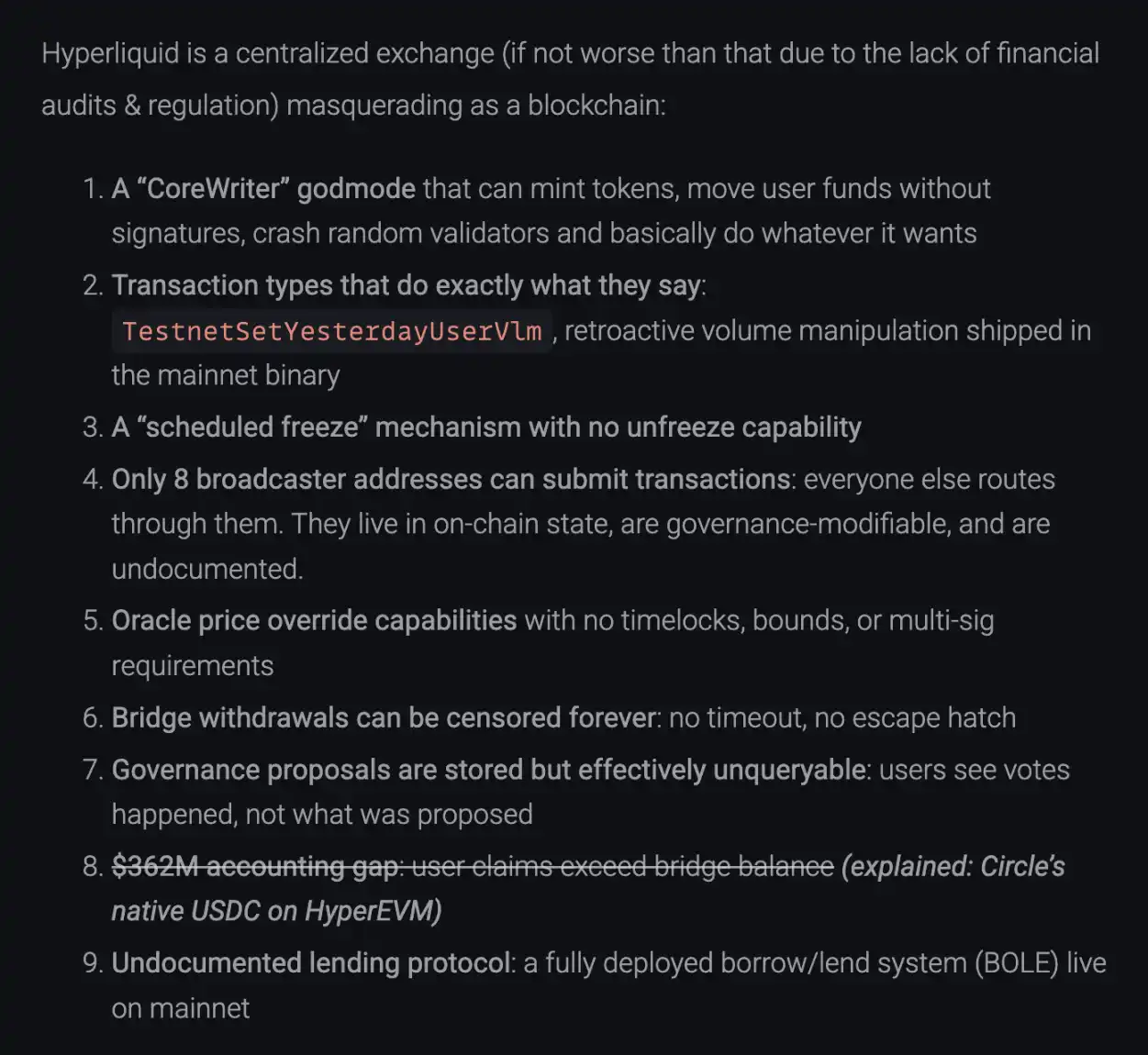
已澄清的指控

指控:「CoreWriter」上帝模式: 指控称其能凭空印钞、挪用资金。

回应: 官方解释这是 L1 与 HyperEVM 交互的接口(如质押),权限受限,并无挪用资金能力。

指控:3.62 亿资金缺口。

回应: 如上文所述,系未计算 Native USDC。

指控:未公开的借贷协议。

回应: 官方指出现货 / 借贷功能(HIP-1)文档已公开,处于预发布阶段,并非秘密运行。

已承认但有合理解释的指控

指控:二进制文件含「修改交易量」代码(TestnetSetYesterdayUserVlm)。

回应: 承认存在。但解释为测试网(Testnet)残留代码,用于模拟费率逻辑,主网节点已物理隔离该路径,无法执行。

指控:只有 8 个广播地址能提交交易。

回应: 承认。解释为抗 MEV(最大可提取价值)措施,防止用户被抢跑。承诺未来会实行「多提议者」机制。

指控:链可以被「计划性冻结」且无撤销功能。

回应: 承认。解释这是网络升级(Upgrade)的标准流程,必须全网暂停切换版本。

指控:预言机价格可被瞬间覆盖。

回应: 解释为系统安全性设计。为了在类似 10/10 的极端波动中及时清算坏账,验证者预言机确实没有设置时间锁。

回应缺失 / 模糊

在我们的核对中,有两点指控在官方回应中未被正面提及或完全解决:

指控:治理提案不可查询(Governance proposals are unqueryable),用户只能看到投票发生了,但链上数据不包含提案的具体文本内容。

回应: 官方未在长文中回应此点。这意味着 Hyperliquid 的治理目前对普通用户而言仍是一个「黑盒」,你只能看到结果,看不到过程。

指控:跨链桥无「逃生舱」(No Escape Hatch),提现可能被无限期审查,用户无法强制提款回 L1。

回应: 官方虽然解释了 POPCAT 事件中锁定桥是为了安全,但未反驳「无逃生舱」这一架构事实。这表明在当前阶段,用户资产进出高度依赖验证者集的放行,不具备 L2 Rollup 那样的抗审查强制提款能力。

「拉踩」竞品

这次风波最有趣的地方,在于它逼迫 Hyperliquid 亮出了自己的底牌,也让我们有机会重新审视 Perp 赛道的格局。官方在回应中罕见地「拉踩」了竞品,将枪口对准了 Lighter、Aster 甚至行业巨头 Binance。

其表示,「Lighter 使用单一的中心化序列器,其执行逻辑和零知识证明(ZK)电路均不公开。Aster 使用中心化撮合,甚至提供暗池交易,而暗池交易只有在单一的中心化序列器且执行过程不可验证的情况下才能实现。其他一些包含开源合约的协议则没有可验证的序列器。」

Hyperliquid 直言不讳地将这些竞争对手归为一类,称它们均依赖「中心化排序器(Centralized Sequencer)」。官方强调:在这些平台上,除了排序器运营者,没有任何人能看到完整的状态快照(包括订单簿历史、仓位细节)。相比之下,Hyperliquid 试图通过让所有验证者执行相同的状态机来消除这种「特权」。

而这波「拉踩」或许也正是因为 Hyperliquid 对当前的市场份额产生了担忧,根据 DefiLlama 过去 30 天的交易量数据,市场格局已呈三足鼎立之势:
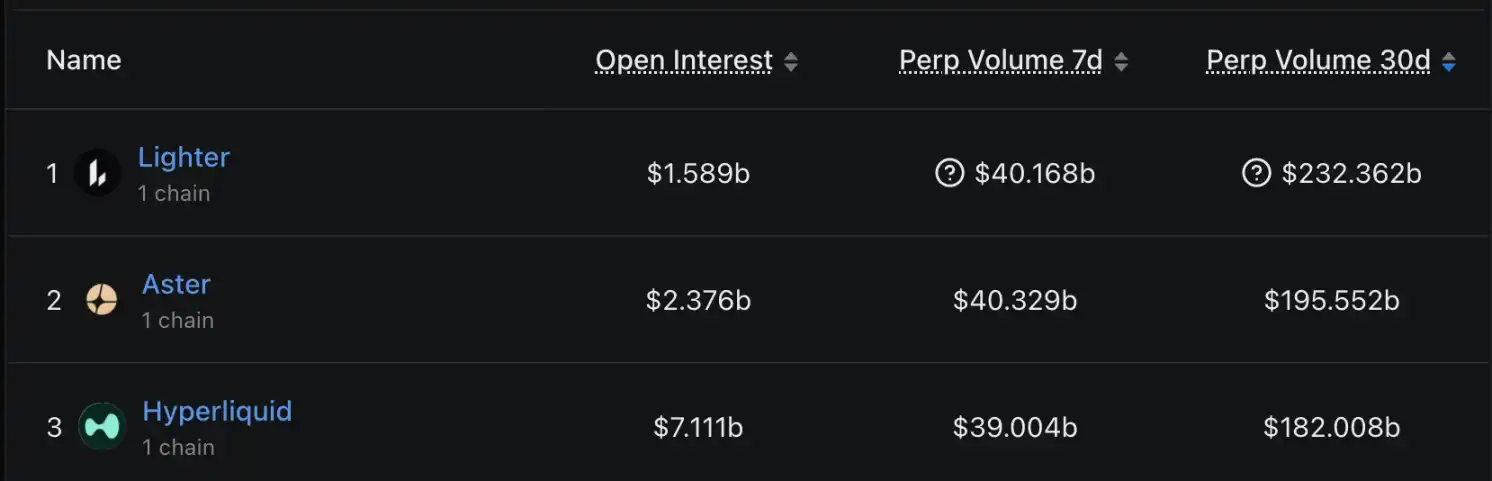
· Lighter:交易量 2323 亿美元,暂居榜首,占比约 26.6%。

· Aster:交易量 1955 亿美元,位居第二,占比约 22.3%。

· Hyperliquid:交易量 1820 亿美元,位居第三,占比约 20.8%。

面对 Lighter 和 Aster 后来者居上的交易量,Hyperliquid 试图打出「透明度」这张牌——即「虽然我有 8 个中心化广播地址,但我全状态上链可查;而你们连查都没法查」。不过值得注意的是,虽然在交易量上 Hyperliquid 略逊于前两名,但在持仓量(Open Interest, OI)上,Hyperliquid 呈现碾压态势。

舆情回应:谁在做空 HYPE?

除了技术与资金问题,社区最为关切的还有近期 HYPE 代币疑似被「内部人士」做空砸盘的传闻。对此,Hyperliquid 团队成员在 Discord 首次给出了定性回应:「0x7ae4 开头做空地址属于一名前员工」,该人员曾是团队成员,但已于 2024 年初被解雇。该前员工的个人交易行为与 Hyperliquid 现有团队无关。平台强调,目前对所有在职员工和承包商实行极其严格的 HYPE 交易限制与合规审查,严禁利用职务之便进行内幕交易。

这一回应试图将「团队作恶」的指控降级为「前员工个人行为」,但在代币分发与解锁机制的透明度上,社区或许仍期待更详尽的公示。

Don't Trust, Verify

Hyperliquid 的这次澄清推文,堪称教科书级别的危机公关——不是靠情绪输出,而是靠数据、代码链接和架构逻辑。它没有止步于自证清白,而是反守为攻,通过对比竞品的架构,强化了自身「全状态上链」的品牌和优势。

虽然 FUD 被证伪,但这次事件给行业留下的思考是深远的。随着 DeFi 协议向独立应用链(AppChain)演进,架构越来越复杂,资产分布越来越碎片化(Bridge + Native)。传统的「看一眼合约余额」的查账方式已经失效。

对于 Hyperliquid 而言,证明了「钱在」只是第一步。如何在保持高性能和抗 MEV 的优势下,逐步移交那 8 个提交地址的权限,真正实现从「透明的中心化」到「透明的去中心化」的跨越,才是它通往「终极 DEX」的必经之路。

而对于用户,这次风波再次印证了加密世界的那条铁律:不要相信任何叙事,去验证每一个字节。

Perguntas relacionadas

Q针对Hyperliquid的3.62亿美元资金缺口指控,官方是如何回应的?

A官方回应称,所谓的3.62亿美元资金缺口是由于Hyperliquid正在从L2 AppChain向独立L1升级,资产储备采用双轨制。质疑者仅计算了Arbitrum跨链桥上的USDC余额,但忽略了已迁移至HyperEVM的原生USDC。根据链上数据,总偿付能力(Arbitrum跨链余额 + HyperEVM原生余额 + HyperEVM合约余额)与用户总余额完全吻合,不存在资金缺口。

Q在9项指控中,哪些被Hyperliquid官方完全澄清?

A官方完全澄清了以下指控:1. 'CoreWriter'上帝模式:解释为L1与HyperEVM交互的受限接口,无挪用资金能力;2. 3.62亿美元资金缺口:系未计算Native USDC导致的误读;3. 未公开的借贷协议:指出现货/借贷功能(HIP-1)文档已公开,处于预发布阶段。

QHyperliquid在回应中承认了哪些指控但提供了合理解释?

A官方承认但提供合理解释的指控包括:1. 二进制文件含'修改交易量'代码:解释为测试网残留代码,主网已物理隔离;2. 只有8个广播地址能提交交易:解释为抗MEV措施,承诺未来实行多提议者机制;3. 链可被'计划性冻结':解释为网络升级的标准流程;4. 预言机价格可被瞬间覆盖:解释为应对极端波动的安全设计。

QHyperliquid在回应中未正面解决哪些指控?

A官方未正面解决两点指控:1. 治理提案不可查询:用户只能看到投票结果,无法查看提案具体内容,治理过程仍为'黑盒';2. 跨链桥无'逃生舱':未反驳提现可能被审查的架构事实,用户资产进出依赖验证者放行,缺乏抗审查强制提款能力。

QHyperliquid在回应中如何通过'拉踩'竞品突出自身优势?

A官方通过对比竞品强调自身'全状态上链'的透明度优势:指责Lighter使用中心化序列器且执行逻辑不公开,Aster依赖中心化撮合和暗池交易,而其他协议缺乏可验证序列器。Hyperliquid声称其通过所有验证者执行相同状态机消除'特权',尽管当前使用8个广播地址,但全状态可查,竞品则无法提供同等透明度。

Leituras Relacionadas

Dalio's Latest Warning: Don't Get Carried Away by AI, Real Returns on US Stocks in the Next 5-10 Years Could Be -5% to -10%

Ray Dalio, founder of Bridgewater Associates, warns investors against excessive concentration in AI stocks. He argues the current market, dominated by a few AI giants, mirrors historical patterns where revolutionary new technologies lead to high risk, volatility, and uncertainty. While acknowledging AI's transformative potential, Dalio emphasizes that most investors fail at this stage of the cycle by over-concentrating in a handful of leading companies. He cites inherent risks: companies cannot accurately forecast investment needs or external shocks (e.g., monetary policy, geopolitics, taxes), face potential disruption from future technologies and international competition (notably from China), and experience significant price swings. Dalio's core advice is diversification, calling it his "Holy Grail of Investing." He presents a mathematical case that a well-diversified portfolio of 15-20 uncorrelated, good bets offers a superior risk-adjusted return compared to a concentrated position. Dalio also offers a cautious outlook, suggesting U.S. stocks may deliver real returns of -5% to -10% over the next 5-10 years based on valuation and bubble indicators. He concludes that in the face of high uncertainty, the prudent strategy is not to avoid betting entirely, but to avoid large, concentrated bets where one lacks sufficient informational edge. Instead, investors should build a strategically balanced, diversified portfolio.

marsbitHá 32m

Dalio's Latest Warning: Don't Get Carried Away by AI, Real Returns on US Stocks in the Next 5-10 Years Could Be -5% to -10%

marsbitHá 32m

Rain Valuation Approaches $20 Billion: The Battle for U-Cards Extends to Rewards Systems

Rain, a stablecoin payments infrastructure company, is shifting the competitive focus for U Cards from simple issuance to user retention and repeated usage. On June 15, Rain launched "Rain Rewards," an embedded loyalty program capability within its card-issuing infrastructure. This allows partner businesses—like fintech platforms and neobanks—to configure branded loyalty points, earning rules, redemptions, and merchant promotions directly within their card products. The system, built from the 2025 acquisition of Uptop, ensures points are only issued upon final transaction settlement, preventing liabilities from refunds. Trials, such as with Avalanche Card, reportedly boosted spending by 25% among enrolled users. Founded by Farooq Malik and Charles Yoo-Naut, Rain evolved from a tool for managing Web3 company expenses into a full-stack enterprise platform. It is a Principal Member of Visa and Mastercard, enabling partners to issue stablecoin-backed cards and wallets while leveraging traditional payment networks. Notably, the popular U Card Plasma One is issued by Rain under Visa's authority. Rain also integrates with Visa's stablecoin settlement pilot, using USDC for network settlement. Rain's rapid funding reflects growing institutional interest in stablecoin payment infrastructure. It raised a $245 million Series A in March 2025, a $58 million Series B in August 2025, and a $250 million Series C in January of this year, reaching a $19.5 billion valuation. Annualized transaction volume exceeds $3 billion, serving over 200 partners including Western Union and Nuvei. Beyond cards, Rain is expanding into programmable payments. Its June 2026 "Agent Control Layer" allows businesses to set spending rules—like merchant categories, amounts, and frequency—for AI agents before transactions occur. This positions Rain not as a single product but as an operating system for stablecoin payments, handling everything from card issuance and wallet management to rewards, on/off-ramps, and automated compliance. The goal is to enable seamless, often invisible, real-world spending of on-chain assets.

Foresight NewsHá 35m

Rain Valuation Approaches $20 Billion: The Battle for U-Cards Extends to Rewards Systems

Foresight NewsHá 35m

Google TPU Shipments Revised Up by 50%

Recent industry research indicates a significant upward revision in the shipments of Google's TPU (Tensor Processing Unit) chips. Previous expectations for 2027 were set at around 10 million units, but new estimates now point to 15 million units, a 50% increase. This substantial boost directly translates to higher demand across the entire supporting supply chain. Google's TPU clusters utilize a standardized all-optical interconnect architecture. Consequently, key hardware components are deeply integrated and scaled in fixed ratios with the chips. The 15 million TPU target will drive corresponding demand increases for NPO optical engines (roughly a 1:1 match), 1.6T optical modules, OCS optical switches, high-end server power supplies, fiber optics & MPO connectors, and liquid cooling solutions. Among these, liquid cooling is highlighted as the sector experiencing the most significant transformation and offering the most stable potential for excess returns. As next-generation TPU chips reach power levels where traditional air cooling is insufficient, liquid cooling becomes essential. 2026 is forecasted as the first year of substantial adoption for Google's liquid cooling solutions. This shift, coupled with delivery and capacity bottlenecks faced by incumbent overseas manufacturers, is creating a prime window for domestic Chinese suppliers to enter and secure Google's core supply chain. The market size for Google-specific liquid cooling is projected to potentially triple from a baseline of hundreds of billions to around 300 billion units by 2028. The logic for the fiber optic sector is also being rewritten. Once considered a cyclical commodity tied to telecom operator procurement, fiber is now a strategic and scarce resource for AI Data Centers (AIDC). A severe supply-demand imbalance, driven by the long lead time for preform production (18-24 months) and surging demand from cloud giants, is supporting strong performance. Chinese fiber manufacturers are well-positioned to capture a significant share of global AIDC demand, with exports potentially reaching 200-300 million core kilometers in 2026. Overall, the investment focus within the AI computing industry is shifting from pure "chip performance speculation" towards the more certain incremental growth in computing infrastructure and its supporting ecosystem. The upward revision in Google TPU shipments, along with the potential for further doubling by 2028, is seen as solidifying performance visibility for the entire supporting supply chain over the next two years.

marsbitHá 2h

Google TPU Shipments Revised Up by 50%

marsbitHá 2h

What Wall Street Really Wants After the Crypto Story Recedes

The tide of speculative crypto narratives has receded, revealing Wall Street's true objective: building a controlled, yield-generating, and compliant financial pipeline on distributed ledgers. They are migrating core functions onto blockchains, not for decentralization, but for efficiency and new revenue streams. Key developments include BlackRock's BUIDL fund, a tokenized treasury fund acting as a foundational reserve asset, and the rise of Securitize, which is going public and partnering with the NYSE to build a 24/7 digital securities trading and settlement system. This signals a major shift of securities clearing to blockchain technology. To make volatile assets like Bitcoin palatable for institutional investors, firms like BlackRock and Goldman Sachs are creating "covered call" ETFs (e.g., BITA). These products systematically sell options on Bitcoin holdings, transforming price volatility into stable monthly income, effectively repackaging crypto as a yield-bearing asset. Stablecoins are being positioned not as speculative tools but as efficient payment rails. Companies like Stripe and Mastercard are integrating them for instant, low-cost merchant settlements and cross-border card payments, respectively. Critically, new legislation like the GENIUS Act shapes them as non-interest-bearing, heavily regulated extensions of the US dollar system. In summary, Wall Street is quietly constructing a parallel, blockchain-based financial infrastructure featuring tokenized traditional assets, structured crypto yields, and programmable dollar pipelines—all under its control and fully integrated with existing regulatory and credit frameworks.

marsbitHá 2h

What Wall Street Really Wants After the Crypto Story Recedes

marsbitHá 2h

Trading

Spot
Futuros

Artigos em Destaque

O que é ATWO

I. Introdução ao ProjetoArena Two é uma plataforma interativa descentralizada que permite aos fãs desempenhar um papel ativo e tokenizado nos resultados de eventos em tempo real. Ao contrário dos modelos tradicionais de transmissão que reduzem os fãs a espectadores passivos, a Arena Two utiliza a tecnologia blockchain para permitir que os fãs votem diretamente em tempo real e influenciem os resultados em campo.II. Informação sobre o TokenNome do token: ATWO(Arena Two)III. Links RelacionadosWebsite:https://arenatwo.com/Exploradores:https://basescan.org/token/0x499D35eBE6cEe9B2Ac35Fd003fcBbeeB9CFc7B32Twitter:https://x.com/arenatwoXNota: A introdução ao projeto provém dos materiais publicados ou fornecidos pela equipa oficial do projeto, que é apenas para referência e não constitui aconselhamento de investimento. A HTX não se responsabiliza por quaisquer perdas diretas ou indiretas resultantes.

258 Visualizações TotaisPublicado em {updateTime}Atualizado em 2026.06.02

O que é ATWO

Como comprar ATWO

Bem-vindo à HTX.com!Tornámos a compra de Arena Two (ATWO) simples e conveniente.Segue o nosso guia passo a passo para iniciar a tua jornada no mundo das criptos.Passo 1: cria a tua conta HTXUtiliza o teu e-mail ou número de telefone para te inscreveres numa conta gratuita na HTX.Desfruta de um processo de inscrição sem complicações e desbloqueia todas as funcionalidades.Obter a minha contaPasso 2: vai para Comprar Cripto e escolhe o teu método de pagamentoCartão de crédito/débito: usa o teu visa ou mastercard para comprar Arena Two (ATWO) instantaneamente.Saldo: usa os fundos da tua conta HTX para transacionar sem problemas.Terceiros: adicionamos métodos de pagamento populares, como Google Pay e Apple Pay, para aumentar a conveniência.P2P: transaciona diretamente com outros utilizadores na HTX.Mercado de balcão (OTC): oferecemos serviços personalizados e taxas de câmbio competitivas para os traders.Passo 3: armazena teu Arena Two (ATWO)Depois de comprar o teu Arena Two (ATWO), armazena-o na tua conta HTX.Alternativamente, podes enviá-lo para outro lugar através de transferência blockchain ou usá-lo para transacionar outras criptomoedas.Passo 4: transaciona Arena Two (ATWO)Transaciona facilmente Arena Two (ATWO) no mercado à vista da HTX.Acede simplesmente à tua conta, seleciona o teu par de trading, executa as tuas transações e monitoriza em tempo real.Oferecemos uma experiência de fácil utilização tanto para principiantes como para traders experientes.

141 Visualizações TotaisPublicado em {updateTime}Atualizado em 2026.06.02

Como comprar ATWO

O que é ZEST

I. Introdução ao Projeto1. O que é o Zest Protocol?O Zest Protocol é um protocolo de empréstimos nativo do Bitcoin construído na camada 2 do Stacks que permite aos utilizadores ganhar rendimento com BTC ou emprestar ativos colateralizando BTC. Os contratos inteligentes do protocolo são escritos na linguagem Clarity, operam totalmente em cadeia e são de código aberto, com um design inspirado no Aave v3. O Zest é atualmente o maior protocolo DeFi no Stacks, com mais de 800 BTC depositados e um pico de TVL superior a 100 milhões de dólares. Em maio de 2026, o protocolo introduziu ainda os Cofres de Colateral em Bitcoin, estendendo as capacidades de empréstimo do Stacks para a rede principal do Bitcoin. Isso permite que os utilizadores emprestem stablecoins sem mover BTC da rede Bitcoin, possibilitando empréstimos com custódia própria.2. Como funciona o Zest Protocol?O Zest Protocol consiste em dois mercados. O mercado do Stacks é construído sobre o Aave v3, permitindo que os utilizadores depositem ativos como sBTC, STX e USDC para ganhar rendimento ou contrair empréstimos sobre-colateralizados. O LTV máximo padrão é de 50% (70% para sBTC). O mercado do Bitcoin opera através dos recém-lançados Cofres de Colateral em Bitcoin. Os utilizadores emprestam stablecoins ao bloquear BTC em cofres de custódia própria na cadeia do Bitcoin. O colateral permanece na rede principal do Bitcoin durante todo o processo, e os utilizadores mantêm a custódia, a menos que a posição seja liquidada.3. Quem fundou o Zest Protocol?Tycho Onnasch (Co-Fundador): Formado na Universidade de Oxford. Envolvido em pesquisa e subsídios para a Stacks Open Internet Foundation. Antigo Gestor na Trust Machines e Fundador da Deedmob. Perfil do LinkedIn: https://www.linkedin.com/in/tychokoonnasch/.Fernando Foy (Co-Fundador): Trabalhou anteriormente em consultoria de TI na Objectif Emploi. Perfil do LinkedIn: https://www.linkedin.com/in/fernando-foy/.Emil E. (Co-Fundador): Possui um Mestrado em Física pela Universidade de Warwick. Antigo Partner de Engenharia na Trust Machines, Desenvolvedor Full-Stack para projetos Web3 e Cientista de Dados no HSBC. Perfil do LinkedIn: https://www.linkedin.com/in/emil-e-49771a145/.Detalhes de Financiamento: Em maio de 2024, o Zest Protocol anunciou a conclusão de uma ronda de financiamento inicial de 3,5 milhões de dólares liderada por Tim Draper, com a participação da Binance Labs, Flow Traders, Trust Machines, entre outros.4. Tokenomics do $ZEST$ZEST é o token nativo do Zest Protocol com um fornecimento total fixo de 1 mil milhões de tokens e sem mecanismo inflacionário.Comunidade (27,83%): Usado para airdrops e incentivos aos utilizadores;Desenvolvimento do Ecossistema (24,82%): Usado para liquidez, parcerias, marketing, listagens em bolsas, etc.;Investidores (22,35%): Apoio às partes investidoras que apoiaram o desenvolvimento inicial do Zest Protocol;Equipa (25%): Alocado para colaboradores principais.Calendário de Vesting: Os tokens da Equipa e dos Investidores estão sujeitos a um período de bloqueio de 1 ano, seguido de 3 anos de desbloqueio linear.5. Cronologia dos Principais Marcos2022: O Zest Protocol é oficialmente fundado.Março de 2024: Concluída a auditoria de segurança e lançado o mercado de empréstimos do Stacks na rede principal.Em fevereiro de 2026, é lançado o Stacks Market V2, introduzindo Grupos de Risco.Em maio de 2026, foram introduzidos os Cofres de Colateral em Bitcoin, e um protótipo operacional da rede principal está agora disponível. Isso permite que os utilizadores utilizem BTC com custódia própria na L1 do Bitcoin como colateral para emprestar stablecoins em cadeias EVM, encerrando a necessidade de bridging, wrapping e custódia de terceiros. Este lançamento é dividido em duas fases. Fase 1: Utiliza transações pré-assinadas para restringir o movimento de BTC; Fase 2: Utiliza BitVM para verificação. II. Informações sobre o TokenNome do token: ZEST (Zest Protocol)III. Links RelacionadosWebsite: https://www.zestprotocol.com/Exploradores: https://bscscan.com/token/0x5506599c722389a60580b5213ea1da60d64754a1Twitter: https://twitter.com/ZestProtocolNota: A introdução ao projeto provém dos materiais publicados ou fornecidos pela equipa oficial do projeto, que é apenas para referência e não constitui aconselhamento de investimento. A HTX não se responsabiliza por quaisquer perdas diretas ou indiretas resultantes.

207 Visualizações TotaisPublicado em {updateTime}Atualizado em 2026.06.02

O que é ZEST

Discussões

Bem-vindo à Comunidade HTX. Aqui, pode manter-se informado sobre os mais recentes desenvolvimentos da plataforma e obter acesso a análises profissionais de mercado. As opiniões dos utilizadores sobre o preço de A (A) são apresentadas abaixo.

活动图片