2天20倍,速览新金狗 snowball 的自动做市机制

marsbitPublicado em 2025-12-22Última atualização em 2025-12-22

Resumo

十二月加密市场遇冷,链上交易低迷,但 meme 币 Snowball 在四天内市值突破1000万美元,引发关注。其核心机制是将通常由开发者收取的“创作者费用”自动转入链上做市机器人,用于回购代币、增加流动性并销毁部分代币,形成“交易产生费用→费用变买盘→买盘推价格→吸引更多交易”的雪球效应。费用比例随市值浮动,低时多收加速积累,高时降低减少摩擦。 链上数据显示,Snowball 持有地址超7000个,前十大持有者占比约20%,筹码相对分散。交易买卖基本持平,流动性池约38万美元。开发者公开钱包及交易日志,强调透明、防跑路。 然而,该机制依赖持续交易量维持飞轮效应,当前市场环境资金活跃度低,若新买盘不足,可能反向螺旋下跌。类似机制项目如 FIREBALL 也在尝试,但历史上 OlympusDAO 和 Safemoon 等机制型项目最终表现不佳,表明机制创新虽能短期吸引资金,却不创造长期价值。Snowball 本质仍是高风险 meme 币,需谨慎参与。

十二月的加密市场和天气一样冷。

链上交易已经冬眠很久,新叙事也难产。看看中文CT这几天在聊的撕逼和八卦,就知道这个市场已经没有什么人在玩了。

但英文区这几天在讨论一个新东西。

一个叫 Snowball 的 meme 币,12月18日在 pump.fun 上发射,四天时间市值冲到1000万美元市值,还在创新高;而中文圈几乎没什么人提。
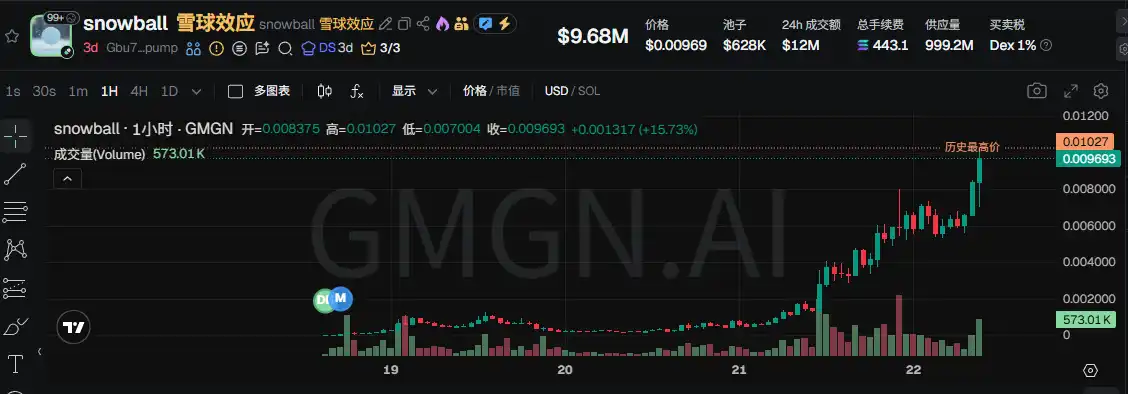
在当前没什么新叙事和 meme 狗都不玩的环境里,这算是为数不多让人眼前一亮,有点局部财富效应的东西了。

而 Snowball 这个名字翻译过来就是雪球效应,本身就是它想讲的故事:

一套能让代币「自己越滚越大」的机制。

把交易费变成买盘,滚雪球做市

要理解 Snowball 在做什么,先得知道 pump.fun 的代币通常怎么赚钱。

在 pump.fun 上,任何人都可以花几分钟创建一个代币。代币创建者可以设置「创作者费用」,说白了就是每笔交易抽一定比例进自己钱包,通常在0.5%到1%之间。

这笔钱理论上可以用来做社区建设、市场推广,但实际操作中,大部分 Dev 的选择是:攒够了就跑。

这也算是土狗典型生命周期的一部分。发射、拉盘、收割手续费、跑路。投资者在赌的不是代币本身,而是开发者的良心。

Snowball的做法是,不要这笔创作者费用的钱。

准确说,是100%的创作者费用不进任何人的钱包,而是自动转进一个链上做市机器人。

这个机器人每隔一段时间执行三件事:

第一,拿积累的资金在市场上买入代币,形成买盘支撑;

第二,把买到的代币和对应的SOL加进流动性池,让交易深度更好;

第三,每次操作销毁0.1%的代币,制造通缩。
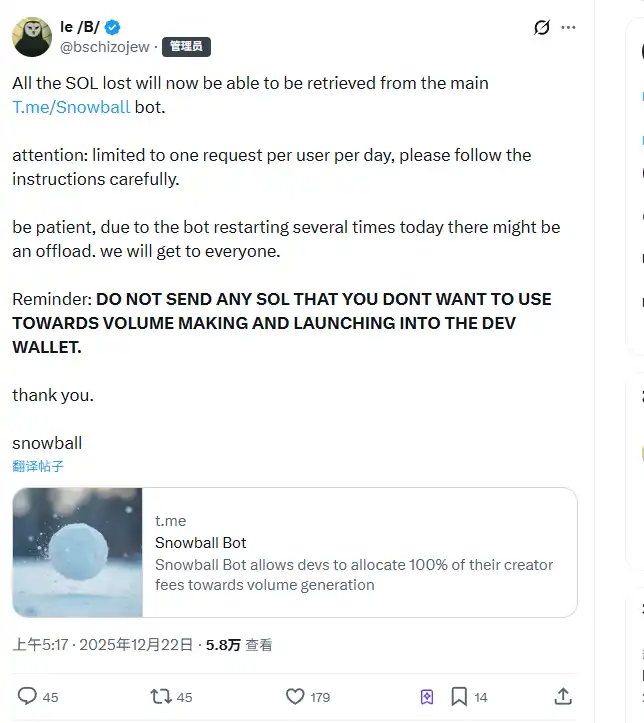
同时,这个币收取的创作者费用的比例不是固定的,会根据市值在0.05%到0.95%之间浮动。

市值低的时候抽得多一点,让机器人更快积累弹药;市值高了就降下来,减少交易摩擦。

用一句话概括这套机制的逻辑,你每交易一次,就有一笔钱自动变成买盘和流动性,而不是进开发者口袋。

因此,你也很容易理解这个雪球效应:

交易产生费用→费用变成买盘→买盘推高价格→价格吸引更多交易→更多费用......理论上可以自己滚起来。

链上数据情况

机制讲完了,看看链上数据。

Snowball在12月18日发射,到现在四天。市值从零冲到1000万美元,24小时成交额超过1100万。

对一个pump.fun上的土狗来说,这个成绩已经算现在这个环境里活得久的了。

筹码结构上,持有者目前有7270个地址。前十大持有者加起来占总供应量的20%左右,最大的单一持有者占4.65%。
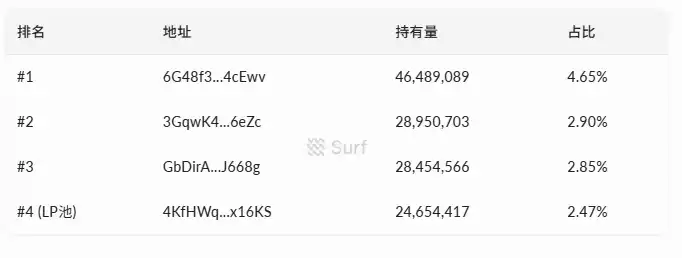
(数据来源:surf.ai)

没有出现一个地址握着两三成筹码的情况,分布算是相对分散。

交易数据方面,发射以来累计58000多笔交易,其中买入33000笔、卖出24000笔。买入总金额440万美元,卖出430万美元,净流入大概10万。买卖基本持平,没有出现一边倒的抛压。

流动性池里躺着大概38万美元,一半是代币一半是SOL。对于这个市值体量来说,深度不算厚,大单进出还是会有明显滑点。

另外一个值得注意的点是,Bybit Alpha 在发射后不到96小时就宣布上线该代币,一定程度上也印证了短期热度。

永动机遇上冷市场

逛了一圈,可以看到英文社区对 Snowball 的讨论主要集中在机制本身。支持者的逻辑很直接:

这是第一个把创作者费用100%锁进协议的meme币,开发者没法拿钱跑路,至少在结构上比其他土狗安全。

开发 Dev 也在配合这个叙事。开发者钱包、做市机器人钱包、交易日志全部公开,强调「链上可查」。

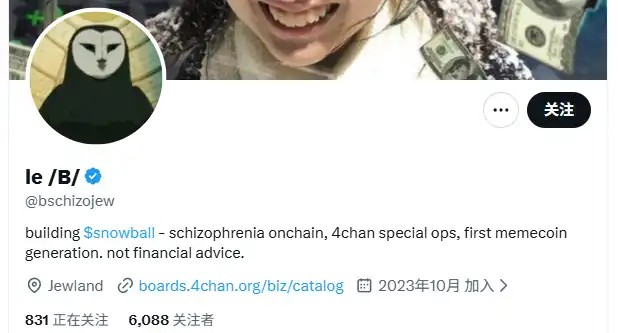
@bschizojew 给自己贴的标签是「链上精神分裂症、4chan特种部队、第一代meme币老兵」,一股自嘲式的 degen 味道,很对加密原生社区的胃口。
但机制安全和能不能赚钱是两回事。

雪球效应成立的前提是,有足够的交易量持续产生费用,喂给机器人去执行回购。交易越多,机器人弹药越足,买盘越强,价格越高,吸引更多人交易...

这也是牛市里任何 meme 所谓的回购飞轮转起来的理想状态。

问题是,飞轮需要外部动力来启动。

当前的加密市场是什么环境?链上活跃度低迷,meme币整体热度下降,愿意冲土狗的资金本来就少。在这种背景下,如果新买盘跟不上,交易量萎缩,机器人能收到的费用就会越来越少,回购力度变弱,价格支撑减弱,交易意愿进一步下降。

飞轮可以正向转,也可以反向转。

更现实的问题是,机制解决的是「开发者抽钱跑路」这一个风险点,但 meme 币面临的风险远不止这个。

庄家砸盘、流动性不足、叙事过气,这些事情随便发生一个,100%的手续费回购能起到的作用很有限。

大家都被割怕了,中文圈有老哥也总结得挺到位:

玩归玩,别上头。

不止一个雪球在滚

Snowball 不是唯一在讲这个自动做市故事的项目。

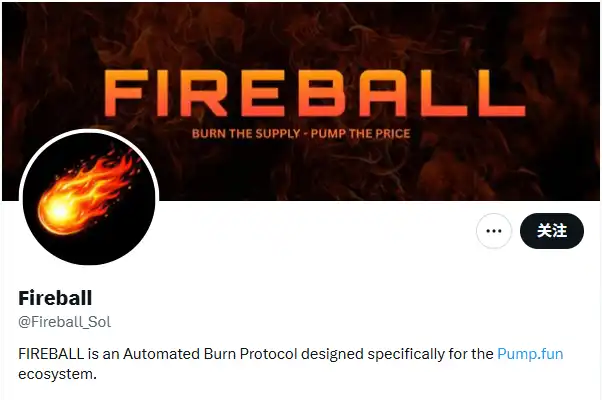
同样在pump.fun生态里,一个叫 FIREBALL 的代币也在做类似的事:自动回购加销毁,把它包装成一个其他代币可以接入的协议。但市值比 Snowball 小得多。
这说明市场现在对「机制型meme币」这个方向是有反应的。

传统的喊单、拉盘、社区炒作那套玩法越来越难吸引资金,用机制设计讲一个「结构性安全」的故事,可能是meme币最近的套路之一。

不过说到人为制造某个机制,也不是什么新玩法了。

2021年OlympusDAO的(3,3)是最典型的案例,用博弈论包装质押机制,讲的故事是「大家都不卖就能一起赚」,高峰期市值冲到几十亿美元。后来的结局大家也知道,螺旋下跌,跌去了90%以上。

再早一点还有 Safemoon 那套「每笔交易抽税分给持有者」的玩法,也是机制创新叙事,最后被SEC起诉,创始人被指控欺诈。

机制可以是很好的叙事钩子,能在短期内聚集资金和注意力,但机制本身不创造价值。

当外部资金停止流入,再精巧的飞轮也会停转。

最后,我们再来捋一下这个小金狗到底在干什么:

把 meme 币的创作者费用变成「自动做市机器人」。机制本身不复杂,解决的问题也很明确,就是让开发者没法直接拿钱跑路。

开发者不能跑路,不等于你能赚钱。

如果你看完觉得这个机制有意思,想参与,记住一句话:它首先是个 meme 币,其次才是个新机制的实验。

Criptomoedas em alta

Perguntas relacionadas

QSnowball 的自动做市机制是如何运作的?

ASnowball 的机制是将100%的创作者费用自动转入链上做市机器人,该机器人定期执行三个操作:用积累的资金买入代币形成买盘支撑、将买到的代币和SOL加入流动性池以提升交易深度、每次操作销毁0.1%的代币制造通缩。交易费用比例会根据市值在0.05%到0.95%之间浮动。

QSnowball 的链上数据表现如何?

A截至文章发布时,Snowball 在四天内市值达到1000万美元,24小时成交额超1100万美元,持有地址7270个,前十大持有者占比约20%,最大单一持有者占4.65%。累计交易5.8万笔,买卖金额基本持平,流动性池约38万美元。

QSnowball 机制解决了传统 pump.fun 代币的什么问题?

A它解决了开发者直接抽取交易费用并可能携款跑路的风险,通过将全部创作者费用自动用于市场回购和流动性提供,在结构上增强了资金安全性。

QSnowball 的机制存在哪些潜在风险?

A该机制依赖持续的交易量来维持回购动力,若市场冷清导致交易萎缩,回购支撑会失效。此外,meme币常见的庄家砸盘、流动性不足或叙事过气等风险仍存在,机制本身无法完全规避。

Q类似 Snowball 的机制型 meme 币还有哪些先例?

A历史上类似案例包括2021年OlympusDAO的(3,3)质押机制和Safemoon的交易抽税分红机制,这些项目曾通过机制设计吸引资金,但最终因外部资金流失或监管问题而暴跌或失败。

Leituras Relacionadas

When the World Cup Collides with Agents: From Web2 to Web3, How Are Wallets Evolving into Agentic Wallets?

World Cup as a Catalyst for Agentic Wallets: From Web2 to Web3 This article explores how the World Cup provides a real-world scenario for observing the evolution of digital wallets from simple asset managers towards "Agentic Wallets"—intelligent, AI-powered interfaces. Using the example of prediction markets like Polymarket, it illustrates how AI Agents can lower the barrier to Web3 interaction. Instead of navigating complex DApps, users can express intent in natural language (e.g., "I think Portugal will win") within platforms like Discord or web pages. The Agent then interprets this intent, finds the relevant market, and seamlessly guides the user through the on-chain transaction via their wallet. The core shift is from wallets as mere "function menus" for signing transactions to "intent interpreters" that understand user goals. The article highlights parallel developments in traditional finance, such as Mastercard's "Agent Pay" and WeChat Pay's AI tests, which focus on granting AI controlled, authorized, and auditable payment capabilities. This underscores a broader trend of AI entering the financial layer. However, the article emphasizes that the primary challenge for Agentic Wallets in Web3 is not automation but establishing clear security boundaries. Unlike traditional systems with chargebacks, on-chain transactions are often irreversible. Therefore, future wallets must ensure users retain ultimate control and comprehension. They need to transparently communicate an Agent's permissions, spending limits, authorized durations, and provide easy ways to pause or revoke access. The World Cup experiments represent early steps toward wallets that are not just applications but ubiquitous, intelligent interfaces that simplify Web3 while keeping users securely in control.

marsbitHá 1h

When the World Cup Collides with Agents: From Web2 to Web3, How Are Wallets Evolving into Agentic Wallets?

marsbitHá 1h

Options Don't Work in DeFi? Vitalik Might Not Agree

For years, the prevailing view has been that options struggle to gain traction in DeFi due to complexity, fragmented liquidity, and lack of natural demand compared to products like perpetual futures. However, a recent algorithmic stablecoin design proposed by Vitalik Buterin presents a different perspective, using options not as a standalone trading product, but as foundational infrastructure for other financial instruments. In this design, one unit of ETH is split into two components: a "stable" side (P) that retains value up to a specified strike price, and an "upside" side (N) that captures all appreciation above that strike. Combined, they always equal one ETH, eliminating debt, margin, and liquidation risks inherent in typical collateralized debt position (CDP) stablecoins. The stable component essentially mimics the payoff of a covered call option. To function as a stablecoin, this structure requires continuously rolling deep in-the-money calls, which introduces challenges like rollover slippage, predictable transaction flow vulnerable to front-running, and persistent liquidity needs. A core hurdle is finding consistent buyers for the leveraged ETH upside exposure (N). While it offers leverage without funding rates or liquidation, it must compete with simpler alternatives like direct call options or perpetuals. The system's scalability depends on a sustained demand for this specific form of leverage. The author draws parallels to their experience with Rysk, where earlier versions of DeFi options protocols struggled. The breakthrough came with Rysk V12, which aligns incentives: asset holders generate yield by selling covered calls against their holdings, while market makers efficiently acquire the desired option exposure. This demonstrates that options can find product-market fit when embedded as a risk distribution and pricing engine within structured products, stablecoins, or yield-generating assets, rather than marketed as a complex direct trading instrument. Vitalik's proposal reinforces this architectural approach—using fully collateralized, non-custodial, and physically settled options as a fundamental building block. The real opportunity for options in DeFi may lie not in becoming the next perpetual swap, but in powering the next generation of on-chain financial products.

marsbitHá 1h

Options Don't Work in DeFi? Vitalik Might Not Agree

marsbitHá 1h

Conversation with Investor Zheng Di: MicroStrategy's Coin Sale Experiment, AI Economy, and Opportunities in US Stocks

Frontier tech investor Zheng "Didier" Di discusses the recent Bitcoin price drop, the financial strategy shift at MicroStrategy, the AI-driven surge in U.S. stocks, and the evolving role of crypto exchanges. Didier posits that the recent BTC decline stems less from macro factors or ETF outflows, and more from market repricing due to MicroStrategy's new financial structure. Following a wave of preferred stock and debt issuance (STRC, STRZ, etc.), MicroStrategy must now manage cash flow to pay dividends, potentially leading to a market expectation of sustained, small-scale BTC sales to maintain its "per-share bitcoin neutral" principle. Didier views this as a financial "experiment" testing market capacity for such recurring sell pressure, which, while creating near-term structural headwinds, likely avoids a true "death spiral" absent major new external shocks. Shifting to AI, Didier argues that tokens are becoming the new form of labor, with AI models and compute (tokenized inputs) increasingly replacing human roles in execution and middle-management. This drives enterprise efficiency and higher margins, fueling the sustained rally in U.S. semiconductor, data center, and infrastructure stocks. He foresees an emerging "machine economy" where automated agents transact and collaborate on-chain. Regarding crypto exchanges offering U.S. equities, Didier sees this as a natural evolution. With few crypto-native assets generating lasting value, exchanges are pivoting towards real-world assets (RWAs) like stocks and bonds. This doesn't necessarily cannibalize crypto but reflects a maturing industry focusing on blockchain's core utilities: decentralized choice and efficient settlement. He notes that trading logic for crypto natives doesn't need to drastically change, as meme-driven and fundamentalist strategies find analogs in U.S. markets. The "1011 event" (likely referring to a major market crash) severely damaged crypto market liquidity, marking a probable end to the altcoin speculative cycle, with capital flowing towards the deeper liquidity of U.S. markets. For the macro outlook, Didier is cautious about near-term market pressure from potential mega-IPOs (e.g., SpaceX) and the U.S. midterm elections, which could bring more regulatory scrutiny. Long-term, he remains bullish on AI's productivity gains and its convergence with blockchain/Web3, predicting a shift from speculative frenzy to a more institutionalized, industrial phase for the crypto sector.

marsbitHá 2h

Conversation with Investor Zheng Di: MicroStrategy's Coin Sale Experiment, AI Economy, and Opportunities in US Stocks

marsbitHá 2h

Playnance’s $GCOIN Lists on KoinBX Amid Rapid Growth in India

Playnance's native token, $GCOIN, has been listed on the cryptocurrency exchange KoinBX as of June 18. This move aims to enhance accessibility for its rapidly growing community, particularly in India, where the blockchain-powered Web3 iGaming ecosystem has gained significant traction. Over 130 partners in Playnance's "Be the Boss" program have built communities engaging thousands of active players in the region. The "Be the Boss" model allows participants to create and manage their own gaming communities, earning rewards tied to community activity. CEO Pini Peter noted India's high engagement, with community leaders successfully building player networks. One partner, Dr. Nicolas, reported earning over $57,000 through the program in recent months, highlighting both the financial rewards and the opportunity to grow an engaged community. $GCOIN serves as the ecosystem's core utility token, incentivizing participation and aligning the interests of players and community leaders ("Bosses"). The listing on KoinBX is part of Playnance's strategy to expand globally, increasing the token's utility and accessibility by combining community ownership, gamified engagement, and blockchain-based incentives. Founded in 2020, Playnance is a Web3 iGaming infrastructure company focused on creating live, non-custodial, on-chain products to onboard mainstream users. It currently processes approximately one million transactions daily, aiming to simplify the user experience while maintaining full on-chain transparency.

TheNewsCryptoHá 3h

Playnance’s $GCOIN Lists on KoinBX Amid Rapid Growth in India

TheNewsCryptoHá 3h

Trading

Spot
Futuros

Artigos em Destaque

Como comprar QUICK

Bem-vindo à HTX.com!Tornámos a compra de Quickswap (QUICK) simples e conveniente.Segue o nosso guia passo a passo para iniciar a tua jornada no mundo das criptos.Passo 1: cria a tua conta HTXUtiliza o teu e-mail ou número de telefone para te inscreveres numa conta gratuita na HTX.Desfruta de um processo de inscrição sem complicações e desbloqueia todas as funcionalidades.Obter a minha contaPasso 2: vai para Comprar Cripto e escolhe o teu método de pagamentoCartão de crédito/débito: usa o teu visa ou mastercard para comprar Quickswap (QUICK) instantaneamente.Saldo: usa os fundos da tua conta HTX para transacionar sem problemas.Terceiros: adicionamos métodos de pagamento populares, como Google Pay e Apple Pay, para aumentar a conveniência.P2P: transaciona diretamente com outros utilizadores na HTX.Mercado de balcão (OTC): oferecemos serviços personalizados e taxas de câmbio competitivas para os traders.Passo 3: armazena teu Quickswap (QUICK)Depois de comprar o teu Quickswap (QUICK), armazena-o na tua conta HTX.Alternativamente, podes enviá-lo para outro lugar através de transferência blockchain ou usá-lo para transacionar outras criptomoedas.Passo 4: transaciona Quickswap (QUICK)Transaciona facilmente Quickswap (QUICK) no mercado à vista da HTX.Acede simplesmente à tua conta, seleciona o teu par de trading, executa as tuas transações e monitoriza em tempo real.Oferecemos uma experiência de fácil utilização tanto para principiantes como para traders experientes.

172 Visualizações TotaisPublicado em {updateTime}Atualizado em 2026.06.02

Como comprar QUICK

Discussões

Bem-vindo à Comunidade HTX. Aqui, pode manter-se informado sobre os mais recentes desenvolvimentos da plataforma e obter acesso a análises profissionais de mercado. As opiniões dos utilizadores sobre o preço de QUICK (QUICK) são apresentadas abaixo.

活动图片