Cardano Brings Pyth Oracles On-Chain In First Pentad Integration

bitcoinistPublicado em 2025-12-12Última atualização em 2025-12-12

Resumo

Cardano has announced its first major integration under the new "Pentad" governance structure, bringing Pyth's Lazer oracle to the blockchain by early 2026. This marks a strategic shift from building in-house oracle solutions to adopting established external infrastructure. Pyth provides ultra-low latency, institutional-grade market data across thousands of price feeds, which is used by hundreds of DeFi applications globally. Charles Hoskinson emphasized that this integration connects Cardano to broader cryptocurrency information networks and is just the first of many planned critical integrations—including bridges, stablecoins, and analytics—aimed at making Cardano a more viable DeFi platform. The move signals a focus on execution and infrastructure readiness as Cardano positions itself for growth in 2026.

Cardano is finally doing the unsexy but absolutely necessary plumbing work: getting serious, external oracle infrastructure wired in, with a governance wrapper that looks a lot more like “adult supervision” than the old ad-hoc ecosystem scramble.

On a Dec. 11 livestream, Charles Hoskinson said the ecosystem’s new “Pentad” structure — the coordination bloc spanning Input Output, the Cardano Foundation, EMURGO, the Midnight Foundation, and Intersect — has approved its first major integration under the “critical integrations” framework: bringing Pyth’s Lazer oracle to Cardano, with deployment targeted for early 2026.

Pyth Deal Kicks Off Cardano’s Critical Integrations Push

“This is the appetizer announcement,” Hoskinson said, framing Pyth as the first of what he expects to be a broader menu: bridges, stablecoins, analytics, custodians — the stuff that turns a chain into a DeFi venue people actually build on, not just a community that argues about roadmaps.

Hoskinson didn’t really sugarcoat why this matters. “Oracles are really the first part of major integrations,” he said, because you need reliable data coming in and you need credible pathways to the rest of the industry. He also admitted the in-house approach hasn’t landed the way it should’ve: Cardano “tried to build an indigenous oracle solution and it hasn’t worked out as well as it should.” So [...] Pyth. That’s the pivot.

Pyth, in its own marketing, has been pushing Lazer as an ultra-low latency product designed for speed-sensitive trading use cases — basically, price updates fast enough that perps and other twitchy DeFi apps don’t feel like they’re operating on last cycle’s data. Hoskinson called Pyth “one of the most advanced Oracle solutions on market,” and emphasized the practical angle: lots of feeds, lots of publishers, and broad distribution across chains.

Intersect’s announcement (the one Hoskinson pulled up mid-stream) from X states: “One of the first concrete outcomes of the Critical Cardano Integrations workstream is now in place! The Steering Committee [...] has approved the first major integration under this framework: bringing Pyth Lazer oracle to Cardano. Pyth provides low-latency, institutional-grade market data across thousands of price feeds spanning crypto, equities, FX, commodities and ETFs, already used by hundreds of DeFi applications across 100+ blockchains to power trading, lending and risk management.”

Hoskinson argued, “[Pyth] effectively attaches Cardano now to the information networks of the entire cryptocurrency space.” He said the team is already exploring whether it can switch parts of the ecosystem — including Djed — over to Pyth, and he wants Cardano dapp teams to seriously evaluate the integration once it’s available.

“Pyth is just the appetizer in the Cardano critical integrations,” he said. “There are many more things to come.”

The broader context is that Cardano’s new “Pentad” has been positioning “critical integrations” as a coordinated, treasury-backed effort to “prime Cardano for 2026,” including a budget proposal tied to ecosystem-wide enablers. If Pyth is the first concrete output, it’s also a signal the Pentad model is going to be judged on execution, not vibes.

Hoskinson, closing out, put it in his usual rally language: “Cardano is not an island anymore [...] the cavalry has come.” The market can do what it wants in the short term. But getting credible oracle rails in place is the kind of boring upgrade that tends to matter later — when teams are deciding where to deploy, and where liquidity is willing to live.

At press time, ADA traded at $0.4253.
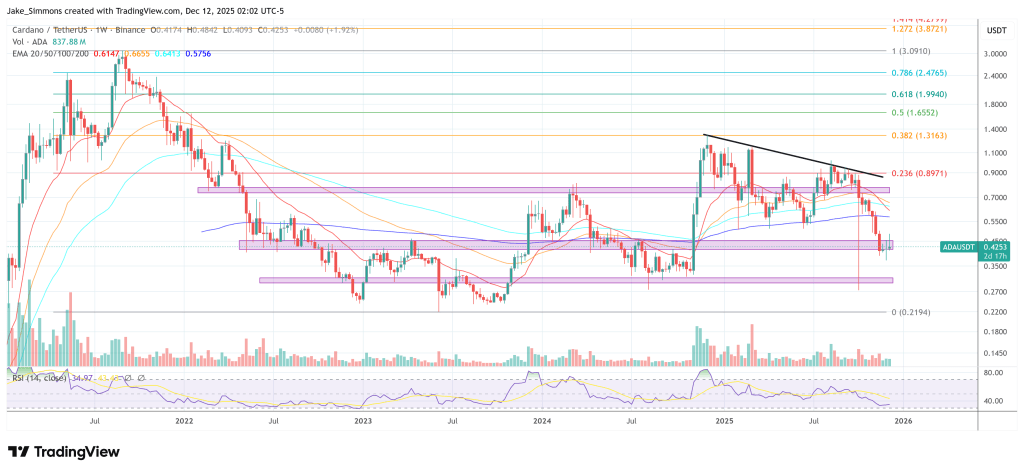
ADA bounces from key support, 1-week chart | Source: ADAUSDT on TradingView.com

Leituras Relacionadas

Uncovering the Truth About Agent Commerce, Payments, and Infrastructure

Decoding Agent Commerce, Payments, and Infrastructure: The Reality Over the past year, I've been building infrastructure for the Agent economy, engaging with major players like Stripe, Visa, Coinbase, Google, and dozens of startups. A clear conclusion emerges: true, large-scale demand does not yet exist. Startups face structural challenges. Data points illustrate this gap. Stripe's Agent commerce platform has over 1,000 merchants but only single-digit transacting agents. Visa's Agent payment token requires 9-month KYC and a $250M revenue threshold, accessible only to giants like Amazon. On-chain analysis reveals actual daily Agent transaction volume is around $17k, half of which are test transactions. The article analyzes four potential markets: **1. Agent-to-Merchant (A2M):** Current AI shopping UX is often inferior to traditional e-commerce for visual, comparison-heavy purchases (clothing, electronics). Chat interfaces are a step back. Real merchant interest is defensive "Agent Engine Optimization," fearing future obsolescence, not current demand. Potential exists in high-frequency, low-decision purchases (e.g., food delivery) or simplifying terrible UX (complex checkouts, non-native shoppers), but these require massive consumer distribution channels dominated by giants like DoorDash and Amazon. **2. Agent-to-API (A2A):** Developers already have subscriptions and billing for core APIs (compute, data). The argument for micro-payments via crypto for sub-dollar API calls is addressed by pre-paid balances today. The deeper issue is supplier resistance; major SaaS firms rely on enterprise contracts, not fractional cent pricing. Opportunity lies in the long tail of niche services, but this is a smaller market catering to developers, a historically low-paying group. **3. Agent-to-Agent (A2A):** This remains a theoretical long-term vision with near-zero current transaction volume. It involves unique challenges: discovery, trust, negotiation, dispute resolution. When it materializes, it will require a fundamentally new settlement infrastructure for high-speed, variable-value, multi-party transactions. It's a real long-term bet, but not the current market. **4. Agent-to-Finance (A2F):** This is the only category with existing, paying demand. Integrating AI into financial workflows (trading, portfolio management) is a natural evolution and enables new capabilities like autonomous rebalancing. However, competition favors incumbents with regulatory licenses, compliance infrastructure, and existing client relationships. **The Real Issue:** Why is infrastructure still being built? Incumbents can afford long-term bets, and payment companies see every problem as a nail for their payment hammer. However, payment is just one piece. The core challenge is *coordination*—orchestrating work between Agents and humans, verifying outcomes, and settling results. Payment is part of settlement, which is part of coordination. Companies that solve the coordination problem will subsume payments, not the other way around. Startups lack the infinite runway of giants and must find today's real market, which, after a year of exploration, lies outside these four categories—in an area with real, growing, and underserved activity.

marsbitHá 2h

Uncovering the Truth About Agent Commerce, Payments, and Infrastructure

marsbitHá 2h

Trading

Spot
Futuros

Artigos em Destaque

Como comprar PYTH

Bem-vindo à HTX.com!Tornámos a compra de PYTH (Pyth) (PYTH) simples e conveniente.Segue o nosso guia passo a passo para iniciar a tua jornada no mundo das criptos.Passo 1: cria a tua conta HTXUtiliza o teu e-mail ou número de telefone para te inscreveres numa conta gratuita na HTX.Desfruta de um processo de inscrição sem complicações e desbloqueia todas as funcionalidades.Obter a minha contaPasso 2: vai para Comprar Cripto e escolhe o teu método de pagamentoCartão de crédito/débito: usa o teu visa ou mastercard para comprar PYTH (Pyth) (PYTH) instantaneamente.Saldo: usa os fundos da tua conta HTX para transacionar sem problemas.Terceiros: adicionamos métodos de pagamento populares, como Google Pay e Apple Pay, para aumentar a conveniência.P2P: transaciona diretamente com outros utilizadores na HTX.Mercado de balcão (OTC): oferecemos serviços personalizados e taxas de câmbio competitivas para os traders.Passo 3: armazena teu PYTH (Pyth) (PYTH)Depois de comprar o teu PYTH (Pyth) (PYTH), armazena-o na tua conta HTX.Alternativamente, podes enviá-lo para outro lugar através de transferência blockchain ou usá-lo para transacionar outras criptomoedas.Passo 4: transaciona PYTH (Pyth) (PYTH)Transaciona facilmente PYTH (Pyth) (PYTH) no mercado à vista da HTX.Acede simplesmente à tua conta, seleciona o teu par de trading, executa as tuas transações e monitoriza em tempo real.Oferecemos uma experiência de fácil utilização tanto para principiantes como para traders experientes.

157 Visualizações TotaisPublicado em {updateTime}Atualizado em 2026.06.02

Como comprar PYTH

Discussões

Bem-vindo à Comunidade HTX. Aqui, pode manter-se informado sobre os mais recentes desenvolvimentos da plataforma e obter acesso a análises profissionais de mercado. As opiniões dos utilizadores sobre o preço de PYTH (PYTH) são apresentadas abaixo.

活动图片













