YouTube enables PYUSD stablecoin payouts for US creators: Report

cointelegraphPublicado em 2025-12-12Última atualização em 2025-12-12

Resumo

YouTube has enabled US-based creators to receive payouts in PayPal’s stablecoin, PYUSD, according to a report. The feature, confirmed by PayPal’s head of crypto, allows creators to accept payments in PYUSD without YouTube directly handling cryptocurrency. This integration builds on PayPal’s existing payment relationship with the platform. The move signals a shift for YouTube, which has historically restricted crypto-related content, and could significantly boost stablecoin adoption given the platform’s large user base. PYUSD, launched in 2023, has grown rapidly, with its market cap surging from around $500 million in January to $3.9 billion, aided by recent integrations with platforms like Spark and Bitfinex.

Video-sharing giant YouTube has reportedly enabled US-based creators to accept payouts in PayPal’s stablecoin, PYUSD.

Fortune reported on Thursday that PayPal’s head of crypto, May Zabaneh, said the feature is live, but only for users in the US. The firm integrated the ability for recipients to accept payments in PYUSD earlier this year, with YouTube ultimately opting to open that choice up to its creators.

“The beauty of what we’ve built is that YouTube doesn’t have to touch crypto and so we can help take away that complexity,” she said.

PayPal has had a long-running relationship with YouTube, with the platform allowing users to pay via its services for many years, alongside utilizing it for creator AdSense payouts.

YouTube may be warming up to crypto, after its history of shadowbanning crypto content, as digital assets are making their way into the mainstream. The move could also be a potential boon for stablecoin adoption, given the size of YouTube’s platform.

Related: Visa pilots fiat-funded stablecoin payouts for US businesses

The stablecoin market has exploded over the past year as mainstream businesses, institutions and governments have moved to integrate the assets with traditional finance.

PSYUD was launched in mid-2023 and has a current market cap of $3.9 billion according to CoinGecko data. It has skyrocketed in market value since the start of the year, increasing from around $500 million in January.
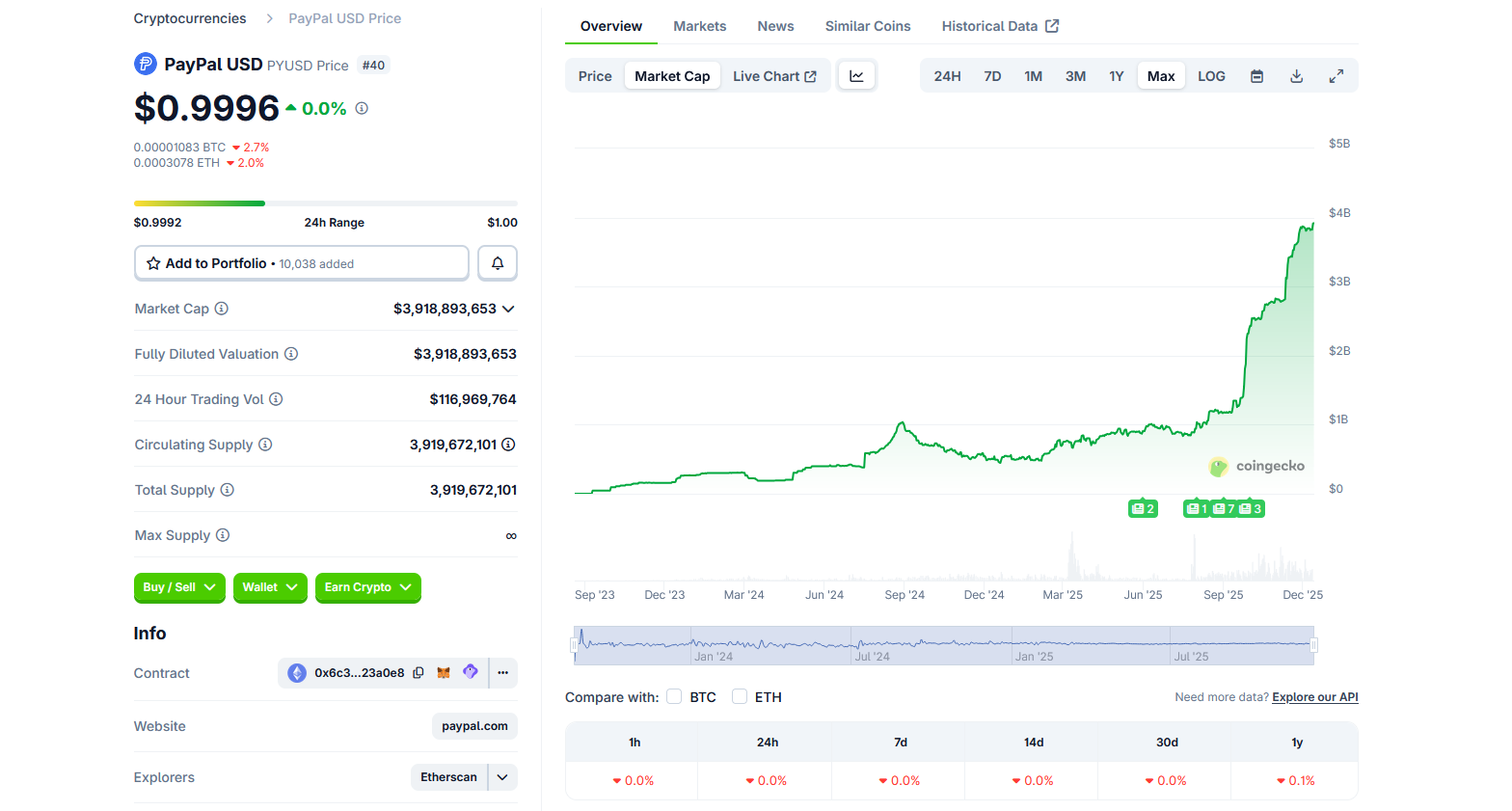
PYUSD market cap. Source: CoinGecko

A significant chunk of PYUSD’s growth has come since the start of September, when the market cap was sitting around $1 billion. During that month, PYUSD was integrated with Spark’s lending markets and Bitfinex’s Stable, an institutional-grade stablecoin blockchain.
Magazine: Stablecoins will see explosive growth in 2025 as world embraces asset class


Leituras Relacionadas

What Wall Street Really Wants After the Crypto Story Recedes

The tide of speculative crypto narratives has receded, revealing Wall Street's true objective: building a controlled, yield-generating, and compliant financial pipeline on distributed ledgers. They are migrating core functions onto blockchains, not for decentralization, but for efficiency and new revenue streams. Key developments include BlackRock's BUIDL fund, a tokenized treasury fund acting as a foundational reserve asset, and the rise of Securitize, which is going public and partnering with the NYSE to build a 24/7 digital securities trading and settlement system. This signals a major shift of securities clearing to blockchain technology. To make volatile assets like Bitcoin palatable for institutional investors, firms like BlackRock and Goldman Sachs are creating "covered call" ETFs (e.g., BITA). These products systematically sell options on Bitcoin holdings, transforming price volatility into stable monthly income, effectively repackaging crypto as a yield-bearing asset. Stablecoins are being positioned not as speculative tools but as efficient payment rails. Companies like Stripe and Mastercard are integrating them for instant, low-cost merchant settlements and cross-border card payments, respectively. Critically, new legislation like the GENIUS Act shapes them as non-interest-bearing, heavily regulated extensions of the US dollar system. In summary, Wall Street is quietly constructing a parallel, blockchain-based financial infrastructure featuring tokenized traditional assets, structured crypto yields, and programmable dollar pipelines—all under its control and fully integrated with existing regulatory and credit frameworks.

marsbitHá 13m

What Wall Street Really Wants After the Crypto Story Recedes

marsbitHá 13m

Tying Itself to SpaceX: Cursor's $60 Billion Rise

This article recounts the rapid rise of AI-powered coding startup Cursor and its 25-year-old MIT graduate CEO, Michael Truell. Launched in 2023, Cursor achieved explosive growth, reaching over 10 billion USD in revenue by late 2025. However, its journey highlights a central dilemma for AI application companies: dependence on foundational model providers. Cursor initially relied heavily on Anthropic's models but faced an existential threat when Anthropic launched its own competing coding tool, Claude Code. In response, Cursor declared an internal emergency in early 2026 and accelerated development of its own model, Composer. To secure the immense computing power needed, Truell struck a pivotal deal with Elon Musk's SpaceX in April 2026. The collaboration grants Cursor access to SpaceX's supercomputing resources for Composer, while SpaceX's Grok model benefits from Cursor's programming data. The agreement includes a potential 600 billion USD acquisition of Cursor by SpaceX later in the year, though a substantial termination fee is in place if the deal falls through. The story explores Cursor's intense, sometimes controversial hiring practices involving lengthy unpaid "work trials," its complex partnership-turned-rivalry with Anthropic, and its high-stakes gamble to ensure independence through the SpaceX alliance. The core question remains: will Cursor evolve into a defining, independent "generational" software company, or become a key piece in a tech giant's AI arsenal?

marsbitHá 18m

Tying Itself to SpaceX: Cursor's $60 Billion Rise

marsbitHá 18m

Warsh's Debut: Will the FED Chair Who Knows Crypto Best Bring Surprises or Shocks to the Market?

Kevin Warsh, the new Federal Reserve Chairman, prepares for his inaugural press conference amidst a challenging macroeconomic landscape: resurgent inflation, a bond market sell-off, and political pressure from President Trump for rate cuts. Uniquely, Warsh holds indirect investments in over 20 crypto and Web3 entities (e.g., Solana, dYdX), making him the first Fed Chair with disclosed crypto exposure. His stance may combine a hawkish, inflation-focused monetary policy with a crypto-friendly regulatory philosophy that shifts from Powell’s “same risk, same rule” approach toward a framework acknowledging blockchain’s productivity value. Warsh’s leadership could impact crypto markets across three dimensions: a paradigm shift in regulation (potentially accelerating pro-innovation legislation and stable币 rules), a re-pricing of risk premiums based on clearer communication and his view of AI as a structural disinflationary force, and a long-term reallocation of global institutional capital driven by increased legitimacy. Two potential scenarios for the press conference are outlined. A “positive surprise” would involve a dovish-leaning tone on rates coupled with signals of regulatory openness, potentially boosting crypto asset valuations. Conversely, a “negative shock” would see a more hawkish-than-expected stance on inflation and rates, triggering a broad risk-asset selloff that crypto markets would not escape. While ethics rules required Warsh to divest his crypto holdings upon confirmation, his deep understanding of the technology may fundamentally lower policy uncertainty and build a more receptive long-term foundation for digital assets’ integration into the mainstream financial system.

marsbitHá 10h

Warsh's Debut: Will the FED Chair Who Knows Crypto Best Bring Surprises or Shocks to the Market?

marsbitHá 10h

Trading

Spot
Futuros

Artigos em Destaque

Como comprar US

Bem-vindo à HTX.com!Tornámos a compra de Talus Network (US) simples e conveniente.Segue o nosso guia passo a passo para iniciar a tua jornada no mundo das criptos.Passo 1: cria a tua conta HTXUtiliza o teu e-mail ou número de telefone para te inscreveres numa conta gratuita na HTX.Desfruta de um processo de inscrição sem complicações e desbloqueia todas as funcionalidades.Obter a minha contaPasso 2: vai para Comprar Cripto e escolhe o teu método de pagamentoCartão de crédito/débito: usa o teu visa ou mastercard para comprar Talus Network (US) instantaneamente.Saldo: usa os fundos da tua conta HTX para transacionar sem problemas.Terceiros: adicionamos métodos de pagamento populares, como Google Pay e Apple Pay, para aumentar a conveniência.P2P: transaciona diretamente com outros utilizadores na HTX.Mercado de balcão (OTC): oferecemos serviços personalizados e taxas de câmbio competitivas para os traders.Passo 3: armazena teu Talus Network (US)Depois de comprar o teu Talus Network (US), armazena-o na tua conta HTX.Alternativamente, podes enviá-lo para outro lugar através de transferência blockchain ou usá-lo para transacionar outras criptomoedas.Passo 4: transaciona Talus Network (US)Transaciona facilmente Talus Network (US) no mercado à vista da HTX.Acede simplesmente à tua conta, seleciona o teu par de trading, executa as tuas transações e monitoriza em tempo real.Oferecemos uma experiência de fácil utilização tanto para principiantes como para traders experientes.

399 Visualizações TotaisPublicado em {updateTime}Atualizado em 2026.06.02

Como comprar US

Discussões

Bem-vindo à Comunidade HTX. Aqui, pode manter-se informado sobre os mais recentes desenvolvimentos da plataforma e obter acesso a análises profissionais de mercado. As opiniões dos utilizadores sobre o preço de US (US) são apresentadas abaixo.

活动图片