Anchored, But Under Strain

insights.glassnodePublicado em 2025-12-10Última atualização em 2025-12-10

Resumo

Bitcoin remains structurally fragile, trading between the STH-Cost Basis at $102.7k and the True Market Mean at $81.3k. On-chain conditions are weakening, with rising unrealized and realized losses, alongside elevated selling from long-term holders. Despite some demand absorbing this pressure, reclaiming key levels like the 0.75 cost-basis quantile ($95k) is crucial for a bullish reversal. Off-chain activity reflects caution: ETF flows are negative, spot and futures liquidity are subdued, and options markets show heightened demand for short-term downside protection ahead of the FOMC meeting. Traders are accumulating volatility, anticipating a near-term move. Post-FOMC, volatility may compress, but the market remains range-bound, balancing persistent sell pressure against patient demand.

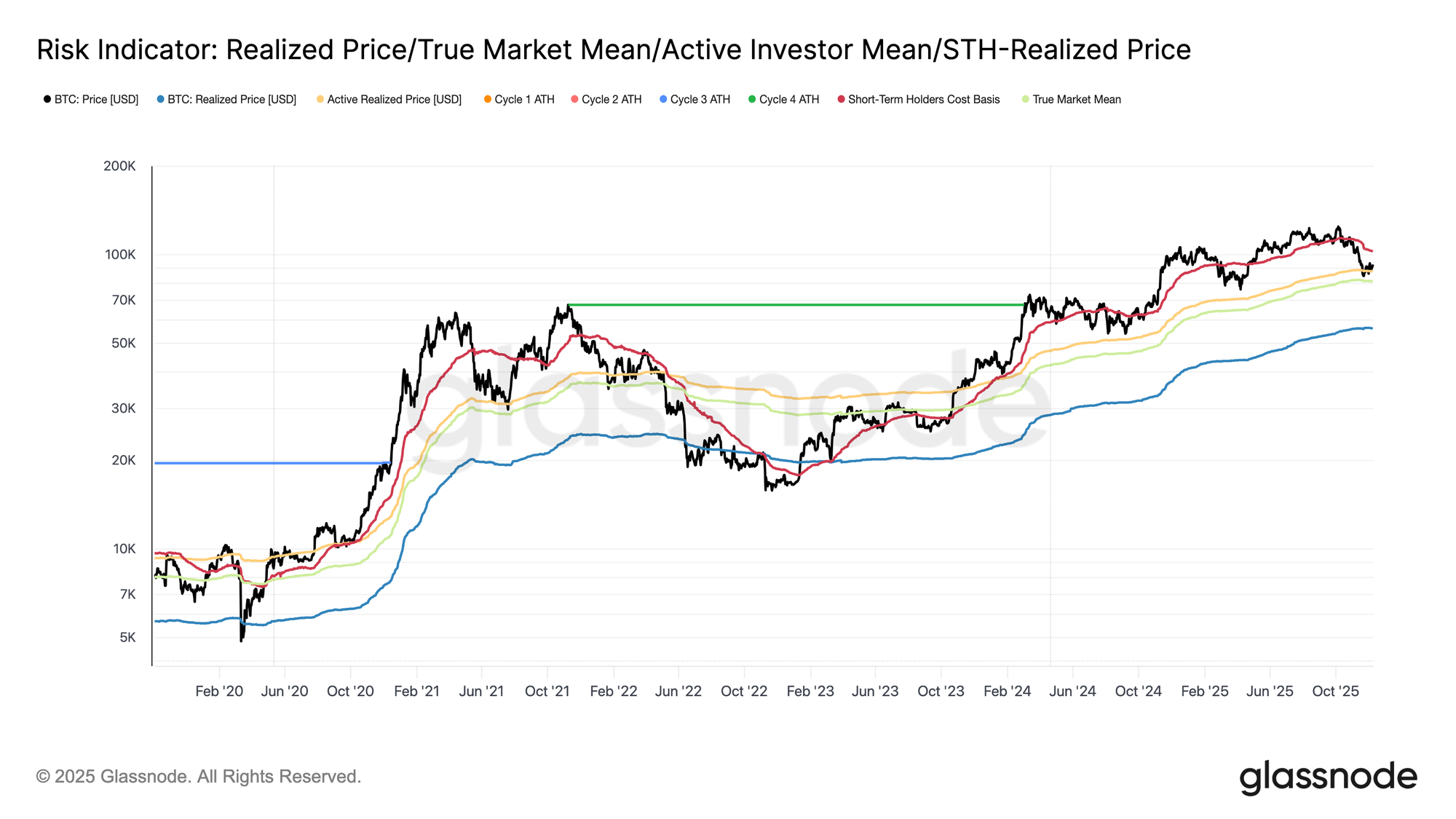
Bitcoin enters the week still confined within a structurally fragile range, bounded by the STH-Cost Basis at $102.7k and the True Market Mean at $81.3k. Last week, we underscored weakening on-chain conditions, thinning demand, and a cautious derivatives landscape that collectively echo the early-2022 setup.

Although price has held marginally above the True Market Mean, unrealized losses continue to expand, realized losses are rising, and spending by long-term investors remains elevated. The key upper thresholds to reclaim are the 0.75 cost-basis quantile at $95k, followed by the STH-Cost Basis. Until then, the True Market Mean remains the most probable bottom-formation zone, barring a new macro shock.
Live Chart

Time Works Against the Bulls

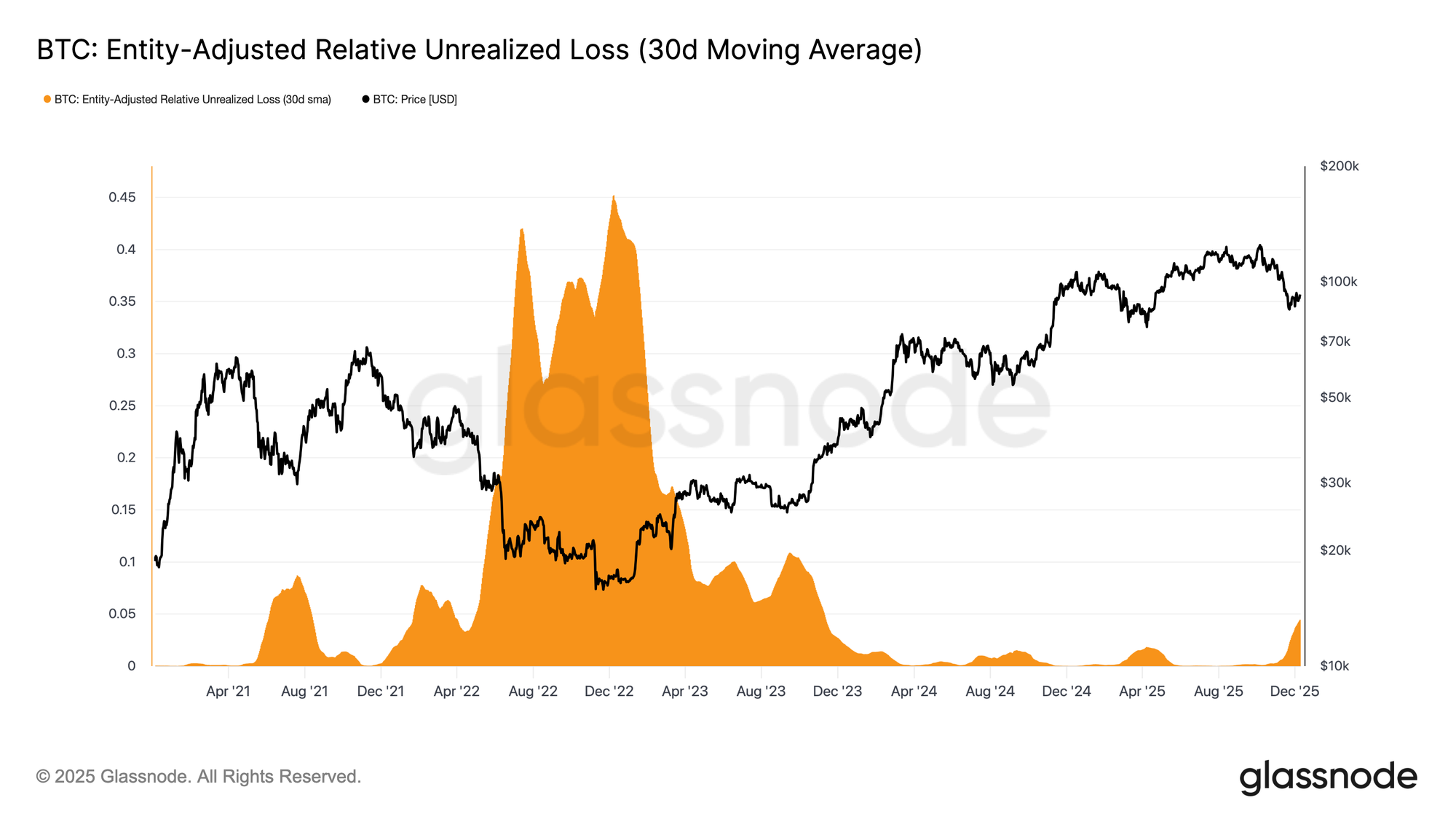
Remaining in a mild bearish phase reflects the tension between modest capital inflows and persistent sell pressure from top buyers. As the market holds within a weak but bounded range, time becomes a negative force, making unrealized losses harder for investors to endure and increasing the likelihood of loss realization.

The Relative Unrealized Loss (30D-SMA) has climbed to 4.4% after nearly two years below 2%, marking a shift from a euphoric phase to one of elevated stress and uncertainty. This hesitation now defines the range, and resolving it will require a renewed wave of liquidity and demand to rebuild confidence.
Live Chart

Losses Rising

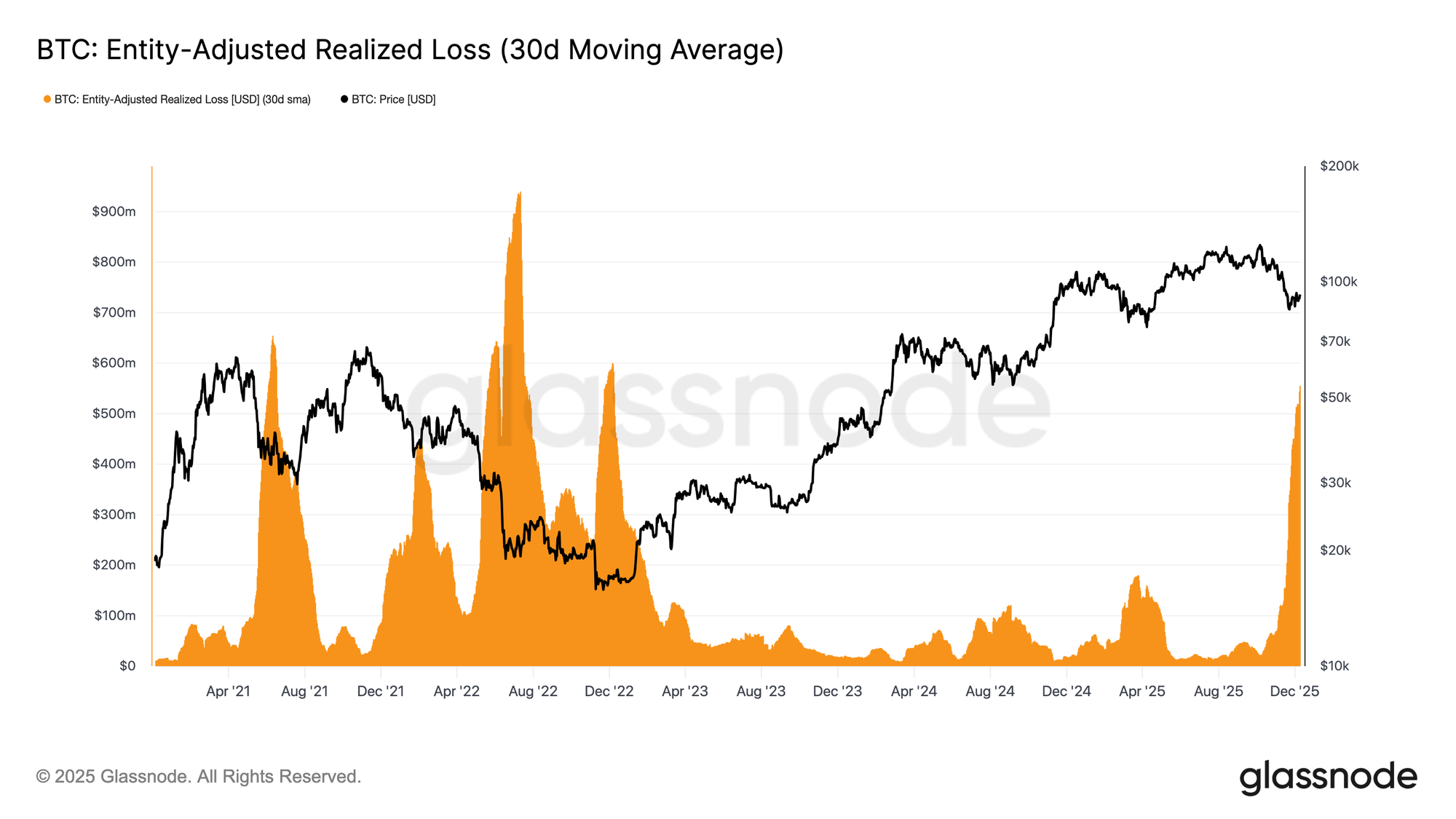
This time-driven pressure is further evident in spending behavior. Even as Bitcoin has rebounded from the November 22 low to roughly $92.7k, the 30D-SMA Entity-Adjusted Realized Loss has continued climbing, reaching $555 million per day, the highest level since the FTX collapse.

Such elevated loss realization during a moderate price recovery reflects mounting frustration among top buyers who are capitulating into strength rather than holding through the rebound.
Live Chart

Holding Back the Reversal

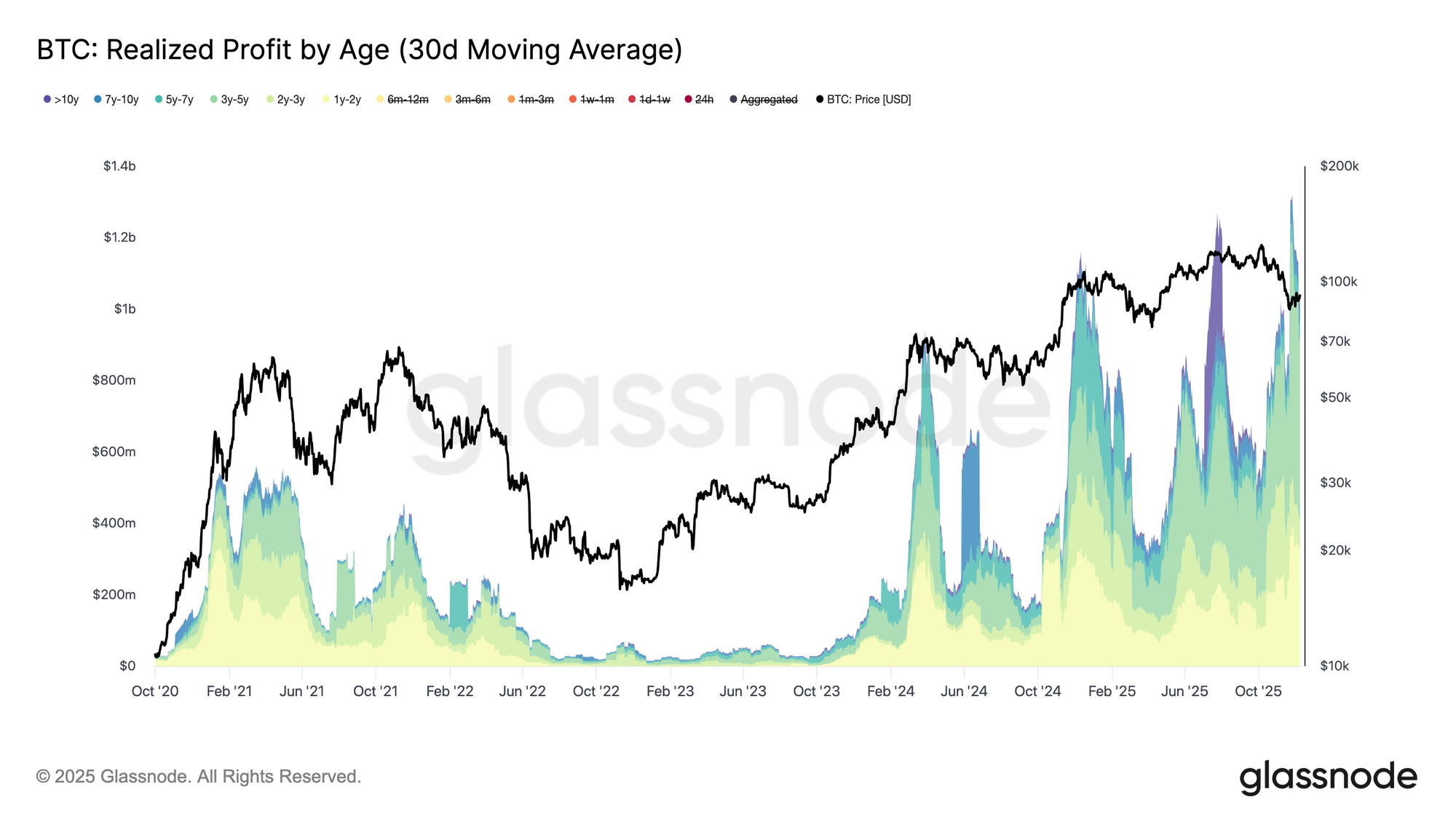
Rising realized losses are further anchoring the recovery, especially as they coincide with a surge in realized profit from seasoned investors. During the recent bounce, >1-year holders increased their realized profit (30D-SMA) above $1B per day, peaking at a new ATH of over $1.3B. Together, these two forces—time-driven capitulation by top buyers and heavy profit-taking by long-term holders ,explain why the market continues to struggle reclaiming the STH-Cost Basis.

Yet, despite this significant sell pressure, price has stabilized and even slightly recovered above the True Market Mean, signalling persistent and patient demand absorbing distribution. In the short term, if seller exhaustion begins to emerge, this underlying buy pressure could drive a retest of the 0.75 quantile (~$95k) and potentially the STH-Cost Basis.
Live Chart

Off-Chain Insights

ETF Woes

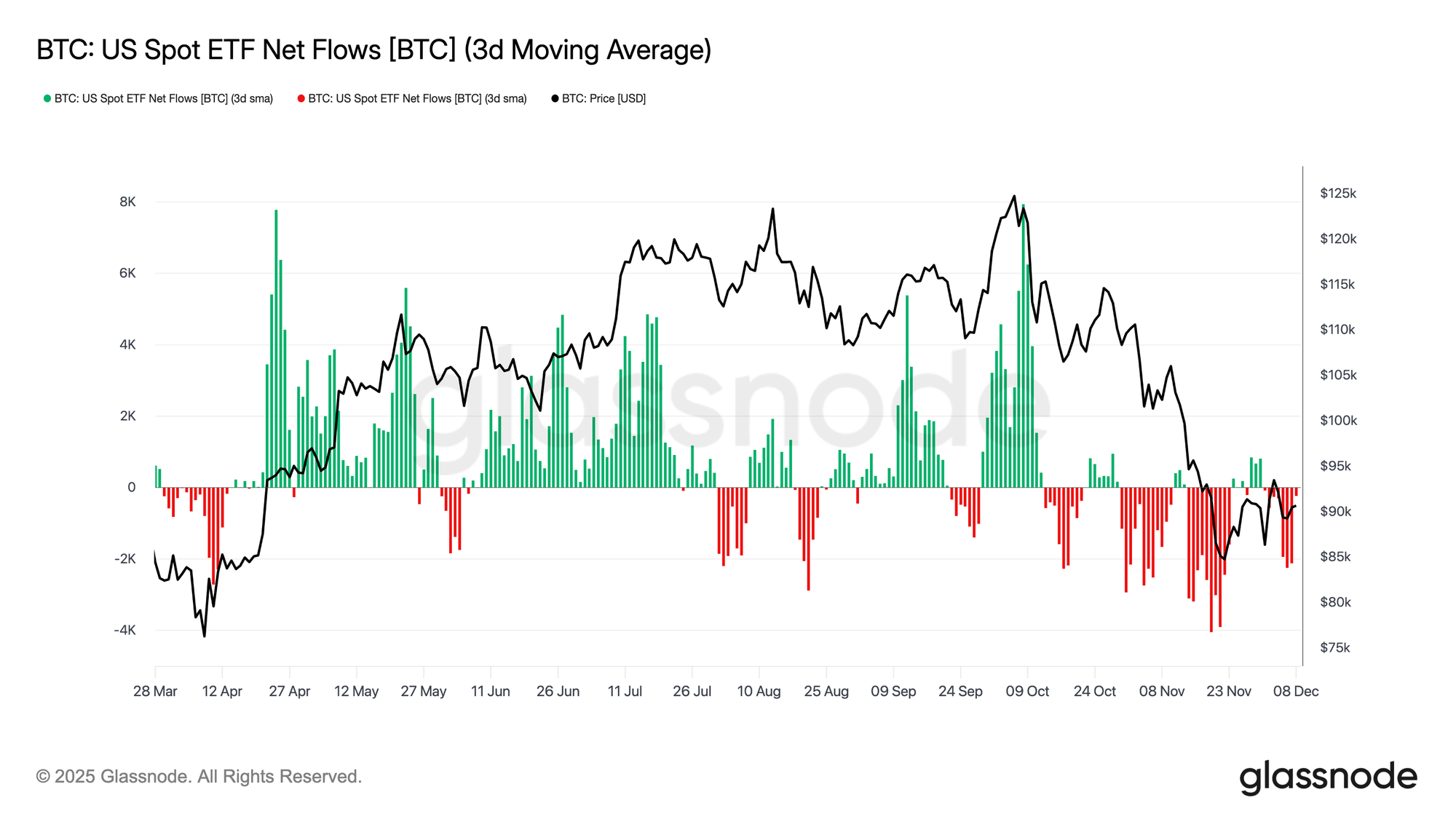
Turning to spot markets, US Bitcoin ETFs logged another quiet week, with the 3-day average of net flows remaining consistently below zero. This extends the cooling trend that began in late November and marks a clear departure from the robust inflow regime that supported price appreciation earlier in the year. Redemptions have been steady across several major issuers, underscoring a more risk-averse stance among institutional allocators as broader market conditions remain unsettled.

As a result, the spot market is operating with a thinner demand buffer, reducing immediate buy-side support and leaving price more vulnerable to macro catalysts and volatility shocks.
Live Chart

Liquidity Remains Subdued

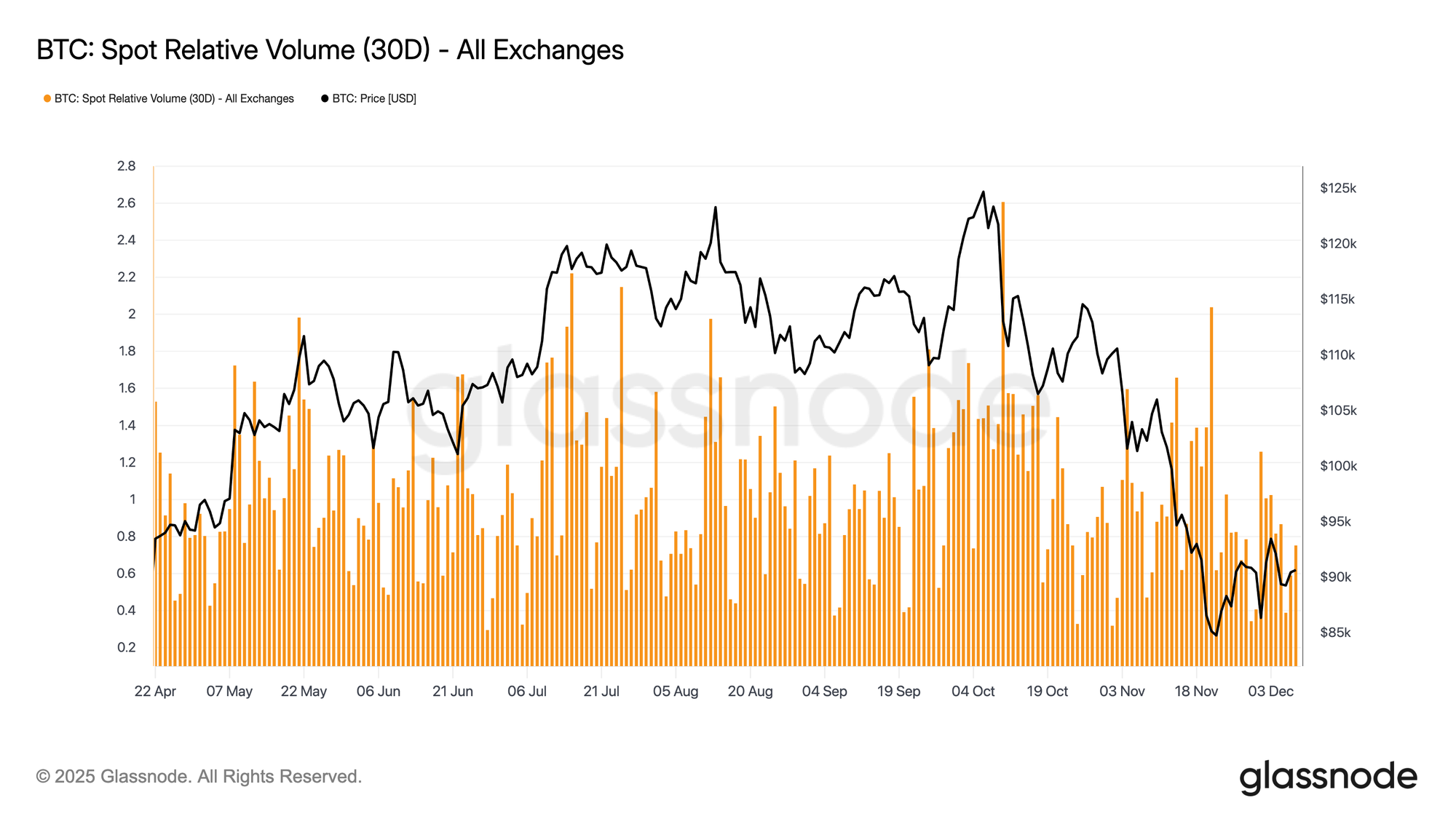
In parallel with softer ETF flows, Bitcoin’s spot relative volume continues to sit near the lower bound of its 30-day range. Trading activity has weakened through November and into December, mirroring the price decline and signalling a retreat in market participation. The contraction in volume reflects a more defensive positioning across the board, with fewer liquidity-driven flows available to absorb volatility or sustain directional moves.

With spot markets running quieter, attention now turns to the upcoming FOMC meeting, which could act as a catalyst for renewed participation depending on the policy tone.
Live Chart

Futures Ghost Town

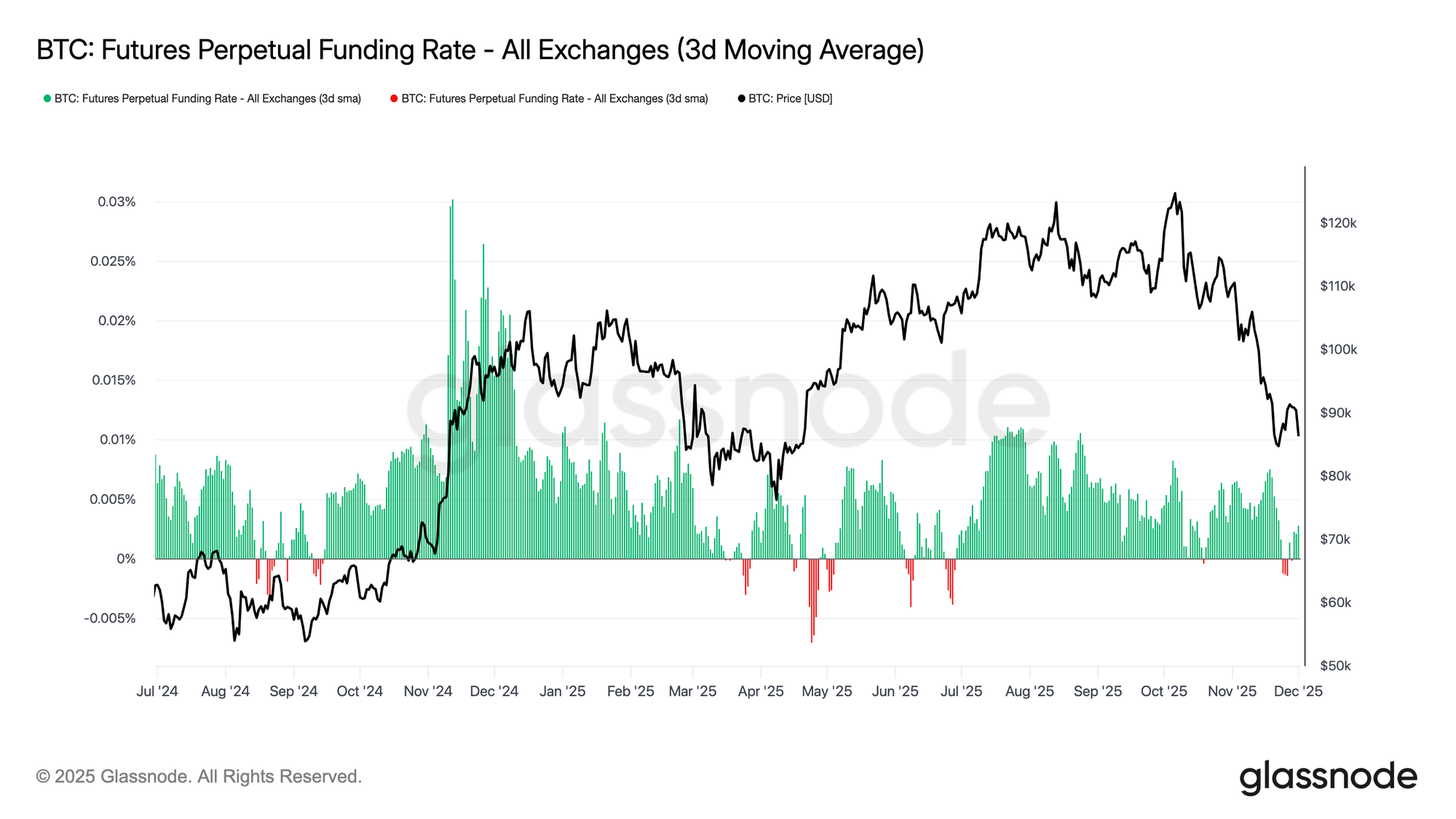
Extending this theme of muted participation, futures markets also show limited appetite for leverage, with Open Interest failing to meaningfully rebuild and funding rates pinned near neutral. These dynamics highlight a derivatives environment defined more by caution than conviction.

Across perpetual markets, funding hovered around zero to slightly negative during the week, underscoring the continued retreat in speculative long positioning. Traders remain balanced or defensive, contributing little directional pressure via leverage.

With derivatives activity subdued, price discovery tilts more heavily toward spot flows and macro catalysts rather than speculative expansion.
Live Chart

IV Pops at the Front End

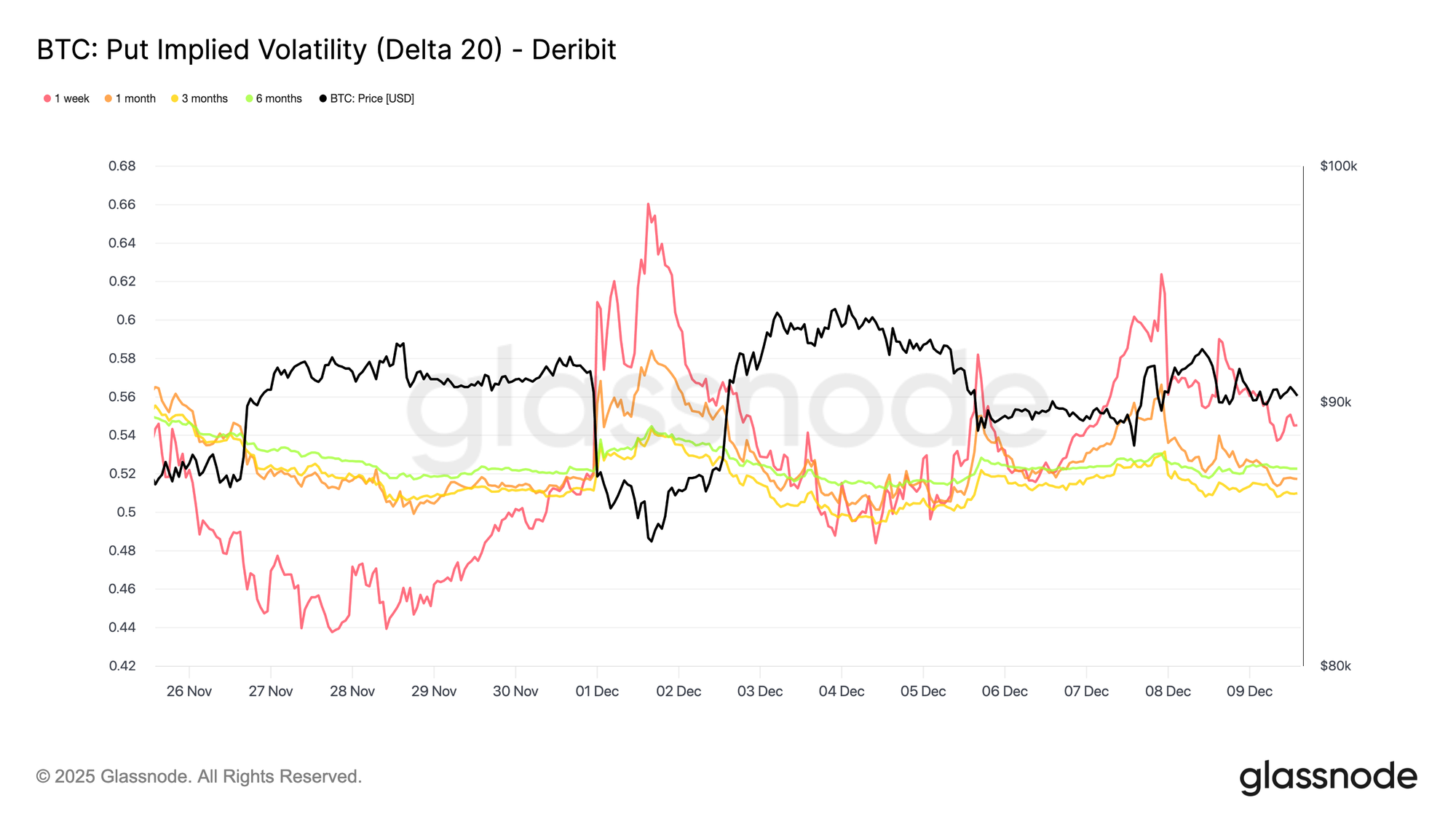
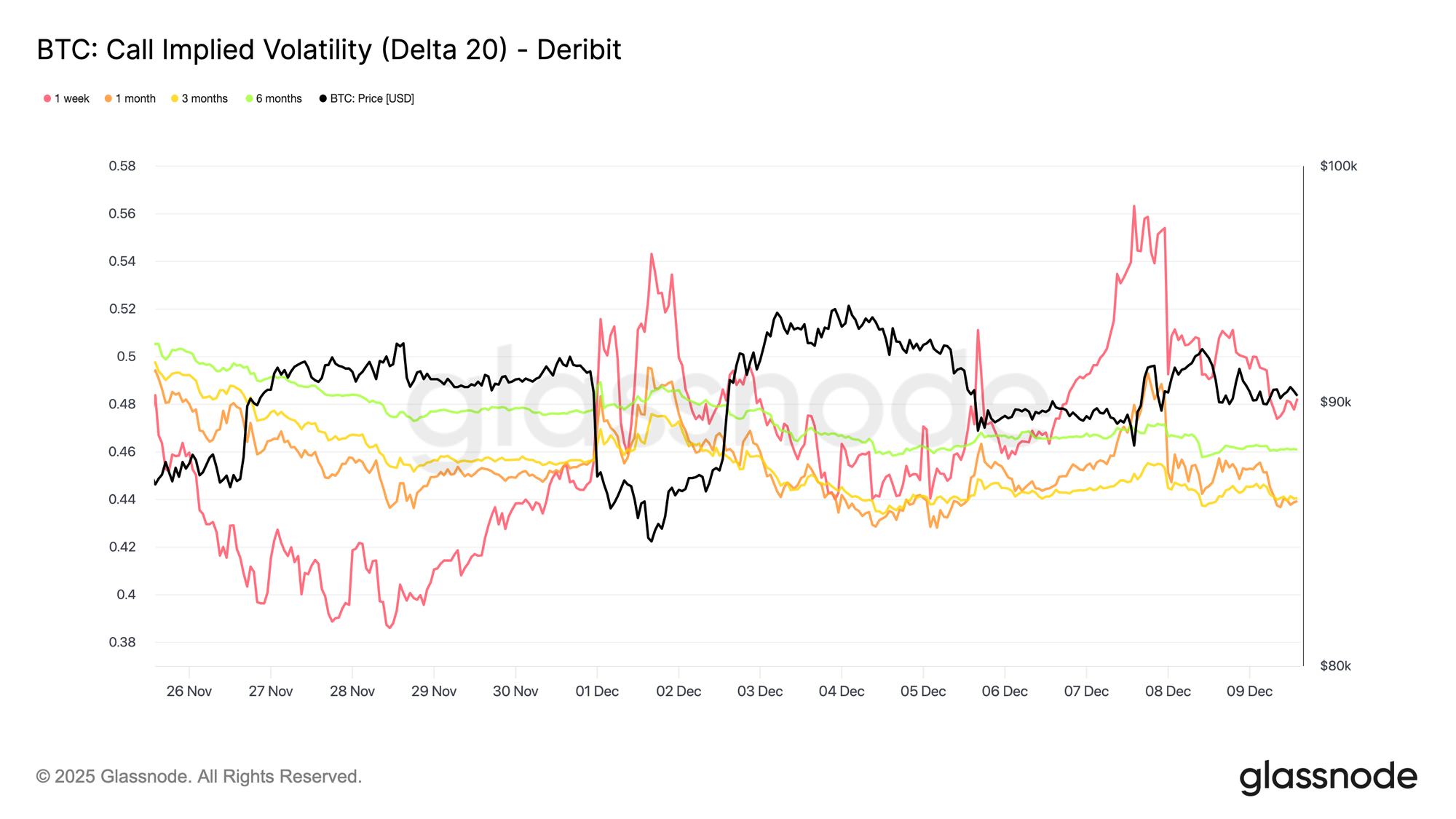
Turning to the options market, Bitcoin’s muted spot action contrasts sharply with a sudden rise in short-dated implied volatility, as traders position for a larger move. Interpolated Implied Volatility, which estimates IV at fixed deltas rather than relying on listed strikes, reveals a clearer structure of how risk is being priced across maturities.

On the 20-Delta CALL, the one-week tenor jumped by roughly ten vol points from last week, while longer maturities stayed relatively flat. The same pattern appears on the 20-Delta PUT, with short-dated downside IV lifting as longer expiries remain quiet.

Overall, traders are accumulating volatility precisely where they expect stress, preferring to own convexity rather than fade it ahead of the December 10 FOMC meeting.
Live Chart
Live Chart

Downside Demand Returns

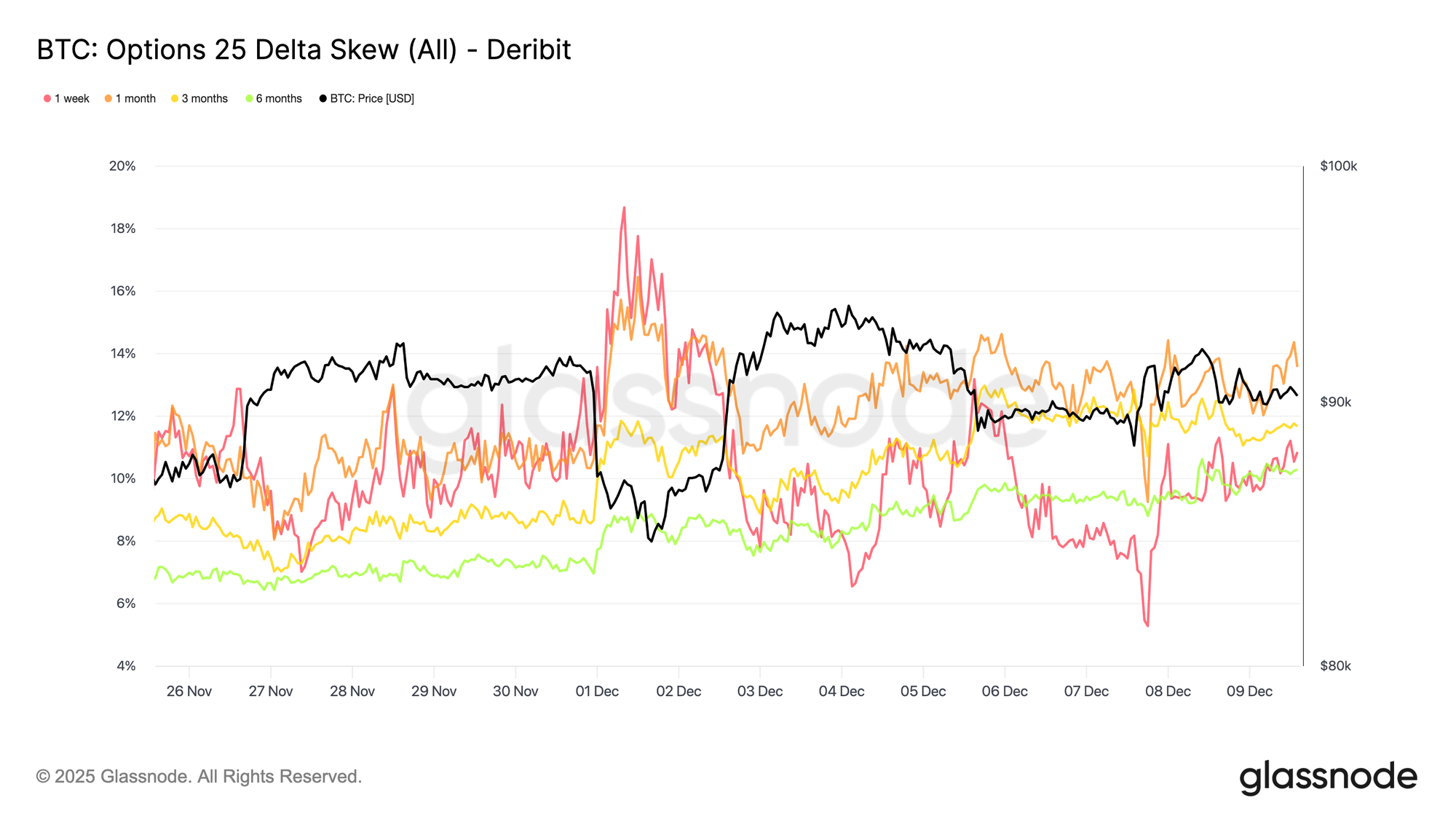
Complementing the rise in front-end volatility, downside protection is once again commanding a premium. The 25-delta skew, which measures the relative cost of puts versus calls at the same delta, has climbed to roughly 11 percent in the one-week tenor, indicating a clear pickup in demand for short-dated downside insurance ahead of the FOMC meeting.

Skew remains tightly clustered across maturities, ranging from 10.3 percent to 13.6 percent. This compression suggests that the preference for put protection is broad-based across the curve, reflecting a consistent hedging bias rather than isolated stress confined to the front end.
Live Chart

Skew Index Shows a Different Tone

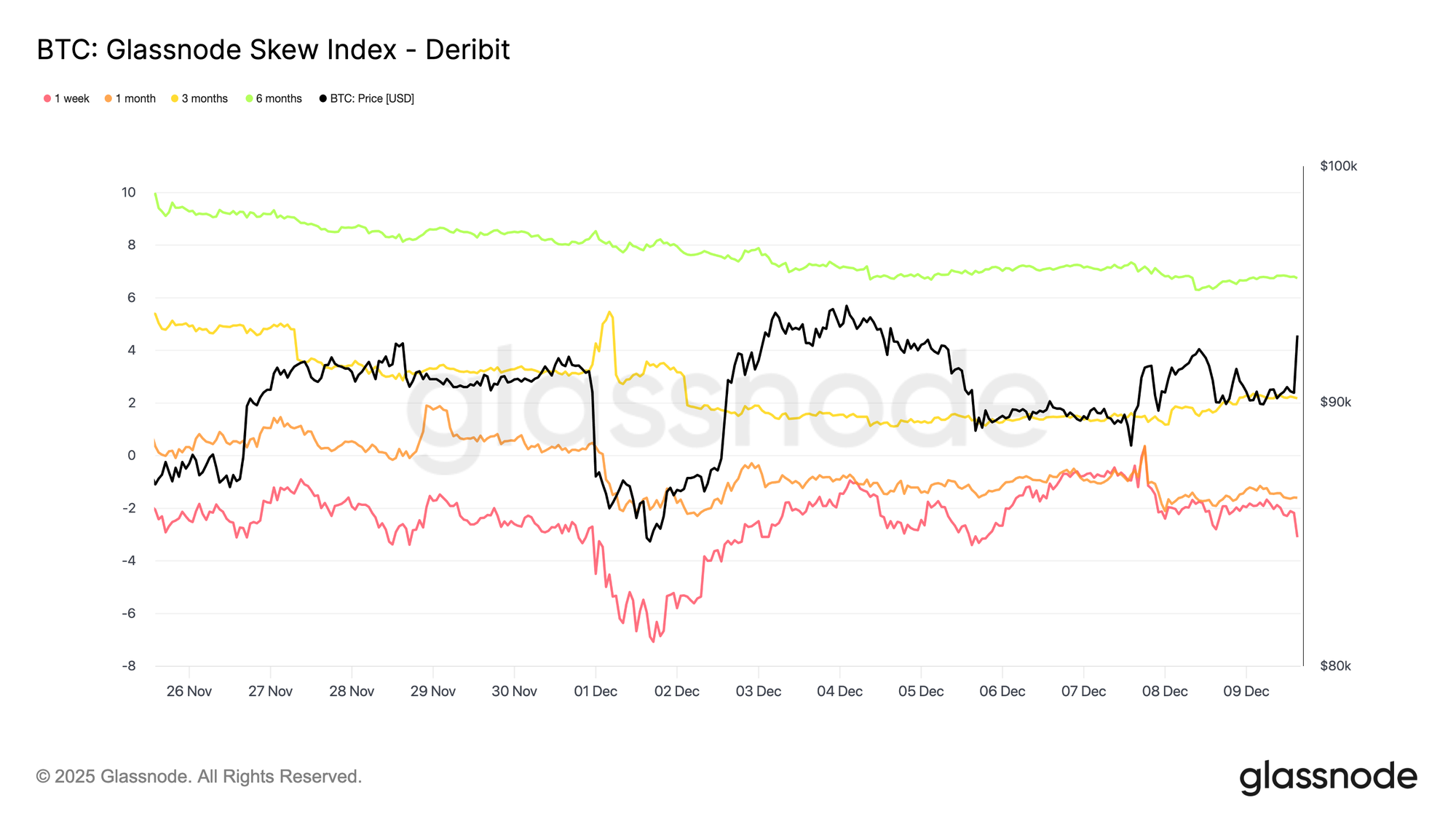
Adding another layer to the options picture, the skew index presents a more nuanced signal compared with the 25-delta skew. Because it is weighted toward low-delta options, it captures pricing across the full downside wing. The one-week and one-month readings sit in put territory, yet the three-month and six-month values, around 2.2 percent and 6.7 percent, fall into call territory, since the index is calculated as calls minus puts.

This creates a notable divergence: the 25-delta skew leans bearish across maturities, while the longer-dated skew index shows upside variance being priced more richly than downside. In essence, traders are not bidding deep OTM downside protection in the longer tenors, even though mid-delta puts remain supported. The surface therefore signals short-term caution, but a more balanced to mildly bullish tone further out the curve, a pattern typical in crypto where participants often hold far-OTM calls for asymmetric upside.
Live Chart

Volatility Accumulation

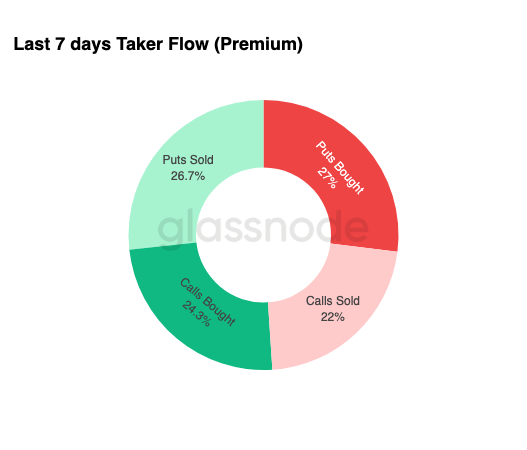
Rounding out the options landscape, weekly flow data reinforces a clear pattern: traders are buying volatility, not selling it. Premiums bought dominate total notional flow, with a slight lead from puts. This does not reflect a directional bias, but rather a regime of volatility accumulation. When traders purchase both wings, it signals hedging and convexity-seeking behaviour rather than sentiment-driven speculation.

Combined with rising implied volatility and a downside-leaning skew, the flow profile suggests that market participants are preparing for a volatility event with a bias toward the downside.
Live Chart

After FOMC

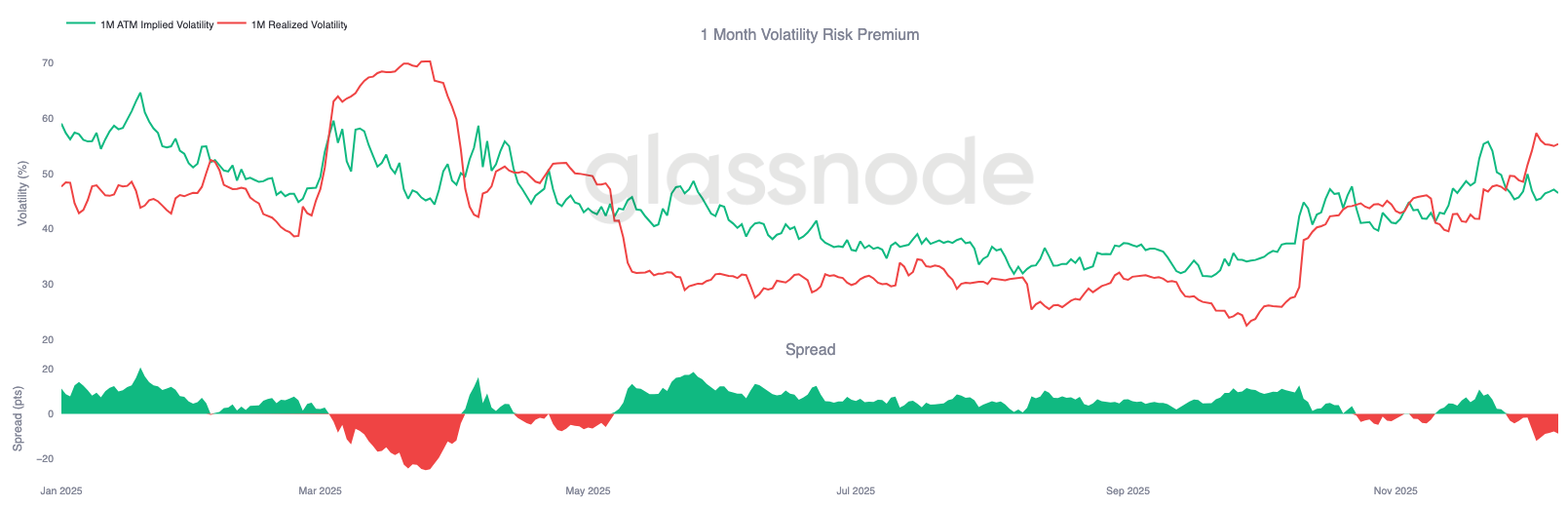
Looking ahead, implied volatility has already begun to ease, and historically, IV tends to compress further once the final major macro event of the year passes. With the December 10 FOMC meeting serving as the last meaningful catalyst, the market is preparing for a transition into a low-liquidity, mean-reverting environment.

After the announcement, gamma sellers typically re-enter, accelerating IV decay into year-end. Absent a hawkish surprise or a notable shift in guidance, the path of least resistance points toward lower implied volatility and a flatter surface through late December.
Live Chart

Conclusion

Bitcoin continues to trade within a structurally fragile environment where rising unrealized losses, elevated realized loss realization, and heavy profit-taking from long-term holders collectively anchor price action. Despite this persistent sell pressure, demand remains sufficiently resilient to keep price above the True Market Mean, suggesting patient buyers are still absorbing distribution. A short-term push toward the 0.75 quantile or even the STH Cost Basis remains possible if seller exhaustion begins to surface.

Off-chain conditions echo this cautious tone. ETF flows remain negative, spot liquidity is subdued, and futures markets lack speculative engagement. Options markets reinforce a defensive posture, with traders accumulating volatility, bidding short-dated downside protection, and positioning for a near-term volatility event ahead of the FOMC meeting.

Taken together, market structure suggests a weak but stable range, held up by patient demand yet constrained by persistent sell pressure. The short-term path hinges on whether liquidity improves and sellers relent, while the longer-term outlook depends on the market’s ability to reclaim key cost-basis thresholds and shift out of this time-driven, psychologically taxing phase.

Leituras Relacionadas

Bitcoin Becomes a National Strategic Asset? U.S. Congressman Proposes Annual Purchase of 200,000 BTC, Locked for 20 Years Without Sale

U.S. Representative Nick Begich (R-Alaska) introduced the "American Reserve Modernization Act" (ARMA) on May 21, aiming to codify a strategic Bitcoin reserve into law. Building on a prior executive order, the bill seeks to establish a permanent national Bitcoin reserve managed by the Treasury Department. The proposed legislation would authorize the Treasury to acquire up to 200,000 Bitcoin annually for five years, targeting a total reserve of 1 million Bitcoin, roughly 5% of the total supply. All acquired Bitcoin would be locked and held for at least 20 years. Representative Begich likened Bitcoin's role in crypto to gold's in precious metals, calling it the dominant store of value in its asset class. The U.S. government currently holds approximately 328,000 Bitcoin, largely from law enforcement seizures, but lacks a coherent management strategy for these assets. Co-sponsors emphasized the urgency of addressing this gap. This move coincides with a wave of crypto-friendly legislation in Washington, including recent bipartisan committee approval of a major digital asset market structure bill. Concurrently, the Treasury has intensified crackdowns on illicit crypto finance, seizing hundreds of millions in assets, further highlighting the need for a comprehensive digital asset strategy. The White House has indicated that operational details for the strategic Bitcoin reserve are forthcoming, with key legal hurdles reportedly cleared.

marsbitHá 6m

Bitcoin Becomes a National Strategic Asset? U.S. Congressman Proposes Annual Purchase of 200,000 BTC, Locked for 20 Years Without Sale

marsbitHá 6m

Blockchain Capital Partner: The Structure of On-Chain Two-Tier Capital Is Still in the Early Stages of Value Discovery

Spencer Bogart, a general partner at Blockchain Capital, argues that the on-chain economy possesses unique features like programmability, composability, and global distribution, fostering an open and fast-paced innovation ecosystem. However, these very features create challenges for large, fiduciarily-responsible institutional capital, which requires robust risk assessment frameworks often difficult in a permissionless and adversarial environment. The proposed solution is the emergence of a two-tiered capital structure. The first, permissionless layer remains the crucible for innovation, where protocols are built, tested, and hardened with real capital. The second, "institutional" layer consists of chains (L1s, L2s, etc.) that, while based on similar code, incorporate risk-management features like the ability to pause or freeze transactions in extreme scenarios, making them suitable for large-scale institutional deployment. The synergy between these layers is key. Protocols proven resilient in the open, permissionless environment can then scale to the institutional layer, accessing deeper capital pools. This creates a lifecycle: build and launch permissionlessly, test and prove robustness publicly, then expand to an institutional-grade chain for scaled adoption. This architecture allows the open, experimental side to continue driving innovation with crypto-native capital, while the institutional layer provides the liquidity, stability, and trust required for mainstream adoption. The major challenge identified is the "cold start" problem: aligning where institutional capital prefers to go with where the most proven applications and network effects currently reside. How this dynamic resolves—whether through protocol migration, new protocol builds, or institutional adaptation—will be crucial to watch. Overall, this evolving structure aims to combine the strengths of open innovation and institutional depth within a shared on-chain ecosystem.

链捕手Há 1h

Blockchain Capital Partner: The Structure of On-Chain Two-Tier Capital Is Still in the Early Stages of Value Discovery

链捕手Há 1h

Trading

Spot
Futuros

Artigos em Destaque

Como comprar HPP

Bem-vindo à HTX.com!Tornámos a compra de House Party Protocol (HPP) simples e conveniente.Segue o nosso guia passo a passo para iniciar a tua jornada no mundo das criptos.Passo 1: cria a tua conta HTXUtiliza o teu e-mail ou número de telefone para te inscreveres numa conta gratuita na HTX.Desfruta de um processo de inscrição sem complicações e desbloqueia todas as funcionalidades.Obter a minha contaPasso 2: vai para Comprar Cripto e escolhe o teu método de pagamentoCartão de crédito/débito: usa o teu visa ou mastercard para comprar House Party Protocol (HPP) instantaneamente.Saldo: usa os fundos da tua conta HTX para transacionar sem problemas.Terceiros: adicionamos métodos de pagamento populares, como Google Pay e Apple Pay, para aumentar a conveniência.P2P: transaciona diretamente com outros utilizadores na HTX.Mercado de balcão (OTC): oferecemos serviços personalizados e taxas de câmbio competitivas para os traders.Passo 3: armazena teu House Party Protocol (HPP)Depois de comprar o teu House Party Protocol (HPP), armazena-o na tua conta HTX.Alternativamente, podes enviá-lo para outro lugar através de transferência blockchain ou usá-lo para transacionar outras criptomoedas.Passo 4: transaciona House Party Protocol (HPP)Transaciona facilmente House Party Protocol (HPP) no mercado à vista da HTX.Acede simplesmente à tua conta, seleciona o teu par de trading, executa as tuas transações e monitoriza em tempo real.Oferecemos uma experiência de fácil utilização tanto para principiantes como para traders experientes.

182 Visualizações TotaisPublicado em {updateTime}Atualizado em 2026.04.29

Como comprar HPP

O que é GENIUS

I. Introdução ao Projeto1. O Que É Genius?Genius (GENIUS) é posicionado como o “terminal definitivo em cadeia”, uma plataforma de negociação descentralizada focada na privacidade e na velocidade. Ao integrar tecnologia de privacidade de topo, visa construir uma infraestrutura de negociação em privacidade de próxima geração em redes como a BNB Chain, permitindo que os utilizadores interajam em cadeia com uma experiência fluida comparável às trocas centralizadas.2. Como Funciona o Genius?A arquitetura técnica central do Genius está estruturada da seguinte forma:(1) Invisível na cadeia: Os utilizadores não precisam de lidar manualmente com aprovações em múltiplas etapas para operações cross-chain, embrulhamento de ativos ou gestão complexa de gás.(2) Negociação sem Assinatura: Através de integrações como a Turnkey, o Genius permite negociações instantâneas sem confirmações pop-up ou autorizações por transação.(3) Agregador de Agregadores: O Genius é alimentado por uma pilha de agregação de classe mundial integrada com mais de 150 DEXs, reivindicando uma eficiência de citação superior em comparação com produtos concorrentes.(4) Gestão de Contas: A plataforma adota uma arquitetura não custodial e utiliza o Turnkey e o Lit Protocol para gestão de chaves, permitindo que os utilizadores acedam às suas contas de forma segura através de chaves de acesso.3. Quem Criou o Genius?De acordo com os seus Termos de Serviço oficiais, o Genius foi desenvolvido pela Shuttle Labs, Inc. Com base na conta oficial do projeto no X, Ryan Myher é um dos principais colaboradores que impulsionam a iteração do produto, incluindo desenvolvimentos como a implementação do protocolo Ghost, bem como um maior envolvimento da comunidade.O fundador da Binance, CZ, juntou-se oficialmente ao projeto como conselheiro, com o objetivo de ajudar a equipa a construir uma experiência de negociação em cadeia mais rápida e que preserve a privacidade.Além disso, o projeto recebeu um forte apoio da YZi Labs, que investiu no Genius e trabalha ao lado da Genius Foundation, responsável pela manutenção do núcleo do Genius Bridge Protocol (GBP).4. Tokenomics do GeniusGENIUS é o token nativo do ecossistema Genius. Até ao momento, o projeto não lançou um documento completo de tokenomics.Com base nas últimas divulgações oficiais, o Genius incorpora um mecanismo deflacionário, e 4,6% do fornecimento total de tokens já foi queimado durante a fase inicial de lançamento.Sistema de Pontos Genius (GP):(1) Trade-to-Earn: A plataforma estabeleceu um pool de recompensas de 200 milhões de Pontos Genius, e os utilizadores ganham GP por cada negociação executada através do terminal.(2) Níveis e Distintivos: O Genius apresenta um sistema de distintivos baseado em progressão que varia de Smart a God, com níveis mais altos a desbloquear benefícios e vantagens adicionais.(3) Rendimento Nativo: Os utilizadores que detêm ativos designados como usdGG no painel podem ganhar rendimento nativo diretamente sem passar por staking complexo.(4) Incentivos de Referência: Os referenciadores podem ganhar reembolsos de taxas superiores a 45% pagos em USDC, juntamente com GP adicionais.5. Cronograma & Principais MarcosMarço de 2020: A conta oficial do projeto no X foi criada, marcando o início da sua fase de preparação inicial.13 de janeiro de 2026: O Genius anunciou um investimento de vários milhões de dólares da YZi Labs e simultaneamente confirmou CZ como conselheiro para acelerar a construção da sua infraestrutura de negociação em privacidade.18 de abril de 2026: O projeto anunciou que o protocolo de privacidade Ghost seria lançado em breve.29 de abril de 2026: O protocolo Ghost abriu oficialmente para os seus primeiros 50 testadores, marcando o início de uma nova era para a negociação em privacidade na BNB Chain. Ao mesmo tempo, a equipa confirmou que 4,6% dos tokens foram queimados.​II. Informação sobre o Token1) Informação BásicaNome do token: GENIUS (Genius)III. Links RelacionadosWebsite:https://www.tradegenius.com/homeExploradores:https://bscscan.com/address/0x1f12b85aac097e43aa1555b2881e98a51090e9a6Sociais:https://x.com/GeniusTerminalNota: A introdução ao projeto provém dos materiais publicados ou fornecidos pela equipa oficial do projeto, que é apenas para referência e não constitui aconselhamento de investimento. A HTX não se responsabiliza por quaisquer perdas diretas ou indiretas resultantes.

310 Visualizações TotaisPublicado em {updateTime}Atualizado em 2026.05.12

O que é GENIUS

Como comprar GENIUS

Bem-vindo à HTX.com!Tornámos a compra de Genius (GENIUS) simples e conveniente.Segue o nosso guia passo a passo para iniciar a tua jornada no mundo das criptos.Passo 1: cria a tua conta HTXUtiliza o teu e-mail ou número de telefone para te inscreveres numa conta gratuita na HTX.Desfruta de um processo de inscrição sem complicações e desbloqueia todas as funcionalidades.Obter a minha contaPasso 2: vai para Comprar Cripto e escolhe o teu método de pagamentoCartão de crédito/débito: usa o teu visa ou mastercard para comprar Genius (GENIUS) instantaneamente.Saldo: usa os fundos da tua conta HTX para transacionar sem problemas.Terceiros: adicionamos métodos de pagamento populares, como Google Pay e Apple Pay, para aumentar a conveniência.P2P: transaciona diretamente com outros utilizadores na HTX.Mercado de balcão (OTC): oferecemos serviços personalizados e taxas de câmbio competitivas para os traders.Passo 3: armazena teu Genius (GENIUS)Depois de comprar o teu Genius (GENIUS), armazena-o na tua conta HTX.Alternativamente, podes enviá-lo para outro lugar através de transferência blockchain ou usá-lo para transacionar outras criptomoedas.Passo 4: transaciona Genius (GENIUS)Transaciona facilmente Genius (GENIUS) no mercado à vista da HTX.Acede simplesmente à tua conta, seleciona o teu par de trading, executa as tuas transações e monitoriza em tempo real.Oferecemos uma experiência de fácil utilização tanto para principiantes como para traders experientes.

178 Visualizações TotaisPublicado em {updateTime}Atualizado em 2026.05.12

Como comprar GENIUS

Discussões

Bem-vindo à Comunidade HTX. Aqui, pode manter-se informado sobre os mais recentes desenvolvimentos da plataforma e obter acesso a análises profissionais de mercado. As opiniões dos utilizadores sobre o preço de A (A) são apresentadas abaixo.

活动图片