This is what happened during Ethereum’s latest All Core Developer call

AmbcryptoPublicado em 2022-07-10Última atualização em 2022-07-10

Resumo

Ethereum core developers concluded their 142nd All Core Developers (ACD) call on 8 July. The meeting discussed issues regarding the Merge mainnet fork, among other important updates on the network.

Ethereum [ETH] core developers concluded their 142nd All Core Developers (ACD) call on 8 July. The meeting discussed issues regarding the Merge mainnet fork, among other important updates on the network.

And we’re off

The meeting reports have been released by Core Developer Tim Beiko and Galaxy Digital researcher Christine Kim. Both recaps provide different perspectives on the call. These perspectives remain important insights into the functioning of the Ethereum Foundation.

The first item on the agenda was the Gray Glacier fork that pushed back the difficulty bomb. Beiko released an Etherscan chart to claim that block times are now back to normal. He went on to brief that Besu hit a data storage-related issue that caused the Besu nodes to sync. The issue has since been fixed and has been released in the tweet thread.
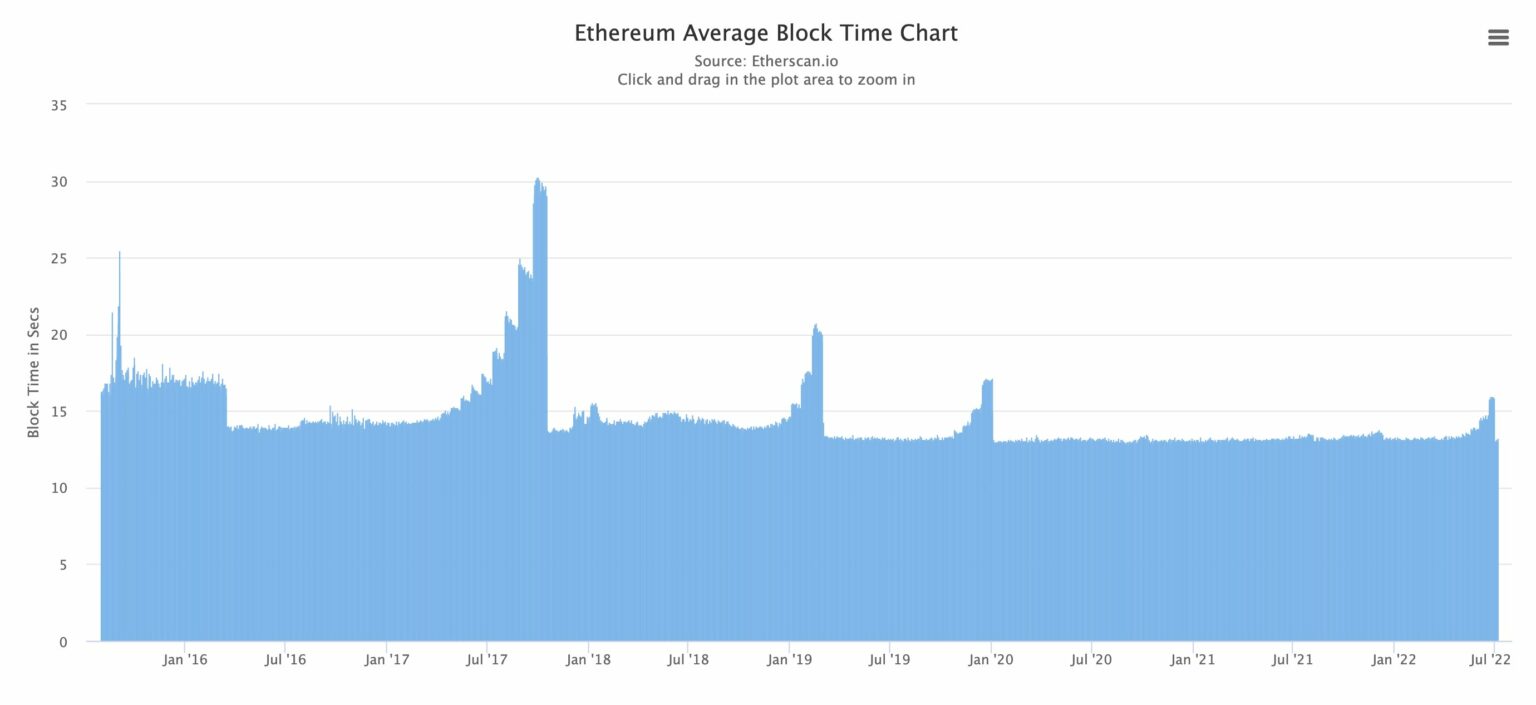
Source: Etherscan

Paritosh, a validator whisperer at Ethereum, raised a concern during the meeting for future references.

“For future forks, we’re going to have to work a lot more on communication and create a guide of common pitfalls and maybe work on a basic script that validates for if nodes are properly set up, right ports are used, right TTD is used, etc.”

Christine Kim also presented her recap of the ACD call. She went on to point out a major distinction in the Goerli merge. Kim recalled that Beiko has suggested a change in the Goerli testnet. According to her, Beiko noted that complexities could be reduced for Goerli as well as the mainnet. This, he stated, could be done by setting one TTD value instead of two. This came as a “surprise” to Kim as it would mean changing the initial testnet procedure. She added that the developers were leaning towards keeping the procedure unchanged to “avoid introducing unforeseen attack vectors”.

The Goerli fork will be the final testnet before the mainnet merge that is reigning heavy on the developers. Kim also stated that “The goal is to deploy mainnet ready code or at least as close to mainnet ready code as possible on Goerli.”

Where does ETH stand now?

ETH’s price remained unaffected by these events after reporting no significant change over the day. However, ETH was up by 17.25% during the week after a “mini crypto rally.” It was trading at $1,219, at press time, after the crypto-markets breathed a sigh of relief in recent days.


Leituras Relacionadas

More and More People Are Using Xiaohongshu as an AI Incubator

"More and more people are turning Xiaohongshu into an AI incubator," observes an article exploring a shift in China’s tech innovation landscape. The AI wave is no longer dominated by experienced tech experts; instead, young people—often with humanities backgrounds, and increasingly Gen Z or even younger—are driving creativity. This reflects a broader trend: AI is transforming entrepreneurship from a capital-heavy, top-down model into a lightweight, accessible process. The rise of "AI Native" creators was highlighted at a recent Xiaohongshu hackathon, where diverse teams showcased projects targeting highly specific, everyday problems—from AI-generated PPT improvements to brain-controlled wheelchairs and apps that simplify communication with hairstylists. The winning project, "Pocket Guitar," offers a portable, user-friendly music tool that mimics real guitar playing. These innovators embrace a "Build in Public" approach: they share ideas, progress, and failures openly on Xiaohongshu, turning development into a collaborative, community-driven process. This method helps validate demand, recruit team members, and grow user bases organically. For instance, one 23-year-old founder assembled a distributed team through technical discussions on the platform, while a 13-year-old award winner used AI to learn coding and solve real-world problems. Two key factors enable this movement: AI democratization (lowering technical barriers) and the power of social communities (enabling open collaboration and instant feedback). Xiaohongshu, originally a lifestyle and shopping guide platform, has thus evolved into a vital innovation infrastructure. It connects creators with real user needs, facilitates low-cost prototyping, and fosters a culture of co-creation. This shift signals a new era of innovation—defined not by grand narratives and scale, but by granular insights, individual creativity, and trust-based community support. Xiaohongshu’s role is expanding from answering "what to buy" to "what to create," positioning it as a potential "App Store for the AI era."

marsbitHá 1h

More and More People Are Using Xiaohongshu as an AI Incubator

marsbitHá 1h

Trading

Spot
Futuros
活动图片