JPMorgan закрыл счета сотрудника криптоплатформы ShapeShift

cryptonews.ruPublicado em 2025-05-25Última atualização em 2025-11-26

Банк JPMorgan Chase закрыл корпоративный счет главы маркетинга криптоплатформы ShapeShift Хьюстона Моргана и уведомил его о прекращении личного банковского обслуживания, сообщает The Block.

«21 ноября я получил уведомление от Chase, что им „нужна дополнительная информация“ и что мои счета могут закрыть. Это случилось внезапно. Со мной не связывались по поводу каких-либо проблем, отсутствующих документов или нерегулярной активности», — сказал Морган.

Спустя несколько минут после сообщения доступ к счетам заблокировали. Топ-менеджер ShapeShift сразу связался со службой поддержкой банка — полчаса его переводили на разные департаменты: общее обслуживание, бизнес-банкинг, отдел проверки счетов и т. д.

«Никто не мог дать внятных объяснений. Никто не запросил пояснений о характере моего бизнеса или какие-либо документы. Сложилось впечатление, что меня просто переадресовывают, не пытаясь решить проблему», — подчеркнул он.

В конечном итоге он связался с представителем по имени Андре, который сообщил, что решение уже принято без возможности обжалования. По словам Моргана, член службы поддержки заявил, что Chase «прекращает сотрудничество» для «защиты финансовой системы банка».

«Он не смог предоставить никаких деталей, ссылаясь на внутреннюю политику. Мне не дали шанса исправить ситуацию, возможности предоставить документы или оспорить решение», — добавил пострадавший.

Связанный с ДАО-структурой ShapeShift бизнес-счет Моргана заблокировали практически сразу. На нем находилось около $40 000, но точную сумму установить нельзя из-за отсутствия доступа к выпискам.

Топ-менеджер использовал счет для операций по своему направлению, совершая 30-50 транзакций ежемесячно.

«Фактически это был квази-счет ShapeShift», — уточнил он.

Во время разговора Андре предупредил, что личный счет представителя криптоплатформы тоже закроют, и рекомендовал вывести средства. Морган последовал рекомендации.

23 ноября JPMorgan Chase закрыл счета генерального директора Strike Джека Маллерса без объяснения конкретных причин. Пользователи связали ситуацию с «Операцией Chokepoint 2.0» — предполагаемым негласным давлением властей США на банки с целью отказа в обслуживании представителей криптоиндустрии.

Новый биткоин-продукт

24 ноября JPMorgan Chase зарегистрировал в SEC структурные ноты с базовым активом в виде спотового биржевого фонда IBIT от BlackRock.

Инструмент позволит инвесторам получать повышенную доходность при определенных условиях движения биткоина до 2028 года.

Продукт предлагает два основных сценария:

  1. Если через год цена IBIT будет равна установленному уровню или выше его, участники рынка получат гарантированные 16%.
  2. Если курс окажется ниже, ноты будут действовать до 2028 года, где при превышении целевой отметки игроки смогут получить 1,5x от роста без ограничений.

Ноты предусматривают защиту от падения: при снижении котировок IBIT не более чем на 30% к 2028 году инвесторы вернут первоначальные инвестиции. При более глубокой коррекции убытки будут пропорциональны потерям фонда.

Под управлением инструмента BlackRock находятся активы на $67 млрд.
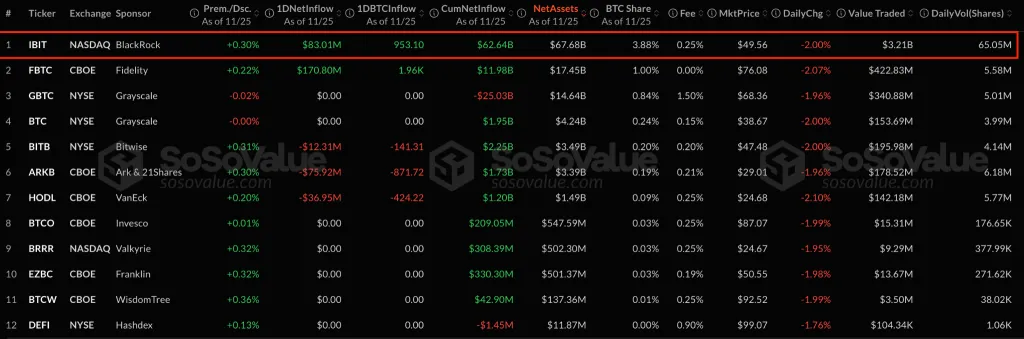
Источник: SoSoValue.

Аналогичный инструмент, привязанный к биткоин-ETF, предлагает Morgan Stanley. В октябре он принес банку $104 млн, согласно Bloomberg.

Агентство подчеркнуло, что спрос на такие продукты растет — это символизирует «конец многолетней стагнации американской индустрии, которая наступила после банкротства Lehman Brothers».

Напомним, в ноябре инвесторы обвинили JPMorgan в атаке на Strategy Майкла Сэйлора.
Leituras Relacionadas

Grayscale: Zcash, Financial Privacy in the Age of AI

Grayscale Research suggests a third wave of public focus on financial privacy is approaching, driven by stablecoin/blockchain adoption and new AI-powered surveillance tools. In this context, Zcash emerges as a decentralized digital currency, similar to Bitcoin but with built-in, robust privacy mechanisms via its "shielded" transactions that conceal sender, receiver, and amount using zero-knowledge proofs. While privacy is often seen as a niche feature, it is argued to be a core requirement for functional money, needed by individuals and businesses alike. Zcash's optional privacy is distinct from mixers or default-private chains like Monero. After years of development (Sapling, Orchard/NU5, Ironwood upgrades) to improve usability, key metrics show growing adoption: shielded transactions comprise ~90% of network activity, and ~25% of circulating ZEC is in shielded pools—a historical high. Despite this, ZEC's market valuation remains low (~0.6% of the "digital currency" sector), implying the market prices privacy as a marginal concern. The investment thesis hinges on a potential re-rating if the value of financial privacy is recognized more broadly. Risks include regulatory challenges around shielded transactions, legacy trusted setup pools, quantum computing threats, and execution risks for upcoming upgrades like Tachyon for scaling. In summary, Zcash represents a significant, technologically mature option in the privacy currency space, with current valuation offering potential upside if privacy demand grows.

marsbitHá 12m

Grayscale: Zcash, Financial Privacy in the Age of AI

marsbitHá 12m

The Bear Market Has Ended, A New Bull Cycle Has Begun

**Title: Bear Market Over, New Bull Cycle Begins** Bitcoin surged over 20% in just three days, from a low of $64,100 on August 19th to a high of $79,500 by August 21st, marking a dramatic shift in market sentiment. This rapid rise triggered massive liquidations exceeding $4 billion, with short positions accounting for $3.7 billion—the largest short squeeze since 2021. The rally was fueled by several key factors. Macroeconomic conditions improved as the US Treasury doubled its long-term bond buyback size, easing pressure. Significant regulatory developments included a White House meeting where former President Trump urged Senate action on the CLARITY Act and hinted at potential US Bitcoin reserves, followed by the CFTC Chairman stating the agency would establish crypto market rules if the bill stalls. On-chain data revealed a fierce battle: large whales faced substantial liquidations on short positions, while others took profits or doubled down on longs. Major altcoins like ETH and XRP also saw impressive gains. Analysts are divided but increasingly bullish. Many, including CryptoQuant's founder, declare the bear market over and a new bull cycle begun. Price targets range from $100k by year-end to ambitious long-term projections of $200k. However, some caution against immediate chasing, noting overbought conditions and viewing the move as a potential "trap" ahead of the crucial September 15th Senate vote on the CLARITY Act. The market's next test is sustaining the momentum with real buying pressure, holding above key resistance near $78k-$80k, and watching ETF inflows and the upcoming regulatory vote.

marsbitHá 16m

The Bear Market Has Ended, A New Bull Cycle Has Begun

marsbitHá 16m

Xiaomi Defended Its Smartphone Gross Margin, Yet to Find a Profit Successor

Xiaomi's Q2 2026 financial report reveals a company navigating a complex transition. While smartphone gross margin held steady at 8.5% through strategic product mix and a record-high average selling price (ASP), this came at the cost of a 26.5% year-over-year decline in global shipments, pressuring its core user acquisition engine. This illustrates Xiaomi's central challenge: managing the "timing gap" between its established and emerging growth engines. Its smartphone business is pivoting from scale to premiumization, but it's unclear if high-end models can fully offset the volume loss from more price-sensitive segments, especially in markets like India and Africa. Meanwhile, the electric vehicle segment has become a significant revenue contributor, delivering 104,200 units and generating ¥23.9 billion. However, its profit contribution remains unclear as it, along with AI investments, is still in a scaling and investment phase. The AI and humanoid robot initiatives, though strategically prioritized and tested in Xiaomi's own factories, are in early-stage validation with no near-term commercialization timeline. Financially, the company remains stable, supported by a robust cash position and its high-margin internet services business, which hit a new high in monthly active users. Management emphasized continued heavy investment in AI, chips, and robotics to fuel the next growth cycle. The key question is whether these new engines—cars, AI, robotics—can achieve commercial scale and profitability before the smartphone engine's growth slows further.

marsbitHá 17m

Xiaomi Defended Its Smartphone Gross Margin, Yet to Find a Profit Successor

marsbitHá 17m

Is RWA Still Meaningful Without DeFi?

The article "Would RWA Still Matter Without DeFi?" argues that tokenizing real-world assets (RWA) alone, like putting a barcode on a container, is not transformative. True value emerges when these tokenized assets are integrated into decentralized finance (DeFi) ecosystems, enabling valuation, financing, hedging, trading, and loss management in a programmable, automated manner. Tokenization provides digital representation, but DeFi provides utility through leverage, liquidity, and composability. The core challenge lies in aligning the different "time clocks" of blockchain (fast, 24/7), traditional markets (limited hours), and asset redemption (slow processes), which creates liquidation risks and gaps. Effective RWA integration requires more than a token; it needs a full stack: legally enforceable rights, reliable data oracles, clear transfer rules, executable secondary liquidity, appropriate collateral parameters, and credible loss resolution paths. Liquidity is defined not by total value locked (TVL) but by the ability to exit a position under stress within a required timeframe. Risk management for RWAs must be modeled as a dependency graph, monitoring interconnected nodes like issuers, custodians, oracles, and liquidity pools for early warning signs beyond just price data. While tokenized government bonds serve as an initial "ping test," the future lies in more complex assets like computing power and energy, which require bespoke risk models. Tokenized stocks paired with perpetual futures present a major test, combining global equity ownership with crypto-native leverage, necessitating robust architectural safeguards like isolation and dynamic collateral rules. The conclusion is that without DeFi, RWA tokenization offers limited value—improving distribution and transparency. The significant opportunity arises when tokenized assets become functional components within open, programmable capital markets, where they can be used as collateral and facilitate complex financial strategies. The token is merely the barcode; the market operating system is the real machine.

marsbitHá 38m

Is RWA Still Meaningful Without DeFi?

marsbitHá 38m

Trading

Spot
活动图片