Ставки хедж-фондов против доллара достигли максимума за 20 лет

cryptonews.ruPublicado em 2025-04-25Última atualização em 2025-11-26

Крупный капитал агрессивно наращивает ставки на снижение американской валюты. Текущий объем позиций достиг уровней, которые не наблюдались в течение последних двух десятилетий. Индекс позиционирования показывает, что фонды находятся в зоне экстремальных продаж.

Историческая статистика свидетельствует, что подобная ситуация часто предшествует восстановлению курса, а не его дальнейшему падению.

Рекордные ставки против доллара США как угроза для рынка криптовалют

Аналитик Гильерме Таварес отметил риски данной рыночной конфигурации. По его мнению, такая согласованность действий трейдеров создает опасность резкого разворота.

“Хедж-фонды удерживают значительные короткие позиции по DXY, а исторически подобные уровни часто предшествуют хорошим возможностям для покупки – по крайней мере, для краткосрочного отскока. Когда торговля становится слишком переполненной, обычно стоит рассмотреть противоположную сторону”, – написал он.

За минувшие 20 лет каждый случай масштабных продаж американской валюты завершался одинаково. Происходил рост котировок, который вынуждал спекулянтов экстренно закрывать убыточные сделки.
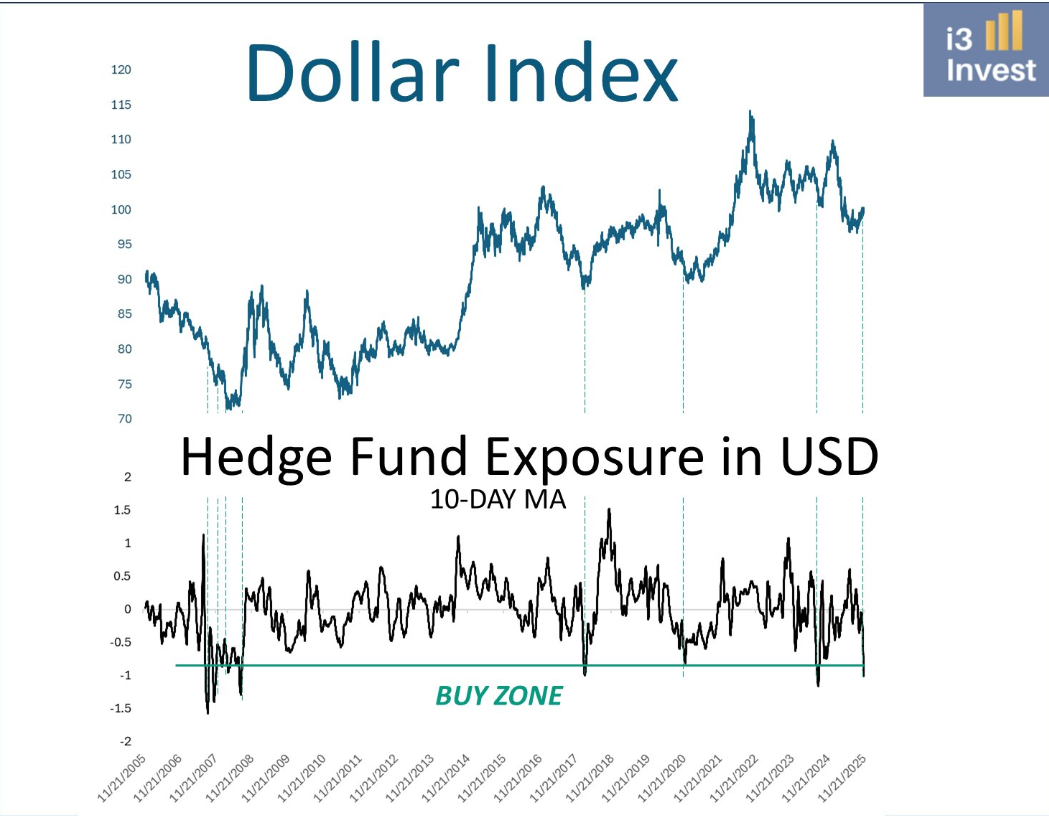
Экспозиция хедж-фондов по DXY
Экспозиция хедж-фондов по DXY. Источник: Tavares on X

Макроэкономические факторы и ликвидность

Аналитическая группа EndGame Macro также выпустила предупреждение для участников рынка. Эксперты подчеркивают, что экстремальное позиционирование редко формируется в спокойных условиях. Фонды играют на понижение уже ослабевшего актива. Следовательно, финансовая система становится уязвимой к любым изменениям настроений или ликвидности.

Фундаментальная среда сейчас не поддерживает продолжение девальвации нацвалюты США. Долговой рынок уже учел в ценах будущие действия ФРС. Глобальный экономический рост замедляется. Условия финансирования в долларах ужесточаются. Эти факторы повышают вероятность смены тренда.

“Такая ситуация не гарантирует бычьего роста доллара, но говорит о том, что возможности снижения, скорее всего, ограничены”, – считает аналитик EndGame Macro.

Влияние динамики DXY на биткоин

Отраслевые эксперты продолжают указывать на обратную корреляцию между индексом доллара и цифровыми активами. Рост курса американской валюты традиционно оказывает давление на котировки биткоина.

“Доллар растет = плохо для криптовалют. Доллар вниз = хорошо для криптовалют. Если доллар продолжит расти до 2026 года… возможно, вам придется поцеловать этот любимый бычий рынок на прощание”, – предупреждает аналитик Milk Road.

Существует риск резкого восстановления котировок на фоне принудительного закрытия коротких позиций. Это создаст длительное давление на индустрию в период ожидаемого цикла роста.

Технические сигналы к смене тренда

Специалисты по техническому анализу фиксируют сигналы пробоя на графике индекса DXY. По данным трейдера Daan Crypto, котировки впервые за девять месяцев закрылись выше 200-дневной скользящей средней. Это может означать завершение нисходящего тренда, который длился около восьми месяцев.

“Это не идеально для рисковых активов и оказывает давление на них… Нужно следить”, – сказал он.

Слабость иены и снижение аппетита к риску после недавней волатильности усиливают технический импульс. Если фонды начнут массово ликвидировать короткие позиции, доллар продемонстрирует уверенный рост. Это негативно скажется на стоимости биткоина и фондовых индексов. Ближайшие недели станут определяющими для среднесрочных перспектив крипторынка.


Leituras Relacionadas

Galaxy Research: Can SEC's New Regulations Usher in a New Era for Token Financing?

**SEC Proposes New Framework for Token Offerings, Potentially Unlocking Legal Paths for U.S. Crypto Fundraising** On August 18, the U.S. Securities and Exchange Commission (SEC) proposed new rules, dubbed "Reg Crypto," specifically tailored for crypto asset offerings. This framework marks a departure from applying traditional securities rules designed for stocks to tokens. It creates a potential legal pathway for token sales to the U.S. public, including non-accredited investors, without full registration. The proposed rules apply to crypto assets that are not themselves securities but were sold as part of an investment contract where the issuer promised to build a product, network, or ecosystem. It establishes a four-phase lifecycle: Raise, Disclose, Build, and Exit. The "Raise" phase includes two new fundraising exemptions: a startup exemption allowing up to $5 million over four years and a larger, Regulation A-based exemption for up to $20 million or $75 million over 12 months. The "Disclose" phase requires specific token-related disclosures like supply schedules, governance, and development progress. After the issuer completes its promised development work and files a transition report, the "Exit" phase allows the associated investment contract to terminate, even if the token continues to trade. The analysis highlights that the framework's most immediate impact may be providing a formal "exit" path for existing tokens with unclear legal status, rather than immediately sparking a new wave of U.S.-based token offerings. It offers advantages over traditional private placements by allowing public sales and immediate token transferability but imposes ongoing disclosure and reporting obligations. A key hurdle is that the larger exemption requires a substantial U.S. operational presence, which may deter projects with offshore structures. Overall, the proposal is seen as a constructive step toward regulatory clarity, acknowledging that token offerings differ from equity offerings and require tailored investor disclosures. However, it remains a proposal subject to a 60-day public comment period, and its long-term stability may ultimately depend on congressional action.

marsbitHá 2h

Galaxy Research: Can SEC's New Regulations Usher in a New Era for Token Financing?

marsbitHá 2h

Bitcoin and Ethereum Soar Together! Eight Altcoins Worth Watching in the Later Market

Bitcoin and Ethereum Surge, Fueling Altcoin Speculation. Bitcoin Eyes $77,000, Ethereum Gains 20% in a Single Day. Market anticipates capital rotation from major cryptos to high-beta altcoins, but a selective rise is expected, favoring projects with genuine users, protocol revenue, and healthy tokenomics. Analysts highlight eight altcoins across key sectors: **High-Performance Blockchains:** * **SOL (Solana):** Market cap ~$51.88B. A dominant player with a strong ecosystem. Considered a relatively safe bet for potential catch-up growth. * **SUI (Sui):** Market cap ~$3.03B. High volatility potential but faces risks from its low circulating supply and future token unlocks. **DeFi Lending:** * **UNI (Uniswap):** Market cap ~$2.38B. Transitioning to a revenue-capturing asset post-fee switch implementation. * **AAVE (Aave):** Market cap ~$1.53B. Features balanced tokenomics and revenue but has seen significant recent gains. * **MORPHO:** Market cap ~$1.50B. Rapid protocol growth but weaker token value capture and opaque supply data. **Perpetual DEX:** * **HYPE (Hyperliquid):** Market cap ~$16.41B. The clear sector leader with strong revenue but high valuation and a large portion of tokens still locked, warranting caution. **RWA & On-Chain Finance Infrastructure:** * **LINK (Chainlink):** Market cap ~$8.09B. A key oracle provider positioned to benefit from multiple trends like RWA and institutional adoption, offering strong fundamentals. * **ONDO (Ondo Finance):** Market cap ~$1.77B. Shows strong business growth but carries high risks due to concentrated token holdings and a massive unlock scheduled for 2027. **Conclusion:** The altcoin rally is expected to be selective. Recommendations include a medium position in SOL, small allocations to SUI and UNI/AAVE for DeFi exposure, and caution with HYPE and ONDO due to their specific risks. LINK is suggested as a core holding for the RWA thematic.

marsbitHá 4h

Bitcoin and Ethereum Soar Together! Eight Altcoins Worth Watching in the Later Market

marsbitHá 4h

Shanghai's $10 Billion Unicorn Is About to Go Public

Shanghai-based automotive-grade millimeter-wave radar chip unicorn Calterah Microelectronics Technology (Shanghai) Co., Ltd. has filed for an IPO on Shanghai's STAR Market, aiming to raise 3.49 billion yuan. Founded in 2014 by Chen Jiashu, a UC Berkeley PhD graduate, and his professor Ali Niknejad, Calterah pioneered CMOS technology for 77GHz radar chips, breaking the decades-long monopoly of international giants like Texas Instruments. Its low-cost, highly integrated solutions enabled millimeter-wave radar to move from luxury to mass-market vehicles. By 2025, Calterah captured a 31.1% share in China's automotive millimeter-wave radar chip market (second domestically, fourth globally), with cumulative shipments exceeding 30 million units. Its client list includes BYD, Geely, Nio, and Volvo. The company has undergone 11 funding rounds, attracting high-profile investors such as the National Integrated Circuit Industry Investment Fund Phase II, China Capital Management, and GD Capital. Its valuation has reached tens of billions of yuan, with a projected post-IPO valuation of approximately 14 billion yuan. Despite rapid revenue growth—increasing from 206 million yuan in 2023 to 632 million yuan in 2025 with a 75.28% CAGR—Calterah remains unprofitable. It reported net losses of 323 million yuan, 334 million yuan, and 193 million yuan from 2023 to 2025, accumulating over 900 million yuan in losses over three and a half years. These losses are primarily attributed to heavy R&D investment, which totaled over 1.039 billion yuan in the reporting period, often exceeding annual revenue. The company faces significant risks, including high customer concentration (its top five customers accounted for over 99% of revenue from 2023-2025, with BYD alone representing over 50% in 2025) and supply chain concentration. Revenue pressure from key customers and dependencies on overseas suppliers for EDA tools and IP pose challenges to sustainable growth. The IPO is seen as crucial for securing capital to expand production, diversify its customer base, and reduce supply chain dependencies.

marsbitHá 4h

Shanghai's $10 Billion Unicorn Is About to Go Public

marsbitHá 4h

Ray Dalio's Latest Macro Analysis Full Text: Buy More Gold, Add Some Bitcoin

In his latest macro analysis, Ray Dalio applies his framework from "How Countries Go Broke: The Big Cycle" to the current global debt environment. He highlights recent events like Japan selling U.S. Treasuries and rising U.S. long-term yields as signs of an unsustainable debt dynamic. Dalio explains that excessive government debt leads to either unacceptably high interest rates, severe economic downturns, or significant currency debasement through central bank money printing. He summarizes the U.S. fiscal situation: with $5.5 trillion in revenue, $7.5 trillion in spending, a $2 trillion deficit, and total debt at six times annual revenue, debt servicing costs are immense. Without correction, U.S. debt could reach $55-$60 trillion in a decade. Dalio proposes a "3% Three-Way" solution: reducing the budget deficit to 3% of GDP through balanced spending cuts, tax increases, and interest rate reductions to avoid a traumatic adjustment. In response to FAQs, he argues that the risk of a U.S. debt crisis is high and could materialize within a few years if the current path continues. He dismisses the notion that the dollar's reserve status makes the U.S. immune, citing historical precedents of reserve currency declines. He is also unconvinced by Japan's high-debt stability, noting poor returns for yen-denominated assets. For investors, Dalio recommends diversifying globally, underweighting bonds, and overweighting assets like gold and a small allocation to Bitcoin (around 10-15% to gold) to hedge against currency debasement and poor debt returns.

marsbitHá 5h

Ray Dalio's Latest Macro Analysis Full Text: Buy More Gold, Add Some Bitcoin

marsbitHá 5h

Trading

Spot
活动图片