Three Ways the Music Industry Can Reduce NFT Speculation

dailyhodlPublicado em 2022-07-08Última atualização em 2022-07-08

Resumo

Now that the market is in turmoil, NFT market participants expect more than just...

Now that the market is in turmoil, NFT market participants expect more than just a quick return. These use cases show what NFT looks like when utility is prioritized over speculation.
The recent drop in the market has had a significant effect on non-fungible tokens (NFTs). Most NFT floor prices have gone down by 75% or more over the past few months. As prices have dropped, many investors have lost faith and are now wondering if the whole NFT craze was just speculation.
This Chainalysis report suggests that the meteoric rise in 2021 was caused in part by ‘wash trading,’ which is when someone sells an asset to themselves to make it look like there is market demand.
But even in this chaotic situation, musicians are finding new and interesting ways to use non-fungible tokens. Let’s look at three examples of how NFT might be useful – revenue rights, digital tickets and VIP access and NFT-based charity efforts.
Sharing revenues from streaming
Investors who purchase an artist’s NFT may also obtain rights to the revenue generated by their music. This is the idea that can be realized by tokenizing revenue rights. Artists get money right away to help pay for production and marketing costs, but they still own the rights to their music.
For users, it’s like they’re giving money to artists they think have a chance of making it, with the hope that they’ll be able to share in their success.
Alan Walker’s Unity campaign, which began in May and raised $25,000 in a matter of days, exemplifies how this model works in practice. The song is on track to reach its streaming goal earlier than expected, and it has inspired a second, even bigger campaign around Walker’s Origins EP.
This crowdfunding model may also include ‘fan missions,’ which reward users with extra airdrops and perks for accomplishing specific tasks.
Since the value of the rights goes up as the artist gets more popular, investors have a reason to wait until the artist succeeds.
Tokenized tickets and exclusive membership
Another growing trend is using NFTs as digital tickets or passes that give their owners special benefits. One big example of this is how FTX and Coachella worked together to make the Coachella Collectibles series. The series provides unique opportunities such as lifetime passes, meet and greets and more.
The Way Out West (WOW) Festival is also working on a similar collaboration to create an exclusive NFT collection of festivalgoers’ captured moments. Web 3.0 experiences appear to be in high demand at events worldwide. So, organizers are making efforts to provide more of these kinds of opportunities to encourage people to keep their digital tickets for a longer time.
Several music groups have also launched NFT collections in order to make their most devoted fans VIPs. Avenged Sevenfold was one of the first bands to exploit this concept, releasing their Deathbats Club NFT collection. The band has granted owners IP rights to their own Deathbats and continues to give options, such as integrating three Deathbats into Iron Maiden’s ‘Legacy of the Beast’ mobile game.
The HEAD5 Collection by deadmau5 is another good example. Those who had previously held official deadmau5 NFTs were offered the chance to start minting other fan club NFTs ahead of schedule. It shows how blockchain technology makes it possible for artists to thank their most loyal fans.
People who have passes to exclusive events or fan clubs are more interested in using them than selling them, which makes speculation less likely.
Using NFTs to solve world problems
Last but not least, proceeds from NFT sales may be donated to verified charity organizations. Grimes, a Canadian musician and producer, did this in 2021 when she put out the WarNymph Collection. The sale of the collection brought in more than $6 million, and an undisclosed portion of the money went to Carbon180, an NGO that works to reduce carbon emissions and fight climate change.
Another notable example is UNICEF, which launched an NFT collection to raise funds for school connectivity.
If investors put their money into tokens for such purposes, it is unlikely that they will use them to speculate in the future.
Speculation will not end – but it will be reduced
Changing how people think about NFTs takes a long time, but projects with real benefits and big effects on the world should definitely try to do it. Slowly but surely, the industry will move past speculation and into the realm of usefulness.

Leituras Relacionadas

Unveiling the Whales of the World Cup Prediction Market: Smart Money Stumbles on the Pitch, 'Buy No' Outperforms 'Buy Yes'

**Title: Unveiling the Whales of the World Cup Prediction Market: "Smart Money" Stumbles on the Pitch as "Buying No" Outperforms "Buying Yes"** An analysis of pre-match trades over $5,000 on Polymarket for 20 completed group stage matches reveals a counterintuitive finding: large "smart money" bets were not consistently accurate. Aggregated pre-match buying volume was $89.55 million, with a weighted hit rate of only 48.5%. Holding these positions would have resulted in an estimated net loss of about $1.76 million (ROI -2.0%), challenging the notion that big money reliably predicts outcomes. The data highlights several key dynamics. Draws proved to be a major risk, significantly impacting bets on favored teams, as seen in Belgium-Egypt and Spain-Cape Verde. Markets were more efficient for clear mismatches (e.g., Germany's big win) but became prone to bias when favorites were overvalued. Notably, buying "No" shares (betting against a specific outcome) significantly outperformed buying "Yes," with hit rates of 62.4% vs. 37.5%. This suggests the market often overprices popular narratives, creating value in contrarian positions. Individual trades showed extreme volatility. One wallet (mintblade) earned an estimated $6.77 million by betting against Iran, while another (LEEEROYJENKINS) lost roughly $8.39 million on a Belgium win. The market favors high-risk, high-reward information trading rather than steady arbitrage. For sustained insight, wallets with consistent performance across multiple matches (e.g., swisstony) are more telling than one-off big bets. Ultimately, the Polymarket acts less as a crystal ball and more as a mirror, reflecting crowd bias and the inherent unpredictability of football. True "smart money" may lie not in predicting the future, but in identifying and exploiting market mispricings while respecting risk.

marsbitHá 16m

Unveiling the Whales of the World Cup Prediction Market: Smart Money Stumbles on the Pitch, 'Buy No' Outperforms 'Buy Yes'

marsbitHá 16m

Bezos' Third Startup Still Can't Avoid Musk

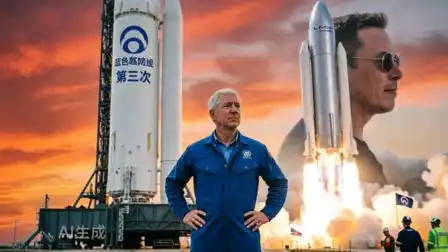
Jeff Bezos Returns as CEO for Third Venture, Still Can't Avoid Musk After stepping down as Amazon CEO in 2021, Jeff Bezos has returned to the front lines as co-CEO of Prometheus, an AI startup he founded. In a recent CNBC interview, Bezos described the experience as "Type 2 fun"—exhausting but ultimately rewarding. Founded less than a year ago, Prometheus has already raised over $18 billion in two funding rounds, achieving a staggering $41 billion valuation. Prometheus aims to develop a "General Engineer AI" to accelerate the entire "invention loop"—design, simulation, testing, and manufacturing—for complex physical products like jet engines, spacecraft, and medical devices. This positions the company at the intersection of Bezos's past experiences: Amazon's platform-building scale and Blue Origin's rigorous physical engineering. This marks Bezos's third major venture, following Amazon and Blue Origin. His co-CEO is Vik Bajaj, bringing expertise from life sciences and hard tech. Bezos now dedicates most of his time to Prometheus, signaling his belief in its transformative potential. The move also comes as Bezos's space company, Blue Origin, faces challenges, including a recent test explosion delaying its New Glenn rocket. Meanwhile, Elon Musk's SpaceX achieved a record-breaking IPO, surpassing Amazon's market cap. While Musk focuses on AI for executing physical tasks (like Tesla's robots and SpaceX's engineering), Bezos is betting on AI to *invent* in the physical world. Prometheus enters a crowded industrial AI field with players like OpenAI, NVIDIA, and Tesla's Optimus. Its lofty valuation bets on the unproven but massive opportunity to become the foundational platform for engineering in the AI era—a "blue ocean" Bezos hopes to define before Musk does.

marsbitHá 19m

Bezos' Third Startup Still Can't Avoid Musk

marsbitHá 19m

Won't US Stocks Ever Fall Again? The 'Great Melt-up' Trap in the Era of High Debt

The article analyzes a popular theory circulating online that the U.S. stock market may be mathematically incapable of a true, sustained decline due to the country's massive and growing national debt. The argument suggests that the government's only path to managing this debt is through inflation and money printing, which would nominally lift asset prices like stocks, creating a perpetual "melt-up." The author places this idea within the historical context of market melt-ups, such as the dot-com bubble and Japan's asset bubble, where prices detach from fundamentals driven by momentum and FOMO. While acknowledging that a high-debt environment creates incentives for inflation, which is generally favorable for assets over cash, the article refutes key claims of the online theory. It clarifies that interest payments are not about to exceed GDP, that printing money is not the only option for the government, and that stocks do not reliably rise in lockstep with hyperinflation, citing historical examples from Germany, Zimbabwe, and Venezuela. The more probable outcome, according to the author, is a prolonged period of financial repression—moderate inflation above interest rates that slowly erodes debt and cash purchasing power, leading to nominally higher asset prices but potentially lower real returns. The core warning is that while long-term market trends may be upward, this does not eliminate the risk of significant interim crashes (30%, 40%, or more) or guarantee real wealth creation during inflationary times. The conclusion advises against betting one's entire financial future on a smooth, perpetually rising market narrative. Instead, it recommends a disciplined, diversified strategy involving productive assets (stocks, real estate, some gold, short-term bonds) and an adequate cash buffer to avoid forced selling during downturns. The key takeaway is to avoid extreme concentration in expensive assets and leverage, and not to base investment decisions on the hope that every market dip will inevitably be rescued.

marsbitHá 39m

Won't US Stocks Ever Fall Again? The 'Great Melt-up' Trap in the Era of High Debt

marsbitHá 39m

Trading

Spot
Futuros
活动图片