Cardano Founder Reveals Midnight Launch Roadmap

bitcoinistPublicado em 2025-11-21Última atualização em 2025-11-22

Resumo

At the Midnight Summit, Cardano founder and Input Output Global CEO Charles Hoskinson set out a staged rollout for Midnight,...

Trusted Editorial content, reviewed by leading industry experts and seasoned editors. Ad Disclosure

At the Midnight Summit, Cardano founder and Input Output Global CEO Charles Hoskinson set out a staged rollout for Midnight, a privacy-and-identity network he describes as crypto’s next generational layer. In a Dapp Central interview, he positioned Midnight as an extender of existing ecosystems rather than a competitor: “We’re here to make your life easier and allow you to do new things your network doesn’t do… and you can pay in that network’s token,” pointing to interoperability with major chains such as Ethereum, Solana, Bitcoin and XRP.

Cardano Sidechain Launches In Four Stages

Hoskinson’s deployment plan is a four-gate launch intended to move from distribution to full decentralization through sequential upgrades. The first gate is liquidity and token delivery. The Cardano founder said NIGHT claims and initial market trading begin on December 8, 2025, the point at which Midnight becomes price-discoverable: “They get the tokens, they can trade them on exchanges and DEXes… it creates a price signal […] it’s on CoinMarketCap, it’s a real thing.” He tied this to the Glacier Drop and Scavenger Mine funnels, estimating participation at “well more than a million users,” while acknowledging wallet counts don’t map cleanly to individuals.

The second gate is a federated mainnet targeted for Q1 2026. Hoskinson described a production environment with mixed operators—some nodes run by IOG and some by external enterprises, including a Fortune 500 participant—so Midnight’s builder base can deploy applications with real users before final decentralization. He cited more than 100 partners already building for Midnight, and summit materials likewise list federated mainnet as the next milestone after NIGHT liquidity.

The third gate is an incentivized testnet to onboard stake pool operators and validate Midnight’s final consensus protocol. Hoskinson said the protocol has formal liveness and safety proofs and targets roughly 5,000 transactions per second with sub-second blocks, but has never been deployed on Substrate. “It would be irresponsible just to kind of launch that out,” he said, arguing that both the algorithm and operator tooling must be proven under incentives before mainnet adoption.

The fourth gate follows once the incentivized testnet is stable: a hard fork into the final mainnet consensus and a completed end-to-end network. The Cardano founder expects this phase to coincide with broad exchange access and a transition from Cardano-adjacent rollout to general cross-chain privacy services: “Midnight wakes up… to a Midnight-Ethereum, Midnight-Solana, Midnight-Bitcoin […] Midnight-XRP.” In his framing, this is when Midnight becomes a neutral privacy layer that other ecosystems consume rather than a single-community product.

Midnight’s adoption strategy hinges on dual-token economics. NIGHT holders generate DUST, a consumable fuel for computation. Through a “capacity exchange,” DUST can be sold for other chains’ tokens or delegated by DApp builders so users can interact without first buying crypto.

Hoskinson framed this as importing Web2’s frictionless payment expectation into Web3: “If you have NIGHT […] your users […] can use your DApp for free without having a token […] That’s an entirely new thing in the cryptocurrency space.”

Hoskinson also argued that AI makes privacy economically existential. He said models are “hoovering up… your likeness and your output,” enabling uncompensated digital replicas and accelerating job displacement: “People realize this is existential now […] it’s I no longer have a job.”

In response, Midnight’s selective-disclosure stack is meant to let users reclaim data ownership and use zero-knowledge proofs to verify properties—such as humanity or eligibility—without revealing identity, countering what he described as bot-heavy online participation.

Governance is presented as a correction to Cardano’s institutional friction. Hoskinson said Midnight’s code governance will be housed at the Linux Foundation and executed by a KPI-driven Midnight Foundation, aiming for clearer accountability and faster delivery.

Hoskinson summarized the endpoint as a “crypto triumvirate”: “Bitcoin is the trust and value layer […] Cardano the computation layer […] Midnight the privacy and identity layer.” If the four gates land as described—December 8 liquidity, Q1 2026 federated mainnet, Q2 2026 incentivized testnet, then a final mainnet hard fork—Midnight’s cross-ecosystem privacy thesis will move from roadmap to live infrastructure through 2026.

At press time, the Cardano (ADA) token traded at $0.3898.
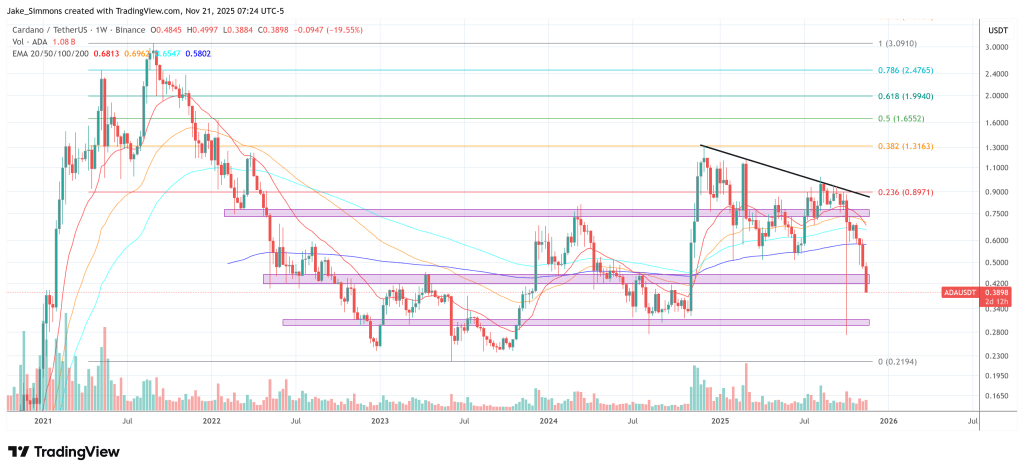
Cardano price
Cardano breaks below another key support zone, 1-week chart | Source: ADAUSDT on TradingView.com
Featured image created with DALL.E, chart from TradingView.com
Editorial Process for bitcoinist is centered on delivering thoroughly researched, accurate, and unbiased content. We uphold strict sourcing standards, and each page undergoes diligent review by our team of top technology experts and seasoned editors. This process ensures the integrity, relevance, and value of our content for our readers.

Jake Simmons has been a Bitcoin enthusiast since 2016. Ever since he heard about Bitcoin, he has been studying the topic every day and trying to share his knowledge with others. His goal is to contribute to Bitcoin's financial revolution, which will replace the fiat money system. Besides BTC and crypto, Jake studied Business Informatics at a university. After graduation in 2017, he has been working in the blockchain and crypto sector. You can follow Jake on Twitter at @realJakeSimmons.

Criptomoedas em alta

Leituras Relacionadas

IPO Imminent, OpenAI Faces Major Personnel Upheaval

OpenAI, preparing for a potential IPO, is experiencing significant leadership turmoil. In mid-August 2026, longtime "GPU geek" Scott Gray quietly left, and within three days, Chief Operating Officer Brad Lightcap (8-year veteran) and Chief Revenue Officer Denise Dresser (8-month tenure) departed. This follows a broader exodus of at least 10 senior executives in 2026, including heads of product, safety, and ethics. Analysts view this as a strategic "surgery" to transform from a research lab into a sales-driven enterprise company before going public. Revenue now tilts toward enterprise clients, surpassing consumer income sooner than expected, with annualized revenue reaching $40 billion. The new CRO, Dali Rajic, is a veteran enterprise sales leader. Concurrently, OpenAI has disbanded independent safety teams like "Preparedness," which assessed catastrophic risks, integrating their functions into core research. Critics warn this removes dedicated "brakes" on AI development. The leadership vacuum raises questions about who is the clear second-in-command after former apps CEO Fidji Simo moved to an advisory role. Co-founder Greg Brockman appears to be consolidating power. As OpenAI races against rival Anthropic ($47B annualized revenue), it faces the dual challenge of commercial execution while managing the departure of foundational technical talent and ensuring responsible AI development remains a priority.

marsbitHá 1h

IPO Imminent, OpenAI Faces Major Personnel Upheaval

marsbitHá 1h

AI Can 'Have Moods Too'! New Research from USTC: Confusion and Anxiety Make AI Work Better

The article discusses research from the University of Science and Technology of China and Oxford, revealing that allowing AI to recognize and act upon simulated "internal emotions" can significantly improve its performance. The study demonstrates a coherent pairing between specific emotional states in AI agents and their subsequent skill choices. For instance, an agent feeling curious and desirous will search for products, while one feeling confused and tense will rephrase queries. This mirrors human decision-making influenced by emotions. Statistical validation showed a 76.5% semantic consistency in these pairings. Crucially, the research challenges the traditional view of AI errors as flaws to be eliminated. It found that "bad" emotions like confusion, tension, or frustration serve as useful metacognitive signals, indicating a mismatch between the current strategy and the environment. By responding to these signals, AI can proactively adjust before a failure occurs. This is particularly effective in complex tasks prone to failure. For example, in tasks like "heating an item" and "picking up two items," success rates surged from 9.6% to 56.9% and 4.4% to 31.3%, respectively, when using the emotion-driven skill selection method (EMOTION2SKILL). The AI's "nervous" state about a closed microwave, for instance, prompted it to check and open it first, preventing failure. The article also mentions related work from Tianjin University, which embeds emotional prediction into world models (Large Emotional World Model, LEWM), significantly improving prediction accuracy in human-centric environments. Removing emotional data was found to degrade performance even in unrelated logical reasoning tasks. These studies build on earlier findings, like those from Anthropic, that identifiable emotional representations exist within large language models (LLMs). The focus is shifting from philosophical debate about AI emotion to practically harnessing these internal states as functional signals to enhance AI robustness and capability.

marsbitHá 2h

AI Can 'Have Moods Too'! New Research from USTC: Confusion and Anxiety Make AI Work Better

marsbitHá 2h

Trading

Spot

Artigos em Destaque

Como comprar ADA

Bem-vindo à HTX.com!Tornámos a compra de Cardano (ADA) simples e conveniente.Segue o nosso guia passo a passo para iniciar a tua jornada no mundo das criptos.Passo 1: cria a tua conta HTXUtiliza o teu e-mail ou número de telefone para te inscreveres numa conta gratuita na HTX.Desfruta de um processo de inscrição sem complicações e desbloqueia todas as funcionalidades.Obter a minha contaPasso 2: vai para Comprar Cripto e escolhe o teu método de pagamentoCartão de crédito/débito: usa o teu visa ou mastercard para comprar Cardano (ADA) instantaneamente.Saldo: usa os fundos da tua conta HTX para transacionar sem problemas.Terceiros: adicionamos métodos de pagamento populares, como Google Pay e Apple Pay, para aumentar a conveniência.P2P: transaciona diretamente com outros utilizadores na HTX.Mercado de balcão (OTC): oferecemos serviços personalizados e taxas de câmbio competitivas para os traders.Passo 3: armazena teu Cardano (ADA)Depois de comprar o teu Cardano (ADA), armazena-o na tua conta HTX.Alternativamente, podes enviá-lo para outro lugar através de transferência blockchain ou usá-lo para transacionar outras criptomoedas.Passo 4: transaciona Cardano (ADA)Transaciona facilmente Cardano (ADA) no mercado à vista da HTX.Acede simplesmente à tua conta, seleciona o teu par de trading, executa as tuas transações e monitoriza em tempo real.Oferecemos uma experiência de fácil utilização tanto para principiantes como para traders experientes.

1.6k Visualizações TotaisPublicado em {updateTime}Atualizado em 2026.06.02

Como comprar ADA

Discussões

Bem-vindo à Comunidade HTX. Aqui, pode manter-se informado sobre os mais recentes desenvolvimentos da plataforma e obter acesso a análises profissionais de mercado. As opiniões dos utilizadores sobre o preço de ADA (ADA) são apresentadas abaixo.

活动图片