What is the Ultimate Blue-chip Crypto Asset: BTC, NFTs, or Land?

cryptoslatePublicado em 2022-07-07Última atualização em 2022-07-07

Resumo

One of the biggest changes to the crypto market today compared to the last bear market is the different types of assets that exist. 

One of the biggest changes to the crypto market today compared to the last bear market is the different types of assets that exist. 

Instead of choosing between Dash, Litecoin, Ethereum, Bitcoin, etc., people can invest in NFTs and plots of digital land in the metaverse.

Common sense indicates that these new, experimental assets are riskier compared to BTC and ETH. While it’s difficult to objectively measure risk, we can use on-chain data to assess price volatility.

With the bear market fully underway, now is the perfect time to compare these assets and see what the ultimate blue-chip assets could be going forward: Crypto, NFTs, or metaverse land. 

Here, we’ll compare three hypothetical investors: Abe, Bob and Cathy. One year ago, each put their money into a different asset class within the crypto space. 

Abe’s portfolio: 50% BTC & 50% ETH. 

Bob’s portfolio: 50% BAYC & 50% CryptoPunks

Cathy’s portfolio: 50% Decentraland Land & 50% Sandbox parcels. 

These comparisons arent’s 1-to-1 (buying 3 Bored Apes at $6,000 each one year ago is a very different move than investing $6,000 in a longstanding “safe” token like ETH.) So, we’ve created 3 “reasonable” portfolios along these 50/50 lines that aren’t exactly the same. To be explained later.

In this article, we’ll track how each of these investors’ portfolio’s performed and explore why some of these investments are more volatile than others. 

Abe’s Token Portfolio

One of the upsides of investing in tokens instead of NFTs is liquidity and divisibility. We are able to put a precise USD dollar value on BTC and ETH on any given day, buy any amount we want, and receive a fair market rate. 

On this day a year ago, June 28, 2021, BTC cost $35,867. For ease of calculation, we’ll round this to the nearest hundred—$35,900. ETH was $2,160—rounded to $2,200. 

Our token investor chose an excellent time to jump in. After the enthusiasm of the Coinbase listing on April 13, 2021, and the Federal Reserve dropping interest rates to 0.25% to stimulate the economy, the market roared. However, it was temporarily sent crashing primarily due to a wave of strict regulations in China, and it was roughly here when Abe aped in.

In hindsight, Abe bought the bottom of the cycle, putting $50,000 into BTC and $50,000 into ETH (getting about 1.39 BTC and 22.7 ETH.)

The insane climb upward continued until November 8, 2021, when Abe’s initial investment was worth $203,767.52. 

But then, speculative enthusiasm for cryptocurrencies started waning as retail and investors cut back on risky assets.

From January to June, the Federal Reserve raised interest rates by 75 basis points in quick succession, the largest margin in 28 years.

In February, the war in Ukraine triggered a downturn in macroeconomic conditions, resulting in a bearish environment for the crypto market.

To top it off, the flash crash of Terra Luna in May looked like the beginning of a series of blockchain industry car wrecks. 

All these events have driven down the price of BTC and ETH—assets which, to the vast majority of the non-crypto public, are stand-ins for the “price of crypto” itself. 
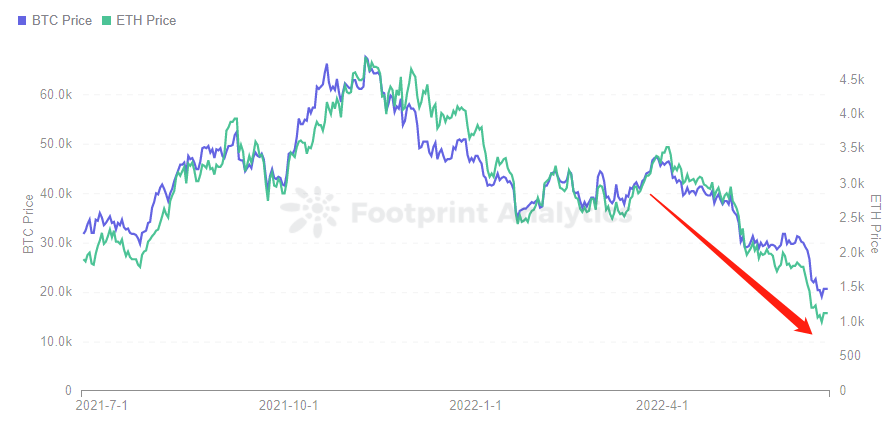
Footprint Analytics - BTC Price & ETH Price

Footprint Analytics – BTC Price & ETH Price

On June 28, 2022, Abe’s 1.39 BTC and 22.7 ETH portfolio was worth $54,197.7, down 45.8%. The drop from the all-time high was 73.4%.

The NFT Portfolio

Although NFTs are not as liquidity as BTC or ETH, they are unique and collectible. And when the market is in a better state, holders can also get a specific dollar value from it.

What did the NFT market look like in June 2021?

  • Germination and construction period: 

In June 2017, CrytoPunks, the world’s first NFT project, was officially born, bringing the NFT concept to a climax. Led by OpenSea, NFT trading has become more convenient and perfect, making NFT application areas gradually expand from games and artworks.

  • Expansion period.

By 2021, Axie Infinity sales were rising rapidly, driving the growth of the NFT market. The same year, BAYC was also established and entered the public eye.

This is the perfect time for Bob to enter the market when NFTs are in their infancy. Because NFT abides by a rule, the sooner its attributes are rarer, the higher the value and the lower the price is more balanced (the NFT trading market is immature, and the transaction frequency is low).

BAYC and CryptoPunks rank among the top NFTs in terms of trading volume in 2021.
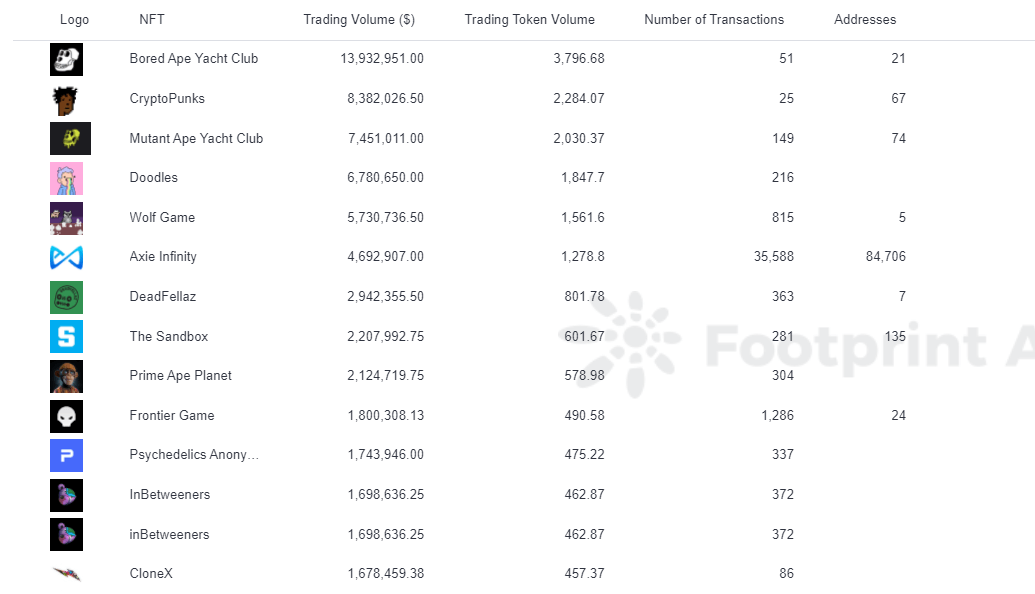
Footprint Analytics - NFT Projects by Trading Volume in 2021

Footprint Analytics – NFT Projects by Trading Volume in 2021

Assuming Bob buys 1 BAYC (3.5713 ETH) and 1 CryptoPunk (28.9191 ETH) on June 28, 2021, at an average price, his initial investment is worth $71,478.88 at that time.

In 2021, world economic development was severely impacted by the epidemic, and fiscal easing in major economies brought inflation and currency devaluation, driving users to crypto markets such as artwork, NFT, and BTC. trading activity in the NFT market continued to increase from August to March 2021.
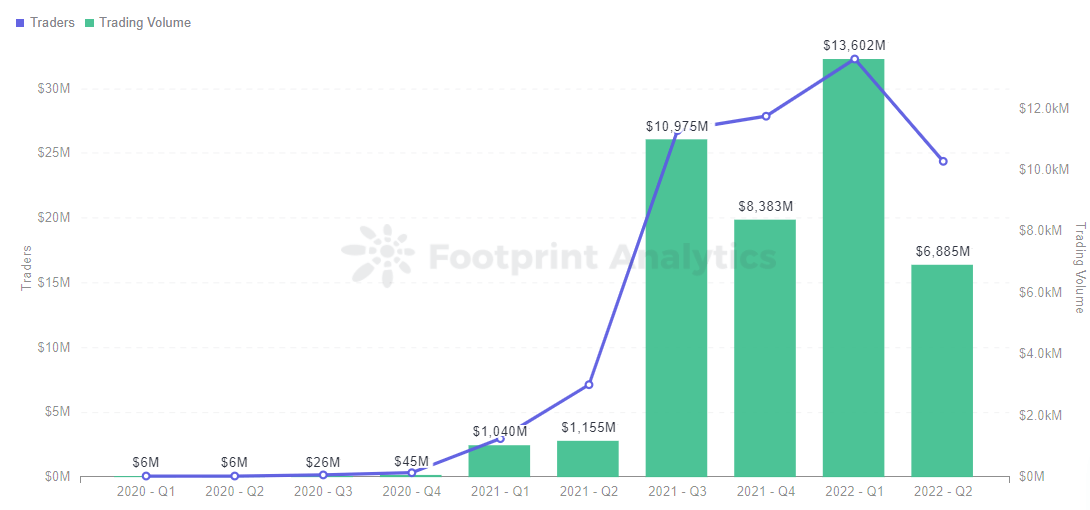
Footprint Analytics - NFT Traders & Trading Volume

Footprint Analytics – NFT Traders & Trading Volume

If Bob had followed ETH and sold it at its peak on November 8 (ETH at $4,826.25), when the average prices of BAYC and CryptoPunk were 43.8835 ETH and 98.5848 ETH, respectively, his portfolio would have been worth $687,587.63, an increase of 861.95%.

The Crypto market crash led to a decline in investor interest in NFT, significantly impacting its overall trading volume and market cap decline. Over the past 90 days, total trading volume has fallen by 63.84% and total market capitalization by 38.07%.
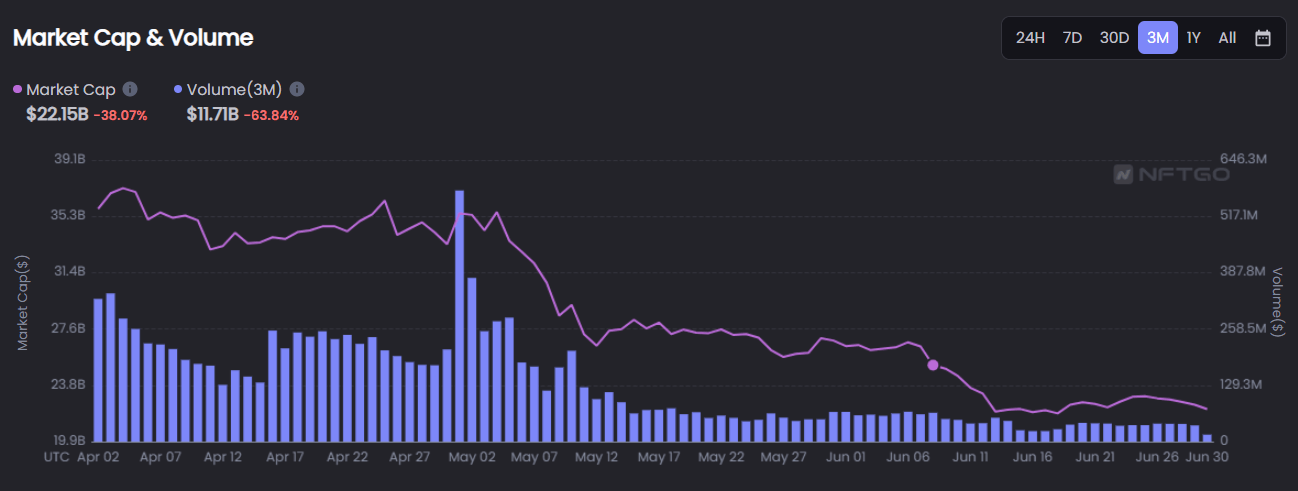
Screenshot Source  - nftgo - Market Cap & Volume

Screenshot Source  – nftgo – Market Cap & Volume

As of June 28, 2022, ETH is trading at $1,144, BAYC at 113.5035 ETH, and CryptoPunk at 77.6991 ETH. Bob’s portfolio is worth $218,735.77, up 206.01% year-over-year. It is down 68.19% from its all-time high.

Clearly, blue-chip NFTs, as of the beginning of summer 2022, aren’t as volatile as many people think compared to the so-called “safe” crypto investments BTC and ETH. 

*Since investing half your portfolio into BAYC NFTs would have been quite insane in June 2021, we’re taking a different approach to 50/50 in this portfolio. Bob bought 1 Punk and 1 Ape. 

The Land Portfolio

By being interested in the metaverse in June 2021, Cathy can be considered an early adopter. At that time, the word “metaverse” had not yet become a household name. 

Facebook’s rebranding to Meta was still four months away. 

Was the metaverse some new version of Second Life? Did you need a VR headset to access it? Almost nobody who wasn’t deep in the crypto rapithole already knew. 

But the rumblings were there. On June 4, Sotheby’s opened a virtual gallery in Decentraland, and the game made waves as the first to break 1 million in a metaverse land sale. 

On June 28, 2021, Cathy became a metaverse landlord. Her purchase was one of 37 NFT sales in Decentraland, which generated $148,500 in total. 

Because all the transactions on the blockchain are on a public ledger, we can actually see and analyze all the LAND sold on this date. 
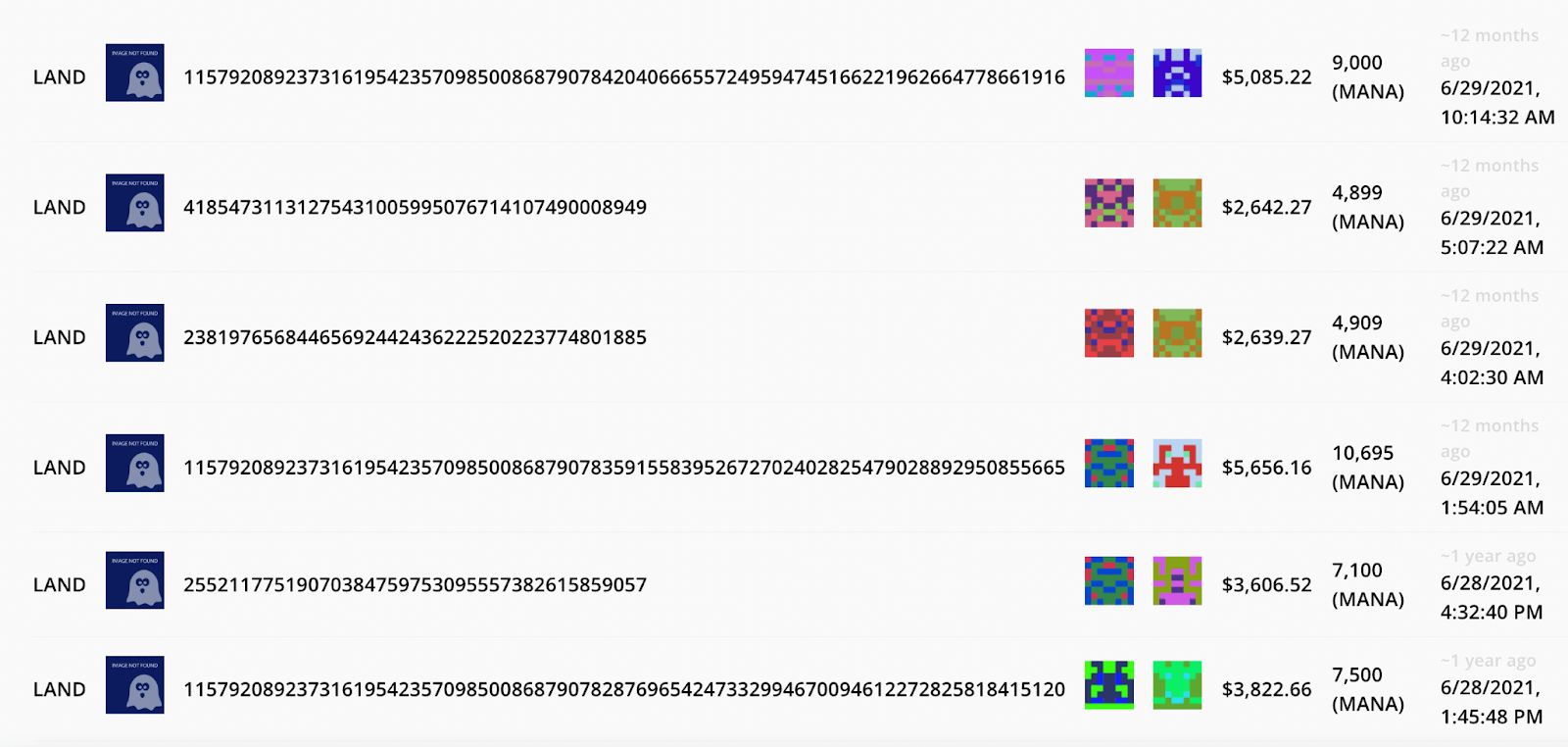
Screenshot Source - nonfungible

Screenshot Source – nonfungible

The average sale price on June 28 was about $4,000, which seems like a reasonable assessment looking at these sales. (I.e., if there were a single sale at an astronomical price, it would make the average a bad yardstick for how much Cathy could have paid.)

So, dipping her toes into the metaverse, Cathy bought one plot of land for $4,000—perhaps this one: 

Screenshot Source - nonfungible

Screenshot Source – nonfungible

She also added a parcel in The Sandbox. At that time, the search term “Sandbox” hardly brought to mind the metaverse title that would take over news headlines in just a few months for the 3842% jump in its token price. 

On June 28, 46 NFTs were sold, bringing in $43,500, an average price of $945. This is a few hundred higher than the median price for the day but is still accurate enough to do a general analysis. 
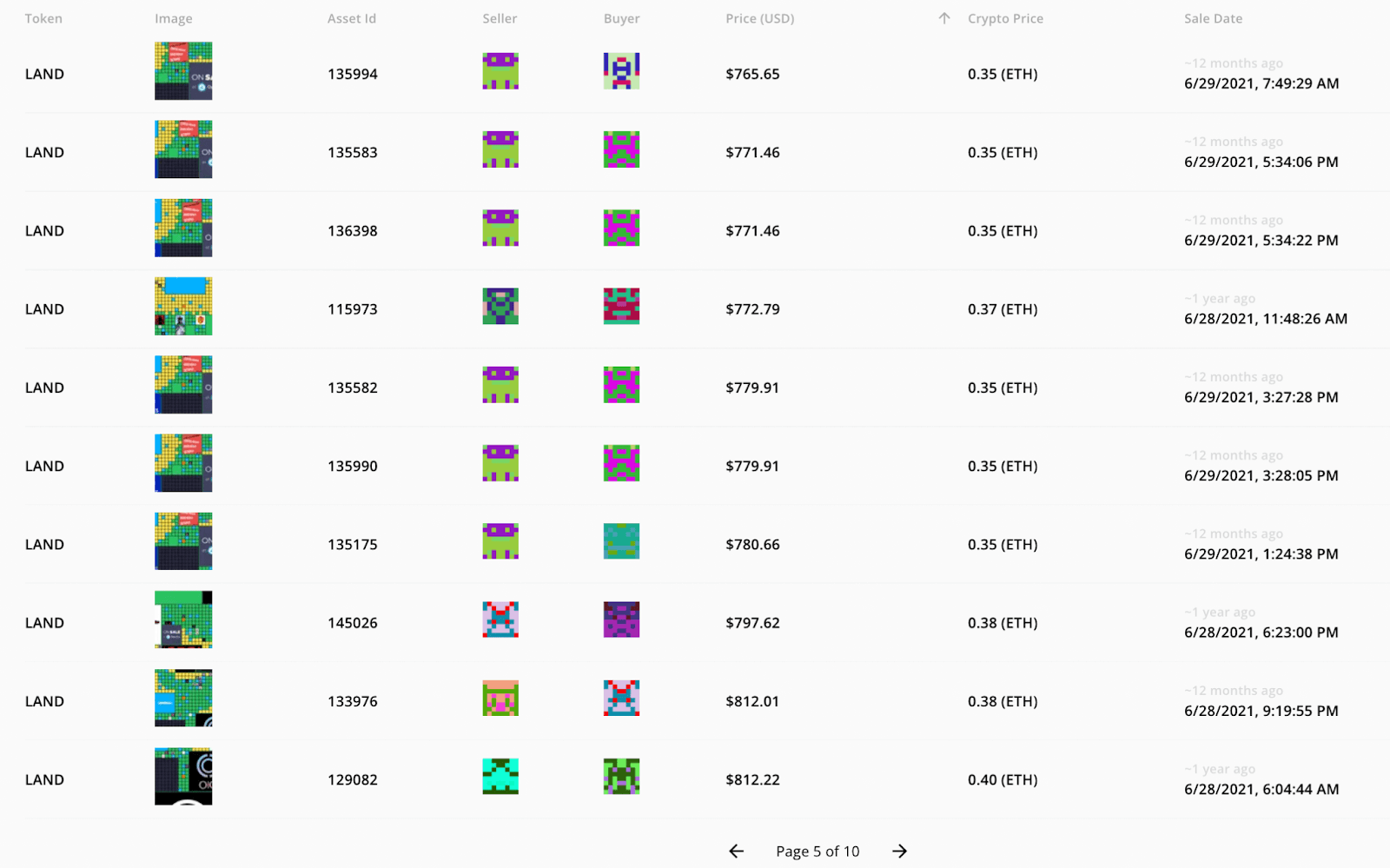
Screenshot Source - nonfungible

Screenshot Source – nonfungible

So, to maintain a nearly 50/50 allocation in the two biggest-name products in the asset category, Cathy bought one plot of Decentraland land at $4,000 and 4 Sandbox lands at $945 each—a total metaverse land portfolio of $7,780. 

Her judgment would prove visionary. By November 8, 2021, when ETH BTC peaked, the average sale price in Decentraland increased by 3.0469 ETH to $14,705. The average price of The Sandbox land skyrocketed to $6,096, a 734.62% percent increase. 

If we’re just going by averages, her 1 Decentraland plot and 4 Sandbox parcels would be worth $39,089. 

If we instead look at the real asset shown above that cost just under $4,000 on June 28, 2021, then it increased by $59,135. It flipped hands for $55,313 on November 15, 2021, the closest sale to the ETH peak.  

Over the next year, the prices of metaverse land declined sharply as the volume in Decentraland and The Sandbox decreased to ATLs by 76.81% and 79.03% respectively. 

On June 28, 2022, Cathy’s portfolio was down by $14,811 from ATH (-62%). A big hit, but still way up from her original investment. Metaverse land is clearly extremely volatile and can still be called a Hail Mary play rather than a safe blue-chip. 

Summary

While the bull market saw enormous gains for NFTs and metaverse land, the on-chain data for top projects indicates that prices are not as volatile as many people believe relative to “safe” assets like BTC and ETH. 

In this article, we created three hypothetical portfolios and found that the safe crypto bet had a steeper fall from ATH (as of June 28) than investments into NFTs and metaverse land. The gains over the bull market would have also been significantly higher for the latter two “riskier” assets. 

While there are several possible explanations for this (e.g., harder for institutions to push down the prices of NFTs and land), this data supports the idea thesis that the top NFTs and metaverse land projects have performed exceptionally well through the entirety of the last year—booms, busts, crashes and all.
Leituras Relacionadas

The Value Distribution of Stablecoins

**Summary: The Value Distribution of Stablecoins** The article argues that stablecoins are evolving from mere trading tools into broader channels for dollar access. It divides the stablecoin ecosystem into four layers to analyze how value is distributed: 1. **Issuance Layer:** Mints stablecoins, holds reserve assets, and captures the spread between reserve yield and user costs (e.g., Tether, Circle). This layer currently earns the largest profit margin. 2. **Infrastructure Layer:** Connects stablecoins to the traditional financial system, handling fiat on/off-ramps, banking integration, compliance (KYC/AML), and asset management (e.g., Bridge, BVNK). This is the "unglamorous" but critical work, building the essential bridges between crypto and real-world finance. 3. **Acquiring/Distribution Layer:** Integrates stablecoins into merchant systems, manages payment flows, and provides enterprise financial software (e.g., Stripe, Coinbase). They act as the access point for businesses. 4. **Application Layer:** The end-users and businesses that ultimately use stablecoins for payments, settlements, or as a store of value. They benefit from convenience but have little pricing power. The core thesis is that while the issuance layer currently dominates profits, the often-overlooked **infrastructure layer holds significant long-term potential**. The real challenge and barrier to mass adoption is not the on-chain transfer of stablecoins (which is simple), but the complex "last mile" integration into existing business workflows, banking systems, and regulatory frameworks across different countries. Companies in this layer are currently in a "land grab" phase, investing heavily to build networks, secure bank partnerships, and establish compliance pathways. While their position is currently pressured by the profitable issuers above and distribution platforms below, the article suggests that if stablecoins become a default financial rail for businesses, the infrastructure providers who have done the hard work of integration will ultimately gain strong pricing power and become entrenched, essential players.

marsbitHá 4h

The Value Distribution of Stablecoins

marsbitHá 4h

The Value Distribution of Stablecoins

The Value Distribution of Stablecoins The article argues that stablecoins are evolving from a mere trading tool into a broad "dollar channel." It analyzes the industry's value chain through four layers: 1. **Issuance Layer (e.g., Tether, Circle):** The top layer that mints stablecoins, holds reserve assets, and captures the thickest interest rate spread. 2. **Infrastructure Layer (e.g., Bridge, BVNK):** Connects stablecoins to the traditional financial system, handling critical but complex "dirty work" like fiat on/off-ramps, banking integration, compliance (KYC/AML), and cross-border settlement. 3. **Acquiring/Distribution Layer (e.g., Stripe, Coinbase):** Embeds stablecoins into merchant systems, manages payment flows, and integrates with enterprise software. 4. **Application Layer:** End-users and businesses that ultimately use stablecoins for payments, settlement, or storing value. The author posits that while the issuance layer currently captures the most profit, the most overlooked and potentially critical layer is infrastructure. The core challenge for stablecoin adoption isn't the on-chain transfer (which is simple), but bridging the gap between blockchain and the real-world financial system. This involves solving practical problems for businesses: fiat conversion, reconciliation, tax handling, and user onboarding. Infrastructure companies are currently in a difficult "land-grab" phase—building networks, securing banking relationships, and achieving compliance country-by-country. They face pressure from both the profitable issuance layer above and distribution platforms below. However, the author suggests this layer is building a crucial moat. Once stablecoins become a default business rail, the infrastructure players who have done the hard work of integration may gain significant, durable value and pricing power.

链捕手Há 4h

The Value Distribution of Stablecoins

链捕手Há 4h

How to Do Research Well: Deliberately Practice the Real Skills That Matter

No one truly teaches you how to do research. You're often given a desk, a pre-selected problem, and vague instructions to "create something new." Consequently, many people reverse-engineer the job based on visible outputs—papers, posts, announcements—learning only how to *appear* like a researcher rather than how to *become* one. True research capability is built from stacking small, trainable skills, nearly all of which can be developed through deliberate practice. **Pick Your Own Problem:** Most researchers absorb problems from advisors or trends, lacking the underlying reasoning. Choosing a problem you genuinely care about, as John Schulman advises, leads to original work. Develop "taste" like a muscle: predict experiment outcomes, guess paper results from methods, and track which findings remain important over time. **Upgrade Your Inputs:** Relying on shared reading lists (arXiv hot lists, filtered group chats) leads to unoriginal conclusions. Undervalued old literature often holds crucial insights (e.g., MoE, LSTM, backpropagation). Richard Sutton's "The Bitter Lesson" or Claude Shannon's 1952 talk on creative thinking are more predictive than lengthy modern surveys. Breadth matters as much as depth: draw from neuroscience, mechanism design, hardware knowledge, and honest statistics. Read papers directly, especially appendices and limitations sections. **Write Everything Down:** As Paul Graham noted, writing exposes flaws in seemingly mature ideas. Writing is the cheapest defense against self-deception. Following Feynman's principle, Darwin programmatically wrote down facts contradicting his theory to combat memory bias. Maintain a detailed log of hypotheses, setups, predictions, results, and updated understandings. Reviewing past logs fosters essential humility.

marsbitHá 7h

How to Do Research Well: Deliberately Practice the Real Skills That Matter

marsbitHá 7h

Trading

Spot
Futuros

Artigos em Destaque

O que é BITCOIN

Compreender o HarryPotterObamaSonic10Inu (ERC-20) e a Sua Posição no Espaço Cripto Nos últimos anos, o mercado de criptomoedas assistiu a um aumento na popularidade das moedas meme, cativando não apenas os traders, mas também aqueles que procuram envolvimento comunitário e valor de entretenimento. Entre estes tokens únicos está o HarryPotterObamaSonic10Inu (ERC-20), um projeto intrigante que mistura referências culturais no tecido das criptomoedas. Este artigo explora os principais aspetos do HarryPotterObamaSonic10Inu, examinando os seus mecanismos, a sua ética orientada pela comunidade e o seu envolvimento com o vasto panorama cripto. O que é o HarryPotterObamaSonic10Inu (ERC-20)? Como o nome sugere, o HarryPotterObamaSonic10Inu é uma moeda meme construída na blockchain Ethereum, classificada sob o padrão ERC-20. Ao contrário das criptomoedas tradicionais, que podem enfatizar a utilidade prática ou o potencial de investimento, este token prospera no valor de entretenimento e na força da sua comunidade. O projeto visa promover um ambiente onde utilizadores envolvidos possam reunir-se, partilhar ideias e participar em atividades inspiradas por diversos fenómenos culturais. Uma característica notável do HarryPotterObamaSonic10Inu é a zero taxa sobre transações. Este elemento atraente visa encorajar a negociação e o envolvimento da comunidade, isento de encargos adicionais que podem desencorajar os traders de pequena escala. A oferta total da moeda está fixada em mil milhões de tokens, uma cifra que marca a sua intenção de manter uma circulação substancial dentro da comunidade. Criador do HarryPotterObamaSonic10Inu (ERC-20) As origens do HarryPotterObamaSonic10Inu estão um pouco envoltas em mistério; os detalhes sobre o criador permanecem desconhecidos. O desenvolvimento deste token carece de uma equipa identificável ou de um plano explícito, o que não é raro no setor das moedas meme. Em vez disso, o projeto surgiu de forma orgânica, com o seu progresso a depender fortemente do entusiasmo e da participação da sua comunidade. Investidores do HarryPotterObamaSonic10Inu (ERC-20) No que diz respeito a investimentos externos e apoios, o HarryPotterObamaSonic10Inu também permanece ambíguo. O token não lista quaisquer fundações de investimento conhecidas ou apoio organizacional significativo. Em vez disso, o “sangue vital” do projeto é a sua comunidade de base, que informa o seu crescimento e sustentabilidade através da ação coletiva e do envolvimento no espaço cripto. Como Funciona o HarryPotterObamaSonic10Inu (ERC-20)? Como uma moeda meme, o HarryPotterObamaSonic10Inu opera principalmente fora dos quadros tradicionais que muitas vezes governam o valor dos ativos. Existem vários aspetos distintivos que definem como o projeto funciona: Transações Sem Taxas: Sem taxas sobre transações, os utilizadores podem comprar e vender o token livremente, sem a preocupação de custos ocultos. Envolvimento da Comunidade: O projeto prospera na interação da comunidade, aproveitando plataformas de redes sociais para criar entusiasmo e facilitar a participação. Discussões, partilha de conteúdo e envolvimento são elementos cruciais que ajudam a expandir o seu alcance e a fomentar a lealdade entre os apoiantes. Sem Utilidade Prática: Deve ser notado que o HarryPotterObamaSonic10Inu não oferece utilidade concreta dentro do ecossistema financeiro. Em vez disso, é classificado como um token principalmente para entretenimento e atividades comunitárias. Referência Cultural: O token incorpora de forma inteligente elementos da cultura popular para atrair interesse, conectando-se tanto com entusiastas de memes como com seguidores de criptomoedas. HarryPotterObamaSonic10Inu exemplifica como as moedas meme operam de forma diferente de projetos de criptomoedas mais tradicionais, entrando no mercado como construções sociais inovadoras em vez de ativos utilitários. Linha do Tempo do HarryPotterObamaSonic10Inu (ERC-20) A história do HarryPotterObamaSonic10Inu é marcada por vários marcos notáveis: Criação: O token surgiu de um meme viral, capturando a imaginação de muitos entusiastas de criptomoedas. Datas específicas de criação não estão disponíveis, sublinhando a sua ascensão orgânica. Listagem em Exchanges: O HarryPotterObamaSonic10Inu conseguiu entrar em várias exchanges, permitindo um acesso e negociação mais fáceis pela comunidade. Iniciativas de Envolvimento da Comunidade: Atividades contínuas direcionadas a melhorar a interação comunitária, incluindo concursos, campanhas em redes sociais e geração de conteúdo por fãs e defensores. Planos de Expansão Futura: O roteiro do projeto inclui o lançamento de uma coleção de NFTs, mercadorias e um site de eCommerce relacionado aos seus temas culturais, envolvendo ainda mais a comunidade e tentando adicionar mais dimensões ao seu ecossistema. Pontos-Chave sobre o HarryPotterObamaSonic10Inu (ERC-20) Natureza Orientada pela Comunidade: O projeto prioriza a contribuição coletiva e a criatividade, assegurando que o envolvimento dos utilizadores está na vanguarda do seu desenvolvimento. Classificação como Moeda Meme: Representa o epítome da criptomoeda baseada em entretenimento, destacando-se dos veículos de investimento tradicionais. Sem Afiliação Direta com o Bitcoin: Apesar da semelhança no nome do ticker, o HarryPotterObamaSonic10Inu é distinto e não tem qualquer relação com o Bitcoin ou outras criptomoedas estabelecidas. Foco na Colaboração: O HarryPotterObamaSonic10Inu é projetado para criar um espaço de colaboração e partilha de histórias entre os seus detentores, proporcionando uma via para a criatividade e o fortalecimento da comunidade. Perspectivas Futuras: A ambição de expandir além da sua premissa inicial para NFTs e mercadorias delineia um caminho para o projeto potencialmente entrar em avenidas mais mainstream dentro da cultura digital. À medida que as moedas meme continuam a capturar a imaginação da comunidade cripto, HarryPotterObamaSonic10Inu (ERC-20) destaca-se devido aos seus laços culturais e abordagem centrada na comunidade. Embora possa não se encaixar no molde típico de um token orientado para utilidade, a sua essência reside na alegria e camaradagem fomentadas entre os seus apoiantes, destacando a natureza em evolução das criptomoedas em uma era cada vez mais digital. À medida que o projeto continua a desenvolver-se, será importante observar como as dinâmicas comunitárias influenciam a sua trajetória no panorama em constante mudança da tecnologia blockchain.

1.7k Visualizações TotaisPublicado em {updateTime}Atualizado em 2024.12.03

O que é BITCOIN

Como comprar BTC

Bem-vindo à HTX.com!Tornámos a compra de Bitcoin (BTC) simples e conveniente.Segue o nosso guia passo a passo para iniciar a tua jornada no mundo das criptos.Passo 1: cria a tua conta HTXUtiliza o teu e-mail ou número de telefone para te inscreveres numa conta gratuita na HTX.Desfruta de um processo de inscrição sem complicações e desbloqueia todas as funcionalidades.Obter a minha contaPasso 2: vai para Comprar Cripto e escolhe o teu método de pagamentoCartão de crédito/débito: usa o teu visa ou mastercard para comprar Bitcoin (BTC) instantaneamente.Saldo: usa os fundos da tua conta HTX para transacionar sem problemas.Terceiros: adicionamos métodos de pagamento populares, como Google Pay e Apple Pay, para aumentar a conveniência.P2P: transaciona diretamente com outros utilizadores na HTX.Mercado de balcão (OTC): oferecemos serviços personalizados e taxas de câmbio competitivas para os traders.Passo 3: armazena teu Bitcoin (BTC)Depois de comprar o teu Bitcoin (BTC), armazena-o na tua conta HTX.Alternativamente, podes enviá-lo para outro lugar através de transferência blockchain ou usá-lo para transacionar outras criptomoedas.Passo 4: transaciona Bitcoin (BTC)Transaciona facilmente Bitcoin (BTC) no mercado à vista da HTX.Acede simplesmente à tua conta, seleciona o teu par de trading, executa as tuas transações e monitoriza em tempo real.Oferecemos uma experiência de fácil utilização tanto para principiantes como para traders experientes.

4.2k Visualizações TotaisPublicado em {updateTime}Atualizado em 2026.06.02

Como comprar BTC

O que é $BITCOIN

OURO DIGITAL ($BITCOIN): Uma Análise Abrangente Introdução ao OURO DIGITAL ($BITCOIN) OURO DIGITAL ($BITCOIN) é um projeto baseado em blockchain que opera na rede Solana, com o objetivo de combinar as características dos metais preciosos tradicionais com a inovação das tecnologias descentralizadas. Embora partilhe um nome com o Bitcoin, frequentemente referido como “ouro digital” devido à sua percepção como uma reserva de valor, o OURO DIGITAL é um token separado projetado para criar um ecossistema único dentro da paisagem Web3. O seu objetivo é posicionar-se como um ativo digital alternativo viável, embora os detalhes sobre as suas aplicações e funcionalidades ainda estejam em desenvolvimento. O que é o OURO DIGITAL ($BITCOIN)? OURO DIGITAL ($BITCOIN) é um token de criptomoeda explicitamente projetado para uso na blockchain Solana. Em contraste com o Bitcoin, que fornece um papel amplamente reconhecido como armazenamento de valor, este token parece focar em aplicações e características mais amplas. Aspectos notáveis incluem: Infraestrutura Blockchain: O token é construído na blockchain Solana, conhecida pela sua capacidade de lidar com transações de alta velocidade e baixo custo. Dinâmicas de Oferta: O OURO DIGITAL tem um fornecimento máximo limitado a 100 quatrilhões de tokens (100P $BITCOIN), embora os detalhes sobre o seu fornecimento circulante ainda não tenham sido divulgados. Utilidade: Embora as funcionalidades precisas não estejam explicitamente delineadas, existem indicações de que o token poderia ser utilizado para várias aplicações, potencialmente envolvendo aplicações descentralizadas (dApps) ou estratégias de tokenização de ativos. Quem é o Criador do OURO DIGITAL ($BITCOIN)? Neste momento, a identidade dos criadores e da equipa de desenvolvimento por trás do OURO DIGITAL ($BITCOIN) permanece desconhecida. Esta situação é típica entre muitos projetos inovadores no espaço da blockchain, particularmente aqueles alinhados com finanças descentralizadas e fenómenos de moedas meme. Embora tal anonimato possa fomentar uma cultura orientada pela comunidade, intensifica as preocupações sobre governança e responsabilidade. Quem são os Investidores do OURO DIGITAL ($BITCOIN)? As informações disponíveis indicam que o OURO DIGITAL ($BITCOIN) não tem apoiantes institucionais conhecidos ou investimentos proeminentes de capital de risco. O projeto parece operar num modelo peer-to-peer focado no apoio e adoção da comunidade, em vez de rotas de financiamento tradicionais. A sua atividade e liquidez estão principalmente situadas em exchanges descentralizadas (DEXs), como a PumpSwap, em vez de plataformas de negociação centralizadas estabelecidas, destacando ainda mais a sua abordagem de base. Como Funciona o OURO DIGITAL ($BITCOIN) A mecânica operacional do OURO DIGITAL ($BITCOIN) pode ser elaborada com base no seu design de blockchain e nas características da rede: Mecanismo de Consenso: Ao aproveitar o exclusivo proof-of-history (PoH) da Solana combinado com um modelo de proof-of-stake (PoS), o projeto assegura uma validação eficiente das transações, contribuindo para o alto desempenho da rede. Tokenomics: Embora mecanismos deflacionários específicos não tenham sido extensivamente detalhados, o vasto fornecimento máximo de tokens implica que pode atender a microtransações ou casos de uso de nicho que ainda estão por definir. Interoperabilidade: Existe o potencial para integração com o ecossistema mais amplo da Solana, incluindo várias plataformas de finanças descentralizadas (DeFi). No entanto, os detalhes sobre integrações específicas permanecem não especificados. Cronologia de Eventos Chave Aqui está uma cronologia que destaca marcos significativos relacionados ao OURO DIGITAL ($BITCOIN): 2023: O lançamento inicial do token ocorre na blockchain Solana, marcado pelo seu endereço de contrato. 2024: O OURO DIGITAL ganha visibilidade ao tornar-se disponível para negociação em exchanges descentralizadas como a PumpSwap, permitindo que os utilizadores o negociem contra SOL. 2025: O projeto testemunha atividade de negociação esporádica e potencial interesse em envolvimentos liderados pela comunidade, embora não tenham sido documentadas parcerias ou avanços técnicos notáveis até ao momento. Análise Crítica Forças Escalabilidade: A infraestrutura subjacente da Solana suporta altos volumes de transações, o que pode aumentar a utilidade do $BITCOIN em vários cenários de transação. Acessibilidade: O potencial preço de negociação baixo por token pode atrair investidores de retalho, facilitando uma participação mais ampla devido a oportunidades de propriedade fracionada. Riscos Falta de Transparência: A ausência de apoiantes, desenvolvedores ou um processo de auditoria publicamente conhecidos pode gerar ceticismo em relação à sustentabilidade e confiabilidade do projeto. Volatilidade do Mercado: A atividade de negociação depende fortemente do comportamento especulativo, o que pode resultar em volatilidade significativa dos preços e incerteza para os investidores. Conclusão O OURO DIGITAL ($BITCOIN) surge como um projeto intrigante, mas ambíguo, dentro do ecossistema em rápida evolução da Solana. Embora tente aproveitar a narrativa do “ouro digital”, a sua divergência do papel estabelecido do Bitcoin como reserva de valor sublinha a necessidade de uma diferenciação mais clara da sua utilidade pretendida e estrutura de governança. A aceitação e adoção futuras dependerão provavelmente da abordagem da atual opacidade e da definição mais explícita das suas estratégias operacionais e económicas. Nota: Este relatório abrange informações sintetizadas disponíveis até outubro de 2023, e desenvolvimentos podem ter ocorrido além do período de pesquisa.

92 Visualizações TotaisPublicado em {updateTime}Atualizado em 2025.05.13

O que é $BITCOIN

Discussões

Bem-vindo à Comunidade HTX. Aqui, pode manter-se informado sobre os mais recentes desenvolvimentos da plataforma e obter acesso a análises profissionais de mercado. As opiniões dos utilizadores sobre o preço de BTC (BTC) são apresentadas abaixo.

活动图片