
How a fake job offer took down the world’s most popular crypto game

THE BLOCKPublicado em 2022-07-07Última atualização em 2022-07-07

Resumo

Hackers duped a senior engineer at Axie Infinity into applying for a job at a fictitious company.

QUICK TAKE

Hackers duped a senior engineer at Axie Infinity into applying for a job at a fictitious company.

The scheme resulted in the loss of $540 million in crypto earlier this year.

Details of how the hack was carried out are being reported for the first time by The Block.

Rarely has a job application backfired more spectacularly than in the case of one senior engineer at Axie Infinity, whose interest in joining what turned out to be a fictitious company led to one of the crypto sector’s biggest hacks.

Ronin, the Ethereum-linked sidechain that underpins play-to-earn game Axie Infinity, lost $540 million in crypto to an exploit in March. While the US government later tied the incident to North Korean hacking group Lazarus, full details of how the exploit was carried out have not been disclosed.

The Block can now reveal that a fake job ad was Ronin’s undoing.

According to two people with direct knowledge of the matter, who were granted anonymity due to the sensitive nature of the incident, a senior engineer at Axie Infinity was duped into applying for a job at a company that, in reality, did not exist.

Axie Infinity was huge. At its peak, workers in Southeast Asia were even able to earn a living through the play-to-earn game. It boasted 2.7 million daily active users and $214 million in weekly trading volume for its in-game NFTs in November last year — although both numbers have since plummeted.

Earlier this year, staff at Axie Infinity developer Sky Mavis were approached by people purporting to represent the fake company and encouraged to apply for jobs, according to the people familiar with the matter. One source added that the approaches were made through the professional networking site LinkedIn.

After what one source described as multiple rounds of interviews, a Sky Mavis engineer was offered a job with an extremely generous compensation package.

The fake “offer” was delivered in the form of a PDF document, which the engineer downloaded — allowing spyware to infiltrate Ronin’s systems. From there, hackers were able to attack and take over four out of nine validators on the Ronin network — leaving them just one validator short of total control.

In a post-mortem blog post on the hack, published April 27, Sky Mavis said: “Employees are under constant advanced spear-phishing attacks on various social channels and one employee was compromised. This employee no longer works at Sky Mavis. The attacker managed to leverage that access to penetrate Sky Mavis IT infrastructure and gain access to the validator nodes.”

Validators fulfill various functions in blockchains, including the creation of transaction blocks and the updating of data oracles. Ronin uses a so-called “proof of authority” system for signing transactions, concentrating power in the hands of nine trusted actors.

An April blog post on the incident from blockchain analysis firm Elliptic explains: “Funds can be moved out if five of the nine validators approve it. The attacker managed to get hold of the private cryptographic keys belonging to five of the validators, which was enough to steal the cryptoassets.”

But after successfully infiltrating Ronin’s systems through the fake job ad, the hackers had control of just four out of the nine validators — meaning they needed another in order to take control.

In its post-mortem, Sky Mavis revealed that the hackers managed to use the Axie DAO (Decentralized Autonomous Organization) — a group set up to support the gaming ecosystem — to complete the heist. Sky Mavis had asked the DAO for help dealing with a heavy transaction load in November 2021.

“The Axie DAO allowlisted Sky Mavis to sign various transactions on its behalf. This was discontinued in December 2021, but the allowlist access was not revoked,” said Sky Mavis in the blog post. “Once the attacker got access to Sky Mavis systems they were able to get the signature from the Axie DAO validator.”

A month after the hack, Sky Mavis had increased the number of its validator nodes to 11, and said in the blog post that its long-term goal was to have more than 100.
But after successfully infiltrating Ronin’s systems through the fake job ad, the hackers had control of just four out of the nine validators — meaning they needed another in order to take control.

In its post-mortem, Sky Mavis revealed that the hackers managed to use the Axie DAO (Decentralized Autonomous Organization) — a group set up to support the gaming ecosystem — to complete the heist. Sky Mavis had asked the DAO for help dealing with a heavy transaction load in November 2021.

“The Axie DAO allowlisted Sky Mavis to sign various transactions on its behalf. This was discontinued in December 2021, but the allowlist access was not revoked,” said Sky Mavis in the blog post. “Once the attacker got access to Sky Mavis systems they were able to get the signature from the Axie DAO validator.”

A month after the hack, Sky Mavis had increased the number of its validator nodes to 11, and said in the blog post that its long-term goal was to have more than 100.

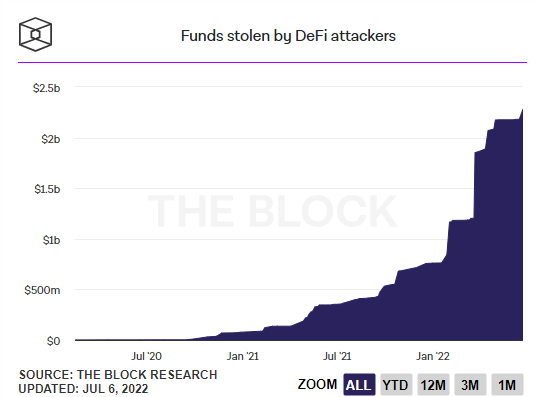
Chart embedded from The Block Crypto Data.


Leituras Relacionadas

Understanding Bound in One Article: The "Multi-signature + Timelock" Escape Mechanism and the Off-Chain Matching Black Box

**Title**: Understanding Bound: The Escape Mechanism of "Multi-Sig + Time Lock" and the Off-Chain Matching Black Box **Summary**: Bound Exchange, evolved from the earlier radFi platform, introduces a novel approach to Bitcoin trading by combining self-custody security with exchange-like speed. Its core mechanism relies on a 2-of-2 multi-signature (multi-sig) address for user deposits. One private key is held by the user via a passkey, and the other is held by Bound. This setup requires both keys to sign any transaction, preventing Bound from unilaterally accessing user funds (non-custodial). To address the risk of Bound becoming unavailable, a 3-month timelock is integrated into the Bitcoin script. After this period, users can withdraw their assets with just their single signature, ensuring an escape hatch. For trading, Bound operates a concentrated liquidity AMM. However, as Bitcoin L1 lacks smart contracts, the AMM curve, liquidity management, and trade price calculations occur off-chain in Bound's backend database. On-chain Bitcoin transactions serve only as final settlement receipts for pre-determined amounts. This creates a centralization point: the critical sequence of trade execution—which determines the exact price along the curve for each order—is managed off-chain by Bound in a non-transparent "black box." While the 2-of-2 setup protects user本金 (principal), the pricing and ordering of trades introduce potential operational MEV risks, as the order processing is invisible and unverifiable on-chain. In practice, users can also connect external wallets (like Unisat) for fully self-custodied trading, but this requires manually signing every transaction. The platform currently supports deposits of BTC and Runes only.

marsbitMesmo agora

Understanding Bound in One Article: The "Multi-signature + Timelock" Escape Mechanism and the Off-Chain Matching Black Box

marsbitMesmo agora

Technology Has No Barriers, 24/7 Trading is the Key to Hyperliquid's Success

The article argues that Hyperliquid's competitive edge lies not in technological superiority but in its 24/7 trading model, which fundamentally challenges traditional finance's fixed market hours. Based in Singapore with an 11-person team, Hyperliquid has generated significant revenue and trading volume. Its core advantage is the ability to facilitate trading continuously, including during weekends when major exchanges like the CME are closed. This was demonstrated when Hyperliquid listed a SpaceX pre-IPO perpetual contract on a Sunday, allowing the market to price the company hours before traditional institutions opened. This disruption has drawn regulatory scrutiny from traditional giants like CME and ICE, who cite risks like lack of KYC and market manipulation. However, the article suggests their concern stems from Hyperliquid eroding the "time monopoly" of established markets. The piece contrasts Hyperliquid's synthetic derivatives—pure price-betting contracts with no underlying asset or centralized issuer—with other models like PreStocks (dependent on real股权) and Ondo (licensed but targetable). Hyperliquid's code-based, decentralized structure makes it resilient to takedowns, even if founders face legal action. Ultimately, the author concludes that while it raises legitimate regulatory questions, Hyperliquid's "unforgeable" competitive barrier is the time advantage of non-stop trading, a feature legacy systems cannot replicate.

marsbitHá 6m

Technology Has No Barriers, 24/7 Trading is the Key to Hyperliquid's Success

marsbitHá 6m

New Information Laundering in Prediction Markets: How Secrets Blend into Investment Signals

"The New Information Laundering in Prediction Markets: How Secrets Infiltrate Investment Signals In late February 2026, nine linked anonymous wallets on Polymarket placed over 80 bets on specific details of a US-Iran war, winning over $2.4 million with a 98% win rate. This exemplifies 'information laundering'—a destructive flaw inherent to prediction markets. These markets function by aggregating trader supply and demand on an order book to set prices, which represent collective probability estimates. This makes them valuable real-time sentiment indicators for institutions. However, the system cannot distinguish between public information and stolen secrets. Confidential information enters one end, and 'clean' market prices—bearing no trace of their illicit origin—emerge from the other. For example, an insider knowing of an imminent strike can buy contracts at low odds, pushing the price up and disguising the secret as a savvy market signal, then profit massively when the event occurs. Analysts can sometimes uncover these schemes due to the blockchain's transparency, as seen with Bubblemaps. Paradoxically, this same transparency can inadvertently broadcast secrets to adversarial observers, providing them with low-cost intelligence. Current laws, like insider trading regulations focused on corporate information, fail to address this issue, especially concerning events like military actions with no 'issuer.' Jurisdictional challenges are amplified as platforms operate offshore, easily bypassing national bans with VPNs. Recent US congressional investigations and proposed bills aim to ban war betting and trading on non-public information by officials. The core issue is that information laundering is not a bug but a feature: a market that perfectly converts knowledge into price will inherently reward those with the best information, including those who obtained it illicitly. As prediction markets grow, potentially reaching hundreds of billions in volume, society must confront whether it can tolerate a machine that profitably transforms its most guarded secrets into public, tradable numbers."

链捕手Há 15m

New Information Laundering in Prediction Markets: How Secrets Blend into Investment Signals

链捕手Há 15m

Trump’s Dual Pressure: When the Iran Deal Meets the Midterm Elections

U.S. President Donald Trump’s efforts to negotiate a deal with Iran are triggering a political backlash within his own Republican Party, as the approach of midterm elections intensifies internal divisions. Reports of a potential agreement—involving a temporary ceasefire, phased sanctions relief, and the unfreezing of Iranian assets in exchange for discussions on Tehran diluting or transferring its stockpile of highly enriched uranium—have drawn sharp criticism from GOP hawks. Key allies like Senators Lindsey Graham and Ted Cruz warned that such concessions could allow Iran to recuperate, undermine recent U.S. military gains, and ultimately strengthen a hostile regime. The dispute highlights a broader political struggle for Trump, who must reconcile his "America First" posture with diplomatic compromise while facing a tough electoral landscape. With Republicans fighting to maintain control of Congress and Trump’s approval ratings declining, the Iran deal has quickly become a test of party loyalty and perceived toughness. Public sparring between Trump aides and critics—including former Secretary of State Mike Pompeo—underscores the internal pressure. While Secretary of State Marco Rubio defended Trump’s historically hardline stance, skeptics like Senator Thom Tillis questioned the logic of any deal that leaves nuclear materials in Iran. The outcome now hinges on whether Trump can persuade his party’s hardliners to accept a negotiated exit.

marsbitHá 17m

Trump’s Dual Pressure: When the Iran Deal Meets the Midterm Elections

marsbitHá 17m

Trading

Spot
Futuros

Artigos em Destaque

Como comprar AXS

Bem-vindo à HTX.com!Tornámos a compra de Axie Infinity (AXS) simples e conveniente.Segue o nosso guia passo a passo para iniciar a tua jornada no mundo das criptos.Passo 1: cria a tua conta HTXUtiliza o teu e-mail ou número de telefone para te inscreveres numa conta gratuita na HTX.Desfruta de um processo de inscrição sem complicações e desbloqueia todas as funcionalidades.Obter a minha contaPasso 2: vai para Comprar Cripto e escolhe o teu método de pagamentoCartão de crédito/débito: usa o teu visa ou mastercard para comprar Axie Infinity (AXS) instantaneamente.Saldo: usa os fundos da tua conta HTX para transacionar sem problemas.Terceiros: adicionamos métodos de pagamento populares, como Google Pay e Apple Pay, para aumentar a conveniência.P2P: transaciona diretamente com outros utilizadores na HTX.Mercado de balcão (OTC): oferecemos serviços personalizados e taxas de câmbio competitivas para os traders.Passo 3: armazena teu Axie Infinity (AXS)Depois de comprar o teu Axie Infinity (AXS), armazena-o na tua conta HTX.Alternativamente, podes enviá-lo para outro lugar através de transferência blockchain ou usá-lo para transacionar outras criptomoedas.Passo 4: transaciona Axie Infinity (AXS)Transaciona facilmente Axie Infinity (AXS) no mercado à vista da HTX.Acede simplesmente à tua conta, seleciona o teu par de trading, executa as tuas transações e monitoriza em tempo real.Oferecemos uma experiência de fácil utilização tanto para principiantes como para traders experientes.

310 Visualizações TotaisPublicado em {updateTime}Atualizado em 2025.03.21

Como comprar AXS

Discussões

Bem-vindo à Comunidade HTX. Aqui, pode manter-se informado sobre os mais recentes desenvolvimentos da plataforma e obter acesso a análises profissionais de mercado. As opiniões dos utilizadores sobre o preço de AXS (AXS) são apresentadas abaixo.

活动图片