RealFi Will Turn Cardano Into A $1 Billion DeFi Powerhouse By 2026: Hoskinson

bitcoinistPublicado em 2025-11-12Última atualização em 2025-11-12

Resumo

Broadcasting on November 11 from “warm, sunny Colorado,” Cardano founder Charles Hoskinson said he expects RealFi to become the dominant...

Trusted Editorial content, reviewed by leading industry experts and seasoned editors. Ad Disclosure

Broadcasting on November 11 from “warm, sunny Colorado,” Cardano founder Charles Hoskinson said he expects RealFi to become the dominant liquidity engine across the Cardano–Midnight stack and push on-chain value to the billion-dollar mark within the next year. “RealFi will be the TVL monster for Cardano and Midnight alike. Billions and billions of dollars,” he said, adding a concrete target: “I want a TVL of over a billion dollars by the end of 2026.”

How Hoskinson Wants To Achieve A $1 Billion Cardano TVL

The pledge situates RealFi—Cardano’s long-trailed push into micro-lending and real-world credit rails—as the centerpiece of a broader liquidity plan that spans Bitcoin inflows, privacy-preserving DeFi on Midnight, and trustless cross-chain settlement.

Hoskinson described Midnight as a fourth-generation crypto platform designed for “rational privacy, selective disclosure, and cooperative economics,” positioning it as a neutral L2-to-everyone that routes identity, compliance and privacy logic off-chain while settling into whichever networks hold users and liquidity. “Midnight’s dream is to be a layer 2 to everyone. You can deploy into Ethereum, you can deploy into Solana, you can deploy into Cardano,” he said.

He tied that architecture directly back to ADA demand and stake-pool economics. “Midnight exists as a smart contract on Cardano […] If Midnight is heavily used, it creates ADA usage,” Hoskinson said. Fees may be abstracted, but “there has to be ADA at the end of the rainbow,” with Midnight’s staking paying the Knight token to SPOs on Cardano so “you make ADA and Knight.” He argued this design increases transaction load on Cardano, broadens listings for Cardano-native assets, and opens “new revenue streams for stake pool operators.”

On interoperability, Hoskinson said the final stage of the Midnight rollout includes a bidirectional recursive-SNARK bridge with Cardano that removes traditional bridge operators. “On the Cardano side, we added BLS support […] both sides will have trustless bridging capability.”

He paired that with performance claims—“5,000 TPS and sub-second block time” for the proof-aggregation role—and fast settlement once Ouroboros Peras lands, framing Midnight as a proof engine and coordination layer that can fold the state of connected chains and return constant-size proofs “validated on a cell phone.”

The liquidity plan extends to Bitcoin and RealFi. On Bitcoin DeFi, Hoskinson said the team has “been able to source more than 24,000 BTC” that could move, while acknowledging the gating items are yield products and finalizing the technology stack. His RealFi comments were unequivocal: the initiative is “going to be a huge [expletive] thing next year,” with smart contracts “being written right now,” and he reiterated the thesis that peer-to-peer micro-lending across Africa, South America and Southeast Asia can anchor on-chain credit flows. “Billions and billions of dollars,” he said.

Midnight’s go-to-market cadence is built around privacy-first DeFi and cross-chain composability. Hoskinson wants privacy-enabled stablecoins and DEXs on Midnight and was explicit about his distaste for centralized, asset-backed stables: “They can be frozen at any time […] That’s not a cryptocurrency.” He pointed to algorithmic, private designs as the preferred path and said oracles and bridges will arrive via decentralized integrations rather than bespoke native rewrites. “When chainlink? […] We can just use a trustless bridge and proofs and trusted execution environments to ferry the information over.”

He also highlighted early traction metrics and community programs designed to accelerate adoption. On Midnight’s scavenger hunt, he claimed “in 21 days, more compute has been expended […] than the first few years of Bitcoin,” with detailed numbers promised at the upcoming Midnight Summit near London. For ecosystem growth, he plans to recruit and pay 500 Midnight ambassadors in 2026, funneling part of their remuneration into Midnight DeFi and targeting “hundreds of thousands of monthly active users” and significant cross-chain transaction flow.

The AMA featured an extended critique of the Cardano Foundation’s governance and incentive structure, which he argued has impeded critical integrations such as stablecoins. “It’s the wrong structure, wrong governance, wrong leadership,” he said, calling for community-elected board oversight and published KPIs. He contrasted that with what he called “tough love” for a maturing protocol: “Cardano’s grown up. It needs to go to college […] You never abandon your children. You just fundamentally change your relationship.”

At press time, ADA traded at $0.59.
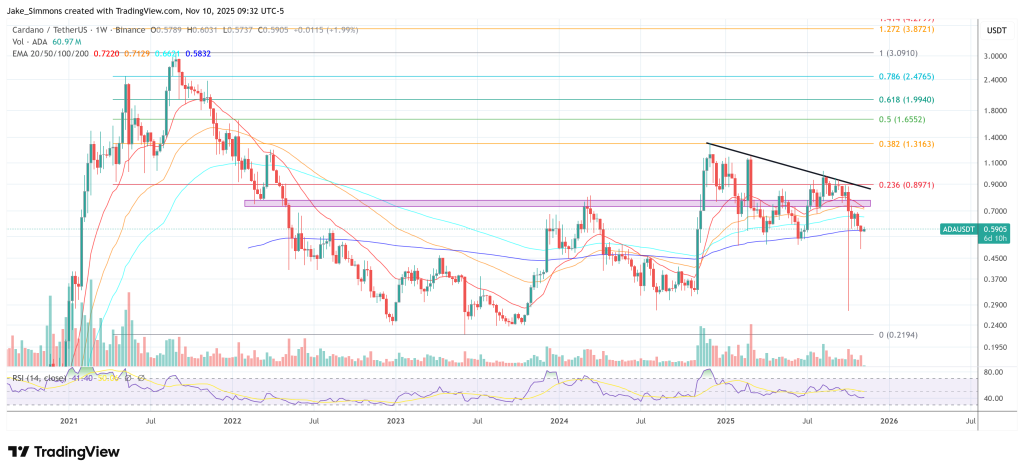
Cardano price
ADA bulls must defend the 200-week EMA, 1-week chart | Source: ADAUSDT on TradingView.com
Featured image created with DALL.E, chart from TradingView.com
Editorial Process for bitcoinist is centered on delivering thoroughly researched, accurate, and unbiased content. We uphold strict sourcing standards, and each page undergoes diligent review by our team of top technology experts and seasoned editors. This process ensures the integrity, relevance, and value of our content for our readers.

Jake Simmons has been a Bitcoin enthusiast since 2016. Ever since he heard about Bitcoin, he has been studying the topic every day and trying to share his knowledge with others. His goal is to contribute to Bitcoin's financial revolution, which will replace the fiat money system. Besides BTC and crypto, Jake studied Business Informatics at a university. After graduation in 2017, he has been working in the blockchain and crypto sector. You can follow Jake on Twitter at @realJakeSimmons.

Leituras Relacionadas

Harvard and Others Exit, Six Core Talents Depart in a Month: What's Happening to Ethereum?

Ethereum faces significant internal and external pressures, marked by a wave of high-profile departures from its core development team and a loss of confidence from major institutional investors. Within four months, at least seven key figures—including researchers, protocol leads, and a former executive director—have left the Ethereum Foundation. This exodus, partly triggered by controversy over a new "mission statement" requiring employee sign-off, risks derailing critical roadmap upgrades like PeerDAS and Verkle trees, and has already contributed to delays in the planned Glamsterdam upgrade. Compounding the internal instability, major institutions are reducing their exposure. Goldman Sachs slashed its iShares Ethereum Trust holdings by approximately 70%, and Harvard's endowment fund completely exited its $87 million Ethereum ETF position. Concurrently, the Ethereum Foundation itself has been unstaking and selling ETH for "treasury rebalancing," further unsettling the market. These challenges emerge as Ethereum's competitive dominance erodes. Its share of the total DeFi market has fallen to around 54%, with rivals like Solana and Base gaining ground. In fee revenue, it was recently outpaced by newer chains like Hyperliquid. Furthermore, a trend of institutions exploring proprietary or hybrid blockchains (exemplified by Circle's Arc) threatens Ethereum's position as the premier settlement layer for institutional assets. While founder Vitalik Buterin's vision for Ethereum as a secure, decentralized "technical sanctuary" and "world computer" remains clear, its realization is threatened by the concurrent loss of execution capability, institutional patience, and market share during a critical competitive phase.

链捕手Há 10m

Harvard and Others Exit, Six Core Talents Depart in a Month: What's Happening to Ethereum?

链捕手Há 10m

IOSG | After the Halving of Developer Count: Crypto Isn't Dead, It's Just Handing Over Talent to AI

IOSG Report: Crypto's Developer Exodus Masks a "Talent Deleveraging" and Migration to AI The number of monthly active crypto developers on GitHub has roughly halved from its 2022 peak to around 23,000. This decline is not a sign of industry collapse but a "talent deleveraging." The exodus consists largely of newcomers who entered during the bull market, while the cohort of established developers (2+ years of experience) has grown to a record high, now contributing about 70% of the code. These core builders are consolidating in ecosystems with real users and activity, like Bitcoin and Solana. The crypto industry has forged a unique skill set: building operational, trusted systems from scratch in environments with no external authority, near-zero tolerance for error, and missing rules. This involves creating trust through pure code/mechanisms and making judgments under profound technical and economic uncertainty. This capability is finding new, high-value applications in the AI era, which faces structurally similar problems: trust in opaque autonomous systems, a lack of governance frameworks, and coordination among self-interested AI agents. Key migration patterns include: 1. **Direct Hardware/Infrastructure Translation:** Projects like CoreWeave pivoted from GPU mining to AI compute supply. 2. **Mechanism Design & Trust Engineering:** Crypto's experience in decentralized coordination and incentive design (e.g., via tokenomics, staking/slashing) is being applied to critical AI challenges: * **Compute Aggregation & Verification:** Solving trust and efficiency problems in decentralized GPU networks (e.g., Hyperbolic). * **AI Agent Governance:** Using cryptoeconomic mechanisms to align the behavior of multiple autonomous AI agents (e.g., EigenLayer's approach). * **Autonomous Agent Payments:** Leveraging stablecoins and programmable money for fast, permissionless micro-transactions between AI agents (e.g., x402 protocol). The builder's role is evolving from "writing smart contracts" to "designing trust mechanisms for autonomous AI systems." This convergence is reflected in hiring trends at major firms and significant capital allocation from top venture funds like Paradigm and a16z into the crypto-AI intersection. While regional approaches differ—with the US focusing more on foundational protocol innovation and Asia on application-layer integration—the core thesis remains: the systemic skills honed in crypto's trustless environments are becoming a scarce and critical asset for scaling AI.

marsbitHá 11m

IOSG | After the Halving of Developer Count: Crypto Isn't Dead, It's Just Handing Over Talent to AI

marsbitHá 11m

Trading

Spot
Futuros

Artigos em Destaque

Como comprar HPP

Bem-vindo à HTX.com!Tornámos a compra de House Party Protocol (HPP) simples e conveniente.Segue o nosso guia passo a passo para iniciar a tua jornada no mundo das criptos.Passo 1: cria a tua conta HTXUtiliza o teu e-mail ou número de telefone para te inscreveres numa conta gratuita na HTX.Desfruta de um processo de inscrição sem complicações e desbloqueia todas as funcionalidades.Obter a minha contaPasso 2: vai para Comprar Cripto e escolhe o teu método de pagamentoCartão de crédito/débito: usa o teu visa ou mastercard para comprar House Party Protocol (HPP) instantaneamente.Saldo: usa os fundos da tua conta HTX para transacionar sem problemas.Terceiros: adicionamos métodos de pagamento populares, como Google Pay e Apple Pay, para aumentar a conveniência.P2P: transaciona diretamente com outros utilizadores na HTX.Mercado de balcão (OTC): oferecemos serviços personalizados e taxas de câmbio competitivas para os traders.Passo 3: armazena teu House Party Protocol (HPP)Depois de comprar o teu House Party Protocol (HPP), armazena-o na tua conta HTX.Alternativamente, podes enviá-lo para outro lugar através de transferência blockchain ou usá-lo para transacionar outras criptomoedas.Passo 4: transaciona House Party Protocol (HPP)Transaciona facilmente House Party Protocol (HPP) no mercado à vista da HTX.Acede simplesmente à tua conta, seleciona o teu par de trading, executa as tuas transações e monitoriza em tempo real.Oferecemos uma experiência de fácil utilização tanto para principiantes como para traders experientes.

173 Visualizações TotaisPublicado em {updateTime}Atualizado em 2026.04.29

Como comprar HPP

O que é GENIUS

I. Introdução ao Projeto1. O Que É Genius?Genius (GENIUS) é posicionado como o “terminal definitivo em cadeia”, uma plataforma de negociação descentralizada focada na privacidade e na velocidade. Ao integrar tecnologia de privacidade de topo, visa construir uma infraestrutura de negociação em privacidade de próxima geração em redes como a BNB Chain, permitindo que os utilizadores interajam em cadeia com uma experiência fluida comparável às trocas centralizadas.2. Como Funciona o Genius?A arquitetura técnica central do Genius está estruturada da seguinte forma:(1) Invisível na cadeia: Os utilizadores não precisam de lidar manualmente com aprovações em múltiplas etapas para operações cross-chain, embrulhamento de ativos ou gestão complexa de gás.(2) Negociação sem Assinatura: Através de integrações como a Turnkey, o Genius permite negociações instantâneas sem confirmações pop-up ou autorizações por transação.(3) Agregador de Agregadores: O Genius é alimentado por uma pilha de agregação de classe mundial integrada com mais de 150 DEXs, reivindicando uma eficiência de citação superior em comparação com produtos concorrentes.(4) Gestão de Contas: A plataforma adota uma arquitetura não custodial e utiliza o Turnkey e o Lit Protocol para gestão de chaves, permitindo que os utilizadores acedam às suas contas de forma segura através de chaves de acesso.3. Quem Criou o Genius?De acordo com os seus Termos de Serviço oficiais, o Genius foi desenvolvido pela Shuttle Labs, Inc. Com base na conta oficial do projeto no X, Ryan Myher é um dos principais colaboradores que impulsionam a iteração do produto, incluindo desenvolvimentos como a implementação do protocolo Ghost, bem como um maior envolvimento da comunidade.O fundador da Binance, CZ, juntou-se oficialmente ao projeto como conselheiro, com o objetivo de ajudar a equipa a construir uma experiência de negociação em cadeia mais rápida e que preserve a privacidade.Além disso, o projeto recebeu um forte apoio da YZi Labs, que investiu no Genius e trabalha ao lado da Genius Foundation, responsável pela manutenção do núcleo do Genius Bridge Protocol (GBP).4. Tokenomics do GeniusGENIUS é o token nativo do ecossistema Genius. Até ao momento, o projeto não lançou um documento completo de tokenomics.Com base nas últimas divulgações oficiais, o Genius incorpora um mecanismo deflacionário, e 4,6% do fornecimento total de tokens já foi queimado durante a fase inicial de lançamento.Sistema de Pontos Genius (GP):(1) Trade-to-Earn: A plataforma estabeleceu um pool de recompensas de 200 milhões de Pontos Genius, e os utilizadores ganham GP por cada negociação executada através do terminal.(2) Níveis e Distintivos: O Genius apresenta um sistema de distintivos baseado em progressão que varia de Smart a God, com níveis mais altos a desbloquear benefícios e vantagens adicionais.(3) Rendimento Nativo: Os utilizadores que detêm ativos designados como usdGG no painel podem ganhar rendimento nativo diretamente sem passar por staking complexo.(4) Incentivos de Referência: Os referenciadores podem ganhar reembolsos de taxas superiores a 45% pagos em USDC, juntamente com GP adicionais.5. Cronograma & Principais MarcosMarço de 2020: A conta oficial do projeto no X foi criada, marcando o início da sua fase de preparação inicial.13 de janeiro de 2026: O Genius anunciou um investimento de vários milhões de dólares da YZi Labs e simultaneamente confirmou CZ como conselheiro para acelerar a construção da sua infraestrutura de negociação em privacidade.18 de abril de 2026: O projeto anunciou que o protocolo de privacidade Ghost seria lançado em breve.29 de abril de 2026: O protocolo Ghost abriu oficialmente para os seus primeiros 50 testadores, marcando o início de uma nova era para a negociação em privacidade na BNB Chain. Ao mesmo tempo, a equipa confirmou que 4,6% dos tokens foram queimados.​II. Informação sobre o Token1) Informação BásicaNome do token: GENIUS (Genius)III. Links RelacionadosWebsite:https://www.tradegenius.com/homeExploradores:https://bscscan.com/address/0x1f12b85aac097e43aa1555b2881e98a51090e9a6Sociais:https://x.com/GeniusTerminalNota: A introdução ao projeto provém dos materiais publicados ou fornecidos pela equipa oficial do projeto, que é apenas para referência e não constitui aconselhamento de investimento. A HTX não se responsabiliza por quaisquer perdas diretas ou indiretas resultantes.

297 Visualizações TotaisPublicado em {updateTime}Atualizado em 2026.05.12

O que é GENIUS

Como comprar GENIUS

Bem-vindo à HTX.com!Tornámos a compra de Genius (GENIUS) simples e conveniente.Segue o nosso guia passo a passo para iniciar a tua jornada no mundo das criptos.Passo 1: cria a tua conta HTXUtiliza o teu e-mail ou número de telefone para te inscreveres numa conta gratuita na HTX.Desfruta de um processo de inscrição sem complicações e desbloqueia todas as funcionalidades.Obter a minha contaPasso 2: vai para Comprar Cripto e escolhe o teu método de pagamentoCartão de crédito/débito: usa o teu visa ou mastercard para comprar Genius (GENIUS) instantaneamente.Saldo: usa os fundos da tua conta HTX para transacionar sem problemas.Terceiros: adicionamos métodos de pagamento populares, como Google Pay e Apple Pay, para aumentar a conveniência.P2P: transaciona diretamente com outros utilizadores na HTX.Mercado de balcão (OTC): oferecemos serviços personalizados e taxas de câmbio competitivas para os traders.Passo 3: armazena teu Genius (GENIUS)Depois de comprar o teu Genius (GENIUS), armazena-o na tua conta HTX.Alternativamente, podes enviá-lo para outro lugar através de transferência blockchain ou usá-lo para transacionar outras criptomoedas.Passo 4: transaciona Genius (GENIUS)Transaciona facilmente Genius (GENIUS) no mercado à vista da HTX.Acede simplesmente à tua conta, seleciona o teu par de trading, executa as tuas transações e monitoriza em tempo real.Oferecemos uma experiência de fácil utilização tanto para principiantes como para traders experientes.

174 Visualizações TotaisPublicado em {updateTime}Atualizado em 2026.05.12

Como comprar GENIUS

Discussões

Bem-vindo à Comunidade HTX. Aqui, pode manter-se informado sobre os mais recentes desenvolvimentos da plataforma e obter acesso a análises profissionais de mercado. As opiniões dos utilizadores sobre o preço de A (A) são apresentadas abaixo.

活动图片