Stuck in Limbo

insights.glassnodePublicado em 2025-11-11Última atualização em 2025-11-12

Executive Summary

  • Bitcoin remains in a mild bearish phase, trading between $97K and $111.9K, with resistance near $116K marked by top-buyers’ supply cluster.
  • Seller exhaustion and renewed accumulation near $100K provide short-term support but lack strong follow-through demand.
  • A dense supply cluster between $106K–$118K continues to cap rallies as investors exit near breakeven.
  • ETF flows have turned modestly negative, reflecting fading institutional demand and a cautious risk appetite.
  • Futures markets show muted funding rates and low open interest, signalling subdued speculative activity across both Bitcoin and altcoins.
  • Options traders maintain a defensive stance, with put protection concentrated around $100K, while the 25-delta skew remains a key gauge for sentiment shifts.
  • Overall, the market is consolidating within a defined range, awaiting stronger inflows or macro catalysts to break out of the current equilibrium.

Over the past week, Bitcoin briefly slipped below $100K, extending the broader downtrend that has persisted since early October. This move pushed the market into a mild bearish regime, with prices now trading beneath the short-term holder cost basis.

In this edition, we analyze the forces driving the rebound toward $106K using on-chain cost-basis models and accumulation–distribution dynamics. We then pivot to off-chain indicators, exploring ETFs, futures markets and options market sentiment to assess whether this recovery reflects genuine demand or a short-lived relief rally.

On-chain Insights

Grinding Lower

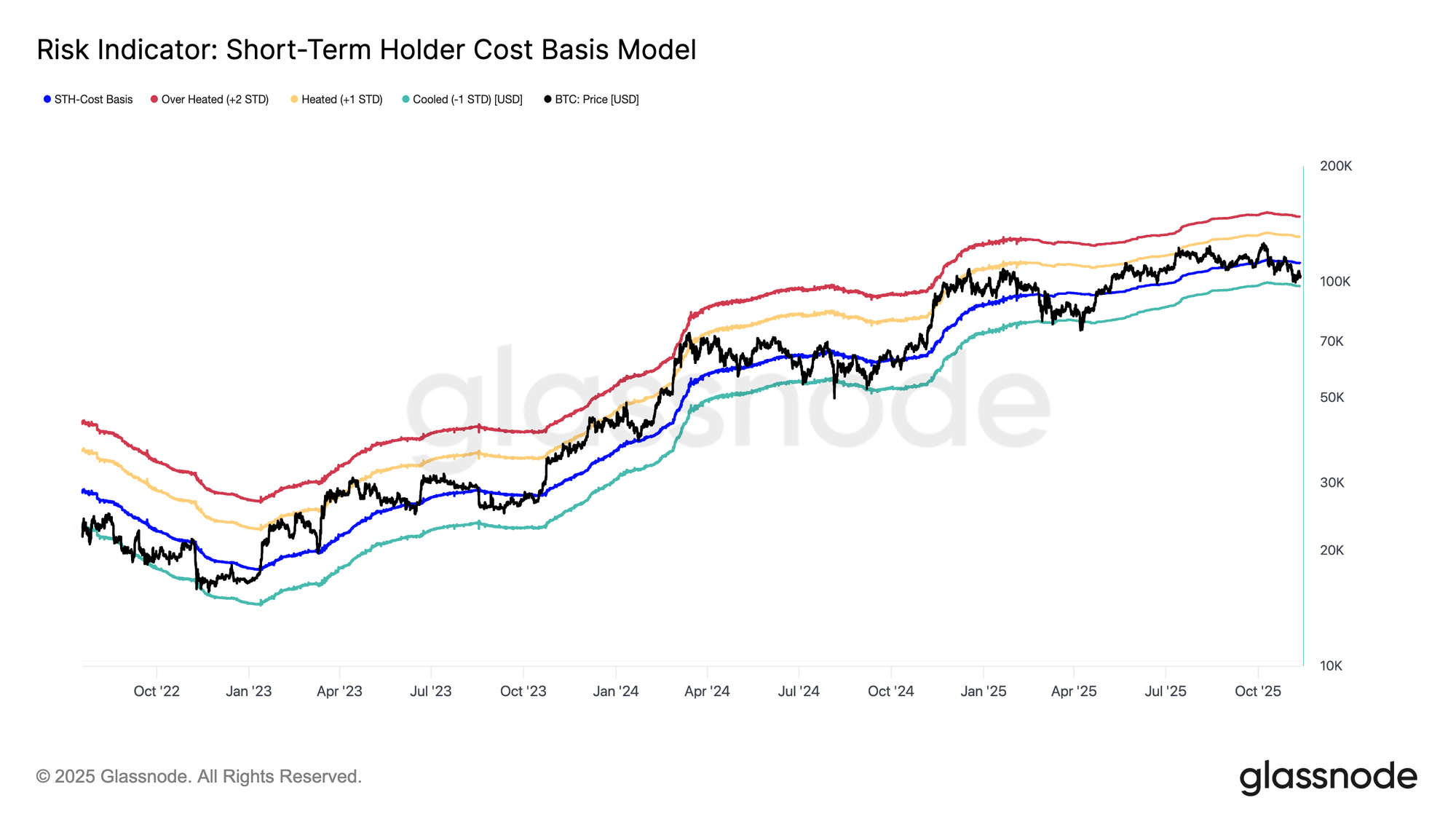
Since early October, with Bitcoin breaking below the short-term holder cost basis (🔵), a range suffering from the lack of conviction and low liquidity has been confirmed. Since then, price action has trended lower, approaching the -1 STD band near $97.5K.

This recent drawdown resembles the contraction phases seen during June–October 2024 and February–April 2025, where prices oscillated within a defined lower range before recovery. Consequently, unless Bitcoin reclaims the short-term holder cost basis (~$111.9K) as support, the probability of revisiting the lower bound of this range remains elevated.
Live Chart

Seller Exhaustion Near $100K

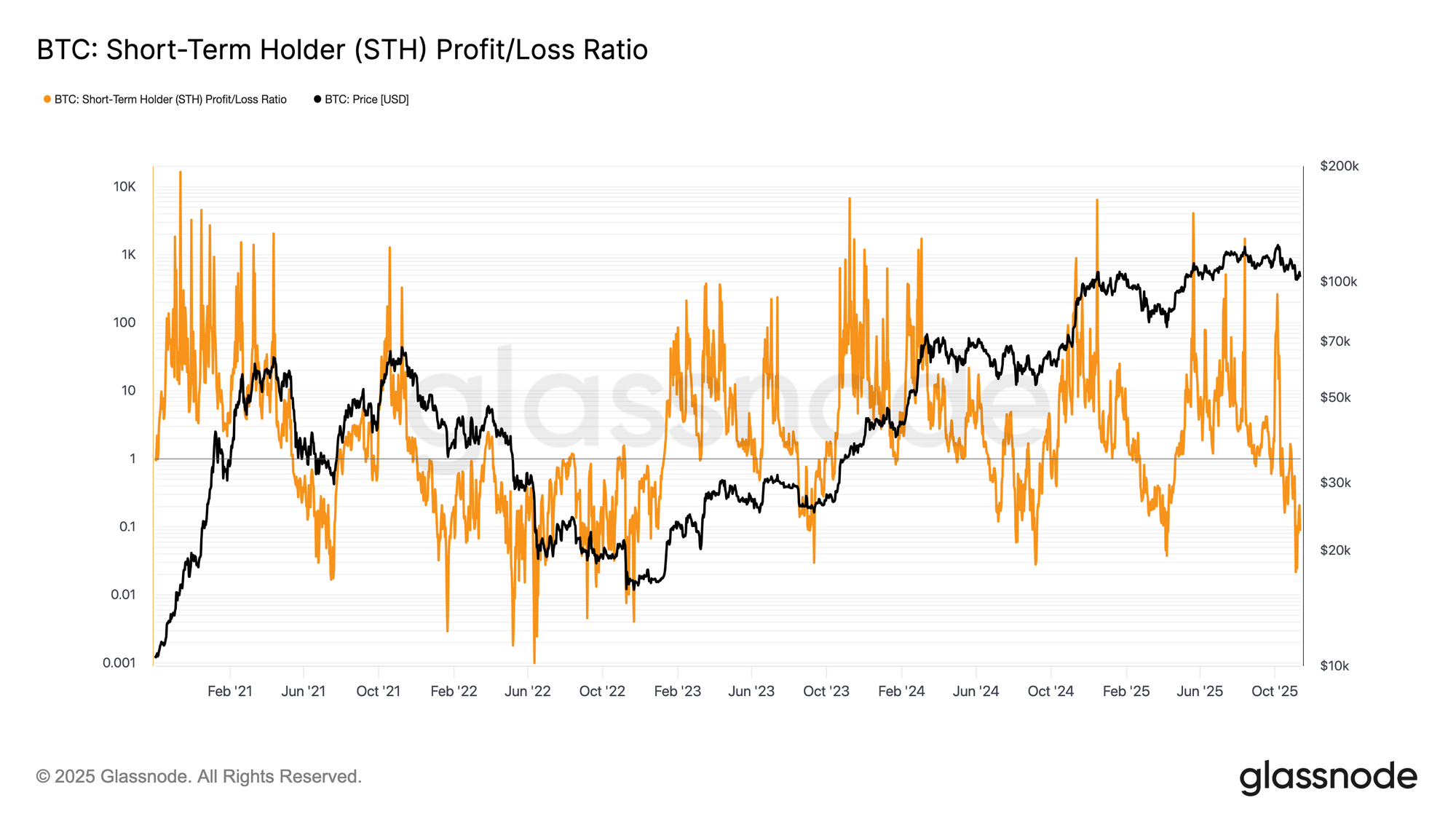
Building on this structural setup, the sub-$100K zone has emerged as a critical battleground where seller exhaustion is beginning to take shape. Much of the downward pressure stems from top buyers among short-term holders, who have been realizing heavy losses during the decline.

As Bitcoin tested $98K, the STH Realized Profit-Loss Ratio fell below 0.21, meaning over 80% of realized value came from coins sold at a loss. This intensity of capitulation briefly exceeded the last three major washouts of this cycle, underscoring how top-heavy the market has become and how pivotal the $100K level remains for near-term stability.
Live Chart

Fueling the Bounce Back

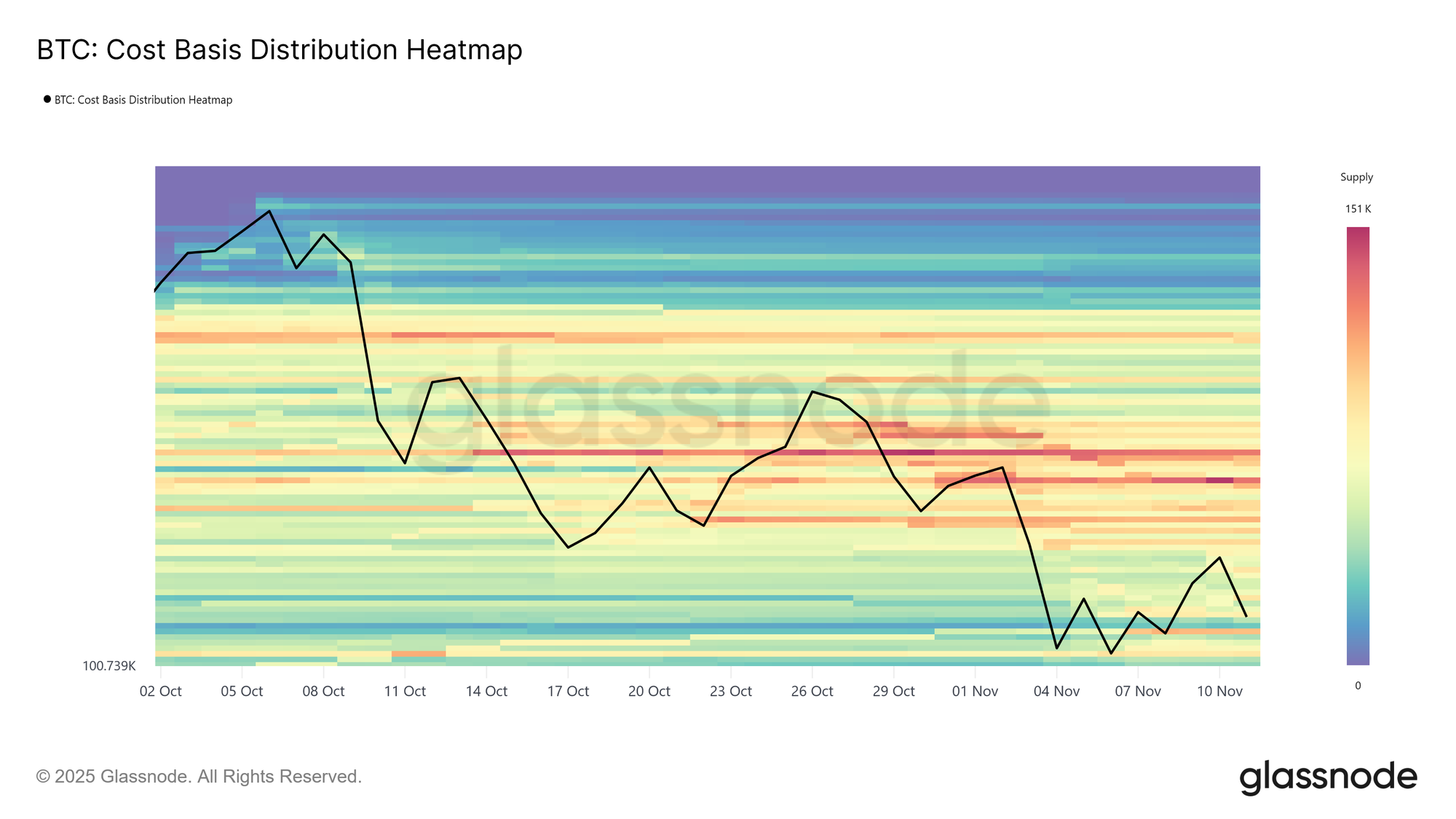
Turning to the demand side, the Cost Basis Distribution Heatmap reveals a clear buildup of realized supply around the sub-$100K zone, both before and after the rebound to $106K. The intensifying heat in this range signals renewed accumulation by buyers absorbing capitulation flows. This dynamic completes the picture; pairing seller exhaustion with steady accumulation, creating the foundation for a short-term recovery even within a broader bearish structure.

Conversely, a dense supply cluster between $106K and $118K continues to cap upward momentum, as many investors use this range to exit near breakeven. This overhang of latent supply creates a natural resistance zone where rallies may stall, suggesting that sustained recovery will require renewed inflows strong enough to absorb this wave of distribution.
Live Chart

Demand Fades, Resistance Builds

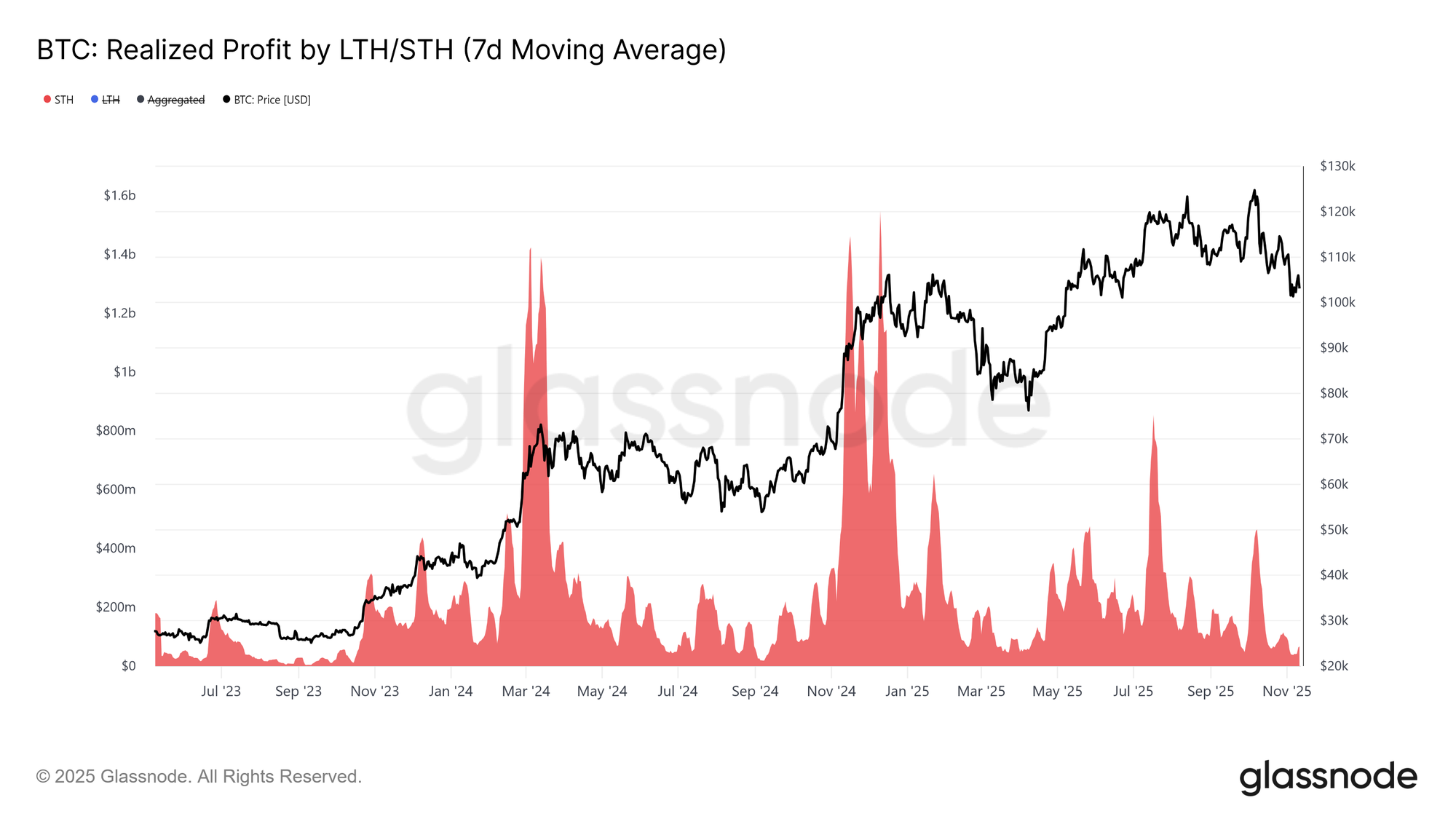
The current market structure confirms a continuation of the downtrend that began in early October. A dense supply zone above $106K continues to exert sell pressure, and reclaiming the short-term holder cost basis (~$111.9K) remains a key prerequisite for any sustainable shift toward recovery.

On the demand side, the Realized Profit of Short-Term Holders (a proxy for new investor momentum) has been notably weak since June 2025, reflecting a lack of fresh inflows. For Bitcoin to push through the $106K–$118K top-buyer cluster, this metric must reverse higher, signalling renewed conviction and stronger demand from new market entrants.
Live Chart

Off-Chain Insights

ETF Outflows Resurface

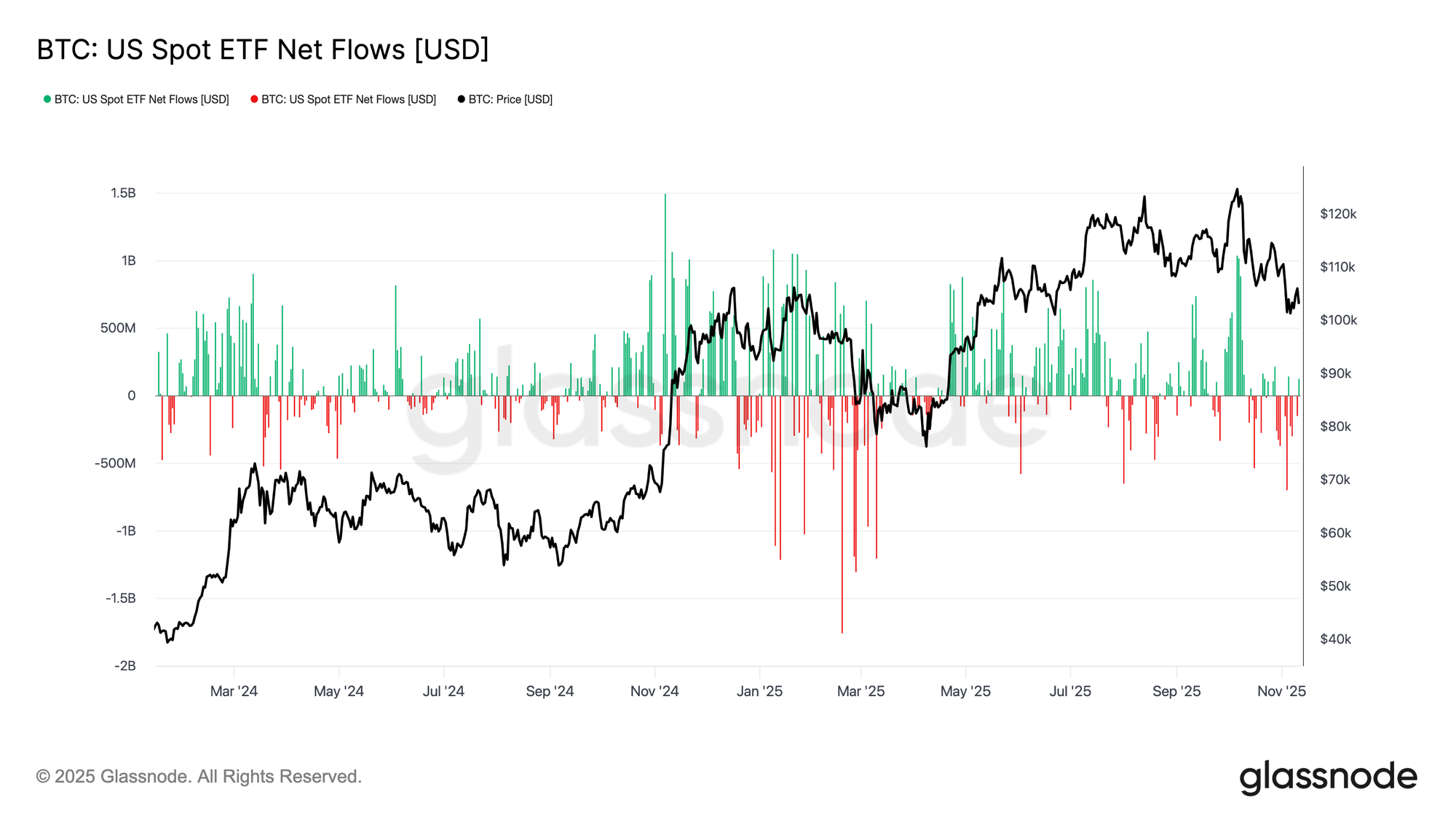
Transitioning to the off-chain section, we first gauge the U.S. spot Bitcoin ETF markets. US spot Bitcoin ETFs have shifted to modest outflows in recent weeks, mirroring muted price action and waning momentum. After strong mid-year inflows, aggregate demand has flattened, suggesting a pause in institutional accumulation.

Historically, such neutral flow regimes align with market consolidation, where conviction rebuilds before the next directional move. A decisive return of inflows would signal renewed institutional confidence, while prolonged outflows could reinforce a more defensive market tone.
Live Chart

Leverage Dries Up

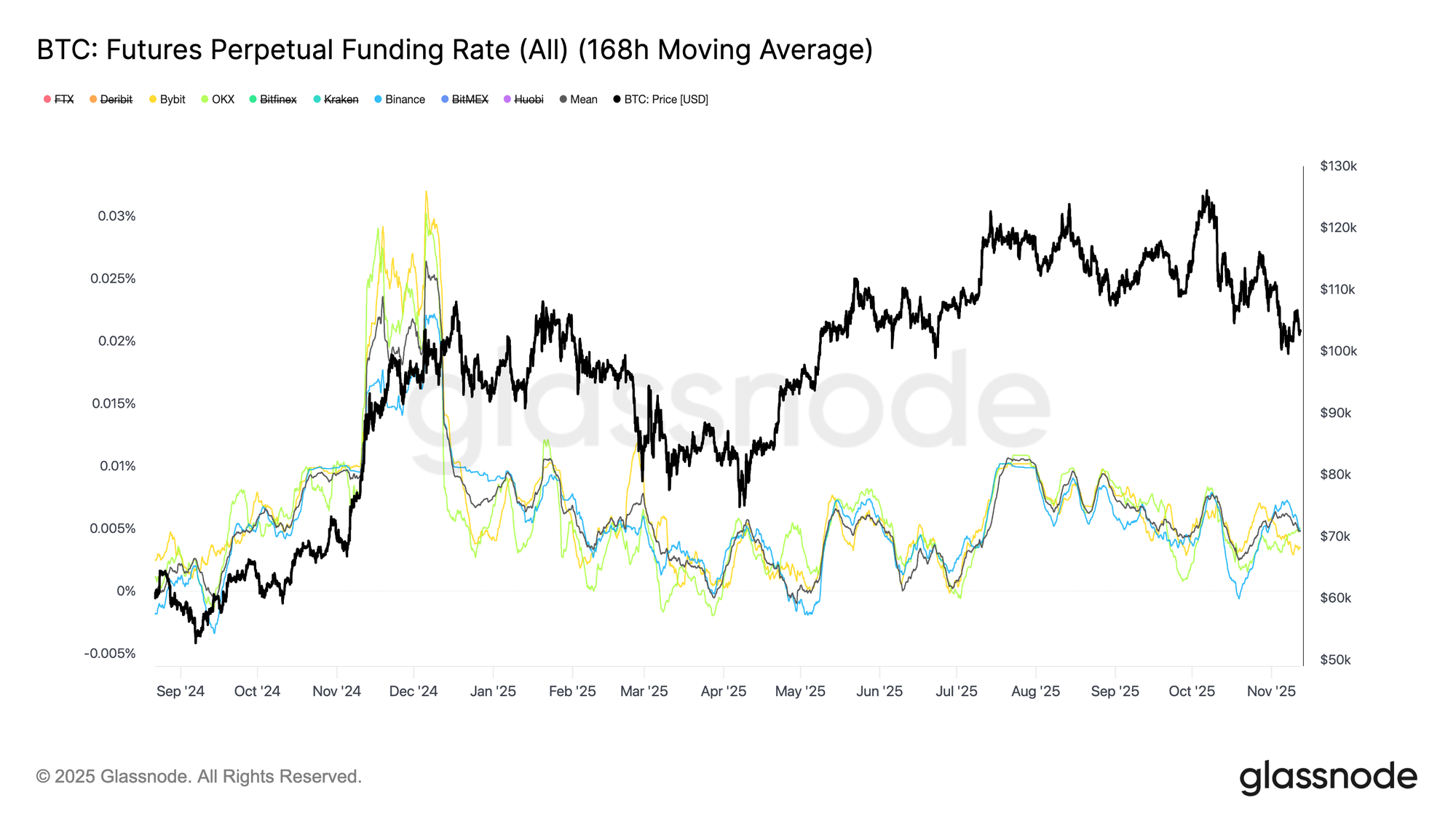
Bitcoin perpetual futures funding rates remain subdued across major exchanges, highlighting the lack of speculative appetite in derivatives markets. Since the leverage flush in October, both funding rates and open interest have drifted lower, signalling that traders are staying cautious with limited directional exposure.

This absence of aggressive positioning reflects a phase of market hesitation, often seen before volatility re-emerges. For now, the derivatives landscape remains quiet and balanced, leaning toward neutral sentiment rather than speculation-driven momentum.
Live Chart

Speculation Cools Broadly

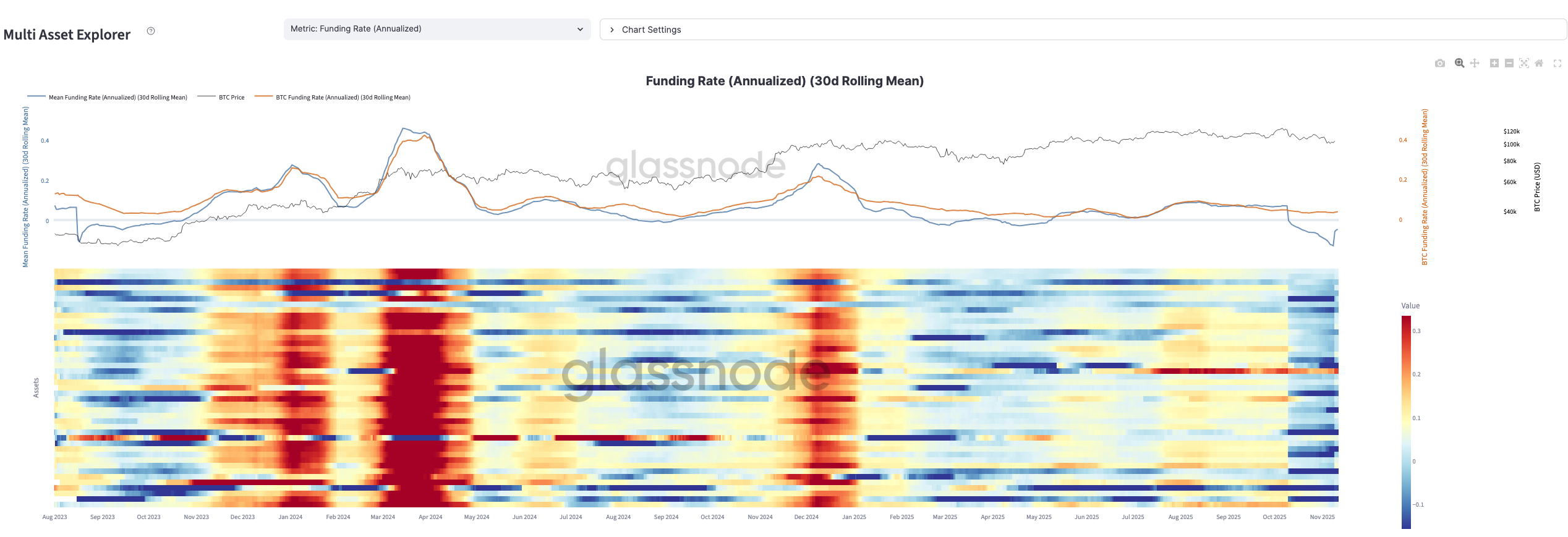
Speculators’ reluctance to use leverage for directional bets extends beyond Bitcoin. Using our newly launched Multi-Asset Explorer, we can assess key futures indicators, funding rates and open interest across the top 100 digital assets.

The first heatmap shows a clear cooling in market-wide funding intensity since mid-year, interrupted only by brief spikes. This broad moderation suggests that traders have de-risked, with leverage and conviction subdued across both Bitcoin and altcoins. Overall, derivatives sentiment remains cautious, and liquidity continues to thin across the board.
Live Chart

Open interest trends across digital asset futures reveal a sharp decline in speculative engagement, most evident in altcoin markets. The heatmap shows a sustained dominance of blue tones, reflecting ongoing contraction in open interest and a clear absence of risk appetite.

While Bitcoin maintains relatively stable positioning, leverage in altcoins has unwound to near cycle lows, with little sign of fresh capital rotation. This pattern underscores a defensive stance among traders, prioritizing capital preservation over speculation. In essence, altcoin derivatives activity has thinned materially—positioning remains light, conviction low, and market attention firmly centred on Bitcoin.

Live Chart

Put Protection Still in Demand

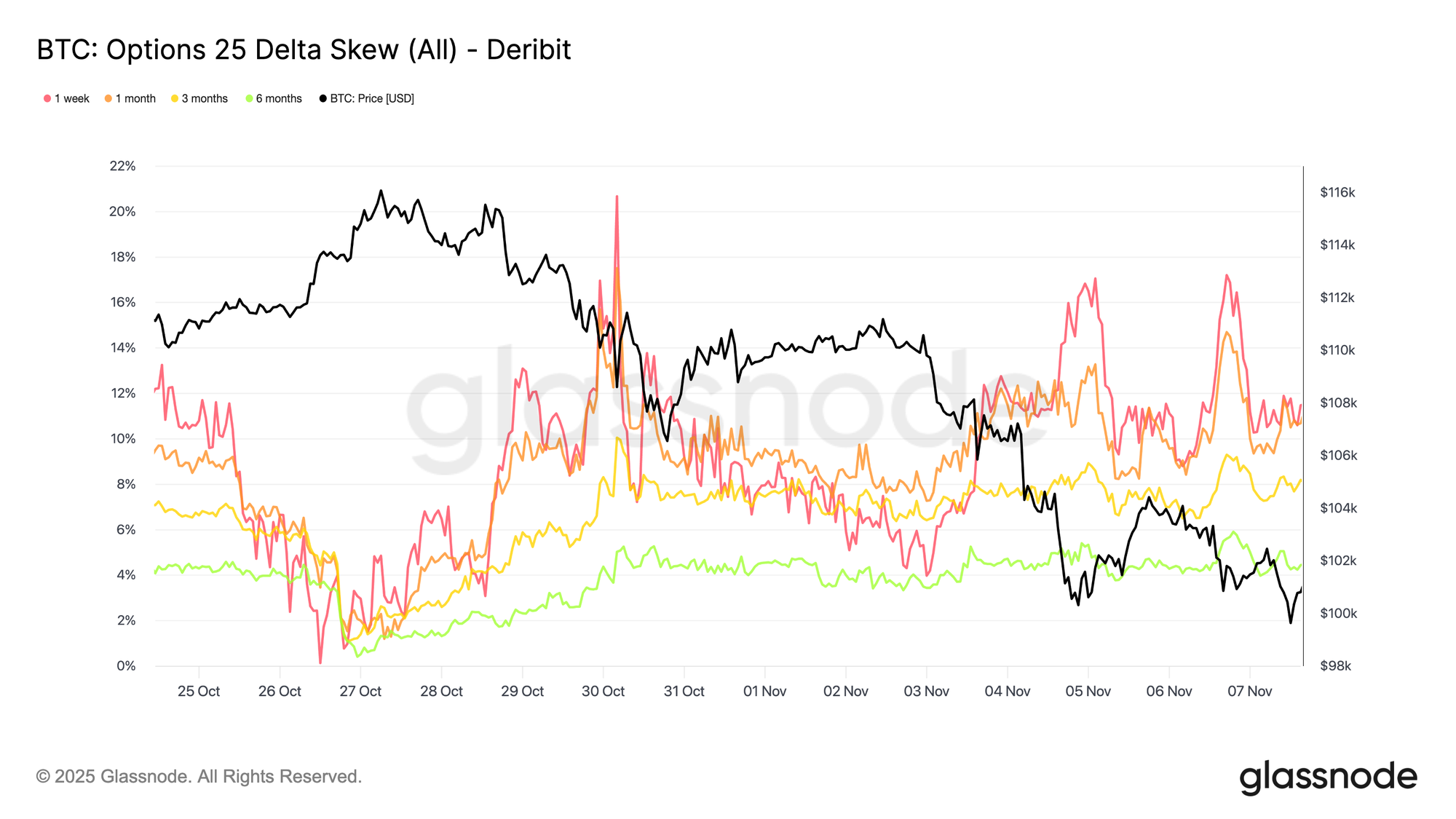
Put protection remains elevated, indicating traders continue to pay a premium for downside insurance. Hedging remains the dominant theme, with short-term expiries pricing roughly 11% implied volatility skew in favour of puts. Three-month and six-month expiries show a softer bias, with 8 and 4 volatility points of downside preference, respectively.

For now, the absence of a clear catalyst limits the potential for skew to shift in favor of calls. The options market continues to price in a retest of the $100K level and a potential break below. However, what will ultimately matter is how the market reacts if that test occurs, rather than the mere pricing of the event.
Live Chart

Implied Volatility in a Range

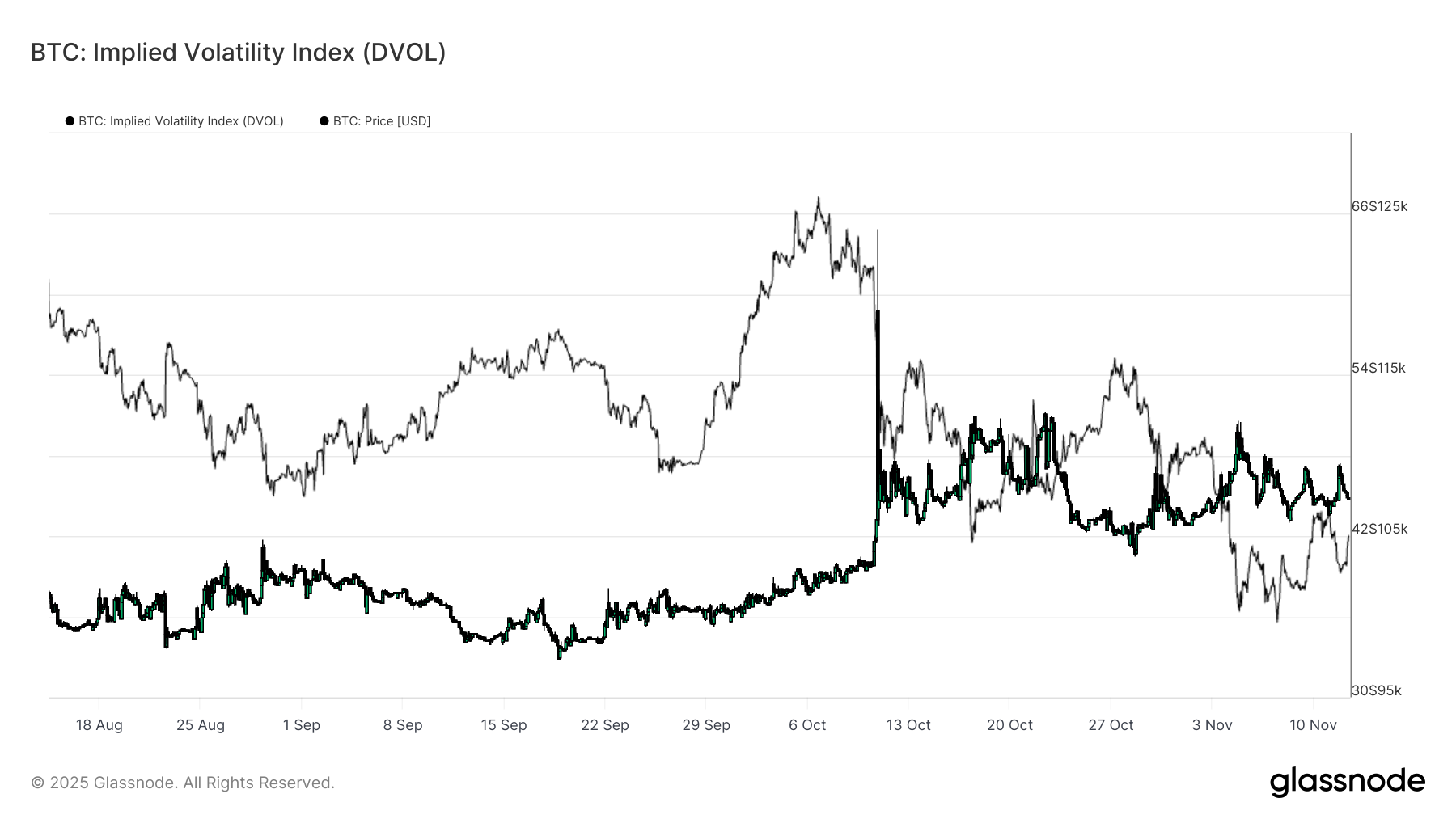
Transitioning from skew to volatility, the broader volatility environment has settled into a holding pattern. The DVOL, Bitcoin’s implied volatility index that measures the market’s expectation of future volatility derived from options prices, remains elevated but range-bound.

Since the October 10 liquidation event, volatility has shifted to a higher regime, oscillating between 40 and 50. This range suggests that the market has adjusted to a higher baseline of uncertainty without entering a state of panic. Volatility remains supported by macroeconomic risk factors and cautious sentiment; however, the absence of further expansion points to consolidation rather than capitulation.
Live Chart

The $100K Line of Defense

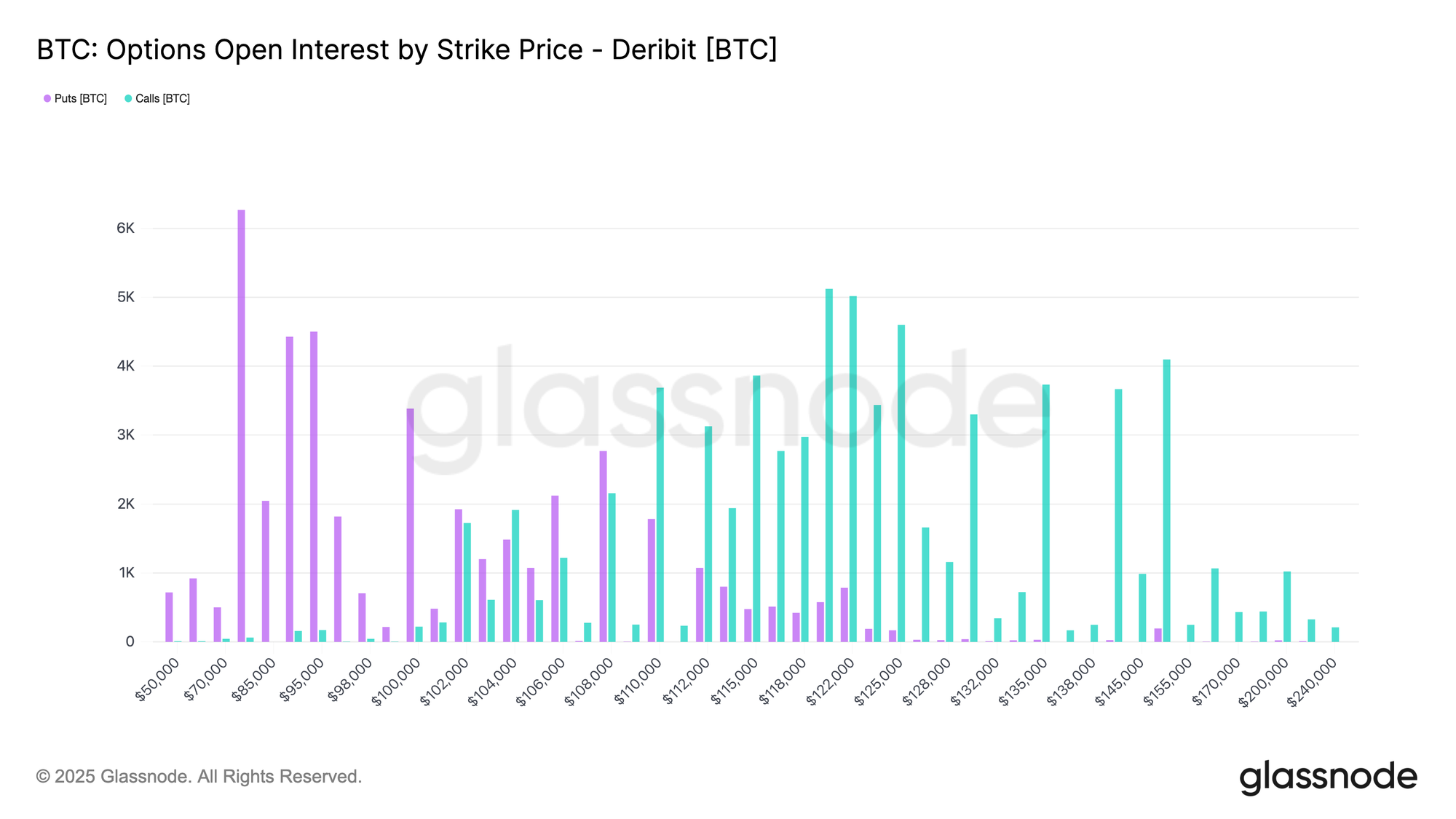
Looking at the end-of-November expiry, open interest clusters heavily around and just below the $100K strike, making it a critical battleground. A decisive break below this level could trigger dealer hedging flows that amplify downside volatility.

If spot retests the $100K area, brief intraday dips below are possible, but a sustained close beneath this threshold would likely mark a shift toward extreme bearish sentiment and potentially ignite another wave of volatility.
Live Chart

Flows Reflect Short-Term Protection Bias

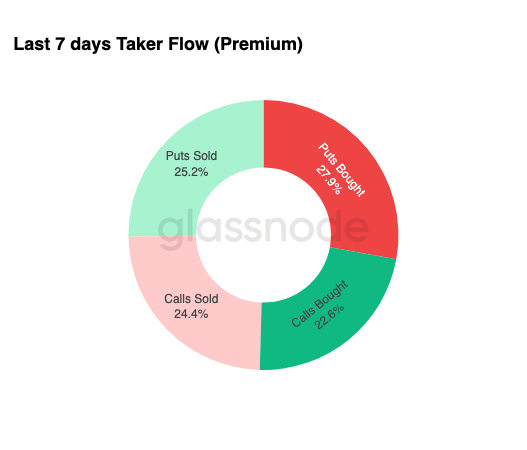
Finally, option flows over the past week reinforce this cautious positioning. Activity was concentrated on the put side, with notable buying between the 108K and 95K strikes.

Some flows reflected outright long protection, such as the 100K strike expiring November 28, while others were structured as calendar spreads, for example, buying the 108K November expiry while selling the 108K December expiry. This pattern effectively captures the current stance; traders anticipate near-term turbulence but remain neutral to moderately optimistic over the longer term.
Live Chart

Options Traders’ Psychology

The next potential catalyst is the resolution of the U.S. government shutdown, an outcome that would likely be welcomed by markets. However, ongoing tariff tensions are expected to keep volatility elevated through Q4. Until the December 10 FOMC meeting, risk appetite is likely to remain muted, as the event is broadly perceived as neutral.

For traders, the 25-delta skew remains the primary gauge for tracking shifts in sentiment. A sustained flattening or reversal toward call bias would signal that market participants are beginning to regain confidence in the upside.

Conclusion

Bitcoin continues to trade within a mild bearish range, defined by strong resistance between $106K–$118K and key structural support near $97.5K–$100K. The market remains under the influence of top-heavy supply, with short-term holders still realizing losses. On-chain data highlighted a brief accumulation near $100K, suggesting localized support, yet without a decisive reclaim of the short-term holders’ cost basis (~$111.9), upside momentum is likely to stay constrained.

Off-chain indicators also echo this cautious tone. ETF outflows, muted funding rates, and low open interest point to subdued speculative engagement, while options traders continue to favor downside protection around the $100K line.

Overall, both on-chain and off-chain signals portray a market in a state of consolidation, stabilizing yet not yet ready to confirm a bullish reversal. Until renewed inflows or a clear macro catalyst emerge, Bitcoin appears bound to oscillate within this $97K–$111.9K corridor, with $100K remaining the psychological line of defence.


Disclaimer: This report does not provide any investment advice. All data is provided for informational and educational purposes only. No investment decision shall be based on the information provided here, and you are solely responsible for your own investment decisions.

Exchange balances presented are derived from Glassnode’s comprehensive database of address labels, which are amassed through both officially published exchange information and proprietary clustering algorithms. While we strive to ensure the utmost accuracy in representing exchange balances, it is important to note that these figures might not always encapsulate the entirety of an exchange’s reserves, particularly when exchanges refrain from disclosing their official addresses. We urge users to exercise caution and discretion when utilizing these metrics. Glassnode shall not be held responsible for any discrepancies or potential inaccuracies. 

Please read our Transparency Notice when using exchange data.

Leituras Relacionadas

Why Are the Most Believers in AGI Buying NVIDIA Put Options?

The article analyzes the significant, market-moving 13F filing for Q1 2026 by Situational Awareness LP (SALP), a fund managed by former OpenAI researcher Leopold Aschenbrenner. While Aschenbrenner is a prominent believer in the accelerated arrival of AGI and has built the fund as a focused bet on AI infrastructure, the filing revealed large new put option positions (totaling billions in notional value) on key AI/semiconductor names like Nvidia, SMH ETF, Broadcom, and AMD. The article argues this is not a bearish turn on AI but a sophisticated hedging strategy. Given the macro backdrop in late March (rising oil prices, inflation concerns, higher-for-longer interest rates), the fund is managing volatility in its high-beta, high-valuation portfolio of AI infrastructure plays (like Bloom Energy, CoreWeave, Core Scientific). The puts act as "insurance" against a potential systemic pullback in the AI trade. Simultaneously, SALP maintained or added to core long positions in companies tied to power, data centers, compute, and storage—the "bottlenecks" expected to capture AI capital spending. It trimmed or exited some Q1 winners (e.g., Lumentum) and reduced leverage (e.g., selling CoreWeave calls), suggesting a rotation from crowded, high-momentum trades towards assets with clearer long-term fundamental pathways. The key takeaway is an evolution in the AI investment theme: from a broad, linear rally to a more discerning, "show-me-the-money" phase. The focus shifts from simply buying the AI narrative to identifying companies that can convert capex into tangible revenue, while actively managing portfolio risk in a volatile macro environment. The strategy reflects a move from unilateral bullishness to "offense with defense."

marsbitHá 47m

Why Are the Most Believers in AGI Buying NVIDIA Put Options?

marsbitHá 47m

AI Saved a Group of New Energy Investors

The article "AI Saves a Group of New Energy Investors" details a remarkable turnaround in the green energy investment sector, driven by its convergence with artificial intelligence infrastructure. After a prolonged downturn marked by valuation slumps and funding cold spells since 2022, the sector has experienced a dramatic resurgence in 2026. This shift is attributed to new policies, particularly the "AI-Energy Synergy" national strategy, which mandates green power and energy storage systems for new large-scale computing centers. This redefines green electricity and storage from traditional manufacturing into core, indispensable assets for AI's operational backbone, creating a new narrative where "computing power equals electricity, and green power equals assets." This paradigm change is reflected in surging market performance. Power stocks like Datang Power have seen massive gains, and green energy ETFs have recorded significant capital inflows. The IPO market is also active, with companies like Sige New Energy listing successfully. Investment and financing have accelerated sharply, with major expansion projects and large-scale IPOs like China Resources New Energy's record-breaking offering. Notably, some top projects have seen valuations rebound by approximately 60%. The article highlights that the previous industry trough became a prime investment window. With AI-driven demand predicted to create massive power shortfalls (e.g., a projected 55GW gap for data centers), sectors like energy storage, grid upgrades, and green power are seeing explosive growth. Investors are now prioritizing areas like power management, large-scale storage, virtual power plants, and supporting technologies like liquid cooling—the "pick-and-shovel" plays of the AI infrastructure boom. Examples like KKR's highly successful investment in cooling company CoolIT Systems underscore the lucrative opportunities. In conclusion, the integration with AI has sparked a fundamental revaluation of new energy assets. For investors who endured the sector's低谷, a harvest season has arrived, with the broader investment upswing seemingly just beginning.

marsbitHá 1h

AI Saved a Group of New Energy Investors

marsbitHá 1h

Trading

Spot
Futuros

Artigos em Destaque

Como comprar HPP

Bem-vindo à HTX.com!Tornámos a compra de House Party Protocol (HPP) simples e conveniente.Segue o nosso guia passo a passo para iniciar a tua jornada no mundo das criptos.Passo 1: cria a tua conta HTXUtiliza o teu e-mail ou número de telefone para te inscreveres numa conta gratuita na HTX.Desfruta de um processo de inscrição sem complicações e desbloqueia todas as funcionalidades.Obter a minha contaPasso 2: vai para Comprar Cripto e escolhe o teu método de pagamentoCartão de crédito/débito: usa o teu visa ou mastercard para comprar House Party Protocol (HPP) instantaneamente.Saldo: usa os fundos da tua conta HTX para transacionar sem problemas.Terceiros: adicionamos métodos de pagamento populares, como Google Pay e Apple Pay, para aumentar a conveniência.P2P: transaciona diretamente com outros utilizadores na HTX.Mercado de balcão (OTC): oferecemos serviços personalizados e taxas de câmbio competitivas para os traders.Passo 3: armazena teu House Party Protocol (HPP)Depois de comprar o teu House Party Protocol (HPP), armazena-o na tua conta HTX.Alternativamente, podes enviá-lo para outro lugar através de transferência blockchain ou usá-lo para transacionar outras criptomoedas.Passo 4: transaciona House Party Protocol (HPP)Transaciona facilmente House Party Protocol (HPP) no mercado à vista da HTX.Acede simplesmente à tua conta, seleciona o teu par de trading, executa as tuas transações e monitoriza em tempo real.Oferecemos uma experiência de fácil utilização tanto para principiantes como para traders experientes.

173 Visualizações TotaisPublicado em {updateTime}Atualizado em 2026.04.29

Como comprar HPP

O que é GENIUS

I. Introdução ao Projeto1. O Que É Genius?Genius (GENIUS) é posicionado como o “terminal definitivo em cadeia”, uma plataforma de negociação descentralizada focada na privacidade e na velocidade. Ao integrar tecnologia de privacidade de topo, visa construir uma infraestrutura de negociação em privacidade de próxima geração em redes como a BNB Chain, permitindo que os utilizadores interajam em cadeia com uma experiência fluida comparável às trocas centralizadas.2. Como Funciona o Genius?A arquitetura técnica central do Genius está estruturada da seguinte forma:(1) Invisível na cadeia: Os utilizadores não precisam de lidar manualmente com aprovações em múltiplas etapas para operações cross-chain, embrulhamento de ativos ou gestão complexa de gás.(2) Negociação sem Assinatura: Através de integrações como a Turnkey, o Genius permite negociações instantâneas sem confirmações pop-up ou autorizações por transação.(3) Agregador de Agregadores: O Genius é alimentado por uma pilha de agregação de classe mundial integrada com mais de 150 DEXs, reivindicando uma eficiência de citação superior em comparação com produtos concorrentes.(4) Gestão de Contas: A plataforma adota uma arquitetura não custodial e utiliza o Turnkey e o Lit Protocol para gestão de chaves, permitindo que os utilizadores acedam às suas contas de forma segura através de chaves de acesso.3. Quem Criou o Genius?De acordo com os seus Termos de Serviço oficiais, o Genius foi desenvolvido pela Shuttle Labs, Inc. Com base na conta oficial do projeto no X, Ryan Myher é um dos principais colaboradores que impulsionam a iteração do produto, incluindo desenvolvimentos como a implementação do protocolo Ghost, bem como um maior envolvimento da comunidade.O fundador da Binance, CZ, juntou-se oficialmente ao projeto como conselheiro, com o objetivo de ajudar a equipa a construir uma experiência de negociação em cadeia mais rápida e que preserve a privacidade.Além disso, o projeto recebeu um forte apoio da YZi Labs, que investiu no Genius e trabalha ao lado da Genius Foundation, responsável pela manutenção do núcleo do Genius Bridge Protocol (GBP).4. Tokenomics do GeniusGENIUS é o token nativo do ecossistema Genius. Até ao momento, o projeto não lançou um documento completo de tokenomics.Com base nas últimas divulgações oficiais, o Genius incorpora um mecanismo deflacionário, e 4,6% do fornecimento total de tokens já foi queimado durante a fase inicial de lançamento.Sistema de Pontos Genius (GP):(1) Trade-to-Earn: A plataforma estabeleceu um pool de recompensas de 200 milhões de Pontos Genius, e os utilizadores ganham GP por cada negociação executada através do terminal.(2) Níveis e Distintivos: O Genius apresenta um sistema de distintivos baseado em progressão que varia de Smart a God, com níveis mais altos a desbloquear benefícios e vantagens adicionais.(3) Rendimento Nativo: Os utilizadores que detêm ativos designados como usdGG no painel podem ganhar rendimento nativo diretamente sem passar por staking complexo.(4) Incentivos de Referência: Os referenciadores podem ganhar reembolsos de taxas superiores a 45% pagos em USDC, juntamente com GP adicionais.5. Cronograma & Principais MarcosMarço de 2020: A conta oficial do projeto no X foi criada, marcando o início da sua fase de preparação inicial.13 de janeiro de 2026: O Genius anunciou um investimento de vários milhões de dólares da YZi Labs e simultaneamente confirmou CZ como conselheiro para acelerar a construção da sua infraestrutura de negociação em privacidade.18 de abril de 2026: O projeto anunciou que o protocolo de privacidade Ghost seria lançado em breve.29 de abril de 2026: O protocolo Ghost abriu oficialmente para os seus primeiros 50 testadores, marcando o início de uma nova era para a negociação em privacidade na BNB Chain. Ao mesmo tempo, a equipa confirmou que 4,6% dos tokens foram queimados.​II. Informação sobre o Token1) Informação BásicaNome do token: GENIUS (Genius)III. Links RelacionadosWebsite:https://www.tradegenius.com/homeExploradores:https://bscscan.com/address/0x1f12b85aac097e43aa1555b2881e98a51090e9a6Sociais:https://x.com/GeniusTerminalNota: A introdução ao projeto provém dos materiais publicados ou fornecidos pela equipa oficial do projeto, que é apenas para referência e não constitui aconselhamento de investimento. A HTX não se responsabiliza por quaisquer perdas diretas ou indiretas resultantes.

297 Visualizações TotaisPublicado em {updateTime}Atualizado em 2026.05.12

O que é GENIUS

Como comprar GENIUS

Bem-vindo à HTX.com!Tornámos a compra de Genius (GENIUS) simples e conveniente.Segue o nosso guia passo a passo para iniciar a tua jornada no mundo das criptos.Passo 1: cria a tua conta HTXUtiliza o teu e-mail ou número de telefone para te inscreveres numa conta gratuita na HTX.Desfruta de um processo de inscrição sem complicações e desbloqueia todas as funcionalidades.Obter a minha contaPasso 2: vai para Comprar Cripto e escolhe o teu método de pagamentoCartão de crédito/débito: usa o teu visa ou mastercard para comprar Genius (GENIUS) instantaneamente.Saldo: usa os fundos da tua conta HTX para transacionar sem problemas.Terceiros: adicionamos métodos de pagamento populares, como Google Pay e Apple Pay, para aumentar a conveniência.P2P: transaciona diretamente com outros utilizadores na HTX.Mercado de balcão (OTC): oferecemos serviços personalizados e taxas de câmbio competitivas para os traders.Passo 3: armazena teu Genius (GENIUS)Depois de comprar o teu Genius (GENIUS), armazena-o na tua conta HTX.Alternativamente, podes enviá-lo para outro lugar através de transferência blockchain ou usá-lo para transacionar outras criptomoedas.Passo 4: transaciona Genius (GENIUS)Transaciona facilmente Genius (GENIUS) no mercado à vista da HTX.Acede simplesmente à tua conta, seleciona o teu par de trading, executa as tuas transações e monitoriza em tempo real.Oferecemos uma experiência de fácil utilização tanto para principiantes como para traders experientes.

174 Visualizações TotaisPublicado em {updateTime}Atualizado em 2026.05.12

Como comprar GENIUS

Discussões

Bem-vindo à Comunidade HTX. Aqui, pode manter-se informado sobre os mais recentes desenvolvimentos da plataforma e obter acesso a análises profissionais de mercado. As opiniões dos utilizadores sobre o preço de A (A) são apresentadas abaixo.

活动图片