США ввели санкции против пособников хакеров из КНДР. Кого это коснулось

cryptonews.ruPublicado em 2025-09-11Última atualização em 2025-11-12

Министерство финансов США объявило о введении новых санкций против ряда северокорейских банкиров и финансовых организаций. Под ограничения попали восемь человек и две компании — все их активы в США или находящиеся под американской юрисдикцией замораживаются. По данным властей, эти люди и структуры помогали Северной Корее добывать деньги через кибератаки, мошенничество в IT-сфере и другие незаконные схемы. Заработанные средства, как утверждается, использовались для финансирования ядерной и ракетной программ страны. GetBlock AML Research публикует обзор новых ограничительных мер.

Что стало причиной санкций

По информации Министерства финансов США, правительство Северной Кореи уже много лет использует различные нелегальные способы для получения денег. В числе таких методов — кибератаки, шпионаж в интернете и кражи средств с финансовых платформ. За последние три года северокорейские хакеры похитили более $3 млрд, в основном в виде криптовалют.

Кроме того, тысячи северокорейских IT-специалистов работают за рубежом под чужими именами. Они создают аккаунты на фриланс-платформах, используют поддельные документы и зарабатывают миллионы долларов в год, выполняя заказы в сфере программирования. Зачастую эти деньги передаются государству.

Чтобы обналичить и перевести незаконные доходы, Северная Корея использует сеть посредников — банкиров и компаний, действующих в разных странах, включая Китай и Россию. Через эти связи средства проходят по международным каналам и маскируются под законные финансовые операции.
Год КНДР: все самое главное о хакерских группировках Северной Кореи

Год КНДР: все самое главное о хакерских группировках Северной Кореи

Северокорейские хакеры на данные момент являются главной угрозой для криптовалютного рынка, поскольку им удалось автоматизировать и поставить на поток кражу цифровых активов

Читать дальше

Кто попал под санкции

Компании:

Ryujong Credit Bank — банк из Пхеньяна, который, по данным США, помогал переводить иностранную валюту между Китаем и Северной Кореей, обходя международные ограничения. Также участвовал в отмывании денег, заработанных за границей.

Korea Mangyongdae Computer Technology Corporation (KMCTC) — IT-компания, официально базирующаяся в Пхеньяне. Она направляла своих сотрудников для работы в китайских городах, используя подставных лиц для получения и перевода денег, заработанных на иностранных заказах.

Физические лица:

  • Choe Chun Pom — представитель Центрального банка КНДР в России, участвовал в переводах и организации поездок чиновников.
  • Han Hong Gil — сотрудник Koryo Commercial Bank, проводил переводы на сотни тысяч долларов в интересах Ryujong Credit Bank.
  • Jang Kuk Chol и Ho Jong Son — управляли зарубежными фондами на сумму свыше $5 млн, в том числе связанными с кибератаками и нелегальной IT-деятельностью.
  • Ho Yong Chol — северокорейский банкир, работающий в Китае. Провел операции на десятки миллионов долларов, помогая обходить санкции.
  • Jong Sung Hyok — представитель Foreign Trade Bank в российском Владивостоке, занимался международными расчетами и переводами.
  • Ri Jin Hyok — также представитель этого банка, участвовал в переводах валюты и криптоактивов.
  • U Yong Su — руководитель компании KMCTC, отвечал за управление IT-проектами и финансовые операции за рубежом.

Эти восемь человек считаются ключевыми посредниками, обеспечивающими доступ Северной Корее к международным финансам через сети банков и подставных компаний.
Теневая блокчейн-экономика: баланс преступников превысил $75 млрд

Теневая блокчейн-экономика: баланс преступников превысил $75 млрд

Преступные и незаконные организации накопили на своих кошельках активы на $75 млрд — это рекордные показатель за последние годы

Читать дальше

Криптокошельки под санкциями

В санкционный список также включены 53 криптокошелька, связанные с северокорейским банком Cheil Credit Bank. Через них проходило около $16 млн в криптовалюте (USDT). Большая часть поступала с крупных бирж и от уже известных подозрительных адресов.
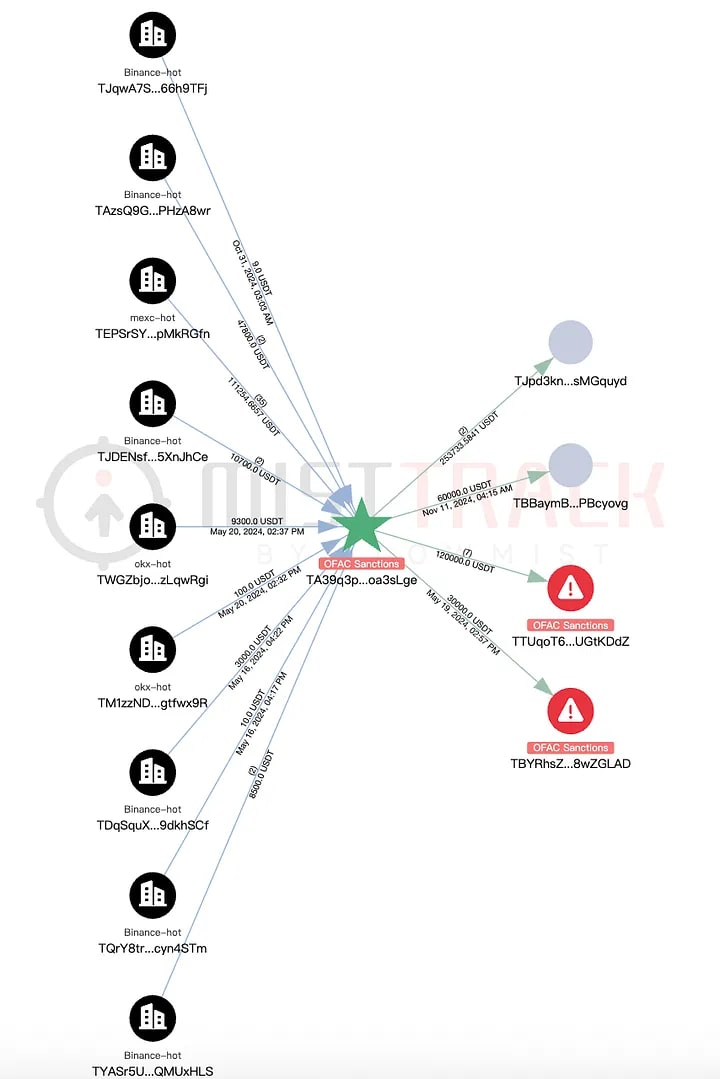
Связь заблокированных адресов с крупными биржами

Связь заблокированных адресов с крупными биржами. Визуализация: MistTrack

На момент публикации примерно 60% этих кошельков пусты — средства были переведены на другие адреса. Остальные 40% содержат около $6,5 млн, которые уже заблокированы эмитентом стейблкоина Tether.

Список заблокированных кошельков
TA3941uFAvmVibSkQ6fMJXxmaSNovX86mz
TA39q3p75XRSWYAEaSF7dANtyksoa3sLge
TBATDh41qMQ1yeVYecneEvhpfayYmkAQWS
TBwghbQMsBC5xcUxE7ZpYXhfDMXZAfiFv6
TBWRDpQsW1ZVPGGaBAwVLNb7iqmVBuM1nj
TBYRhsZR7Mdn9ezpGVLwZiNVnGm8wZGLAD
TBZefVsyQpzzxc2WSCLbZBECvxVdzGqdtC
TC5UNu3LGrjjVCuLNDdVgjm4oL5cQAyFRZ
TCA7AfTSuDmgYk2VaezfPuZF4Z4X8wxwcQ
TDNKsLvsY2iSznyghddXz7ZDRc4X3191Z8
TE3mCcPULjPUE7ykX7RArDPAhyahoy3d2j
TF4J8Gp7zbS8NA3HLuxsLdx7Ebzr6weCGn
TFdHux43bs21qRsygv5WQWfgtbQeT6nXey
TFrH3dcpnR3tADrAcfyJwiK4brsgf3B7PG
TFurWgnyNMq9bhLrLoT9FGnrLfAL2BtR5R
TGDaYNWFXi9HJ7NacfETF15vhUH7eRhKzt
TGdpkwNVFjw2DnbHBCFKLvCygPVPz9w4iM
TGKgLatirRpTugS6wgCUKerjLbzWKXAVqx
TGMFaAXH15oaW8MpcNHLid6NbMKWaaNPdC
TGpNzk9noyvCCdnFPuSg5cqptPs16LjXZq
TGRZZsD8gxahF5oE6C7K8LLRHqQzoPa5bX
THEQTsqPhRDDfgcfBW5npH5Lr9PZhpthrf
THHb5iMAbZgQYY19h6uY66y5xt6e11gcZC
THob8vRrpDybXeqZDj8ukQhMjJVJ5nCbTW
THUqqeevBQS3EYordDJKwp8DLFknesnfCD
TJ812KESWjzJZGEWBPFCu74Js5zQS7jN5A
TJBg9SxwiUUoqJGk18vK9avxkuV8GrKMK7
TLRMHPjLGXsVpD9RVzSfat6zDiVDrd4b4w
TMECKT19hfumcK3KqQKbhxkn1ohyeR58xu
TMgnRWb9xFMtktny9Lzty21QYLLQD93ft6
TMiSGhXXVsvJzqwGbwAsGiFxWg2eALZoM5
TPcUZYthDfxNsHQnZZGBM1BDNBeNSjfPZE
TPF9UQhqpV18BPWg5xo6MeB3h8t4iEg9gP
TPo3JyryRcQ3uhBWexeYhtkpMitsUwY4uB
TPPR7e8hGC57dexrE2jy1f94wtuGyVP6Dp
TQKQ4ntejdYYJpuYkFz8oCSDoXW6RKRDdY
TQthYM5nLqwAEr6DScC8tRtw29ncEB53mK
TR18rEj7gWjKBJLYrowyfnvjWLTTsXGngK
TRkGqvaobVp4XDNmSceRo5hDcJYDTFmYjd
TTct1DezYvriNWU7Wi3mygLoskkaw61mra
TTUqoT6EAmiM1xLvwVwxhjvjaoEUGtKDdZ
TTzMs5AR66jr9mQMkWfCHVwd3AiLLYPepQ
TUKsuPVb8kgJVFp5x528KC5HisUVdzxami
TVDsEFm19zLV8HeXdt6G75rLroxnp6uqpV
TVu2SiQrWSnfwk8quAeDxfiaLy6FHzYkMA
TVyiDQ25H6Rx6PcNV1WyjGasGSa8ehj1Uv
TW3RgbhYkFEFnmRJ9mE9b83T9XYSMkjwuD
TWwv8FQiES3yHGig7y3zJWYuPaZfSV3vmY
TXc4kRiMEcdXRxWpSKkD5qKaARExN4uxPq
TXFUYHVJMDyKikutvCG6qNgTUS5pxtZhHs
TYD6a4PAAfAgegEdDf9oZUnW4DFmS8jeFT
TYK29mbyvVxLaLUKdFSTRADMwoxaVbVZQg
TYxwUhoLPF7AgfG9GaXFEp8CQi8K8KG1m3

Активность по этим кошелькам наблюдалась с августа 2023 по июль 2025 года, наиболее активно — в середине 2024 и первой половине 2025 года. Большинство операций прекратилось за неделю до официального объявления санкций. Многие переводы проходили в несколько этапов, чтобы скрыть происхождение средств. Некоторые кошельки также взаимодействовали с крупными криптобиржами.
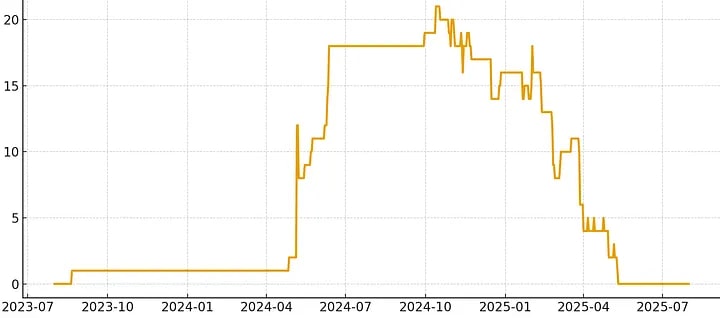
График активности заблокированных адресов

График активности заблокированных адресов

Что это значит

Новые санкции показывают, насколько активно Северная Корея использует киберпреступления и подставные компании, чтобы зарабатывать деньги и обходить международные ограничения.

Американские власти призывают финансовые организации и криптовалютные сервисы внимательнее проверять источники поступающих средств, отслеживать подозрительные транзакции и избегать взаимодействия с адресами, которые могут быть связаны с санкционированными структурами.

Основная цель этих мер — перекрыть Северной Корее каналы финансирования и снизить влияние ее киберпреступных сетей на мировую экономику.
Leituras Relacionadas

AI Boosting Efficiency and Cutting Costs Makes VC Increasingly Expensive

"AI for Cost Reduction Makes VC Funding More Expensive" Despite the "cost-reduction and efficiency" narrative of AI, venture capital (VC) investment in the AI sector is becoming increasingly costly. While AI tools lower the initial costs for many startups—with team sizes shrinking across funding stages—the market is polarizing. For top-tier AI teams, especially those from leading companies like Google and OpenAI, funding rounds are now larger and valuations are higher than ever at the seed and early stages. For example, new ventures by prominent researchers are securing billions in funding with valuations reaching tens of billions before having a mature product. This creates a "barbell" market: lightweight startups need less capital, while elite AI firms attract massive investments early on. This dynamic raises the cost for VCs to acquire and maintain meaningful ownership stakes. As valuations soar early, securing the same equity percentage requires significantly larger capital commitments. VCs must now invest more upfront and reserve substantial funds for follow-on rounds to avoid dilution, prompting large firms like Accel and a16z to raise massive new funds. Consequently, capital is concentrating intensely in a few perceived winners like OpenAI and Anthropic, widening the gap between large and small VC funds. While high valuations bake in future growth expectations, they also compress potential returns, demanding that portfolio companies achieve unprecedented scale. For major VCs, the core strategy is clear: secure early positions in potential winners and maintain the capital to keep investing as valuations rapidly escalate.

marsbitHá 21m

AI Boosting Efficiency and Cutting Costs Makes VC Increasingly Expensive

marsbitHá 21m

An Eight-Year Investment Takes a Sharp Turn: Why Did Ethereum Suddenly Abandon Poseidon?

On August 13, Ethereum researcher Justin Drake announced a significant shift in Ethereum's Layer-1 cryptographic roadmap: abandoning the SNARK-friendly hash function Poseidon in favor of traditional functions like SHA2 or BLAKE2. This decision ends eight years of research and investment, marking a major revision to the post-quantum security strategy. Poseidon, introduced in 2019, was highly efficient for zkRollups and zkVMs within SNARK circuits. However, its need for prolonged cryptanalysis and the pressing timeline for quantum resistance revealed limitations. Recent breakthroughs in SNARK design, specifically using binary fields, now enable traditional, battle-tested hash functions to perform as efficiently as Poseidon within SNARKs. Benchmarks show modern laptops can now verify over a million traditional hash calls per second. This change is partly driven by accelerated concerns over quantum computing threats. Reports warn that "Cryptographically Relevant Quantum Computers" could break current blockchain signatures like ECDSA by the early 2030s, risking trillions in assets. Ethereum's response focuses on hash-based post-quantum signature schemes, deemed more quantum-resistant than some lattice-based alternatives under pressure from AI cryptanalysis. Ethereum's updated post-quantum roadmap targets a production-ready "leanVM" for signature aggregation by 2027, with full deployment across consensus, execution, and data layers by 2028. The shift to mature hash functions like SHA2 reduces reliance on newer algorithms and aligns with the goal of using widely analyzed cryptographic primitives. Other major blockchains are also preparing. Solana's core teams have independently chosen the NIST-standardized Falcon signature scheme for its compact size. Starknet plans a phased migration, starting with replacing its Pedersen hash with BLAKE2. Ethereum's move signifies a strategic pivot towards proven security foundations for the quantum era.

marsbitHá 1h

An Eight-Year Investment Takes a Sharp Turn: Why Did Ethereum Suddenly Abandon Poseidon?

marsbitHá 1h

Programmers Worldwide Are Wasting Money on Anthropic! The Company Can't Stand It Anymore

Anthropic recently published guidelines to help developers using Claude Code reduce unnecessary token costs. The key recommendations include: 1) Clear (/clear) conversations after completing a task to avoid carrying irrelevant file reads and command outputs into the next task. 2) Set the model and reasoning effort level at the start of a session, as switching mid-session invalidates the prompt cache, requiring a full-price recalculation of the entire dialog history. 3) Attach files using @ references instead of typing paths manually to avoid extra tool calls and searches that bloat the context. 4) Add quiet flags to verbose commands (e.g., in CLAUDE.md) to minimize lengthy output in the dialog history. 5) Use /compact while the session cache is still warm (before breaks) to compress the dialog at one-tenth the cost. 6) Offload large-output tasks to a sub-agent, which runs in an isolated context and only returns conclusions, preventing intermediate outputs from polluting the main dialog. The article explains token pricing: input tokens (prefill) are processed in parallel, while output tokens (decode) are generated serially, making output tokens five times more expensive. Caching is crucial for savings—if a request's prefix (system prompt, CLAUDE.md, dialog history) matches the previous one byte-for-byte, reading it costs only 10% of the standard input price. However, cache invalidation occurs when changing models, effort levels, fast mode, compressing dialogs, after cache expiration, or when resuming old sessions. Dialog history also grows quadratically (O(n²)) as file contents and command outputs accumulate, increasing costs per round. Proactive context management—like isolating noisy tasks, using /rewind to trim unproductive turns, and task-based session clearing—is becoming an essential skill for cost-effective AI-assisted development.

marsbitHá 3h

Programmers Worldwide Are Wasting Money on Anthropic! The Company Can't Stand It Anymore

marsbitHá 3h

Pax Silica vs. WAICO: The US Wants to Prohibit Europe from Using Chinese Artificial Intelligence

The United States is preparing to demand that European and other partners abandon Chinese artificial intelligence initiatives, threatening exclusion from the American-led "Pax Silica" coalition, according to a leaked U.S. State Department document. This ultimatum forces signatories of the "AI Opportunity Statement" to choose between the Western technological ecosystem and alternative frameworks, with China not explicitly named but clearly targeted. Pax Silica is a U.S. strategy for AI and semiconductor hegemony, launched in late 2025. Its European presence expanded significantly in mid-2026. Concurrently, China, Russia, and 27 other nations established the World AI Cooperation Organization (WAICO) in July 2026 as an independent intergovernmental platform promoting AI governance based on UN principles. This situation creates a difficult choice, especially for European nations balancing strategic autonomy with dependence on U.S. tech and security. It also pressures Global South countries with pragmatic ties to both Washington and Beijing. The formation of competing blocks risks fragmenting the global tech landscape, forcing companies to split supply chains, increasing costs, and potentially leading to incompatible standards and protocols. The era of open globalization in AI may be ending, replaced by geopolitical confrontation where technological sovereignty trumps economic efficiency. The decisions made will shape the global digital economy for decades.

cryptonews.ruHá 5h

Pax Silica vs. WAICO: The US Wants to Prohibit Europe from Using Chinese Artificial Intelligence

cryptonews.ruHá 5h

Trading

Spot
活动图片