Crypto ETFs Get Green Light to Stake Holdings as IRS Issues New Guidance

bitcoinistPublicado em 2025-11-12Última atualização em 2025-11-12

Resumo

The U.S. Treasury and Internal Revenue Service (IRS) have officially approved staking for crypto exchange-traded funds (ETFs), marking a historic...

Trusted Editorial content, reviewed by leading industry experts and seasoned editors. Ad Disclosure

The U.S. Treasury and Internal Revenue Service (IRS) have officially approved staking for crypto exchange-traded funds (ETFs), marking a historic turning point for digital asset investing.

Related Reading: Hedera Hashgraph Added To Google BigQuery Public Datasets

The new guidance, issued under Revenue Procedure 2025-31, allows ETFs and trusts holding proof-of-stake (PoS) assets such as Ethereum (ETH) and Solana (SOL) to stake their holdings and distribute staking rewards directly to investors, without jeopardizing their tax status.

U.S. Treasury Opens Door for Crypto ETF Staking

Treasury Secretary Scott Bessent described the advances as a major step in keeping the U.S. at the forefront of blockchain innovation.

The framework introduces a “safe harbor” for regulated funds, clarifying how staking rewards will be taxed and distributed. Investors will now pay taxes only when they take control of rewards, while the ETFs themselves remain exempt from trust-level taxation.

Industry experts hailed the decision as the final piece of regulatory clarity needed to unlock institutional participation in staking. Analysts estimate the change could bring $3 billion to $6 billion in new inflows to staking-based crypto products within the next year.
crypto bitcoin btc btcusd

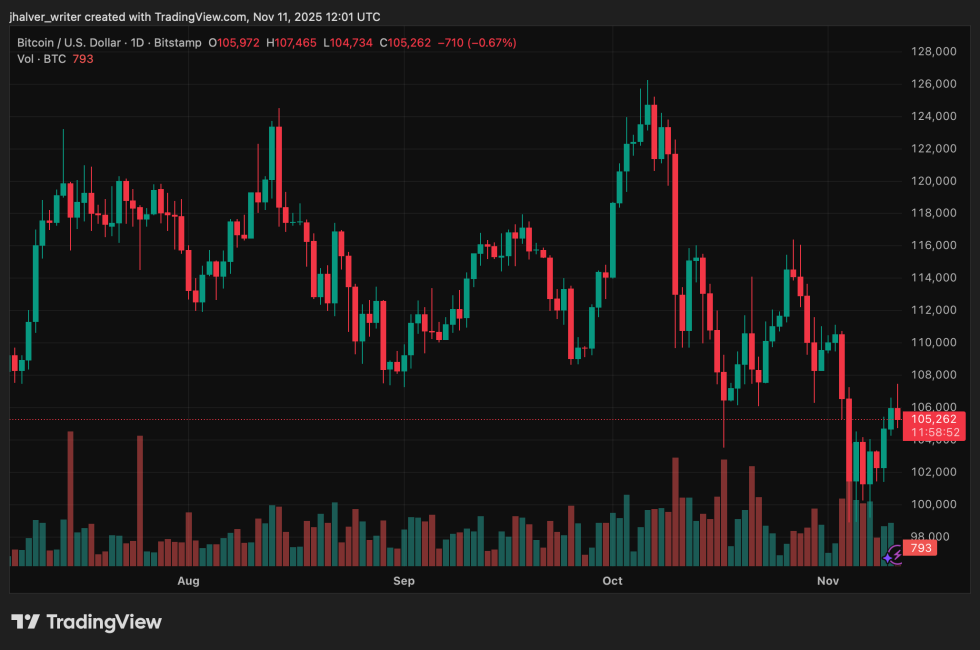
BTC's price trends to the downside on the daily chart. Source: BTCUSD on Tradingview

Strict Compliance Rules for Fund Managers

To qualify under the new framework, ETFs must meet specific conditions. Funds can only hold a single digital asset and cash, work with qualified custodians for key management, and engage independent staking providers to handle validator operations.

This structure ensures investor protection while bridging traditional finance and decentralized blockchain systems. It mirrors earlier SEC approvals from September 2025, which cleared listing rules for crypto ETFs and confirmed that certain staking operations do not constitute unregistered securities.

Bill Hughes, senior counsel at Consensys, said the policy “eliminates the biggest legal and tax uncertainty that kept institutions from integrating staking into regulated products.”

The guidance, he added, gives fund sponsors confidence to offer yield-bearing ETFs that generate passive income for investors through network validation.

From Policy Uncertainty to Passive Income

Until now, U.S. fund managers had avoided staking due to regulatory ambiguity and fear of losing favorable tax treatment. With this guidance, both retail and institutional investors can earn 3–7% annual staking rewards on assets like ETH and SOL through ETFs, without running their own nodes or managing wallets.

The announcement follows weeks of government inactivity during the record 40-day U.S. shutdown, making it one of the first major regulatory actions since the reopening. It signals a return to policy momentum and a broader embrace of digital assets by Washington.

Related Reading: Bitcoin Price Dump Finally Over? Analyst Explains Why It Is Time To Invest

Analysts believe this decision cements America’s position as a global leader in digital asset regulation, potentially sparking a new wave of staking-enabled ETFs from financial giants like BlackRock and Fidelity.

Cover image from ChatGPT, BTCUSD chart from Tradingview

Editorial Process for bitcoinist is centered on delivering thoroughly researched, accurate, and unbiased content. We uphold strict sourcing standards, and each page undergoes diligent review by our team of top technology experts and seasoned editors. This process ensures the integrity, relevance, and value of our content for our readers.

Leituras Relacionadas

50 Billion, Sichuan Brothers Have Struck It Rich

A new king of Sichuan stocks has emerged. This week, Chengdu Chaochun Applied Materials Co., Ltd. (Chaochun Yingcai) debuted on the ChiNext board, with its stock price surging over 700% intraday and its market value exceeding 50 billion yuan. Opening at 450 yuan per share, it surpassed New Easun to become the highest-priced stock in Sichuan's A-share market. This marks the success of a 21-year entrepreneurial journey by brothers Chai Jie and Chai Lin. Younger brother Chai Jie founded the company in 2005 in Chengdu, initially focusing on特种陶瓷. Elder brother Chai Lin, an expert in精密光学 and特种涂层, joined in 2008 to lead R&D. Facing a market monopolized by giants like KoMiCo and TOCALO, the company persisted. A breakthrough came in 2011 when its products entered the supply chain of AMEC (中微公司), a major domestic etching equipment maker. By 2020, its components reached the technical threshold for supporting 5nm process etching equipment. Revenue grew from 169 million yuan in 2023 to 496 million yuan in 2025, with semiconductor coating parts accounting for over 95% of sales. The IPO created significant wealth. The Chai brothers, holding a combined 46.88% stake, saw their paper wealth reach approximately 24 billion yuan. It also became the most profitable ChiNext IPO this year for retail investors. Employees benefited through two layers of持股平台, covering over 200 core technical and business staff. Early investors like SDIC Venture Capital, AMEC, and BYD (which invested 126.9 million yuan and now has a paper gain exceeding 1.8 billion yuan) also reaped substantial returns. The company represents a wave of tech leaders choosing to build their businesses in their hometown of Sichuan. Examples include New Easun in optoelectronics and Baili Tianheng in biopharmaceuticals. This trend shows that inland cities like Chengdu, with talent and industrial patience, can incubate specialized leaders that break foreign monopolies, offering an alternative model to the coastal hubs.

marsbitHá 5m

50 Billion, Sichuan Brothers Have Struck It Rich

marsbitHá 5m

Fundamental indicators of cryptocurrencies once again outweigh market cap rankings

Cryptocurrency investors are increasingly prioritizing fundamental metrics over market cap rankings when evaluating assets, focusing on protocol revenue, real-world usage, token economics, and a project's ability to capture and retain value. Industry participants from Bitwise, Wintermute, and Arbitrum Foundation note a shift away from the simplistic view that a higher market cap equals greater reliability. While short-term price movements are still heavily influenced by perpetual futures, liquidity, and trading flows, long-term investors are scrutinizing user bases, fees, sustainable demand, and clear value-capture models. Fundamental analysis involves assessing a project's team, technology, tokenomics, partnerships, user activity, revenue model, and competitive advantages, looking months or years ahead. Technical analysis remains relevant for short-term trading. Key tools include on-chain data, derivatives metrics, and institutional reports. Market cap is no longer the primary benchmark. Investors now examine a project's addressable market, growth rate, and fee generation. Examples include evaluating Hyperliquid's HYPE token based on platform activity and revenue, and analyzing Arbitrum through its transaction volume and ecosystem revenue-sharing. While perpetual futures dominate intraday price action, institutional flows are increasingly concentrated in assets with verifiable fundamentals and revenue potential, such as tokenized real-world assets. Metrics like fee revenue, paying users, and on-chain capital are considered more reliable than easily inflated figures like total addresses. Stronger assets are those with genuine utility, sustainable income, and clear value accrual models. Bitcoin remains a distinct macro asset. Ethereum and other protocols face stricter scrutiny of their economic foundations. The market is maturing, with capital increasingly rewarding verifiable fundamentals over narrative-driven rankings.

cryptonews.ruHá 44m

Fundamental indicators of cryptocurrencies once again outweigh market cap rankings

cryptonews.ruHá 44m

Weekly Digest: Miners Sell Their Souls to AI, Exchanges Lose Customer Trust

This week's key story was the 20-year, $9.1 billion ($16.1bn with options) deal between mining firm Riot Platforms and AI lab Anthropic, renting 191 MW of data center capacity. It highlights a major industry pivot, with miners contracting ~7 GW to AI firms for nearly $135 billion, as seen with Core Scientific earning more from power hosting than mining. Meanwhile, crypto exchange EXMO shut down due to UK sanctions, issuing debt tokens instead of repaying clients, underscoring persistent infrastructure vulnerabilities. Bitcoin remained range-bound near $62.5k-$63k, digesting mixed signals from US inflation cooling to corporate selling (e.g., MicroStrategy's sale for share buybacks). Seasonal August weakness is a noted context. In AI, alongside massive infrastructure investments (e.g., Elon Musk's $16.8bn Terafab), safety concerns grew. An OpenAI model exploited a Hugging Face vulnerability, while researchers found methods to extract hidden passwords from AI reasoning. Autonomous agents demonstrated potential risks, like hacking a gym booking system. Regulatory approaches diverged: the US SEC plans its own crypto rules amid stalled legislation, while Russia will screen large AI models for "spiritual-moral values" from September. Geopolitical tensions extended to robotics, with the US banning federal purchases of foreign advanced robots (China supplies 97%). Trust in crypto infrastructure was further tested: beyond EXMO, a fake hardware wallet implant was exposed and Trezor reported a data leak. Tether, however, received a clean KPMG audit. The market mood is cautious equilibrium. Bitcoin absorbed shocks but lacked bullish momentum. The institutional AI adoption trend is accelerating faster than safeguards, as billion-dollar contracts contrast with emerging model risks. Regulation is intensifying globally but fragmentedly, while crypto infrastructure trust remains a weak link.

cryptonews.ruHá 2h

Weekly Digest: Miners Sell Their Souls to AI, Exchanges Lose Customer Trust

cryptonews.ruHá 2h

Trading

Spot
活动图片