Dave Weisberger Torches XRP Fantasy: ‘$1,000 Targets Are Delusional’

bitcoinistPublicado em 2025-11-11Última atualização em 2025-11-11

Resumo

Dave Weisberger, former chairman and co-founder of CoinRoutes and now president of BetterTrade.digital, delivered a pointed critique of popular XRP...

Trusted Editorial content, reviewed by leading industry experts and seasoned editors. Ad Disclosure

Dave Weisberger, former chairman and co-founder of CoinRoutes and now president of BetterTrade.digital, delivered a pointed critique of popular XRP price targets while laying out a structurally bullish—yet methodical—thesis for Bitcoin’s long-term value. In a November 10 video, Weisberger argued that Bitcoin’s investment case rests on verifiable scarcity and a distributed network with unmatched uptime, whereas XRP’s path to durable upside must be underwritten by tangible network revenues that accrue to the token.

Weisberger framed investor behavior in first principles: people buy assets because they expect them to rise and because they have a thesis for why they should. For Bitcoin, he said, that thesis is the re-emergence of “sound money” in a digital age. He positioned Bitcoin as a successor to gold, which he argues lost its monetary anchor after 1913 and definitively in 1971.

“The idea of gold, where you have to trust the people who have what they say they have […] there’s a lot of trust baked in the system,” he said. By contrast, “the idea of Bitcoin, which is maintained by a network of node operators that is incredibly large, global and distributed […] it is provably scarce. It is programmatically scarce at the same time.”

Weisberger also emphasized Bitcoin’s open participation model, drawing a line between permissionless validation and the industrial realities of block production. “There’s no barriers to entry […] If you want to run a node, you can,” he said, while noting economies of scale for miners. That, he claimed, differentiates Bitcoin from other crypto assets.

Why $1,000 XRP Price Targets Are ‘Delusional’

Turning to XRP, he asserted that non-Bitcoin tokens must answer an equity-like question: how does the network generate revenue, and how does value flow back to token holders? “Your path to value has to be the same as with an equity,” he said. The mechanism could be direct profit sharing, fee-driven burns, or required token usage, but “there has to be a reason.”

He warned that in systems offering commoditized, switchable utility, large financial institutions can migrate if costs rise, naturally capping fee levels and, by extension, token value. That switching dynamic, he suggested, limits the ceiling for XRP even under generous adoption scenarios.

Weisberger was explicit that he is not anti-XRP. He disclosed he holds a position, calling the asset “potentially a good investment” with scope to “appreciate a couple of times from here.” But he rejected extreme price claims as mathematically incoherent.

“What gets me completely crazy are these idiots who talk about this in terms of $10,000 prices or $1,000 prices,” he said, contrasting XRP’s supply with Bitcoin’s. “There are quite literally 5,000 times more XRP tokens than Bitcoin […] if you think it flips Bitcoin, you’re saying $21.” On four-figure targets: “$1,000 are […] on its face absurd and clearly innumerate or can’t do math.”

He also reiterated a separation he says Ripple itself drew in the early years: “Ripple and XRP are not the same thing. One is a token. One represents an operational business.” While praising Ripple’s push into prime brokerage—“a brilliant move,” in his words—he framed the strategic aim as balance-sheet strength and financing income, not necessarily perpetual token price appreciation.

“They need the XRP on their balance sheet to be robust because that’s what gives them their advantage,” he said, describing prime brokerage as a leverage-provision business augmented by software. He claimed Ripple has assembled components—“They bought Hidden Road. They bought Custodians. They bought other components.”—to build “what could be a very interesting business,” drawing an analogy to profit centers at Goldman Sachs and Morgan Stanley.

For XRP’s market price, however, he argued operational priorities are pragmatic: “XRP, the ledger, they need it to not go down. They don’t need it to go up, although they would like it to go up.”

Price spikes, he added, can even be counterproductive for network economics. “If the price of XRP goes up too much, they’re, just like everybody else, going to be forced a little bit to switch […] they’re not going to subsidize it for very long.” In his view, the sustainable equilibrium is one where the ledger operates cost-effectively and any token appreciation is justified by usage-driven cash flows, not hype.

At press time, XRP traded at $2.44.
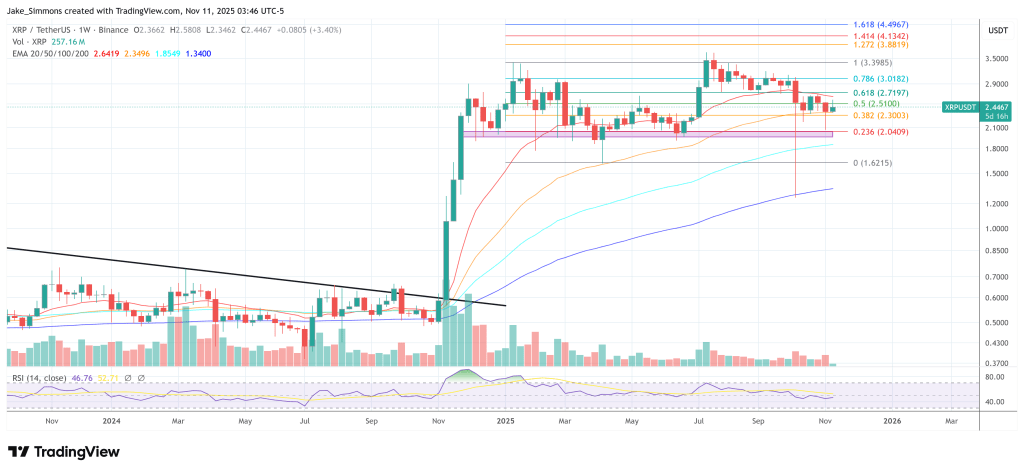
XRP price
XRP price, 1-week chart | Source: XRPUSDT on TradingView.com
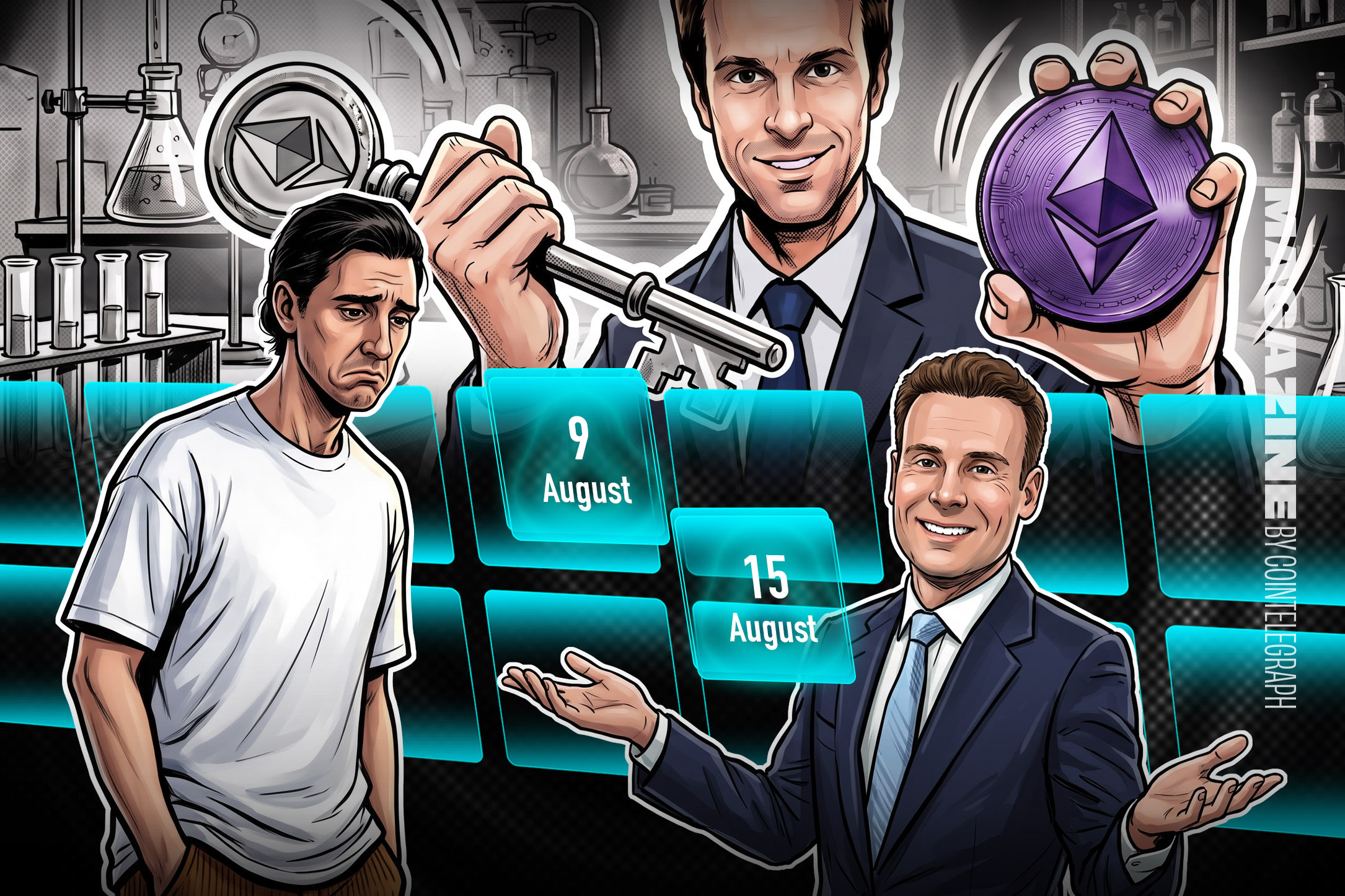
Featured image created with DALL.E, chart from TradingView.com
Editorial Process for bitcoinist is centered on delivering thoroughly researched, accurate, and unbiased content. We uphold strict sourcing standards, and each page undergoes diligent review by our team of top technology experts and seasoned editors. This process ensures the integrity, relevance, and value of our content for our readers.

Jake Simmons has been a Bitcoin enthusiast since 2016. Ever since he heard about Bitcoin, he has been studying the topic every day and trying to share his knowledge with others. His goal is to contribute to Bitcoin's financial revolution, which will replace the fiat money system. Besides BTC and crypto, Jake studied Business Informatics at a university. After graduation in 2017, he has been working in the blockchain and crypto sector. You can follow Jake on Twitter at @realJakeSimmons.

Leituras Relacionadas

Deep Dissection of the Anthropic Account Banning Storm: The Behind-the-Scenes of the Safety Religion, AI Civil War, and Claude's Dilemma Under US-China Decoupling

"Deconstructing Anthropic's Account Banning Storm: Safety Dogma, AI Civil War, and the Claude Dilemma Under US-China Decoupling" analyzes the aggressive user account suspension policies of Anthropic, particularly for its product Claude Code. The article attributes this to a multi-layered convergence of factors. The root cause is traced to founder Dario Amodei's personal "safety religion." Shaped by his father's illness and his exit from OpenAI over safety disagreements with Sam Altman, Amodei embedded this "zero-tolerance" philosophy into Anthropic's DNA. This manifests in technologies like Constitutional AI and a "preventive enforcement" approach to risk, prioritizing safety over user experience or growth. This stance defines Anthropic's position in the US "AI Civil War," pitting "safety-first" proponents like Amodei against "accelerationists" like Altman who prioritize rapid development and commercialization. Anthropic's strict model aligns with its business strategy targeting high-value, low-risk enterprise clients who pay a premium for security, unlike OpenAI's mass-market approach. Capital from Amazon and Google supports Anthropic but also creates a delicate balance, as these investors need its safety reputation without allowing overly restrictive policies to cripple its commercial viability. The conflict escalated when Anthropic refused a US Department of Defense contract requiring the removal of safety guardrails, leading to its placement on a "supply chain risk" blacklist—a key example of the public battle between the two AI factions. For Chinese users, the stringent bans are further compounded by US-China tech decoupling. Anthropic's policies act as a tool for compliance with US export controls, making Chinese users—who often circumvent regional blocks via VPNs or virtual cards—primary targets for "preventive" account terminations to avoid regulatory penalties. The article concludes that Anthropic's harsh account control measures are unlikely to loosen in the near future, being integral to its founding philosophy, business model, and geopolitical compliance needs, positioning it as a unique, security-obsessed player in the tripartite global AI competition involving US safety and acceleration factions and rising Chinese AI power.

marsbitHá 4m

Deep Dissection of the Anthropic Account Banning Storm: The Behind-the-Scenes of the Safety Religion, AI Civil War, and Claude's Dilemma Under US-China Decoupling

marsbitHá 4m

SpaceX IPO Rush: A Capital Feast That Could Reshape the Landscape of AI and Crypto

SpaceX's potential IPO is emerging as a pivotal event that could reshape the landscape for both AI and Crypto markets. Far more than a traditional aerospace offering, SpaceX represents the core of Musk's future-tech ecosystem, with its Starlink satellite network positioning it as a global digital infrastructure company. This shift could redefine the foundational layers of the internet, communication, and data flow. Historically, major tech capital market movements, like AI booms or Bitcoin ETF approvals, have profoundly influenced crypto cycles. The SpaceX IPO could trigger a similar "super-narrative" fusion, boosting investor sentiment toward future digital infrastructure. This is particularly relevant for Crypto, which aims to build decentralized versions of such global systems. Key crypto sectors likely to benefit include: * **DePIN (Decentralized Physical Infrastructure Networks):** Projects like Render, Filecoin, and Helium, which incentivize real-world infrastructure for compute, storage, and connectivity. * **AI Crypto:** Platforms such as Bittensor and Fetch.ai, which leverage blockchain for decentralized AI computation, data markets, and agent economies. * **On-chain Payments & SocialFi:** Ecosystems like Solana and Ton, which could gain traction if Musk's X platform integrates digital payments and stablecoins. Ultimately, the IPO symbolizes a broader capital re-evaluation of core digital-age assets—networks, AI, data, and decentralized systems—aligning closely with crypto's long-term vision. It may act as a catalyst, redirecting global tech investment flows toward the crypto space as the next chapter in digital infrastructure unfolds.

marsbitHá 1h

SpaceX IPO Rush: A Capital Feast That Could Reshape the Landscape of AI and Crypto

marsbitHá 1h

KUN and Pharos Network Forge Strategic Partnership to Jointly Drive Innovation in RealFi, RWA, and Cross-Border Payment Infrastructure

Hong Kong. Layer 1 infrastructure Pharos Network and licensed digital payment expert KUN have signed a strategic MoU. They will integrate Pharos's institutional blockchain with KUN's licensed global payment rails to drive the tokenization of supply chain credit assets and enable more efficient global settlement on-chain. **Background:** Emerging market SMEs face severe working capital challenges due to slow, costly traditional trade finance, often waiting 30-90 days for payment after delivery. While RWA tokenization is a focus, few projects effectively connect underlying infrastructure to real commerce and licensed payment networks. **Collaboration Focus:** The partnership aims to bridge this gap by bringing supply chain credit and B2B cross-border payments on-chain compliantly. Initial priorities include: * Tokenizing supply chain credit assets to unlock liquidity. * Enabling native on-chain settlement of digital assets. * Exploring enterprise virtual card solutions. * Providing compliant on-chain financial services for verticals like commodities, trade, B2B e-commerce, and Web3. **Executive Quotes:** * Wish Wu, Co-founder & CEO of Pharos Network, highlighted KUN's trusted, licensed payment network as a perfect fit for bringing supply chain assets and cross-border capital flows on-chain accessibly. * Dr. Louis Liu, Founder & CEO of KUN, stated that settlement certainty is RealFi's final hurdle. Bridging KUN's payment rails with Pharos's infrastructure will help convert on-chain assets into real-world liquidity with institutional-grade trust. They will also explore AI-driven optimization for global capital flows. Pharos mainnet is live with over 50 dApps. This partnership strengthens its position as RealFi infrastructure by linking licensed payment systems with on-chain finance.

marsbitHá 1h

KUN and Pharos Network Forge Strategic Partnership to Jointly Drive Innovation in RealFi, RWA, and Cross-Border Payment Infrastructure

marsbitHá 1h

Deconstructing Anthropic: The Best AI Company May Also Be an Organizational Invention

Anthropic has emerged as one of the most notable AI companies, distinguished by its strategic focus and unique organizational culture. Strategically, Anthropic demonstrated exceptional foresight by prioritizing coding early on, recognizing it as a critical path for model learning, commercial value, and accelerating AGI research. Unlike OpenAI's expansive, multi-front approach, Anthropic maintained rigorous focus on scaling language models and the coding vertical, avoiding distractions like multimodal development. This discipline stemmed partly from resource constraints but also from the conviction of its leadership, particularly co-founder Dario Amodei, who exhibits a strong, independent strategic vision. Organizationally, Anthropic’s culture is its “secret sauce.” It is characterized by a strong, mission-oriented focus on AI safety, high trust, low ego among employees, and a distinct humanistic ethos. This culture has resulted in remarkably low talent attrition and high retention rates. Key practices sustaining this culture include stringent cultural screening in hiring, high-context transparency and writing practices led by leadership, a founding structure of seven co-founders with equal equity to diffuse values, and a deliberate “one team” approach that minimizes internal silos and hierarchy. This culture is both a reaction to the political dynamics its founders experienced at previous companies and a functional necessity for the data-intensive, collaborative “dirty work” required to excel in coding and agentic AI. While OpenAI remains a formidable competitor with greater resources and exploration, Anthropic’s success illustrates how focus, cultural cohesion, and a steadfast mission can be powerful drivers in the AI race.

marsbitHá 1h

Deconstructing Anthropic: The Best AI Company May Also Be an Organizational Invention

marsbitHá 1h

Trading

Spot
Futuros

Artigos em Destaque

O que é XRP 2.0

XRP 2.0: Uma Nova Fronteira no Landscape das Criptomoedas Introdução ao XRP 2.0 No reino em constante evolução das criptomoedas, novos projetos surgem continuamente, lutando por atenção e adoção. Uma dessas iniciativas promissoras é o XRP 2.0, um novo projeto de criptomoeda concebido para aproveitar a tecnologia de blockchain avançada e as metodologias de criptografia robustas. Embora o nome tenha paralelos com o XRP da Ripple, é crucial notar que o XRP 2.0 opera de forma independente, focando em melhorar a segurança das transações, a privacidade e a escalabilidade. À medida que o panorama financeiro digital abraça cada vez mais soluções descentralizadas, o XRP 2.0 visa contribuir de forma significativa para a web3 e a expansão global dos projetos de criptomoedas. O que é o XRP 2.0? No seu núcleo, o XRP 2.0 é um projeto de criptomoeda que visa criar um ecossistema de moeda digital seguro e descentralizado. Sua tecnologia fundamental integra princípios de blockchain sofisticados com técnicas de criptografia de ponta. O objetivo abrangente do XRP 2.0 é estabelecer-se como uma plataforma confiável e eficiente que possibilita a execução rápida de transações, priorizando a proteção de privacidade aprimorada para os seus usuários. O projeto é promovido como uma solução para muitas limitações enfrentadas pelas criptomoedas existentes, propondo um sistema que pode lidar com um volume maior de transações com velocidade e privacidade melhoradas. Esta versatilidade posiciona o XRP 2.0 como um concorrente significativo em um mercado repleto de várias moedas digitais. Quem é o Criador do XRP 2.0? A identidade do criador por trás do XRP 2.0 foi identificada como 'Wilbur.' No entanto, detalhes abrangentes sobre Wilbur ou a sua entidade associada permanecem elusivos. O anonimato de muitos criadores de criptomoedas não é um fenômeno incomum na indústria, muitas vezes concebido para manter um grau de privacidade e segurança. Quem são os Investidores do XRP 2.0? Até agora, informações específicas relacionadas às fundações ou organizações de investimento que apoiam o XRP 2.0 não estão disponíveis publicamente. No setor das criptomoedas, o apoio de investidores reputados pode influenciar significativamente a credibilidade e o sucesso de um projeto, no entanto, a transparência em relação aos apoiantes financeiros do XRP 2.0 não foi estabelecida. Como Funciona o XRP 2.0? O XRP 2.0 destaca-se por empregar uma combinação de tecnologia blockchain e algoritmos de criptografia avançados que asseguram transações seguras e descentralizadas. Sua estrutura inovadora inclui características únicas projetadas para fomentar o envolvimento dos usuários e ampliar as funcionalidades além das transações convencionais de criptomoedas. Entre essas características, o XRP 2.0 incorpora capacidades potenciadas por IA, como funcionalidades de texto-para-imagem e texto-para-fala. Estas adições são projetadas para melhorar a experiência interativa dos usuários, promovendo uma maior aplicabilidade em vários setores. Ao unir avanços tecnológicos com um design centrado no utilizador, o XRP 2.0 pretende captar a atenção de uma diversa gama de indivíduos e empresas que procuram integrar soluções de criptomoedas em suas estruturas operacionais. Cronologia do XRP 2.0 Compreender o XRP 2.0 requer examinar os marcos que definiram sua jornada até agora: 23 de Julho de 2023: O XRP 2.0 é apresentado como um novo projeto de criptomoeda, visando revolucionar as capacidades de transação seguras e descentralizadas no domínio do blockchain. 8 de Setembro de 2023: O lançamento de outro projeto, XRP20, ocorre, marcando o surgimento de um token ERC-20 na blockchain Ethereum que permanece não relacionado ao XRP 2.0. 13 de Novembro de 2023: O XRP Ledger passa por uma atualização significativa com o lançamento da versão 2.0.0 do software do servidor rippled. É importante notar que este desenvolvimento está desconectado do projeto de criptomoeda XRP 2.0. Pontos-chave sobre o XRP 2.0 Para destilar a essência do XRP 2.0, vários fatores críticos emergem: Características Únicas: A inclusão de características como texto-para-imagem e texto-para-fala potenciadas por IA diversifica ainda mais as aplicações potenciais do XRP 2.0. Tecnologia Blockchain: A estrutura utiliza mecanismos de blockchain avançados e protocolos de criptografia, assegurando um ambiente seguro e descentralizado para transações. Escalabilidade e Privacidade: O XRP 2.0 prioriza proteção de privacidade aprimorada nos processos de transação e a escalabilidade necessária para acomodar uma base de utilizadores crescente. Sem Afiliação com a Ripple: Importante, apesar do seu nome, o XRP 2.0 não tem qualquer lealdade ou colaboração com o XRP da Ripple, distinguindo sua estrutura operacional e objetivos dentro do ecossistema das criptomoedas. Conclusão O XRP 2.0 representa uma empreitada ambiciosa no domínio das criptomoedas, visando oferecer uma combinação de segurança, privacidade e eficiência em transações digitais. Ao integrar tecnologias sofisticadas e características amigáveis ao utilizador, o projeto propõe-se a ampliar os horizontes do que as criptomoedas podem alcançar na economia digital atual. Embora o anonimato do seu criador e a falta de investidores divulgados possam levantar questões para alguns, o foco do XRP 2.0 em funcionalidades avançadas e descentralização aumenta seu apelo num mercado de criptomoedas cada vez mais congestionado. À medida que o panorama das criptomoedas continua a evoluir, o XRP 2.0 pode ainda emergir como um jogador crucial na expansão de soluções de blockchain seguras e escaláveis.

99 Visualizações TotaisPublicado em {updateTime}Atualizado em 2024.12.03

O que é XRP 2.0

Como comprar XRP

Bem-vindo à HTX.com!Tornámos a compra de XRP (XRP) simples e conveniente.Segue o nosso guia passo a passo para iniciar a tua jornada no mundo das criptos.Passo 1: cria a tua conta HTXUtiliza o teu e-mail ou número de telefone para te inscreveres numa conta gratuita na HTX.Desfruta de um processo de inscrição sem complicações e desbloqueia todas as funcionalidades.Obter a minha contaPasso 2: vai para Comprar Cripto e escolhe o teu método de pagamentoCartão de crédito/débito: usa o teu visa ou mastercard para comprar XRP (XRP) instantaneamente.Saldo: usa os fundos da tua conta HTX para transacionar sem problemas.Terceiros: adicionamos métodos de pagamento populares, como Google Pay e Apple Pay, para aumentar a conveniência.P2P: transaciona diretamente com outros utilizadores na HTX.Mercado de balcão (OTC): oferecemos serviços personalizados e taxas de câmbio competitivas para os traders.Passo 3: armazena teu XRP (XRP)Depois de comprar o teu XRP (XRP), armazena-o na tua conta HTX.Alternativamente, podes enviá-lo para outro lugar através de transferência blockchain ou usá-lo para transacionar outras criptomoedas.Passo 4: transaciona XRP (XRP)Transaciona facilmente XRP (XRP) no mercado à vista da HTX.Acede simplesmente à tua conta, seleciona o teu par de trading, executa as tuas transações e monitoriza em tempo real.Oferecemos uma experiência de fácil utilização tanto para principiantes como para traders experientes.

1.5k Visualizações TotaisPublicado em {updateTime}Atualizado em 2025.03.21

Como comprar XRP

Discussões

Bem-vindo à Comunidade HTX. Aqui, pode manter-se informado sobre os mais recentes desenvolvimentos da plataforma e obter acesso a análises profissionais de mercado. As opiniões dos utilizadores sobre o preço de XRP (XRP) são apresentadas abaixo.

活动图片