Bank Of England Eyes ‘Temporary’ Stablecoin Ownership Cap In Proposed Regulatory Regime

bitcoinistPublicado em 2025-11-11Última atualização em 2025-11-11

Resumo

The Bank of England (BOE) has published the highly anticipated consultation paper on its proposed regulatory regime for stablecoins, set...

Trusted Editorial content, reviewed by leading industry experts and seasoned editors. Ad Disclosure

The Bank of England (BOE) has published the highly anticipated consultation paper on its proposed regulatory regime for stablecoins, set to be implemented in the second half of next year.

BOE Moves Forward With Stablecoin Holding Limits

On Monday, the Bank of England released a new consultation paper on its proposed regulatory framework for sterling-denominated systemic stablecoins, addressing backing rules and holding limits.

The BOE’s new framework is built on feedback received on the November 2023 Discussion Paper, reflecting the Bank’s efforts to draft “robust, future-proof” rules that are aligned with the regulator’s strategy to modernize UK retail payments.

Notably, the Bank has moved forward with a controversial proposal to cap stablecoin ownership to “mitigate financial stability risks stemming from large and rapid outflows of deposits from the banking sector.”

As reported by Bitcoinist, the central bank has been exploring restrictions on stablecoin ownership in the country for months, seeking to impose limits of £10,000 to £20,000 for individuals and £10 million for businesses. The plan resembles its proposed approach to the digital pound, also aimed at addressing financial stability risks.

Some crypto industry and payment groups heavily criticized the central bank’s proposal, arguing that it would put the UK at a disadvantage against the US and the European Union (EU).

Following the backlash, news media outlets reported that the BOE was exploring granting exemptions to businesses that need to hold large amounts of stablecoins, like crypto exchanges.

The consultation paper confirmed the holding limits proposal “to safeguard continued access to credit as the financial system gradually adapts to new forms of digital money.”

However, it clarified that the limits would be “temporary” and would be removed “once the transition no longer poses risks to the provision of finance to the real economy.” It also noted that an exemption regime will allow the largest businesses to hold more stablecoins if required.

New Regime Eyes Joint Regulatory Approach

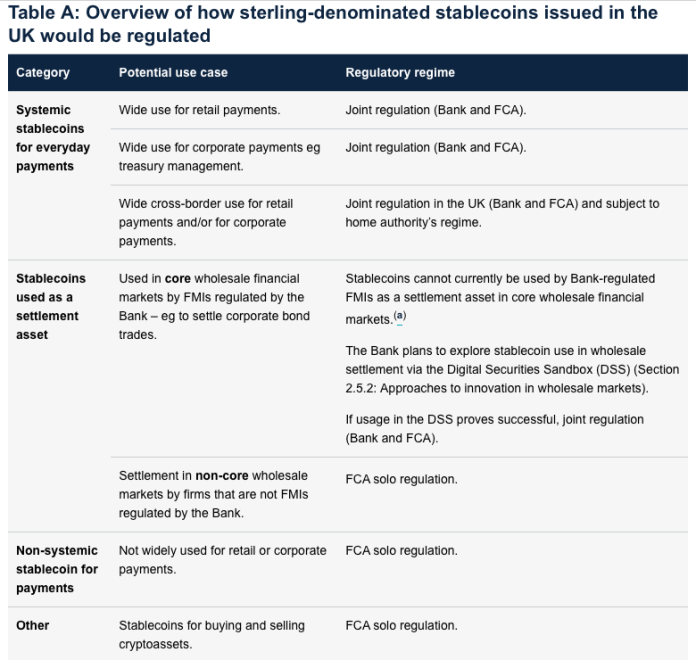
As the announcement explained, the regime will only apply sterling-pegged stablecoins. Meanwhile, stablecoins used for non-systemic purposes, such as the buying and selling of crypto assets, will be supervised by the Financial Conduct Authority (FCA).

The BOE unveiled a joint regulatory approach with the FCA, with a document clarifying how rules will apply in practice set to be published in 2026. “If recognised as systemic by HM Treasury (HMT), they will transition into the Bank’s regime and will be jointly regulated, with the Bank overseeing prudential and financial stability risks, and the FCA continuing to supervise conduct and consumer protection,” the Bank detailed.
stablecoin

Proposed joint approach between the FCA and the Bank of England. Source: BOE

Among the key policy proposals covered in the consultation paper, the Bank suggested that systemic stablecoin issuers be allowed to hold up to 60% of backing assets in short-term UK government debt.

The BOE will provide issuers with unremunerated accounts at the Bank for the remaining 40%, aiming to ensure “robust redemption and public confidence, even under stress.”

Additionally, issuers considered systemic at launch or transitioning from the FCA regime will initially be able to hold up to 95% of their backing assets in short-term UK government debt to support viability as they grow.

A new policy also proposes central bank liquidity arrangements to issuers in times of stress, reinforcing financial stability by “providing a backstop should systemic issuers be unable to monetise their backing assets in private markets.”

Sarah Breeden, Deputy Governor for Financial Stability, affirmed that the BOE’s objective “remains to support innovation and build trust in this emerging form of money.”

“We’ve listened carefully to feedback and amended our proposals for achieving this, including on how stablecoin issuers interact with the Bank of England. These proposals are fit for a future where stablecoins play a meaningful role in payments, giving the industry the clarity it needs to plan with confidence,” she concluded.
stablecoin, bitcoin, btc, btcusdt

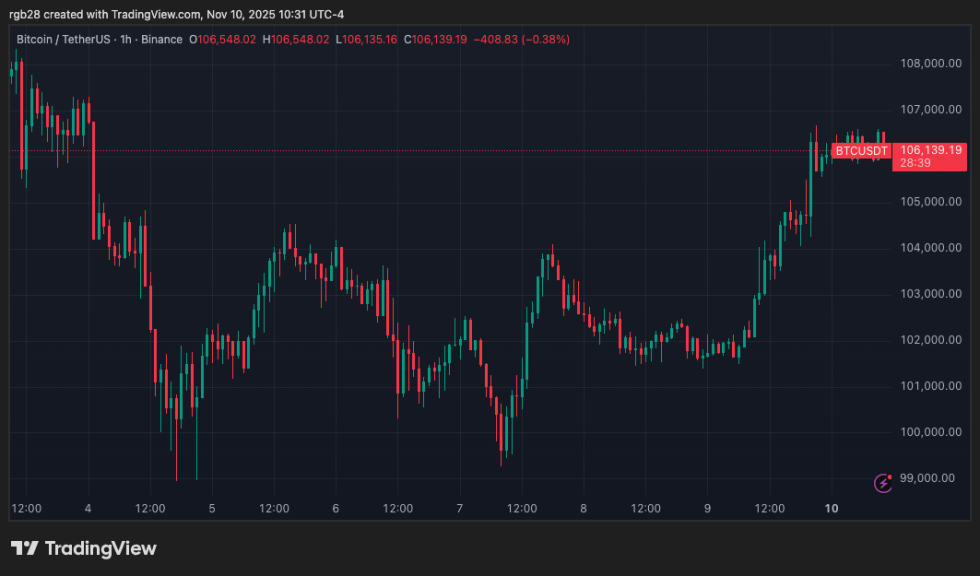
Bitcoin (BTC) trades at $106,139 on the one-week chart. Source: BTCUSDT on TradingView
Featured Image from Unsplash.com, Chart from TradingView.com
Editorial Process for bitcoinist is centered on delivering thoroughly researched, accurate, and unbiased content. We uphold strict sourcing standards, and each page undergoes diligent review by our team of top technology experts and seasoned editors. This process ensures the integrity, relevance, and value of our content for our readers.

Rubmar is a crypto enthusiast who likes learning and improving constantly. She enjoys reporting on the latest news and developments in the crypto industry. Rubmar also enjoys scrapbooking, crafting, simulation games, and watching football.

Criptomoedas em alta

Leituras Relacionadas

Claude's Watermark Has Been Cracked, Gaining 11k Stars, But Installation Is Refused

The article discusses the controversy surrounding Anthropic's implementation of a hidden watermark in all text generated by its AI, Claude. This policy, based on Google DeepMind's SynthID-Text technique, embeds a statistical signature by making inconsequential word choices. The watermark applies globally, even to human-written text lightly edited by Claude, sparking user backlash over issues of ownership and the creation of an "AI content second-class citizen" status. In response, an open-source tool called "watermarks-remover" (originally "remove-claude-marks") was released on GitHub, quickly gaining 11k stars. It works on three levels: removing invisible Unicode characters, using an agent to rewrite text and break statistical patterns, and stripping metadata from various file formats. Notably, Claude itself refused to install this removal tool as an Agent Skill, a task ultimately completed by another AI model, GLM 5.2. The article points out the irony that the removal code may have been written by Claude. The piece frames this as an ongoing battle between watermarking for traceability against misinformation and the desire for unmarked, owned content from paying users. It questions the practicality of mandatory technical markings when AI-generated text becomes indistinguishable from human writing, suggesting the open-source community's rapid development of countermeasures will continually outpace regulatory efforts.

marsbitHá 52m

Claude's Watermark Has Been Cracked, Gaining 11k Stars, But Installation Is Refused

marsbitHá 52m

SafePal Leaks Data of Nearly 40,000 Hardware Wallet Buyers: Private Keys Intact, Yet Danger Moves Closer to the Physical

Hardware wallet manufacturer SafePal has disclosed a data breach affecting approximately 39,798 customers who placed orders between March 2025 and April 2026. The leak exposed personal information including names, email addresses, phone numbers, physical delivery addresses, and purchase records. The company confirmed that private keys, recovery phrases, wallet passwords, and financial details were not compromised, as the cold storage systems operate in an isolated environment separate from the e-commerce servers. However, the breach poses significant risks beyond digital theft. Attackers now possess a high-value list of confirmed hardware wallet owners, effectively marking them as likely holders of substantial cryptocurrency. This enables highly targeted social engineering attacks, such as phishing emails referencing real order details, fake hardware deliveries, or phone scams impersonating SafePal support. The company has already identified and taken down over 30 related phishing sites. A critical aspect of the incident is the delayed disclosure timeline. SafePal acknowledged receiving initial user reports of phishing attempts in May but treated them as isolated. A full investigation began in July, with a public announcement not made until August, leaving users exposed for approximately three months. Furthermore, a configuration error prevented a data-purge routine from deleting old order information as intended, potentially increasing the scope of the leaked data. The incident highlights a structural paradox in the hardware wallet industry: while the devices are designed to secure private keys offline, the necessary e-commerce process collects sensitive personal data that, if leaked, makes the user a target. This mirrors a similar breach suffered by Ledger in 2020. Affected users are advised to be extremely vigilant. They should verify if they are impacted via SafePal's dedicated page, treat all unsolicited communications (emails, calls, physical mail) referencing SafePal as suspicious, and never share recovery phrases. Users who may have entered sensitive information on a phishing site must create a new wallet immediately. The breach underscores that in cryptocurrency security, the most vulnerable link is often the human user, not the cryptographic technology.

marsbitHá 1h

SafePal Leaks Data of Nearly 40,000 Hardware Wallet Buyers: Private Keys Intact, Yet Danger Moves Closer to the Physical

marsbitHá 1h

30 Years After Being Crushed by AI, People Have Fallen Back in Love with Chess

On May 11, 1997, IBM's "Deep Blue" defeated chess champion Garry Kasparov, marking the first time a machine triumphed in a top-level intellectual game. The narrative of human defeat by AI seemed cemented when AlphaGo beat Lee Sedol in Go in 2016, a game once considered AI's final frontier. Yet, nearly 30 years after AI's dominance began, chess is experiencing unprecedented popularity. Chess.com boasts over 250 million registered users and 10 million daily active players. Its CEO, Erik Allebest, attributes this resurgence to several waves: the pandemic, the Netflix series *The Queen's Gambit*, and viral AI chess bots like "Mittens" on social media. Crucially, each surge left a permanently higher user base. The key insight is that AI liberated the game. When machines unequivocally became the best, the pressure to "win" as the ultimate human was removed. Chess returned to its core: the intrinsic joy of play—the thrill of a tactical combo, the tension of a time scramble, the curiosity of post-game analysis. AI, now serving as an always-available coach and anti-cheat tool, became infrastructure that enhanced rather than killed the experience. In contrast, Go, deeply rooted in East Asian elite culture and often pursued for mastery and status, suffered a "collapse of meaning" at the professional level after AlphaGo. Players began mimicking AI moves, erasing distinctive styles and narrative. While some Go players gained fame as online personalities, it didn't translate to widespread engagement with the game itself. The divergence highlights a fundamental question in the age of AI: is the motivation for an activity about *winning* or *playing*? Activities where the process itself is the reward, like chess, can thrive when the pressure of being the best is gone. AI may rightly take over tasks done purely for outcome, but it cannot replace the human experience of simply enjoying the game.

marsbitHá 1h

30 Years After Being Crushed by AI, People Have Fallen Back in Love with Chess

marsbitHá 1h

Exiting Top Ten Shareholders of Kweichow Moutai, 'Long-term Capital' Portfolio Adjustments Revealed: National Social Security Fund Enters 12 New Stocks, Invests in Hard Tech Mthreads

With the ongoing release of semi-annual reports, the second-quarter investment moves of long-term institutional investors like the National Social Security Fund (NSSF) and insurance capital are becoming clear. Central Huijin Asset Management and China Securities Finance Corp., often referred to as the "national team," are no longer among the top ten shareholders of Kweichow Moutai. Data shows that as of August 14th, the NSSF held positions in 33 A-share companies, with a total portfolio value exceeding 11 billion yuan. It added 12 new stocks in Q2, spanning sectors like chemicals, food & beverage, and semiconductors. The NSSF maintains its stable investment style, favoring companies with solid performance and attractive valuations. Apart from exiting Moutai, Huijin and China Securities Finance also left the top ten shareholder lists of companies like Ping An Bank and Dahua Technology. Insurance capital heavily invested in 41 companies in Q2, with a total holding value over 26 billion yuan. They showed a continued preference for cyclical sectors like non-ferrous metals and chemicals, as well as high-dividend-yield stocks. Analysts note that these long-term funds act as market stabilizers and investment bellwethers. Their presence is reshaping the market ecology, steering focus towards fundamental corporate value and away from speculative trading. A notable move was the NSSF's new investment in Moore Threads, a loss-making but leading domestic GPU design company listed on the STAR Market, indicating interest in hard technology sectors. Looking ahead, analysts expect long-term capital to continue a dual-strategy: maintaining a foundation in high-dividend-value stocks while gradually increasing exposure to growth areas aligned with industrial upgrading, such as advanced manufacturing and tech self-sufficiency. The market's recovery is seen as gaining a firmer footing after recent adjustments.

marsbitHá 1h

Exiting Top Ten Shareholders of Kweichow Moutai, 'Long-term Capital' Portfolio Adjustments Revealed: National Social Security Fund Enters 12 New Stocks, Invests in Hard Tech Mthreads

marsbitHá 1h

Data of 54,000 wallet users leaked, Clarity odds just 10%: Hodler’s Digest, Aug. 16

Galaxy Digital has slashed the odds of the CLARITY Act passing in 2026 from 75% to just 10%, citing limited Senate session days. If it fails, the SEC and CFTC plan to issue their own crypto rules, though an SEC meeting was abruptly cancelled. High-profile meetings at the White House are planned to discuss the bill. Amid growing hack fears, crypto companies are urging AI labs to grant developers early access to advanced AI models for cybersecurity, following a $116M Coldcard wallet theft. Data breaches at Trezor and SafePal have exposed over 54,000 users' personal information. The CFTC is clashing with states over regulating prediction markets like Kalshi, ordering it to ignore a New York restraining order to maintain a national market, while a Washington state judge ruled against it. The Ethereum Foundation is revising its post-quantum plan, moving away from the Poseidon hash function, and scoping its next major upgrade, Hegotá, for next year. Tether received its first full clean audit opinion from KPMG, showing reserves exceeding liabilities by $6.814 billion. Marketwise, major cryptos saw weekly declines. Predictions include a possible Bitcoin bottom in October, while analysts dispute the feasibility of BTC reaching $1M by 2030. Glassnode notes Bitcoin is in its longest capitulation phase since FTX's collapse. Three men were charged for an alleged Bitcoin kidnapping plot in Missouri.

cointelegraphHá 2h

Data of 54,000 wallet users leaked, Clarity odds just 10%: Hodler’s Digest, Aug. 16

cointelegraphHá 2h

Trading

Spot

Artigos em Destaque

O que é $BANK

Bank AI: Um Passo Revolucionário no Futuro da Banca Introdução Em uma era marcada por avanços rápidos na tecnologia, o Bank AI está na interseção da inteligência artificial (IA) e dos serviços bancários. Este projeto inovador visa redefinir o panorama financeiro, melhorando a eficiência operacional, as medidas de segurança e as experiências dos clientes através do poder da IA. Ao embarcarmos nesta exploração do Bank AI, iremos aprofundar no que o projeto implica, suas dinâmicas operacionais, seu contexto histórico e marcos significativos. O que é o Bank AI? No seu cerne, o Bank AI representa uma iniciativa transformadora com o objetivo de integrar a inteligência artificial em várias operações bancárias. Este projeto aproveita as capacidades da IA para automatizar processos, melhorar os protocolos de gestão de risco e melhorar a interação com os clientes através de serviços personalizados. Os principais objetivos do Bank AI incluem: Automatização das Funções Bancárias: Ao aproveitar as tecnologias de IA, o Bank AI visa automatizar tarefas rotineiras, reduzindo o peso sobre os recursos humanos e aumentando a eficiência. Gestão de Risco Melhorada: O projeto utiliza algoritmos de IA para prever e identificar riscos, fortalecendo assim as medidas de segurança contra fraudes e outras ameaças. Personalização dos Serviços Bancários: O Bank AI foca em oferecer produtos e serviços financeiros ajustados, analisando dados e comportamentos dos clientes. Melhoria da Experiência do Cliente: A implementação de soluções impulsionadas por IA, como chatbots e assistentes virtuais, visa proporcionar aos usuários interações mais humanizadas, revolucionando a forma como os clientes se envolvem com os bancos. Com esses objetivos, o Bank AI posiciona-se como um ator crucial para tornar a banca mais eficiente, segura e centrada no usuário. Quem é o Criador do Bank AI? Os detalhes sobre o criador do Bank AI permanecem desconhecidos. Assim, nenhuma pessoa ou organização específica foi identificada nas informações disponíveis. O anonimato que cerca a origem do projeto levanta questões, mas não diminui a sua ambiciosa visão e objetivos. Quem são os Investidores do Bank AI? Semelhante ao criador do projeto, informações específicas sobre os investidores ou organizações que apoiam o Bank AI não foram divulgadas. Sem essas informações, é difícil delinear o apoio financeiro e institucional que pode estar impulsionando o projeto para frente. No entanto, a importância de ter uma sólida base de investimento é fundamental para sustentar o desenvolvimento em um campo tão inovador. Como Funciona o Bank AI? O Bank AI opera em várias frentes inovadoras, focando em fatores únicos que o diferenciam das estruturas bancárias tradicionais. Abaixo estão as principais características operacionais: Automatização: Ao aplicar algoritmos de aprendizado de máquina, o Bank AI automatiza vários processos manuais dentro dos bancos. Isso resulta na redução dos custos operacionais e permite que os trabalhadores humanos redirecionem os seus esforços para atividades mais estratégicas. Gestão de Risco Avançada: A integração da IA nas práticas de gestão de risco equipa os bancos com ferramentas para prever com precisão potenciais ameaças, como fraudes, garantindo que as informações e ativos dos clientes permaneçam seguros. Recomendações Financeiras Personalizadas: Através do aprendizado contínuo a partir das interações com os clientes, os sistemas de IA desenvolvem uma compreensão sutil das necessidades dos usuários, permitindo oferecer conselhos adaptados sobre decisões financeiras. Interações Melhoradas com os Clientes: Utilizando chatbots e assistentes virtuais alimentados por IA, o Bank AI permite uma experiência de cliente mais envolvente, permitindo que os usuários tenham suas dúvidas resolvidas rapidamente, reduzindo assim os tempos de espera e melhorando os níveis de satisfação. Juntas, estas características operacionais posicionam o Bank AI como um pioneiro no setor bancário, estabelecendo novos padrões para a prestação de serviços e a excelência operacional. Cronologia do Bank AI Compreender a trajetória do Bank AI requer uma análise do seu contexto histórico. Abaixo está uma cronologia que destaca marcos e desenvolvimentos importantes: Início de 2010: A conceituação da integração da IA nos serviços bancários começou a ganhar atenção à medida que instituições bancárias reconheciam os potenciais benefícios. 2018: Ocorreu um aumento significativo na implementação de tecnologias de IA, quando os bancos começaram a usar ferramentas de IA como chatbots para atendimento ao cliente básico e sistemas de gestão de risco para melhorar o tratamento de segurança. 2023: A sofisticação da IA continuou a avançar, com a introdução de IA generativa para tarefas mais complexas, como processamento de documentos e análise de investimentos em tempo real. Este ano marcou um salto significativo nas capacidades proporcionadas aos bancos pela tecnologia de IA. 2024-Estado Atual: Neste ano, o Bank AI está em uma trajetória ascendente, com pesquisas e desenvolvimentos em andamento prontos para aprimorar ainda mais as capacidades nas operações bancárias. A exploração contínua das aplicações de IA sugere desenvolvimentos emocionantes por vir. Pontos Chave Sobre o Bank AI Integração da IA na Banca: O Bank AI foca na adoção da inteligência artificial para simplificar os processos bancários e melhorar as experiências dos usuários. Automatização e Foco em Gestão de Risco: O projeto enfatiza fortemente essas áreas, visando transferir o peso das tarefas rotineiras enquanto melhora as estruturas de segurança através de análises preditivas. Soluções Bancárias Personalizadas: Ao aproveitar os dados dos clientes, o Bank AI possibilita serviços bancários ajustados que atendem às necessidades individuais dos usuários. Compromisso com o Desenvolvimento: O Bank AI permanece comprometido com contínuas pesquisas e esforços de desenvolvimento, garantindo a sua adaptabilidade e relevância contínua à medida que a tecnologia continua a evoluir. Conclusão Em resumo, o Bank AI exemplifica um passo crucial em frente na indústria bancária, aproveitando a inteligência artificial para remodelar paradigmas operacionais, melhorar a segurança e promover a satisfação do cliente. Apesar das lacunas de informação em torno do criador e dos investidores, os objetivos claros e os mecanismos funcionais do Bank AI fornecem uma base sólida para sua evolução contínua. À medida que a tecnologia de IA continua a avançar e se fundir com o setor bancário, o Bank AI está bem posicionado para impactar significativamente o futuro dos serviços financeiros, aprimorando a maneira como entendemos e interagimos com a banca.

219 Visualizações TotaisPublicado em {updateTime}Atualizado em 2024.12.03

O que é $BANK

Como comprar BANK

Bem-vindo à HTX.com!Tornámos a compra de Lorenzo Protocol (BANK) simples e conveniente.Segue o nosso guia passo a passo para iniciar a tua jornada no mundo das criptos.Passo 1: cria a tua conta HTXUtiliza o teu e-mail ou número de telefone para te inscreveres numa conta gratuita na HTX.Desfruta de um processo de inscrição sem complicações e desbloqueia todas as funcionalidades.Obter a minha contaPasso 2: vai para Comprar Cripto e escolhe o teu método de pagamentoCartão de crédito/débito: usa o teu visa ou mastercard para comprar Lorenzo Protocol (BANK) instantaneamente.Saldo: usa os fundos da tua conta HTX para transacionar sem problemas.Terceiros: adicionamos métodos de pagamento populares, como Google Pay e Apple Pay, para aumentar a conveniência.P2P: transaciona diretamente com outros utilizadores na HTX.Mercado de balcão (OTC): oferecemos serviços personalizados e taxas de câmbio competitivas para os traders.Passo 3: armazena teu Lorenzo Protocol (BANK)Depois de comprar o teu Lorenzo Protocol (BANK), armazena-o na tua conta HTX.Alternativamente, podes enviá-lo para outro lugar através de transferência blockchain ou usá-lo para transacionar outras criptomoedas.Passo 4: transaciona Lorenzo Protocol (BANK)Transaciona facilmente Lorenzo Protocol (BANK) no mercado à vista da HTX.Acede simplesmente à tua conta, seleciona o teu par de trading, executa as tuas transações e monitoriza em tempo real.Oferecemos uma experiência de fácil utilização tanto para principiantes como para traders experientes.

655 Visualizações TotaisPublicado em {updateTime}Atualizado em 2026.06.02

Como comprar BANK

Discussões

Bem-vindo à Comunidade HTX. Aqui, pode manter-se informado sobre os mais recentes desenvolvimentos da plataforma e obter acesso a análises profissionais de mercado. As opiniões dos utilizadores sobre o preço de BANK (BANK) são apresentadas abaixo.

活动图片