Von der Nische zur Wall Street – Ripple erreicht das große Parkett beim Swell2025

bitcoinistPublicado em 2025-11-10Última atualização em 2025-11-11

Resumo

Ein leitender BlackRock-Manager hat Ripple für seine Rolle bei der Einführung von Blockchain in der Finanzwelt gelobt. Die XRP-Community feiert...

Trusted Editorial content, reviewed by leading industry experts and seasoned editors. Ad Disclosure
  • Ein leitender BlackRock-Manager hat Ripple für seine Rolle bei der Einführung von Blockchain in der Finanzwelt gelobt.
  • Die XRP-Community feiert das als lange erwartete Anerkennung durch die Wall Street.
  • Doch Experten fragen sich, ob die Worte wirklich für das ganze Unternehmen BlackRock gelten.

Was viele Krypto-Fans seit Jahren hoffen, scheint nun Wirklichkeit zu werden: Die großen Finanzhäuser öffnen sich der Blockchain-Technologie. Auf der Ripple Swell 2025 Konferenz sprach ein BlackRock-Manager offen über Ripples Bedeutung – und brachte damit die XRP-Gemeinschaft in Feierlaune. Doch hinter der Euphorie stehen noch einige Fragezeichen.

BlackRock spricht über Ripple und die Zukunft der Blockchain

Die Ripple Swell 2025 Konferenz in New York hat einen Moment geschaffen, der vielen in Erinnerung bleiben wird. Maxwell Stein, Mitglied des Digital-Assets-Teams von BlackRock, sprach auf der Bühne über die Zukunft der Finanzwelt – und über Ripple. Er sagte, der Markt sei nun bereit, Blockchain im großen Stil einzusetzen. Dabei lobte er Ripple als wichtigen Teil dieser Entwicklung.

Stein erklärte, dass Ripple bereits Anleihen, Stablecoins und andere Vermögenswerte auf der Blockchain abgebildet habe. Diese Technologie könne bald Kapitalströme in Billionenhöhe bewegen. Für viele im Publikum klang das wie der Beweis, dass Blockchain nicht mehr nur ein Traum, sondern Realität ist – und Ripple einer der Motoren dieser Bewegung.

XRP-Community feiert den großen Moment

Für die Anhänger von XRP war diese Aussage fast wie ein Ritterschlag. Jahrelang wurde Ripple als Nischenprojekt belächelt. Nun lobt einer der größten Finanzverwalter der Welt öffentlich seine Arbeit. Die Stimmung in der Community war entsprechend ausgelassen.

Auf der Plattform X (früher Twitter) verbreiteten sich begeisterte Posts im Minutentakt. Viele nannten Steins Worte den Beweis, dass XRP endlich ernst genommen wird. Für sie war es ein Symbol: Die Brücke zwischen alter Finanzwelt und neuer Blockchain-Ökonomie ist nicht mehr nur Theorie – sie entsteht gerade.

Von Experiment zu Standard: Blockchain wird ernst genommen

Steins Worte zeigten auch, wie sehr sich die Sicht auf Blockchain verändert hat. Noch vor wenigen Jahren galt sie als riskante Spielerei für Technik-Freaks. Heute sprechen führende Finanzmanager von ihr als kommender Standard. BlackRock hat damit – gewollt oder nicht – eine neue Botschaft gesendet: Die Zeit des Zögerns ist vorbei.

Ripple wird so immer mehr zu einem Symbol für den Wandel. Statt nur Transaktionen in der Krypto-Welt zu ermöglichen, arbeitet das Unternehmen daran, die Finanzinfrastruktur selbst zu verändern. Was früher utopisch klang, könnte bald Alltag sein: globale Geldströme, die über Blockchain laufen.

Rechtliche Fragen bremsen den Jubel

Nicht alle sehen das Lob so unkritisch. Der australische Anwalt und XRP-Fan Bill Morgan fragte öffentlich, ob Stein im Namen von BlackRock oder nur privat gesprochen habe. Diese Frage ist wichtig, denn eine offizielle Stellungnahme von BlackRock wäre ein starkes Signal für die gesamte Branche.

Sollte es sich aber nur um eine persönliche Meinung handeln, bleibt die Bedeutung begrenzt – auch wenn sie symbolisch wichtig ist. Viele Beobachter weisen darauf hin, dass rechtliche Unsicherheit weiterhin eine Hürde bleibt. Zwischen Begeisterung und Realität liegt noch ein weiter Weg.

Regulierung als Schlüssel für die Zukunft

Auch Adena Friedman, die Chefin der Nasdaq, sprach auf der Konferenz über den Reifeprozess des Marktes. Sie sagte, dass die Finanzwelt zwar interessiert sei, aber noch klare Regeln brauche, bevor sie voll einsteigen könne. Banken testen bereits tokenisierte Anleihen und Stablecoins, doch ohne eindeutige Gesetze bleibt das Risiko groß.

Ihre Worte erinnerten daran, dass technologische Fortschritte allein nicht reichen. Vertrauen und Regulierung sind nötig, damit Institutionen wirklich aufspringen. Die Swell 2025 zeigte damit nicht nur Begeisterung, sondern auch die Hürden auf dem Weg zur echten Integration von Blockchain in die Finanzwelt.

Fazit: Ripple steht im Rampenlicht – aber der Weg ist noch lang

Die Swell 2025 machte deutlich, dass Ripple längst kein Außenseiter mehr ist. Mit der Unterstützung eines BlackRock-Managers hat das Unternehmen einen Meilenstein erreicht. Doch der Krypto-Markt bleibt volatil: Der XRP-Preis fiel zuletzt um über vier Prozent auf 2,21 US-Dollar.

Trotzdem scheint der Trend klar. Blockchain ist dabei, die Finanzwelt zu verändern – und Ripple ist mittendrin. Was als Vision begann, wird Schritt für Schritt Wirklichkeit. Vielleicht war die Swell 2025 der Moment, in dem die Finanzelite begriff, dass Blockchain gekommen ist, um zu bleiben.

Bitcoin Hyper: Gewinner einer neuen Phase der Krypto-Adoption

Die zunehmende Institutionalisierung von Ripple (XRP) zeigt, dass Kryptowährungen endgültig in der Finanzwelt angekommen sind. Immer mehr Banken und große Investoren nutzen Ripple, um internationale Zahlungen schneller und günstiger abzuwickeln. Das stärkt das Vertrauen in die gesamte Branche – und besonders in Bitcoin, der für viele weiterhin das sicherste und verlässlichste Krypto-Asset bleibt. Wenn Banken und Institutionen verstärkt auf Blockchain-Technologie setzen, steigt auch die Nachfrage nach Bitcoin als digitales Wertaufbewahrungsmittel.
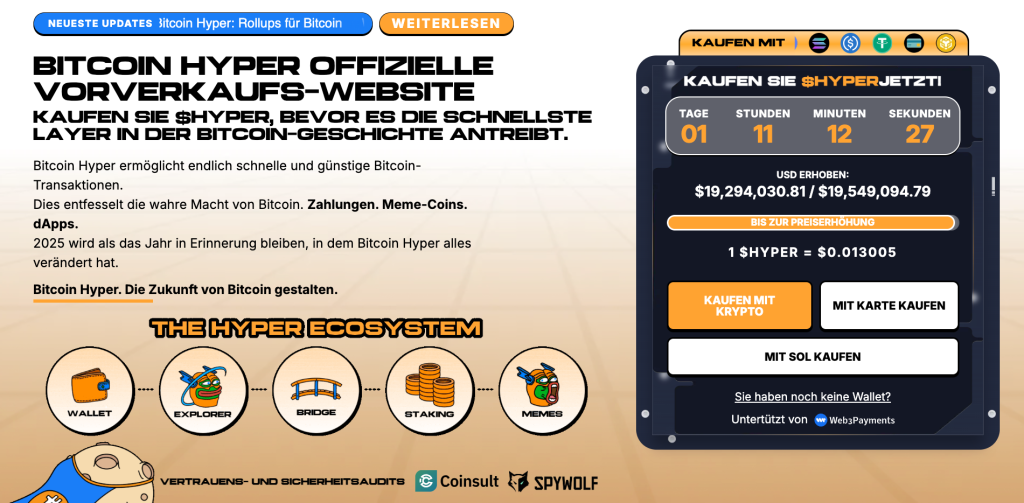
Bitcoin Hyper Presale Oktober 2025 Ripple
Bitcoin Hyper Presale

Lies hier eine langfristige Prognose für Bitcoin Hyper!

Bitcoin Hyper: Aufgebaut auf Vertrauen und Innovation

Bitcoin Hyper ist eng mit Bitcoin verbunden und profitiert von diesem wachsenden Vertrauen. Das Projekt nutzt die Sicherheit des Bitcoin-Netzwerks und kombiniert sie mit der Geschwindigkeit und Flexibilität von Solana. So entsteht eine Erweiterung, die Bitcoin nicht ersetzt, sondern verbessert: schnellere Transaktionen, geringere Gebühren und echte Alltagstauglichkeit. Wenn durch Ripple immer mehr institutionelle Investoren und Banken in den Kryptomarkt einsteigen, wächst auch die Bedeutung von Bitcoin – und damit die Chancen für Bitcoin Hyper, als moderne und praktische Ergänzung mitzuwachsen.

Jetzt rechtzeitig einsteigen und $HYPER im Presale kaufen.

Editorial Process for bitcoinist is centered on delivering thoroughly researched, accurate, and unbiased content. We uphold strict sourcing standards, and each page undergoes diligent review by our team of top technology experts and seasoned editors. This process ensures the integrity, relevance, and value of our content for our readers.

Leituras Relacionadas

Claude's Watermark Has Been Cracked, Gaining 11k Stars, But Installation Is Refused

The article discusses the controversy surrounding Anthropic's implementation of a hidden watermark in all text generated by its AI, Claude. This policy, based on Google DeepMind's SynthID-Text technique, embeds a statistical signature by making inconsequential word choices. The watermark applies globally, even to human-written text lightly edited by Claude, sparking user backlash over issues of ownership and the creation of an "AI content second-class citizen" status. In response, an open-source tool called "watermarks-remover" (originally "remove-claude-marks") was released on GitHub, quickly gaining 11k stars. It works on three levels: removing invisible Unicode characters, using an agent to rewrite text and break statistical patterns, and stripping metadata from various file formats. Notably, Claude itself refused to install this removal tool as an Agent Skill, a task ultimately completed by another AI model, GLM 5.2. The article points out the irony that the removal code may have been written by Claude. The piece frames this as an ongoing battle between watermarking for traceability against misinformation and the desire for unmarked, owned content from paying users. It questions the practicality of mandatory technical markings when AI-generated text becomes indistinguishable from human writing, suggesting the open-source community's rapid development of countermeasures will continually outpace regulatory efforts.

marsbitHá 50m

Claude's Watermark Has Been Cracked, Gaining 11k Stars, But Installation Is Refused

marsbitHá 50m

SafePal Leaks Data of Nearly 40,000 Hardware Wallet Buyers: Private Keys Intact, Yet Danger Moves Closer to the Physical

Hardware wallet manufacturer SafePal has disclosed a data breach affecting approximately 39,798 customers who placed orders between March 2025 and April 2026. The leak exposed personal information including names, email addresses, phone numbers, physical delivery addresses, and purchase records. The company confirmed that private keys, recovery phrases, wallet passwords, and financial details were not compromised, as the cold storage systems operate in an isolated environment separate from the e-commerce servers. However, the breach poses significant risks beyond digital theft. Attackers now possess a high-value list of confirmed hardware wallet owners, effectively marking them as likely holders of substantial cryptocurrency. This enables highly targeted social engineering attacks, such as phishing emails referencing real order details, fake hardware deliveries, or phone scams impersonating SafePal support. The company has already identified and taken down over 30 related phishing sites. A critical aspect of the incident is the delayed disclosure timeline. SafePal acknowledged receiving initial user reports of phishing attempts in May but treated them as isolated. A full investigation began in July, with a public announcement not made until August, leaving users exposed for approximately three months. Furthermore, a configuration error prevented a data-purge routine from deleting old order information as intended, potentially increasing the scope of the leaked data. The incident highlights a structural paradox in the hardware wallet industry: while the devices are designed to secure private keys offline, the necessary e-commerce process collects sensitive personal data that, if leaked, makes the user a target. This mirrors a similar breach suffered by Ledger in 2020. Affected users are advised to be extremely vigilant. They should verify if they are impacted via SafePal's dedicated page, treat all unsolicited communications (emails, calls, physical mail) referencing SafePal as suspicious, and never share recovery phrases. Users who may have entered sensitive information on a phishing site must create a new wallet immediately. The breach underscores that in cryptocurrency security, the most vulnerable link is often the human user, not the cryptographic technology.

marsbitHá 1h

SafePal Leaks Data of Nearly 40,000 Hardware Wallet Buyers: Private Keys Intact, Yet Danger Moves Closer to the Physical

marsbitHá 1h

30 Years After Being Crushed by AI, People Have Fallen Back in Love with Chess

On May 11, 1997, IBM's "Deep Blue" defeated chess champion Garry Kasparov, marking the first time a machine triumphed in a top-level intellectual game. The narrative of human defeat by AI seemed cemented when AlphaGo beat Lee Sedol in Go in 2016, a game once considered AI's final frontier. Yet, nearly 30 years after AI's dominance began, chess is experiencing unprecedented popularity. Chess.com boasts over 250 million registered users and 10 million daily active players. Its CEO, Erik Allebest, attributes this resurgence to several waves: the pandemic, the Netflix series *The Queen's Gambit*, and viral AI chess bots like "Mittens" on social media. Crucially, each surge left a permanently higher user base. The key insight is that AI liberated the game. When machines unequivocally became the best, the pressure to "win" as the ultimate human was removed. Chess returned to its core: the intrinsic joy of play—the thrill of a tactical combo, the tension of a time scramble, the curiosity of post-game analysis. AI, now serving as an always-available coach and anti-cheat tool, became infrastructure that enhanced rather than killed the experience. In contrast, Go, deeply rooted in East Asian elite culture and often pursued for mastery and status, suffered a "collapse of meaning" at the professional level after AlphaGo. Players began mimicking AI moves, erasing distinctive styles and narrative. While some Go players gained fame as online personalities, it didn't translate to widespread engagement with the game itself. The divergence highlights a fundamental question in the age of AI: is the motivation for an activity about *winning* or *playing*? Activities where the process itself is the reward, like chess, can thrive when the pressure of being the best is gone. AI may rightly take over tasks done purely for outcome, but it cannot replace the human experience of simply enjoying the game.

marsbitHá 1h

30 Years After Being Crushed by AI, People Have Fallen Back in Love with Chess

marsbitHá 1h

Exiting Top Ten Shareholders of Kweichow Moutai, 'Long-term Capital' Portfolio Adjustments Revealed: National Social Security Fund Enters 12 New Stocks, Invests in Hard Tech Mthreads

With the ongoing release of semi-annual reports, the second-quarter investment moves of long-term institutional investors like the National Social Security Fund (NSSF) and insurance capital are becoming clear. Central Huijin Asset Management and China Securities Finance Corp., often referred to as the "national team," are no longer among the top ten shareholders of Kweichow Moutai. Data shows that as of August 14th, the NSSF held positions in 33 A-share companies, with a total portfolio value exceeding 11 billion yuan. It added 12 new stocks in Q2, spanning sectors like chemicals, food & beverage, and semiconductors. The NSSF maintains its stable investment style, favoring companies with solid performance and attractive valuations. Apart from exiting Moutai, Huijin and China Securities Finance also left the top ten shareholder lists of companies like Ping An Bank and Dahua Technology. Insurance capital heavily invested in 41 companies in Q2, with a total holding value over 26 billion yuan. They showed a continued preference for cyclical sectors like non-ferrous metals and chemicals, as well as high-dividend-yield stocks. Analysts note that these long-term funds act as market stabilizers and investment bellwethers. Their presence is reshaping the market ecology, steering focus towards fundamental corporate value and away from speculative trading. A notable move was the NSSF's new investment in Moore Threads, a loss-making but leading domestic GPU design company listed on the STAR Market, indicating interest in hard technology sectors. Looking ahead, analysts expect long-term capital to continue a dual-strategy: maintaining a foundation in high-dividend-value stocks while gradually increasing exposure to growth areas aligned with industrial upgrading, such as advanced manufacturing and tech self-sufficiency. The market's recovery is seen as gaining a firmer footing after recent adjustments.

marsbitHá 1h

Exiting Top Ten Shareholders of Kweichow Moutai, 'Long-term Capital' Portfolio Adjustments Revealed: National Social Security Fund Enters 12 New Stocks, Invests in Hard Tech Mthreads

marsbitHá 1h

Data of 54,000 wallet users leaked, Clarity odds just 10%: Hodler’s Digest, Aug. 16

Galaxy Digital has slashed the odds of the CLARITY Act passing in 2026 from 75% to just 10%, citing limited Senate session days. If it fails, the SEC and CFTC plan to issue their own crypto rules, though an SEC meeting was abruptly cancelled. High-profile meetings at the White House are planned to discuss the bill. Amid growing hack fears, crypto companies are urging AI labs to grant developers early access to advanced AI models for cybersecurity, following a $116M Coldcard wallet theft. Data breaches at Trezor and SafePal have exposed over 54,000 users' personal information. The CFTC is clashing with states over regulating prediction markets like Kalshi, ordering it to ignore a New York restraining order to maintain a national market, while a Washington state judge ruled against it. The Ethereum Foundation is revising its post-quantum plan, moving away from the Poseidon hash function, and scoping its next major upgrade, Hegotá, for next year. Tether received its first full clean audit opinion from KPMG, showing reserves exceeding liabilities by $6.814 billion. Marketwise, major cryptos saw weekly declines. Predictions include a possible Bitcoin bottom in October, while analysts dispute the feasibility of BTC reaching $1M by 2030. Glassnode notes Bitcoin is in its longest capitulation phase since FTX's collapse. Three men were charged for an alleged Bitcoin kidnapping plot in Missouri.

cointelegraphHá 2h

Data of 54,000 wallet users leaked, Clarity odds just 10%: Hodler’s Digest, Aug. 16

cointelegraphHá 2h

Trading

Spot
活动图片