Stablecoins Are Booming — And The Fed Thinks They Could Cut Rates

bitcoinistPublicado em 2025-11-10Última atualização em 2025-11-10

Resumo

Federal Reserve Governor Stephen Miran said growing demand for dollar-pegged stablecoins could push down interest rates, putting a new factor...

Trusted Editorial content, reviewed by leading industry experts and seasoned editors. Ad Disclosure

Federal Reserve Governor Stephen Miran said growing demand for dollar-pegged stablecoins could push down interest rates, putting a new factor on the Fed’s radar.

According to a speech he gave at the BCVC Summit on November 7, stablecoins that channel savings into dollar assets may raise the supply of loanable funds and lower the Neutral interest rate, or “R” star.

Stablecoin Growth And Scale

Based on reports compiled by Fed staff, private-sector estimates place stablecoin adoption between $1 trillion and $3 trillion by the end of the decade — a jump large enough to matter for markets and policy.

Miran compared the possible scale of stablecoin demand to the Fed’s own purchases during the COVID-era stimulus and noted that under $7 trillion in Treasury bills are outstanding today, making any major new buyer meaningful.

How It Could Lower Rates

Researchers have started to put numbers on the effect. Work cited in Miran’s remarks estimates stablecoins, if widely used and backed by US securities, might nudge interest rates down by as much as 40 basis points. That kind of shift in R rating would change what counts as a neutral policy stance and could prompt the Fed to set lower policy rates than otherwise.

Big Buyers And Reserve Holdings

Reports and working papers point to one tangible channel: where stablecoin issuers park their reserves. Evidence shows some large issuers have been big buyers of short-term Treasury bills.

BTCUSD trading at $106,041 on the 24-hour chart: TradingView

For example, one study found Tether held an estimated $98 billion in T-bills by Q1 2025, roughly 1.6% of outstanding T-bills, and that such buying has been linked to lower short-term yields. That suggests stablecoin flows can have real effects on front-end rates.

Risks And Policy Choices

Miran told listeners that regulatory clarity will shape the path forward. He praised proposals like the GENIUS Act for forcing issuers to hold safe, liquid dollar assets, but warned that how stablecoins are financed matters: if issuance simply repackages existing dollar holdings, the effect on loanable funds will be small. Policymakers must weigh the boost to dollar demand against possible strains on banks, money markets, and the Treasury market.
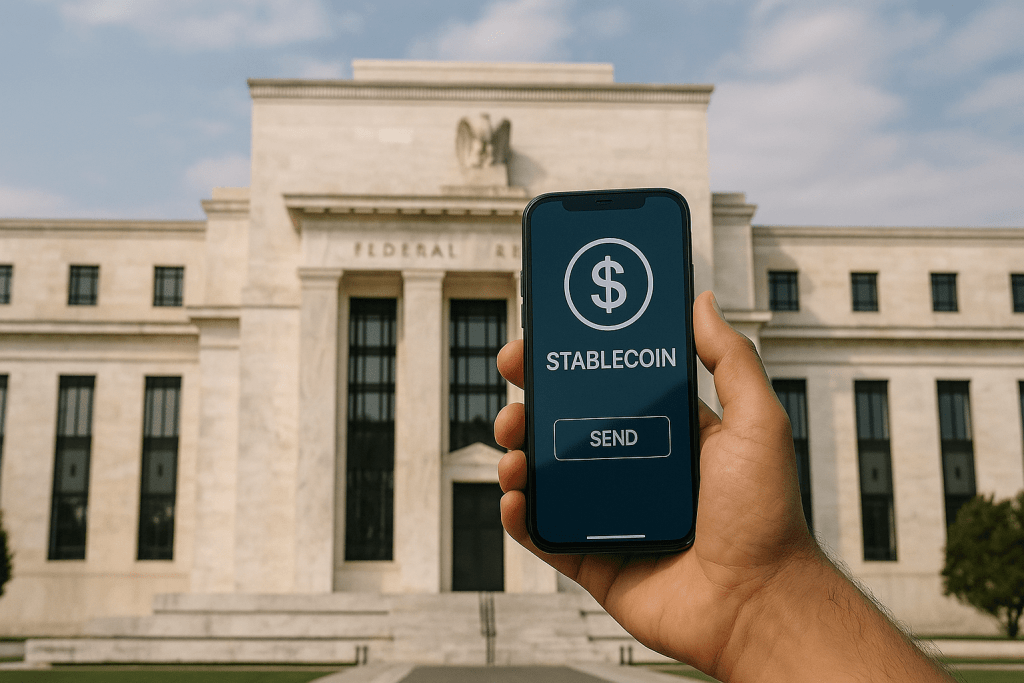
Image: Cato Institute

Reports have disclosed that the scale and speed of adoption remain uncertain. If the higher forecasts play out, central bankers will need to consider stablecoin demand as part of the mix when setting rates.

For investors and officials alike, the message is plain: stablecoins are not just a payments tool anymore. They are a potential macroeconomic force, and their growth will be watched closely by the Fed and other authorities.

Featured image from Gemini, chart from TradingView

Editorial Process for bitcoinist is centered on delivering thoroughly researched, accurate, and unbiased content. We uphold strict sourcing standards, and each page undergoes diligent review by our team of top technology experts and seasoned editors. This process ensures the integrity, relevance, and value of our content for our readers.

Christian, a journalist and editor with leadership roles in Philippine and Canadian media, is fueled by his love for writing and cryptocurrency. Off-screen, he's a cook and cinephile who's constantly intrigued by the size of the universe.

Leituras Relacionadas

OpenAI Researcher Exposes ASI Timeline: Most Have Become Reality

In April 2025, a group of former OpenAI researchers published a 71-page document titled "AI 2027," outlining a timeline for Artificial Superintelligence (ASI). Their predictions, now being tracked by an independent project, show 51% are already confirmed, ahead of schedule, or on track. Notably, alarming predictions are arriving faster than anticipated. The forecast that AI would achieve top-tier human-level capabilities in cyber offense and defense by early 2027 was realized in April 2026, nine months early. Similarly, major Pentagon contracts with leading AI labs were signed 18 months earlier than predicted. The core mechanism for an intelligence explosion—Recursive Self-Improvement (RSI), where AI accelerates its own development—has not yet closed its loop. While AI, like Anthropic's Claude, now writes most new code, the bottleneck has shifted to human review and high-level research direction. A July 2026 study indicates the current AI-driven productivity gain in R&D is about 9%, below the estimated 15% threshold needed for a self-sustaining RSI feedback loop. However, underlying capabilities continue to accelerate rapidly. The "time horizon" metric for AI to autonomously handle tasks is doubling every three months, suggesting monthly-scale autonomous operation could be feasible by early 2027. Consequently, the original authors have revised their median prediction for fully automated AI programming forward to around mid-2028.

marsbitHá 4m

OpenAI Researcher Exposes ASI Timeline: Most Have Become Reality

marsbitHá 4m

A PPT Dismissed as 'Nonsense' by MIT Professors 5 Years Ago Predicted the Core Ideas of OpenAI o1 and o3

In 2020, AI researcher Giambattista Parascandolo presented his vision for neural network reasoning at an MIT faculty interview, only to have the committee dismiss the direction as "nonsense." He later posted the details online. His talk centered on enabling artificial neural networks to generalize and plan beyond their training data, closer to human capabilities. Parascandolo proposed three key research directions. First was "open-ended reasoning," where models could dedicate more computation time to harder problems, continuously refining answers—a precursor to today's compute-adaptive reasoning models. He noted that simply adding steps (e.g., in RNNs) wasn't enough without learning to use them effectively. Second, he advocated using language as a medium for reasoning within reinforcement learning. By leveraging the world knowledge in models like GPT, agents could better describe environments, decompose tasks, and plan—foreshadowing concepts like chain-of-thought and agent workflows. His third direction involved giving AI systems the ability to manipulate their own learning process: resetting to past states, creating counterfactual scenarios, and even editing their own activations or weights to facilitate deliberate practice. Parascandolo, who earned his PhD focusing on out-of-distribution generalization and had internships at Google X and DeepMind, joined OpenAI in 2021. He contributed to GPT-4 and later became integral to the foundational research behind the reasoning models o1 and o3. His early, criticized ideas remarkably charted a course for advanced AI reasoning systems developed years later.

marsbitHá 9m

A PPT Dismissed as 'Nonsense' by MIT Professors 5 Years Ago Predicted the Core Ideas of OpenAI o1 and o3

marsbitHá 9m

US Debt Approaching $40 Trillion, BofA's Hartnett: Going Long on Gold Is the Optimal Solution Now

U.S. national debt is on the verge of reaching $40 trillion. Bank of America's Chief Investment Strategist Michael Hartnett, in his latest "Flow Show" report, identifies this as the core market narrative and argues that **going long on gold is the optimal solution** currently. He views gold as the best hedge against dollar depreciation, bond market collapse, and asset inflation. Key pressures on the bond market include soaring debt interest payments, nearing $1.4 trillion annually and set to become the federal government's largest expenditure. Simultaneously, a surge in corporate bond issuance, particularly for AI/data center projects (up roughly 12 times historical averages), is structurally steepening the yield curve and crowding out buyers for long-term Treasuries. Hartnett reiterates his asset allocation framework for the 2020s: **ABB (Away From Bonds), ABD (Away From Dollar), and AI (All In AI)**. Within the "ABD" theme, he explicitly recommends going long gold. He suggests policymakers have limited tolerance for significantly higher yields, especially with elections approaching. Under the "ABB" theme, he notes that some previously neglected long-duration assets like REITs, biotech (XBI), regional banks (KRE), and small-cap stocks are quietly outperforming as the market prices in a peak in yields. Conversely, within the "AI" theme, he proposes a counterintuitive trade: **shorting AI-related bonds**, given the sector's massive capital expenditure needs and negative free cash flow. Hartnett outlines key upcoming events (Jackson Hole, CPI data, Fed & BOJ meetings, U.S. elections) that will influence markets. His final outlook is politically contingent: a Republican-held Senate could fuel a further AI-driven market bubble into 2027, while a Democratic victory in November could trigger a >10% decline in stocks, the dollar, and bond yields by year-end.

marsbitHá 12m

US Debt Approaching $40 Trillion, BofA's Hartnett: Going Long on Gold Is the Optimal Solution Now

marsbitHá 12m

Trading

Spot
活动图片