First Spot XRP ETFs Expected to Launch This Week, Expert Predicts

bitcoinistPublicado em 2025-11-10Última atualização em 2025-11-10

Resumo

A prominent exchange-traded fund specialist says the first US spot XRP ETFs could debut within days, as Washington moves to...

Trusted Editorial content, reviewed by leading industry experts and seasoned editors. Ad Disclosure

A prominent exchange-traded fund specialist says the first US spot XRP ETFs could debut within days, as Washington moves to end the longest federal shutdown on record and multiple funds surfaced on the Depository Trust & Clearing Corporation’s (DTCC) “active and pre-launch” roster. “Government shutdown ending = spot crypto ETF floodgates opening… In meantime, could see first ‘33 Act spot XRP ETF launch this week,” Nate Geraci wrote on X early Monday, November 10.

Spot XRP ETF Launch This Week?

The timing hinges on fast-moving developments in Washington. On Monday, November 10, Senate leaders advanced a funding package intended to reopen the government, a step that would bring furloughed Securities and Exchange Commission staff back to work and unfreeze routine registration processing.

Even as the shutdown lingers, infrastructure for prospective spot funds is materializing. DTCC’s official “Exchange Traded Funds – Active and Pre Launch” file—updated November 7—now includes several applicants: Bitwise XRP ETF, Canary XRP ETF, CoinShares XRP ETF, 21Shares XRP ETF, and Franklin XRP ETF. DTCC’s own disclaimer on that page is explicit: the file lists both active ETFs and “pre launch” products that “are not yet active” and cannot be processed “unless and until such securities have received all necessary regulatory and other approvals.”

The convergence of DTCC listings with a prospective government reopening is why Geraci—one of the most closely followed voices in the ETF industry—frames the next several days as a potential inflection point. His post also nods to the legal mechanism that could enable a near-term debut: the Securities Act of 1933’s Section 8(a) pathway to automatic effectiveness.

In recent weeks, several crypto ETF issuers have removed the traditional “delaying amendment” from their S-1 registration statements, which—absent SEC action—allows a filing to go effective automatically after 20 days.

None of the above, however, substitutes for an approval order or the passage of the Section 8(a) waiting period. DTCC listings historically function as plumbing—CUSIP, symbol, and processing readiness—rather than a regulatory blessing.

The presence of leveraged or strategy products tied to the token on the same DTCC sheet and the mix of “Y/N” notations in the “Create/Redeem” column further underscore that DTCC is cataloging what could be processed, subject to regulatory status, rather than declaring anything active. The agency’s own header language leaves no ambiguity on that point.

The policy backdrop matters. Multiple newsrooms reported across the weekend and into Monday that the Senate has taken concrete steps toward reopening the government. If the House follows and the President signs, SEC staff would return, potentially accelerating routine correspondence and any last-mile logistics for issuers that chose not to rely on 8(a) automatic effectiveness.

Until then, issuers that did remove delaying amendments technically do not need an affirmative SEC declaration to become effective after the 20-day clock, but they remain exposed to potential SEC comments or interventions once operations normalize.

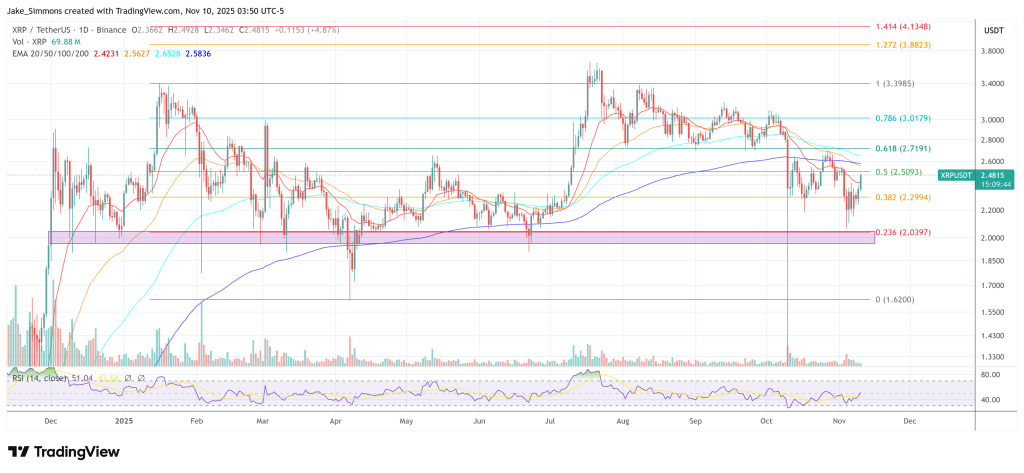
At press time, XRP traded at $2.48.
XRP price
XRP price, 1-day chart | Source: XRPUSDT on TradingView.com
Featured image created with DALL.E, chart from TradingView.com
Editorial Process for bitcoinist is centered on delivering thoroughly researched, accurate, and unbiased content. We uphold strict sourcing standards, and each page undergoes diligent review by our team of top technology experts and seasoned editors. This process ensures the integrity, relevance, and value of our content for our readers.

Jake Simmons has been a Bitcoin enthusiast since 2016. Ever since he heard about Bitcoin, he has been studying the topic every day and trying to share his knowledge with others. His goal is to contribute to Bitcoin's financial revolution, which will replace the fiat money system. Besides BTC and crypto, Jake studied Business Informatics at a university. After graduation in 2017, he has been working in the blockchain and crypto sector. You can follow Jake on Twitter at @realJakeSimmons.

Criptomoedas em alta

Leituras Relacionadas

Deciphering TapeOut: A Child Built a CPU On-Chain

**Title: Understanding TapeOut: A Kid Built a CPU On-Chain** **Summary:** The article explores a remarkable experiment where a young developer named Blonskr has used blockchain technology to build a functional, on-chain CPU. Named "Behemoth," this CPU is based on the 1971 Intel 4004 processor specification. It runs on the BNB Chain, uses block production as its clock (running at a glacial 2.22 Hz), and is perhaps the slowest CPU in existence, yet it represents a novel and intriguing concept in the on-chain space. The core concept is the TapeOut protocol, named after the final "tape out" stage in semiconductor manufacturing. It treats the blockchain as a silicon wafer, with tokens representing fundamental logic components. The protocol's atomic unit is an ERC-1155 token representing a single NAND gate, the fundamental building block of digital logic. Users can visually design circuits on a "canvas," connecting these logic tokens. Once a design is finalized, the underlying tokens are burned, and an ERC-721 NFT representing the permanent, immutable circuit is minted. Blonskr used 2,300 such tokenized NAND gates to construct the Behemoth CPU. Key features of this and any TapeOut circuit include **permanent operation** (running as long as the chain exists), **free, permissionless evaluation** (anyone can query it without gas), and **safe composability** (circuits cannot call external contracts or modify state, making them inherently safe to use). This enables a new form of open, collaborative hardware design, where anyone can build upon and integrate components created by others. While highly niche, TapeOut reimagines the foundations of computation using blockchain's properties of permanence and openness. It pushes the boundaries of what can be built on-chain, potentially enabling future applications like custom mining circuits or decentralized, specialized processors. The experiment demonstrates an exciting combination of extreme technical vision and creative curiosity.

marsbitHá 9m

Deciphering TapeOut: A Child Built a CPU On-Chain

marsbitHá 9m

Novig Sues Wisconsin as Sports Prediction Market Dispute Heats Up

Novig, a sports event prediction market operator, has filed a lawsuit against Wisconsin's attorney general. The legal dispute centers on whether prediction markets fall under federal derivatives regulations or state gambling laws. The lawsuit, filed in a U.S. district court, seeks a declaratory judgment after Novig began offering event contracts to Wisconsin residents. This case is part of a broader conflict. In April, Wisconsin sued other prediction market platforms like Kalshi and Polymarket, alleging their sports-related contracts violate state gambling laws. Novig argues its contracts are "swaps" regulated exclusively by the federal Commodity Futures Trading Commission (CFTC), under the Commodity Exchange Act. Wisconsin contends they are sports betting. Federal courts have issued conflicting rulings on similar cases, creating legal uncertainty. The outcome is significant as prediction markets are a fast-growing sector, with trading volume reaching $9.5 billion on a single day in August. These markets are also increasingly intertwined with cryptocurrency infrastructure. Simultaneously, Novig is pursuing a nationwide legal strategy, having filed similar lawsuits in four other states. The company also recently secured a marketing partnership with the New York Mets, marking the first such deal with an MLB team. The Wisconsin case's resolution will influence whether prediction markets can operate as national financial products or remain constrained by individual state laws.

cryptonews.ruHá 16m

Novig Sues Wisconsin as Sports Prediction Market Dispute Heats Up

cryptonews.ruHá 16m

Держатели XRP могут торговать опционами на платформе Derive, используя FXRP в качестве залога

XRP holders can now trade options on the Derive platform using FXRP as collateral, as announced by Flare on August 12. This integration allows users to open positions from self-custody wallets while the underlying XRP backing the FXRP remains on the XRP Ledger. According to DeFi analyst Will Procheska, this provides XRP's dedicated holder base with a permissionless options market for generating yield or hedging. Derive's platform combines protocol-level settlements with an order book managed by Derive Trading Co., enabling users to retain asset control while professional market-makers provide liquidity. XRP options on Derive are cash-settled in USDC, so profits or obligations adjust the trader's USDC balance without transferring XRP or FXRP. The platform's portfolio margin system assesses overall account risk but may still trigger liquidations if margin levels fall below requirements. The launch expands Flare's XRPFi ecosystem. FXRP, introduced via the FAssets system in September 2025, creates an on-chain representation of XRP for use in smart contracts. It has since been integrated into spot trading and, more recently, permissionless lending markets on Morpho. This addition of options on Derive offers XRP holders hedging and premium-earning capabilities comparable to other major assets. While regulated XRP options debuted on CME Group in October 2025, Derive provides a decentralized alternative with USDC settlement and direct wallet access. The platform also supports perpetual futures, offering further trading strategies. Flare and Derive are exploring automated "strategy vaults" to simplify yield-generating options approaches for users.

cryptonews.ruHá 16m

Держатели XRP могут торговать опционами на платформе Derive, используя FXRP в качестве залога

cryptonews.ruHá 16m

Trading

Spot

Artigos em Destaque

O que é XRP 2.0

XRP 2.0: Uma Nova Fronteira no Landscape das Criptomoedas Introdução ao XRP 2.0 No reino em constante evolução das criptomoedas, novos projetos surgem continuamente, lutando por atenção e adoção. Uma dessas iniciativas promissoras é o XRP 2.0, um novo projeto de criptomoeda concebido para aproveitar a tecnologia de blockchain avançada e as metodologias de criptografia robustas. Embora o nome tenha paralelos com o XRP da Ripple, é crucial notar que o XRP 2.0 opera de forma independente, focando em melhorar a segurança das transações, a privacidade e a escalabilidade. À medida que o panorama financeiro digital abraça cada vez mais soluções descentralizadas, o XRP 2.0 visa contribuir de forma significativa para a web3 e a expansão global dos projetos de criptomoedas. O que é o XRP 2.0? No seu núcleo, o XRP 2.0 é um projeto de criptomoeda que visa criar um ecossistema de moeda digital seguro e descentralizado. Sua tecnologia fundamental integra princípios de blockchain sofisticados com técnicas de criptografia de ponta. O objetivo abrangente do XRP 2.0 é estabelecer-se como uma plataforma confiável e eficiente que possibilita a execução rápida de transações, priorizando a proteção de privacidade aprimorada para os seus usuários. O projeto é promovido como uma solução para muitas limitações enfrentadas pelas criptomoedas existentes, propondo um sistema que pode lidar com um volume maior de transações com velocidade e privacidade melhoradas. Esta versatilidade posiciona o XRP 2.0 como um concorrente significativo em um mercado repleto de várias moedas digitais. Quem é o Criador do XRP 2.0? A identidade do criador por trás do XRP 2.0 foi identificada como 'Wilbur.' No entanto, detalhes abrangentes sobre Wilbur ou a sua entidade associada permanecem elusivos. O anonimato de muitos criadores de criptomoedas não é um fenômeno incomum na indústria, muitas vezes concebido para manter um grau de privacidade e segurança. Quem são os Investidores do XRP 2.0? Até agora, informações específicas relacionadas às fundações ou organizações de investimento que apoiam o XRP 2.0 não estão disponíveis publicamente. No setor das criptomoedas, o apoio de investidores reputados pode influenciar significativamente a credibilidade e o sucesso de um projeto, no entanto, a transparência em relação aos apoiantes financeiros do XRP 2.0 não foi estabelecida. Como Funciona o XRP 2.0? O XRP 2.0 destaca-se por empregar uma combinação de tecnologia blockchain e algoritmos de criptografia avançados que asseguram transações seguras e descentralizadas. Sua estrutura inovadora inclui características únicas projetadas para fomentar o envolvimento dos usuários e ampliar as funcionalidades além das transações convencionais de criptomoedas. Entre essas características, o XRP 2.0 incorpora capacidades potenciadas por IA, como funcionalidades de texto-para-imagem e texto-para-fala. Estas adições são projetadas para melhorar a experiência interativa dos usuários, promovendo uma maior aplicabilidade em vários setores. Ao unir avanços tecnológicos com um design centrado no utilizador, o XRP 2.0 pretende captar a atenção de uma diversa gama de indivíduos e empresas que procuram integrar soluções de criptomoedas em suas estruturas operacionais. Cronologia do XRP 2.0 Compreender o XRP 2.0 requer examinar os marcos que definiram sua jornada até agora: 23 de Julho de 2023: O XRP 2.0 é apresentado como um novo projeto de criptomoeda, visando revolucionar as capacidades de transação seguras e descentralizadas no domínio do blockchain. 8 de Setembro de 2023: O lançamento de outro projeto, XRP20, ocorre, marcando o surgimento de um token ERC-20 na blockchain Ethereum que permanece não relacionado ao XRP 2.0. 13 de Novembro de 2023: O XRP Ledger passa por uma atualização significativa com o lançamento da versão 2.0.0 do software do servidor rippled. É importante notar que este desenvolvimento está desconectado do projeto de criptomoeda XRP 2.0. Pontos-chave sobre o XRP 2.0 Para destilar a essência do XRP 2.0, vários fatores críticos emergem: Características Únicas: A inclusão de características como texto-para-imagem e texto-para-fala potenciadas por IA diversifica ainda mais as aplicações potenciais do XRP 2.0. Tecnologia Blockchain: A estrutura utiliza mecanismos de blockchain avançados e protocolos de criptografia, assegurando um ambiente seguro e descentralizado para transações. Escalabilidade e Privacidade: O XRP 2.0 prioriza proteção de privacidade aprimorada nos processos de transação e a escalabilidade necessária para acomodar uma base de utilizadores crescente. Sem Afiliação com a Ripple: Importante, apesar do seu nome, o XRP 2.0 não tem qualquer lealdade ou colaboração com o XRP da Ripple, distinguindo sua estrutura operacional e objetivos dentro do ecossistema das criptomoedas. Conclusão O XRP 2.0 representa uma empreitada ambiciosa no domínio das criptomoedas, visando oferecer uma combinação de segurança, privacidade e eficiência em transações digitais. Ao integrar tecnologias sofisticadas e características amigáveis ao utilizador, o projeto propõe-se a ampliar os horizontes do que as criptomoedas podem alcançar na economia digital atual. Embora o anonimato do seu criador e a falta de investidores divulgados possam levantar questões para alguns, o foco do XRP 2.0 em funcionalidades avançadas e descentralização aumenta seu apelo num mercado de criptomoedas cada vez mais congestionado. À medida que o panorama das criptomoedas continua a evoluir, o XRP 2.0 pode ainda emergir como um jogador crucial na expansão de soluções de blockchain seguras e escaláveis.

231 Visualizações TotaisPublicado em {updateTime}Atualizado em 2024.12.03

O que é XRP 2.0

Como comprar XRP

Bem-vindo à HTX.com!Tornámos a compra de XRP (XRP) simples e conveniente.Segue o nosso guia passo a passo para iniciar a tua jornada no mundo das criptos.Passo 1: cria a tua conta HTXUtiliza o teu e-mail ou número de telefone para te inscreveres numa conta gratuita na HTX.Desfruta de um processo de inscrição sem complicações e desbloqueia todas as funcionalidades.Obter a minha contaPasso 2: vai para Comprar Cripto e escolhe o teu método de pagamentoCartão de crédito/débito: usa o teu visa ou mastercard para comprar XRP (XRP) instantaneamente.Saldo: usa os fundos da tua conta HTX para transacionar sem problemas.Terceiros: adicionamos métodos de pagamento populares, como Google Pay e Apple Pay, para aumentar a conveniência.P2P: transaciona diretamente com outros utilizadores na HTX.Mercado de balcão (OTC): oferecemos serviços personalizados e taxas de câmbio competitivas para os traders.Passo 3: armazena teu XRP (XRP)Depois de comprar o teu XRP (XRP), armazena-o na tua conta HTX.Alternativamente, podes enviá-lo para outro lugar através de transferência blockchain ou usá-lo para transacionar outras criptomoedas.Passo 4: transaciona XRP (XRP)Transaciona facilmente XRP (XRP) no mercado à vista da HTX.Acede simplesmente à tua conta, seleciona o teu par de trading, executa as tuas transações e monitoriza em tempo real.Oferecemos uma experiência de fácil utilização tanto para principiantes como para traders experientes.

1.9k Visualizações TotaisPublicado em {updateTime}Atualizado em 2026.06.02

Como comprar XRP

Discussões

Bem-vindo à Comunidade HTX. Aqui, pode manter-se informado sobre os mais recentes desenvolvimentos da plataforma e obter acesso a análises profissionais de mercado. As opiniões dos utilizadores sobre o preço de XRP (XRP) são apresentadas abaixo.

活动图片