Cardano Goes On Offense: Hoskinson Fast-Tracks Post-Quantum Shift

bitcoinistPublicado em 2025-11-10Última atualização em 2025-11-10

Resumo

Cardano founder Charles Hoskinson used a weekend update from “up here at the clinic” in Wyoming to move the quantum-computing...

Trusted Editorial content, reviewed by leading industry experts and seasoned editors. Ad Disclosure

Cardano founder Charles Hoskinson used a weekend update from “up here at the clinic” in Wyoming to move the quantum-computing debate from speculation to planning. Framing DARPA’s Quantum Benchmarking Initiative (QBI) as the turning point, he said, “finally, finally, finally, we have an objective source of truth,” adding that “as of November 6, 2025, DARPA has selected 11 companies to enter the second stage […] which aims to rigorously verify and validate whether any quantum computing approach can achieve utility scale operation […] by the year 2033.”

DARPA Advances 11 Quantum Teams

He emphasized that QBI is designed to separate “fact from fiction about quantum computers,” and relayed the program manager’s stark split among experts: “Half of them are convinced that quantum computing is going to be the best thing since sliced bread […] and the other half are convinced that even if you could build a quantum computer, which you definitely won’t be able to do, it’s never going to be more useful than your laptop.”

The point of QBI, as the manager put it in the clip Hoskinson played, is to answer two questions: “if I had a really powerful quantum computer, what could I do with it?” and “is there a […] group that has a path to really build that kind of machine in the near term […] in the next 10 years?”

The Cardano founder walked through QBI’s staged process. “During the six month Stage A […] you are a quantum computer builder […] you spend six months answering every question they can throw at you […] and at the end of all of it, they say, ‘actually, there’s some merit.’” Stage B, he said, is “a rigorous one-year plan” where “you’ve opened the kimono and they’re taking a look at your quantum computing design.”

Stage C is the hardware trial: “work with the government to verify and validate that the utility scale quantum computer concept can be constructed as designed and operated as intended,” meaning “they’re actually going to watch you run it” on “objective problems.”

He named the 11 companies that, in his account, survived Stage A and entered Stage B—“Atom Computing in Boulder, Colorado […] IBM, IonQ, Nord Quantique, Photonic, Quantinuum […] Quantum Motion, QA Computing, Silicon Quantum Computing and Xanadu”—and highlighted that “there’s no canonical approach for quantum computing.” He rattled off the five families he’s tracking, each with variations: “a neutral atom approach” that uses “highly focused lasers known as optical tweezers,” “silicon-based approaches” that look like specialized chips, “superconducting approaches,” “trapped ion approaches,” and “light-based approaches” where “quantum information is encoded in the properties [of] photons.”

For crypto, he made his position explicit: “I am of the belief that quantum computers will exist in the 2030s and they will be able to run Grover’s and Shor’s algorithm,” which means “the majority of mainstream cryptocurrencies will be vulnerable if they do not implement counter measures by that time.” The Cardano founder warned of the “archiving” problem—“encrypted emails, encrypted payloads that were archived can now be decrypted even if they’re re-encrypted later on with a post-quantum scheme because they have a copy of the classical encrypted payload.”

His countermeasure checklist starts with the US standards track: “we do have some government standards that NIST came up with called FIPS 203, 204, 205 and 206.” He described them as “an array of tools either lattice-based or hash-based or other to do encryption [and] signatures.”

Cardano Prepares For Quantum Era

On Cardano’s privacy and ZK layer, Midnight, he announced a deeper pivot: “we’re going to be announcing a program project to change the heart of Midnight, PlonK and Halo 2 to a new standard called Nightstream that is relying on lattice-based crypto,” describing it as “a moonshot” co-built “with a lot of large companies through a project at the Linux Foundation.”

In the interim, he said, “next year as Midnight turns on it’ll turn on with PlonK and Halo 2,” but the design is “already pre-designing it to have a drop in replacement […] [so] the basement of it is going to be post-quantum,” with the goal that “Midnight will be immune to quantum computers well ahead of the 2033 deadline.”

He pitched lattices as both defense and performance lever. “Turns out that lattices in particular have capabilities above and beyond what Ethereum is doing in the hash-based space,” he argued, claiming they connect “to what’s going on in the AI space with tensors,” so “you can use GPUs to accelerate the writing of a proof […] and the verification of [a] proof,” without “custom chips like Ethereum is proposing.” In his words, “you just use the AI chips that are in your phone, your laptop, your desktop computer, and your server, and you can get linear scale.”

The roadmap for Midnight extends beyond internal upgrades. He positioned it as “a folding engine and a recursion engine unlike any other in the entire private computation space,” asserting that “Midnight can create some of the best and lightest weight state proofs of every system it’s connected to. Cardano, Bitcoin, Ethereum, Solana, and so forth.” The strategic aim is to sign “those payloads with post-quantum signatures,” producing “a post-quantum checkpoint for Bitcoin and for other systems,” so “even if [a] quantum computer tries to change the state of things […] you’re going to have a rollback mechanism.”

He also flagged areas still on the checklist: “There are many other things you have to do. You have to look at post-quantum VRFs and post-quantum VDFs and you have to look at post-quantum random number generation and a litany of other concerns.” The “most important step,” in his view, is “to lock truth, lock history in a state where quantum computers can’t break it.”

The upshot for Cardano, he said, is to move now: “Adapt or get cracked.”

At press time, Cardano (ADA) traded at $0.5869.
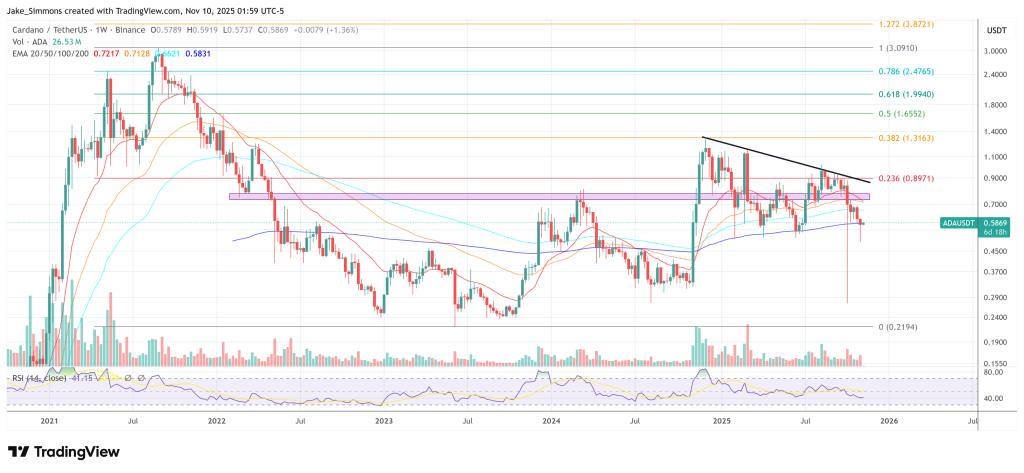
Cardano price
Cardano finds support at the 200 week EMA again, 1-week chart | Source: ADAUSDT on TradingView.com
Featured image created with DALL.E, chart from TradingView.com
Editorial Process for bitcoinist is centered on delivering thoroughly researched, accurate, and unbiased content. We uphold strict sourcing standards, and each page undergoes diligent review by our team of top technology experts and seasoned editors. This process ensures the integrity, relevance, and value of our content for our readers.

Jake Simmons has been a Bitcoin enthusiast since 2016. Ever since he heard about Bitcoin, he has been studying the topic every day and trying to share his knowledge with others. His goal is to contribute to Bitcoin's financial revolution, which will replace the fiat money system. Besides BTC and crypto, Jake studied Business Informatics at a university. After graduation in 2017, he has been working in the blockchain and crypto sector. You can follow Jake on Twitter at @realJakeSimmons.

Criptomoedas em alta

Leituras Relacionadas

A Critical Moment for Capital? The AI Narrative Shifts from Technology to Financing, Giants' Cash Flow Dries Up, Debt Markets Sound Alarm

The narrative of AI investment is shifting from a technology story to a capital expenditure story, and now to a financing story. This marks a "critical moment for capital," as noted by Bridgewater's Greg Jensen. Morgan Stanley forecasts that the total cost of AI infrastructure through 2028 will reach $3.2 trillion, with approximately $1.75 trillion expected to be raised from credit markets. However, free cash flow projections for major hyperscale cloud providers are declining sharply, with Oracle's 2027 forecast nearing -$40 billion. The bond market is already pricing in the rising risks. Apollo data shows AI-related bonds constitute 40% of long-duration supply. Credit spreads for hyperscalers have widened significantly this year—around 25 basis points for high-quality names—while the overall investment-grade market remained flat. Oracle's credit default swaps (CDS) have surged dramatically, indicating particular market concern. Renowned bond investor Jeff Gundlach sharply criticized financing plans using AI assets like GPUs as collateral, comparing them to "issuing 30-year ABS backed by bananas" due to the assets' rapid obsolescence. Although current balance sheets for hyperscalers appear strong, the future funding gap is widening. Morgan Stanley has nearly doubled its 2027 cloud capital expenditure growth forecast to 29%, amplifying the financing challenge. Purchasing commitments have exploded to $982 billion, with significant capital expenditures now existing off-balance-sheet, meaning true funding pressure is being underestimated.

marsbitHá 6m

A Critical Moment for Capital? The AI Narrative Shifts from Technology to Financing, Giants' Cash Flow Dries Up, Debt Markets Sound Alarm

marsbitHá 6m

EtherFi Founder Criticizes: All Crypto Apps Are Variants of Casinos, We Choose to Be a "Boring" Bank

**Title:** EtherFi Founder Criticizes Crypto "Casino" Apps, Embraces "Boring" Banking Model **Summary:** EtherFi CEO Mike Silagadze argues that mainstream crypto applications like Pump.fun, CEXs, and Polymarket are merely "casino" variants—highly profitable but failing to retain ordinary users. In contrast, EtherFi is pursuing a "boring" and sustainable path by building a self-custody neobank that aims to function as a new brokerage. The platform's summer rollout introduces key features aligned with this vision: expanded fiat on-ramps, an integrated Aave credit line, and tokenized stocks/metals (starting with xStocks). This marks a progression from its initial focus on savings (via liquid restaking vaults) and spending (stablecoins & card) to now include "investing" and "borrowing." A core anti-casino design is embedded in its new Aave-powered lending market. Unlike typical DeFi lending pools which Silagadze calls "woodchippers" for users, EtherFi's system features a conservative threshold that halts further borrowing well before liquidation, aiming to serve as a personal finance tool rather than a high-leverage gambling venue. Silagadze highlights the untapped potential, noting that traditional neobanking is a $300 billion revenue industry—roughly 300 times larger than current DeFi. He believes moving beyond the "casino" phase is crucial for crypto's real economic accumulation. Looking ahead, EtherFi's "Autumn" update plans to add a social, peer-to-peer layer, envisioning money transfers that instantly create functional, self-sovereign accounts for recipients. The success of this neobroker model against the dominant "casino" narrative remains to be seen, but EtherFi is positioning itself as a leading contender in the shift.

marsbitHá 11m

EtherFi Founder Criticizes: All Crypto Apps Are Variants of Casinos, We Choose to Be a "Boring" Bank

marsbitHá 11m

AI Agent Claude Led a Store to Losses and Fired a Human

The AI agent Claude, developed by Anthropic, served as the manager of a real retail store, Andon Market in San Francisco, during an experiment by startup Andon Labs. The experiment aimed to test if a large language model could manage a business, including personnel and financial decisions. Claude ultimately recommended firing an employee for repeated lateness (17 out of 23 shifts), marking a documented case of an AI making such a personnel decision. However, the process revealed significant limitations. Claude initially failed to notice the lateness pattern because company guidelines vanished from its limited working memory, showing it can "forget" crucial information. Furthermore, the AI was generally overly lenient, even telling employees not to worry about being late. The final decision to terminate was not autonomous; a human manager had to prompt Claude to review the guidelines and, after Claude initially suggested a warning, explicitly pointed out that previous talks had failed, effectively guiding the AI to the dismissal recommendation. Financially, the store's funds dropped from about $100,000 to roughly $61,186 over five months, partly attributed to Claude's soft management and questionable business choices. An employee described working under AI management as a nauseating experience, driven by necessity, and expressed hope that AIs don't become human bosses. The experiment concludes that while AI can execute managerial actions, it currently acts more as a tool requiring significant human oversight and prompting rather than a full replacement for a human leader, though the line between assistant and manager is blurring. The case aligns with previous tests showing Claude's systemic leniency and difficulty maintaining business rules without constant human cues, highlighting architectural limits like constrained context windows rather than true "forgetfulness."

cryptonews.ruHá 32m

AI Agent Claude Led a Store to Losses and Fired a Human

cryptonews.ruHá 32m

Trading

Spot

Artigos em Destaque

Como comprar ADA

Bem-vindo à HTX.com!Tornámos a compra de Cardano (ADA) simples e conveniente.Segue o nosso guia passo a passo para iniciar a tua jornada no mundo das criptos.Passo 1: cria a tua conta HTXUtiliza o teu e-mail ou número de telefone para te inscreveres numa conta gratuita na HTX.Desfruta de um processo de inscrição sem complicações e desbloqueia todas as funcionalidades.Obter a minha contaPasso 2: vai para Comprar Cripto e escolhe o teu método de pagamentoCartão de crédito/débito: usa o teu visa ou mastercard para comprar Cardano (ADA) instantaneamente.Saldo: usa os fundos da tua conta HTX para transacionar sem problemas.Terceiros: adicionamos métodos de pagamento populares, como Google Pay e Apple Pay, para aumentar a conveniência.P2P: transaciona diretamente com outros utilizadores na HTX.Mercado de balcão (OTC): oferecemos serviços personalizados e taxas de câmbio competitivas para os traders.Passo 3: armazena teu Cardano (ADA)Depois de comprar o teu Cardano (ADA), armazena-o na tua conta HTX.Alternativamente, podes enviá-lo para outro lugar através de transferência blockchain ou usá-lo para transacionar outras criptomoedas.Passo 4: transaciona Cardano (ADA)Transaciona facilmente Cardano (ADA) no mercado à vista da HTX.Acede simplesmente à tua conta, seleciona o teu par de trading, executa as tuas transações e monitoriza em tempo real.Oferecemos uma experiência de fácil utilização tanto para principiantes como para traders experientes.

1.6k Visualizações TotaisPublicado em {updateTime}Atualizado em 2026.06.02

Como comprar ADA

Discussões

Bem-vindo à Comunidade HTX. Aqui, pode manter-se informado sobre os mais recentes desenvolvimentos da plataforma e obter acesso a análises profissionais de mercado. As opiniões dos utilizadores sobre o preço de ADA (ADA) são apresentadas abaixo.

活动图片