Russian Crypto Scammer Roman Novak Found Murdered in Dubai

TheCryptoTimesPublicado em 2025-11-10Última atualização em 2025-11-10

Key Highlights

Roman Novak and his wife were lured to a remote meeting in Dubai and killed after refusing to unlock crypto wallets worth millions. Their disappearance triggered an international investigation.

According to Mirror, the couple’s relatives in Russia reported them as missing after days of failed contact attempts. On November 7, authorities confirmed that the suspects, also Russian citizens, have been detained and will be extradited to Saint Petersburg.

The tragic end and the crime trail 

Their unexpected ending started when Roman Novak went on a trip to the United Arab Emirates (UAE) to attract new investors. He had arranged a private meeting near Hatta, a remote desert town far from Dubai’s urban skyline. Novak and Anna reportedly switched vehicles before arriving at the destination, a move now considered key to understanding the case. Their driver later returned to Dubai alone, sparking immediate suspicion. 

Besides, investigators discovered that Novak and his wife were lured into a rented villa where they were held captive. The kidnappers demanded that Novak unlock crypto wallets estimated to contain tens of millions of dollars. However, when they failed to obtain the funds, the situation escalated fatally. Consequently, the couple lost their lives before any ransom was paid.

Moreover, reports revealed that the couple’s mobile phones remained active for several days. Their signals were traced from Hatta to Oman and later detected in Cape Town, South Africa, before disappearing completely on October 4. Anna’s father and stepmother traveled to Dubai soon after to collect the couple’s underage children. He refused to share further information, citing the ongoing investigation.

Novak’s criminal past and lavish front

Roman Novak had a long history of financial deception. In 2020, a district court in St. Petersburg sentenced him to six years in a general regime colony for fraud. The case involved Transcrypt, a cryptocurrency exchange platform, from where Novak reportedly stole around $4 million.

Before he went missing, Novak presented himself as a successful crypto investor and the Founder of Fintopio, a platform that he said made digital payments quick and easy. He drew in investors from China, the Middle East, and Europe by promising big partnerships with tech companies. He even claimed to have personal connections with Arab princes and Telegram Founder Pavel Durov.

However, after securing nearly $500 million from global investors, Novak fled and abandoned his employees without pay. Consequently, those investors never saw their money again. Russian authorities later confirmed that Novak had previously defrauded partners through projects like “Sport v narod” and “Transcrypt,” stealing around RUB 7.3 million (£68,500).

Possible motives and ongoing investigation

Some Russian media outlets have speculated that one or more of Novak’s defrauded investors may have been behind the killing. However, investigators have not verified these claims. Reports say several suspects have already admitted to the crime, but the couple’s bodies still haven’t been found. Russian and UAE authorities are continuing their investigation.

Additionally, the case comes as international agencies intensify efforts against crypto-linked money laundering. The UK’s National Crime Agency (NCA) recently led a global crackdown on a multi-billion-pound Russian laundering syndicate. The NCA described the operation as spanning “from McMafia, through to Narcos, through to Le Carre.” The network allegedly connected drug cartels, hackers, and spies in an unprecedented collaboration.

The syndicate was reportedly headed by Russian financier Ekaterina Zhdanova and Russian-born Ukrainian George Rossi. They allegedly exchanged cash from British street gangs for cryptocurrencies earned by Russian hackers, further expanding their illicit reach.

A concerning scam trend globally

Crypto kidnappings further put the spotlight on risks for high-value investors. Earlier this year, Michael Carturan of New York was held hostage for 17 days while kidnappers tried to steal his $28 million in Bitcoin. He was tortured brutally, with electric shocks and chainsaw threats, until he managed to escape. His attackers were later arrested.

Across Europe and beyond, high-profile crypto figures face similar threats. In France, 26 suspects were charged with attempting to kidnap Paymium’s CEO’s family. Earlier, Ledger cofounder David Balland and his wife were abducted, with one finger severed. Belgium, Canada, and Australia also reported crypto-related ransom cases, showing a disturbing global pattern of criminals targeting digital-asset wealth.

The deaths of Roman Novak and his wife show how risky cryptocurrency can be when it goes unchecked. Their story reveals that scams and greed in digital markets don’t just cost money—they can turn deadly. It also highlights the need for better protection to keep investors safe and prevent crime across borders.

Also Read: India’s Gujarat CID Busts ₹200 Cr Crypto Racket Linked to Pakistan


Mobile Only ImageMobile Only Image

Leituras Relacionadas

The Tokenization of Gold: A Financial Revolution Driven by Regulation

The Tokenization of Gold: A Regulation-Driven Financial Revolution In early 2025, anticipation of US tariffs triggered a rush to withdraw physical gold from the Bank of England, exposing the friction in London's $1.2 trillion gold market. While daily trading of $737 billion occurs via ownership certificates without moving bullion, demand for physical metal revealed a pricing split based on deliverability. This article explores why the UK's Financial Conduct Authority (FCA) is developing rules for tokenized gold, focusing regulation squarely on the ledger system. London's gold market, cleared by four major banks, performs four key functions: physical storage, quality verification, ownership registration, and credit provision. Tokenization excels at the third—offering cheap, precise ownership records—but fundamentally challenges the fourth by potentially rendering banks' credit intermediation obsolete. Currently, most gold is held in "unallocated" accounts, where investors are unsecured creditors of banks, trading speed for credit risk. Tokenized gold combines the instant transfer of unallocated accounts with the direct ownership claim of allocated bullion, eliminating bank risk. The FCA is prioritizing its use as collateral, where speed is critical, unlocking this vast pool of currently illiquid assets for margin calls. This shift is partly driven by post-2008 banking regulations like Basel III's Net Stable Funding Ratio, which penalized banks for holding unallocated gold. The push now comes from the清算 banks themselves, like HSBC, which have launched proprietary tokenization systems. The crucial regulatory decision will be whether these tokens are allowed to circulate outside their creators' closed ecosystems. True adoption will be visible in LBMA data: high overall trading volume paired with a decline in settlements through the traditional central ledger, as transactions move to instant blockchain transfers. Ultimately, tokenization doesn't replace the physical vaults, security, and assayers but could elevate their importance, shifting their revenue to standardized service fees. The revolution lies not in moving the gold, but in reinventing how its ownership is recorded and transferred.

marsbitHá 8m

The Tokenization of Gold: A Financial Revolution Driven by Regulation

marsbitHá 8m

Yield Leverage and Liquidity Leverage: The STONKBROKER Mechanism is Very Suitable for the RWA Scenario

The article argues that the STONKBROKER mechanism is highly suitable for Real-World Asset (RWA) tokenization scenarios due to its two key leverages: **Profit Leverage** and **Liquidity Leverage**. **Profit Leverage:** Traditional RWA models simply tie tokens to real-world asset yields. STONKBROKER's model is more engaging by allowing NFT holders to earn not only the underlying real-world cash flows but also additional yields generated from the on-chain system's own operations and transaction activity (like fees and slippage). This creates a dual income stream. **Liquidity Leverage:** Standard RWA asset bundles often suffer from poor liquidity. STONKBROKER's mechanism, which allows fixed-ratio swapping between NFTs and a platform's fungible token (and vice versa), solves this. It provides real-time market pricing and flexible exit options for each "RWA asset" NFT by unifying NFT liquidity with ERC-20 token liquidity via an AMM pool. This enhances capital efficiency and attracts more trading activity. The article further speculates on applying this model to broader RWAs (e.g., real estate, bonds). The core idea is to create a more dynamic, liquid, and profitable ecosystem where ordinary users can participate, combining real-world yields with the speculative and transactional energy of a crypto-native system. The author mentions being inspired by the launch of a project called @TheCardWall, which tokenizes high-grade physical trading cards.

marsbitHá 28m

Yield Leverage and Liquidity Leverage: The STONKBROKER Mechanism is Very Suitable for the RWA Scenario

marsbitHá 28m

Deciphering TapeOut: A Child Built a CPU On-Chain

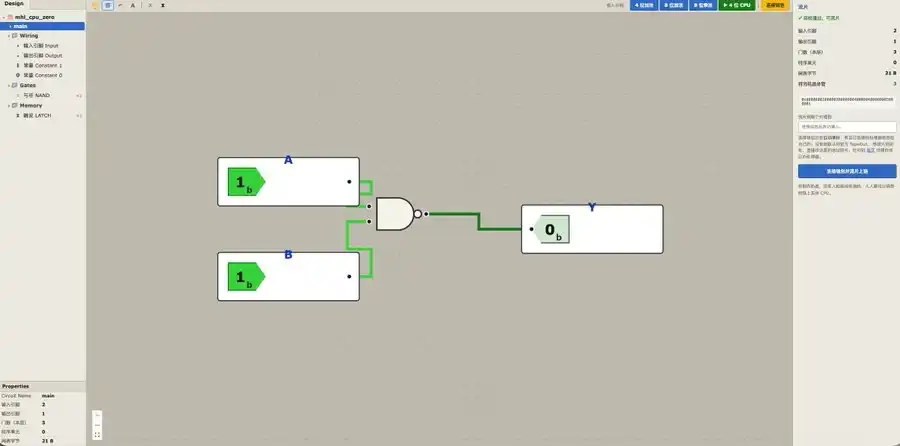
**Title: Understanding TapeOut: A Kid Built a CPU On-Chain** **Summary:** The article explores a remarkable experiment where a young developer named Blonskr has used blockchain technology to build a functional, on-chain CPU. Named "Behemoth," this CPU is based on the 1971 Intel 4004 processor specification. It runs on the BNB Chain, uses block production as its clock (running at a glacial 2.22 Hz), and is perhaps the slowest CPU in existence, yet it represents a novel and intriguing concept in the on-chain space. The core concept is the TapeOut protocol, named after the final "tape out" stage in semiconductor manufacturing. It treats the blockchain as a silicon wafer, with tokens representing fundamental logic components. The protocol's atomic unit is an ERC-1155 token representing a single NAND gate, the fundamental building block of digital logic. Users can visually design circuits on a "canvas," connecting these logic tokens. Once a design is finalized, the underlying tokens are burned, and an ERC-721 NFT representing the permanent, immutable circuit is minted. Blonskr used 2,300 such tokenized NAND gates to construct the Behemoth CPU. Key features of this and any TapeOut circuit include **permanent operation** (running as long as the chain exists), **free, permissionless evaluation** (anyone can query it without gas), and **safe composability** (circuits cannot call external contracts or modify state, making them inherently safe to use). This enables a new form of open, collaborative hardware design, where anyone can build upon and integrate components created by others. While highly niche, TapeOut reimagines the foundations of computation using blockchain's properties of permanence and openness. It pushes the boundaries of what can be built on-chain, potentially enabling future applications like custom mining circuits or decentralized, specialized processors. The experiment demonstrates an exciting combination of extreme technical vision and creative curiosity.

marsbitHá 1h

Deciphering TapeOut: A Child Built a CPU On-Chain

marsbitHá 1h

Novig Sues Wisconsin as Sports Prediction Market Dispute Heats Up

Novig, a sports event prediction market operator, has filed a lawsuit against Wisconsin's attorney general. The legal dispute centers on whether prediction markets fall under federal derivatives regulations or state gambling laws. The lawsuit, filed in a U.S. district court, seeks a declaratory judgment after Novig began offering event contracts to Wisconsin residents. This case is part of a broader conflict. In April, Wisconsin sued other prediction market platforms like Kalshi and Polymarket, alleging their sports-related contracts violate state gambling laws. Novig argues its contracts are "swaps" regulated exclusively by the federal Commodity Futures Trading Commission (CFTC), under the Commodity Exchange Act. Wisconsin contends they are sports betting. Federal courts have issued conflicting rulings on similar cases, creating legal uncertainty. The outcome is significant as prediction markets are a fast-growing sector, with trading volume reaching $9.5 billion on a single day in August. These markets are also increasingly intertwined with cryptocurrency infrastructure. Simultaneously, Novig is pursuing a nationwide legal strategy, having filed similar lawsuits in four other states. The company also recently secured a marketing partnership with the New York Mets, marking the first such deal with an MLB team. The Wisconsin case's resolution will influence whether prediction markets can operate as national financial products or remain constrained by individual state laws.

cryptonews.ruHá 1h

Novig Sues Wisconsin as Sports Prediction Market Dispute Heats Up

cryptonews.ruHá 1h

Trading

Spot
活动图片