Fed Governor Says Stablecoins May Lower Neutral Interest Rate

TheCryptoTimesPublicado em 2025-10-31Última atualização em 2025-11-10

Key Highlights

A growing wave of demand for dollar-backed stablecoins could shape future U.S. interest rate decisions, according to U.S. Federal Reserve Governor Stephen Miran. He delivered the remarks at the BCVC Summit 2025 held at the Harvard Club in New York on November 7, 2025.

Miran explained that rising global use of stablecoins might increase demand for U.S. Treasury. Hence, borrowing costs could move lower. He linked this trend directly to the neutral rate, known as r*, which guides long-term monetary policy decisions. Miran argued that stablecoins “may become a multitrillion-dollar elephant in the room for central bankers” if current growth patterns continue.

Stablecoins function as digital tokens pegged to a specific asset, such as the U.S. dollar. They make it easier and less costly to send money across borders. Miran noted that this fits with the strong worldwide demand for using dollars.

Moreover, the passage of the GENIUS Act this year provided a regulated framework for U.S.-based stablecoin issuers. Hence, they must now maintain full reserves in safe and liquid dollar assets. This rule increases credibility, attracts broader users, and connects stablecoins further into mainstream finance.

Expanding dollar access through stablecoins

Miran highlighted how stablecoins help people in emerging and developing economies access dollars more easily. Unreliable financial systems and capital controls are problems in many nations. As a result, it is frequently difficult for people and companies to hold or deal in stable value currencies. Stablecoins move on blockchain networks, which operate across borders without traditional banking roadblocks. Besides, adoption could accelerate where local currencies suffer from inflation and volatility.

He explained that demand for these tokens could increasingly come from abroad rather than the U.S. market. Users in the U.S. already access insured deposits and yield-bearing assets. However, savers in countries with strict financial controls often cannot. Stablecoins provide a new channel for saving and transacting in dollars. Therefore, global demand may expand the amount of capital seeking U.S. Treasury bills and other short-term dollar assets.

Effects on the neutral rate and Treasury demand

Miran said stablecoin issuers will likely hold reserves in Treasurys, repos, or government money market funds. Consequently, demand for these assets increases. He compared the situation to the “global saving glut” that former Fed Chair Ben Bernanke talked about in the early 2000s. 

Back then, a lot of money from overseas flowed into U.S. investments, which helped push long-term interest rates down. Miran said stablecoins could create a similar effect today, just on a smaller scale, by drawing more global money into U.S. Treasury markets.

Fed researchers think stablecoins could grow to between $1 trillion and $3 trillion by 2030, and some experts believe the number could go even higher. Miran pointed out that if stablecoins become widely used, they could push interest rates down by as much as 0.40%. That means the Fed may eventually need to rethink how it sets interest rates, because the “normal” level could end up being lower than it is today.

Current stablecoin market trends

According to DefiLlama, the total stablecoin market currently stands near $305.2 billion. The market dipped slightly in the past week, but long-term expansion persists. Tether (USDT) controls around 60% of the total supply. 

The stablecoin market grew sharply during the 2020–2021 crypto boom, contracted in 2022, and regained momentum from mid-2023 onward. The growth in this sector keeps rising as usage of stablecoins continues across trading markets, decentralized finance, and cross-border payments.

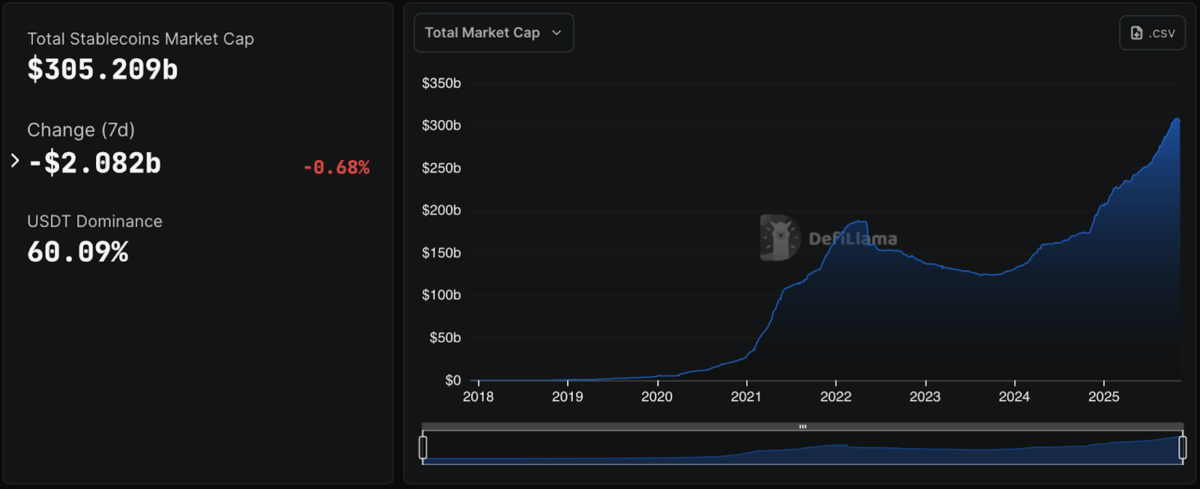
Total Stablecoin Market Cap Data
Source: DefiLIama

Stablecoins are no longer just a crypto trend. They’re starting to shape how money moves across countries. As more people around the world use dollar-backed stablecoins, it is more likely for the U.S. to consider key-policy updates favoring interest while managing the broader financial system. 

Also Read: India’s Gujarat CID Busts ₹200 Cr Crypto Racket Linked to Pakistan


Mobile Only Image

Leituras Relacionadas

Agentic Design Patterns: A Book That Made Me Re-Understand "What Is an Agent, Really?"

"Agentic Design Patterns" is a 2025 book by Antonio Gullí, a Google engineering director, which offers a systematic framework for AI Agent development through 21 design patterns. A core contribution is the "Four Levels of Agency": Level 0 (bare LLMs) are not true agents. Level 1 agents actively decide when and how to use tools. Level 2 agents engage in strategic planning, context engineering (curating and filtering information), and self-reflection. Level 3 involves multi-agent collaboration with defined communication topologies. The book introduces **Context Engineering** as a superset of prompt engineering, managing four layers of information for the agent: system prompts, external data, implicit context (user history, environment), and feedback loops for automated optimization. A key pattern is **Reflection (Producer-Critic)**, where two distinct agents with different prompts collaborate iteratively—one produces output, the other critiques it—until quality is satisfactory or a max iteration limit is reached. For **Memory**, a three-layer model is proposed: Session (ephemeral conversation context), State (temporary task data), and Memory (persistent, long-term storage). Regarding **Multi-Agent Systems**, the book advises against unnecessary complexity, recommending simple topologies like Supervisor or Peer-to-Peer based on task needs. It emphasizes perfecting a single Level 2 agent before moving to multi-agent setups. The author concludes with three actionable takeaways: 1) Add a Critic agent to existing workflows, 2) Practice Context Engineering beyond simple prompts, and 3) Avoid premature multi-agent complexity; first master a robust single agent. The book provides a practical map, codifying common challenges like reflection, memory, and coordination into reusable patterns, saving developers from reinventing foundational solutions.

链捕手Há 3m

Agentic Design Patterns: A Book That Made Me Re-Understand "What Is an Agent, Really?"

链捕手Há 3m

An AI Read SpaceX's Prospectus and Wrote This Investment Memo in 12 Minutes

An AI agent autonomously analyzed SpaceX's 226MB S-1 filing, purchased real-time market data on-chain for $1.87, and generated a comprehensive investment memo in 12 minutes. The memo concludes a "Hold" recommendation. Bull Thesis: SpaceX holds a near-monopoly in commercial launch (80% of global orbital mass since 2023), operates the profitable Starlink business (10.3M subscribers, $7.2B adj. EBITDA), and is vertically integrated from rockets to AI via the xAI acquisition. Starlink alone is a standout, high-margin business. Bear Thesis: The AI division is a massive cash burn ($6.4B operating loss on $3.2B revenue in 2025). True debt obligations approach ~$42B, not the headline $29B, due to bridge loans and X-related debt. Significant contingent liabilities exist, including a potential $10B fee from a Cursor option agreement. The company faces concentrated counterparty risk (e.g., a $45B Anthropic contract), slowing revenue growth, and complex governance as a controlled company with four share classes. Valuation anchors Starlink's standalone value at ~$84B (applying Iridium's 7.4x sales multiple), suggesting the current ~$500B+ IPO target prices in immense future execution risk for Starship and AI. Key risks include Starship delays, accelerating AI losses, and underwriter conflicts (the IPO's lead banks are also lenders on the $20B bridge loan it aims to refinance). Investment triggers: upgrade to "Overweight" if priced ≤$350B and Starship meets milestones; downgrade to "Pass" if priced >$510B or key risks materialize.

marsbitHá 23m

An AI Read SpaceX's Prospectus and Wrote This Investment Memo in 12 Minutes

marsbitHá 23m

Trading

Spot
Futuros

Artigos em Destaque

Como comprar MAY

Bem-vindo à HTX.com!Tornámos a compra de Mayflower (MAY) simples e conveniente.Segue o nosso guia passo a passo para iniciar a tua jornada no mundo das criptos.Passo 1: cria a tua conta HTXUtiliza o teu e-mail ou número de telefone para te inscreveres numa conta gratuita na HTX.Desfruta de um processo de inscrição sem complicações e desbloqueia todas as funcionalidades.Obter a minha contaPasso 2: vai para Comprar Cripto e escolhe o teu método de pagamentoCartão de crédito/débito: usa o teu visa ou mastercard para comprar Mayflower (MAY) instantaneamente.Saldo: usa os fundos da tua conta HTX para transacionar sem problemas.Terceiros: adicionamos métodos de pagamento populares, como Google Pay e Apple Pay, para aumentar a conveniência.P2P: transaciona diretamente com outros utilizadores na HTX.Mercado de balcão (OTC): oferecemos serviços personalizados e taxas de câmbio competitivas para os traders.Passo 3: armazena teu Mayflower (MAY)Depois de comprar o teu Mayflower (MAY), armazena-o na tua conta HTX.Alternativamente, podes enviá-lo para outro lugar através de transferência blockchain ou usá-lo para transacionar outras criptomoedas.Passo 4: transaciona Mayflower (MAY)Transaciona facilmente Mayflower (MAY) no mercado à vista da HTX.Acede simplesmente à tua conta, seleciona o teu par de trading, executa as tuas transações e monitoriza em tempo real.Oferecemos uma experiência de fácil utilização tanto para principiantes como para traders experientes.

256 Visualizações TotaisPublicado em {updateTime}Atualizado em 2025.07.01

Como comprar MAY

Discussões

Bem-vindo à Comunidade HTX. Aqui, pode manter-se informado sobre os mais recentes desenvolvimentos da plataforma e obter acesso a análises profissionais de mercado. As opiniões dos utilizadores sobre o preço de MAY (MAY) são apresentadas abaixo.

活动图片