Ripple Partners With Mastercard to Test RLUSD Fiat Payments

TheCryptoTimesPublicado em 2025-11-05Última atualização em 2025-11-05

Ripple has announced a new collaboration with Mastercard, WebBank, and Gemini to introduce stablecoin-based settlement for fiat payments using its Ripple USD (RLUSD) on the XRP Ledger (XRPL). The initiative, unveiled at Ripple Swell 2025 in New York, aims to demonstrate how blockchain can enhance the back-end of traditional payment systems by speeding up settlement, lowering costs, and improving transparency.

A new model for fiat payment settlement

The partnership bridges two worlds: traditional banking and blockchain-based finance. Mastercard and WebBank, the issuer of Gemini’s credit card, will test RLUSD for settlement between card transactions. Instead of clearing through conventional intermediaries, funds could be moved and reconciled on XRPL, a public ledger designed for secure, near-instant payments.

Sherri Haymond, Mastercard’s Global Head of Digital Commercialization, said the partnership reflects the company’s “principled approach to stablecoins,” noting that Mastercard is committed to consumer protection and compliance while exploring the next evolution of digital settlement.

If fully implemented, this would be one of the first cases of a regulated U.S. bank settling card transactions with a regulated stablecoin on a public blockchain, a potential blueprint for future financial infrastructure.

Bridge between blockchain innovation and banking stability

Stablecoins like RLUSD are digital assets pegged to fiat currencies, in this case, the U.S. dollar, allowing real-time settlement without price volatility. For banks and payment networks, this reduces counterparty risk and settlement delays, common issues in traditional clearing systems.

RLUSD is fully backed by cash and cash-equivalent reserves and regulated under the New York Department of Financial Services (NYDFS). Since its 2024 launch, it has surpassed $1 billion in circulation, signaling early institutional trust in Ripple’s stablecoin model.

Jason Lloyd, CEO of WebBank, called the effort “a bridge between blockchain innovation and banking stability,” while Gemini CFO Dan Chen added that this pilot “connects blockchain innovation directly to real-world payments.”

Mastercard’s growing role in blockchain finance

The collaboration also reflects Mastercard’s expanding footprint in crypto. Last month, it advanced its partnership with Chainlink to pilot cross-chain payment data transfers using Chainlink’s Cross-Chain Interoperability Protocol (CCIP). 

This project connected Mastercard’s traditional card network to decentralized systems, aiming to make blockchain settlements “invisible” to end users while preserving regulatory compliance.

With over 3.5 billion cardholders globally, Mastercard’s blockchain initiatives are now viewed as an attempt to integrate tokenized payments into everyday commerce without disrupting user experience, effectively making Web3 run behind the scenes of mainstream finance.

Ripple’s institutional expansion

For Ripple, the move is another milestone in its ongoing institutional expansion strategy following the end of its legal dispute with the U.S. SEC earlier this year. The company has spent nearly $4 billion acquiring custody, stablecoin, and treasury management firms (including Palisade, Hidden Road, and GTreasury) as part of its push to offer end-to-end digital asset infrastructure for banks and corporations.

Monica Long, Ripple’s President, said the collaboration “shows how regulated digital assets like RLUSD can enhance settlement and pave the way for faster, compliant payments.” She emphasized that the XRP Ledger, long known for its reliability and speed, will serve as the technical backbone for this and other institutional experiments.

What’s next

Ripple and its partners plan to begin onboarding RLUSD for settlement in the coming months, pending regulatory clearance. 

If successful, the pilot could set a precedent for using stablecoins in mainstream card payments, positioning Ripple and Mastercard at the forefront of the next phase of digital finance, where crypto infrastructure powers traditional money movement.

Also read: Ripple Launches Digital Asset Spot Brokerage for US Market


Mobile Only ImageMobile Only Image

Criptomoedas em alta

Leituras Relacionadas

Analyst Who Predicted Bitcoin's Major Drop in October Now Predicts What Could Happen Next

Sean Farrell, head of digital asset strategy at Fundstrat, analyzes the current uncertain and volatile crypto market. He notes that while traditional tech stocks hit record highs, lagging crypto assets have created market apathy, which could be an early sign of a bottom forming. Farrell's base case suggests Bitcoin and the broader crypto market may experience one final sharp decline before initiating a sustained upward trend. It remains unclear if this drop will form a new deep low or test recent lows. He points out that global liquidity conditions and rising US 10-year Treasury yields continue to pressure liquidity-sensitive assets like cryptocurrencies in the short term. Farrell states that the tech sector's growth is driven by significant corporate profit increases, whereas the crypto market hasn't yet received the necessary monetary and fiscal liquidity. Although high US Treasury issuance and rising long-term bond yields are pressuring the market, he predicts a potential shift within the next 3-6 months. After risk appetite diminishes due to high interest rates, liquidity-boosting measures from regulators or central banks could trigger a new bull market. Additionally, Farrell believes that if a new governance proposal aimed at reducing inflation on the Solana network is adopted, it would lessen sell-side pressure and could act as a significant catalyst for the token's price.

cryptonews.ruHá 4h

Analyst Who Predicted Bitcoin's Major Drop in October Now Predicts What Could Happen Next

cryptonews.ruHá 4h

Bitcoin Breaches $64,000 Mark Again as Short Sellers Lose $57.4 Million in Liquidations

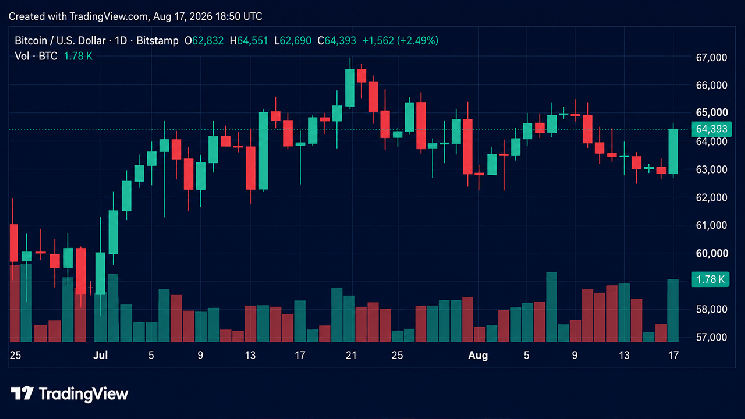
Bitcoin surged back above $64,000 on Monday, reversing a dip below $63,000 that had threatened to revisit mid-August lows. The rally coincided with an announcement from MicroStrategy stating it had neither bought nor sold any Bitcoin over the past week. After falling to a daily low near $62,653, Bitcoin sharply reversed course, climbing approximately $1,000 in six hours to reach a daily high above $64,375. By early afternoon EST, it was trading above $64,200, marking a nearly 2% daily gain and turning its weekly performance positive. The price movement triggered significant liquidations in the derivatives market, with leveraged short positions losing $57.4 million over 24 hours, contributing to total crypto market liquidations nearing $220 million. While MicroStrategy paused its Bitcoin purchases, it increased its cash reserves to $4.8 billion using part of the proceeds from a recent common stock sale. The funds were also used for share buybacks and preferred dividend payments. Analysts suggest this focus on balance sheet strength helps mitigate near-term liquidation pressure, especially as Bitcoin's price remains about 15% below MicroStrategy's average acquisition cost of $75,385. However, critics argue the capital allocation disproportionately benefits preferred shareholders (STRC) over common stockholders (MSTR) and sidelines the company's core growth strategy of aggressive Bitcoin accumulation. Bitcoin initially appeared to react positively to reports of a potential 60-day ceasefire extension between the U.S. and Iran, but the rally's momentum faded after Iranian officials denied the reports. Consequently, Bitcoin currently lacks a clear macroeconomic catalyst to sustain a decisive bullish breakout.

cryptonews.ruHá 4h

Bitcoin Breaches $64,000 Mark Again as Short Sellers Lose $57.4 Million in Liquidations

cryptonews.ruHá 4h

Trading

Spot

Artigos em Destaque

Como comprar NAVER

Bem-vindo à HTX.com!Tornámos a compra de NAVER Corp (NAVER) simples e conveniente.Segue o nosso guia passo a passo para iniciar a tua jornada no mundo das criptos.Passo 1: cria a tua conta HTXUtiliza o teu e-mail ou número de telefone para te inscreveres numa conta gratuita na HTX.Desfruta de um processo de inscrição sem complicações e desbloqueia todas as funcionalidades.Obter a minha contaPasso 2: vai para Comprar Cripto e escolhe o teu método de pagamentoCartão de crédito/débito: usa o teu visa ou mastercard para comprar NAVER Corp (NAVER) instantaneamente.Saldo: usa os fundos da tua conta HTX para transacionar sem problemas.Terceiros: adicionamos métodos de pagamento populares, como Google Pay e Apple Pay, para aumentar a conveniência.P2P: transaciona diretamente com outros utilizadores na HTX.Mercado de balcão (OTC): oferecemos serviços personalizados e taxas de câmbio competitivas para os traders.Passo 3: armazena teu NAVER Corp (NAVER)Depois de comprar o teu NAVER Corp (NAVER), armazena-o na tua conta HTX.Alternativamente, podes enviá-lo para outro lugar através de transferência blockchain ou usá-lo para transacionar outras criptomoedas.Passo 4: transaciona NAVER Corp (NAVER)Transaciona facilmente NAVER Corp (NAVER) no mercado à vista da HTX.Acede simplesmente à tua conta, seleciona o teu par de trading, executa as tuas transações e monitoriza em tempo real.Oferecemos uma experiência de fácil utilização tanto para principiantes como para traders experientes.

75 Visualizações TotaisPublicado em {updateTime}Atualizado em 2026.08.14

Como comprar NAVER

O que é KODEX200

O Contrato Perpetual KODEX200USDT segue o preço do ETF Samsung KODEX 200. Ele acompanha o desempenho do Índice KOSPI 200, oferecendo uma ampla exposição às principais empresas de grande capitalização da Coreia do Sul.

102 Visualizações TotaisPublicado em {updateTime}Atualizado em 2026.08.14

O que é KODEX200

Como comprar KODEX200

Bem-vindo à HTX.com!Tornámos a compra de Samsung KODEX 200 ETF (KODEX200) simples e conveniente.Segue o nosso guia passo a passo para iniciar a tua jornada no mundo das criptos.Passo 1: cria a tua conta HTXUtiliza o teu e-mail ou número de telefone para te inscreveres numa conta gratuita na HTX.Desfruta de um processo de inscrição sem complicações e desbloqueia todas as funcionalidades.Obter a minha contaPasso 2: vai para Comprar Cripto e escolhe o teu método de pagamentoCartão de crédito/débito: usa o teu visa ou mastercard para comprar Samsung KODEX 200 ETF (KODEX200) instantaneamente.Saldo: usa os fundos da tua conta HTX para transacionar sem problemas.Terceiros: adicionamos métodos de pagamento populares, como Google Pay e Apple Pay, para aumentar a conveniência.P2P: transaciona diretamente com outros utilizadores na HTX.Mercado de balcão (OTC): oferecemos serviços personalizados e taxas de câmbio competitivas para os traders.Passo 3: armazena teu Samsung KODEX 200 ETF (KODEX200)Depois de comprar o teu Samsung KODEX 200 ETF (KODEX200), armazena-o na tua conta HTX.Alternativamente, podes enviá-lo para outro lugar através de transferência blockchain ou usá-lo para transacionar outras criptomoedas.Passo 4: transaciona Samsung KODEX 200 ETF (KODEX200)Transaciona facilmente Samsung KODEX 200 ETF (KODEX200) no mercado à vista da HTX.Acede simplesmente à tua conta, seleciona o teu par de trading, executa as tuas transações e monitoriza em tempo real.Oferecemos uma experiência de fácil utilização tanto para principiantes como para traders experientes.

66 Visualizações TotaisPublicado em {updateTime}Atualizado em 2026.08.14

Como comprar KODEX200

Discussões

Bem-vindo à Comunidade HTX. Aqui, pode manter-se informado sobre os mais recentes desenvolvimentos da plataforma e obter acesso a análises profissionais de mercado. As opiniões dos utilizadores sobre o preço de A (A) são apresentadas abaixo.

活动图片