Introducing Tokenized Assets

Token TerminalPublicado em 2025-11-04Última atualização em 2025-11-05

Token Terminal is expanding its standardized onchain analytics to cover the rapidly growing category of tokenized real-world assets (RWAs) – starting with stablecoins, tokenized funds, and tokenized stocks.

These assets represent the next major phase of crypto adoption, as blockchains become the default issuance and transport layer for global financial instruments.

With the launch of this dataset, we’re introducing a new metric for RWAs: Market cap. This metric captures the total value that has been tokenized onchain for a specific asset.

Access the new Tokenized assets page here.


What’s new

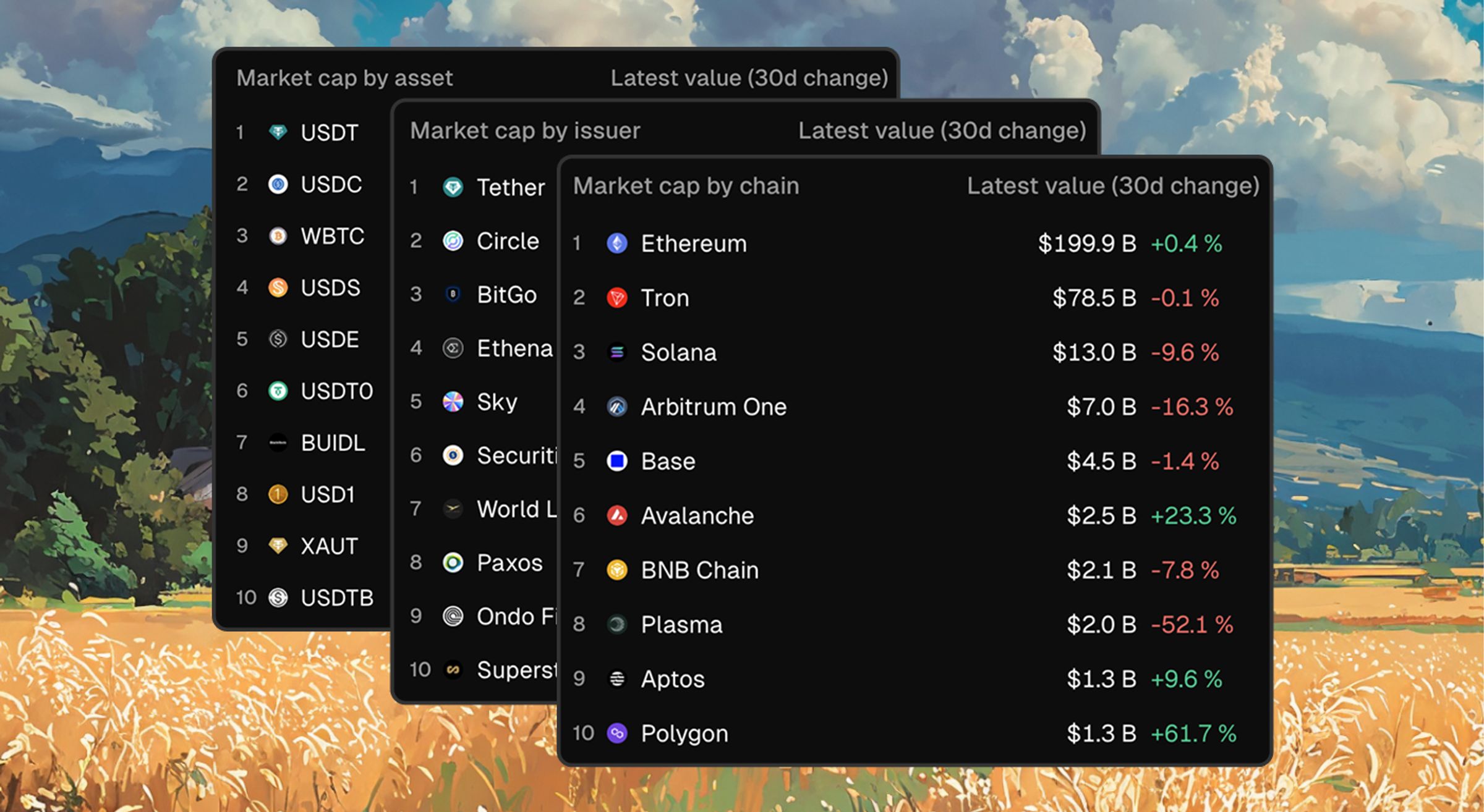
The Tokenized assets page introduces a new analytics layer purpose-built for the rapidly growing RWA sector. The page features three main sections.

1) Overview

Track multi-year time series for Market cap and other key metrics, grouped by asset, issuer, or chain.

2) Leaderboards

Identify which assets, issuers, and/or chains are growing the fastest in terms of Market cap.
3) Data table

Screen all RWAs in a unified, asset-first view, and filter by stablecoins, tokenized funds, and tokenized stocks for more targeted analysis.
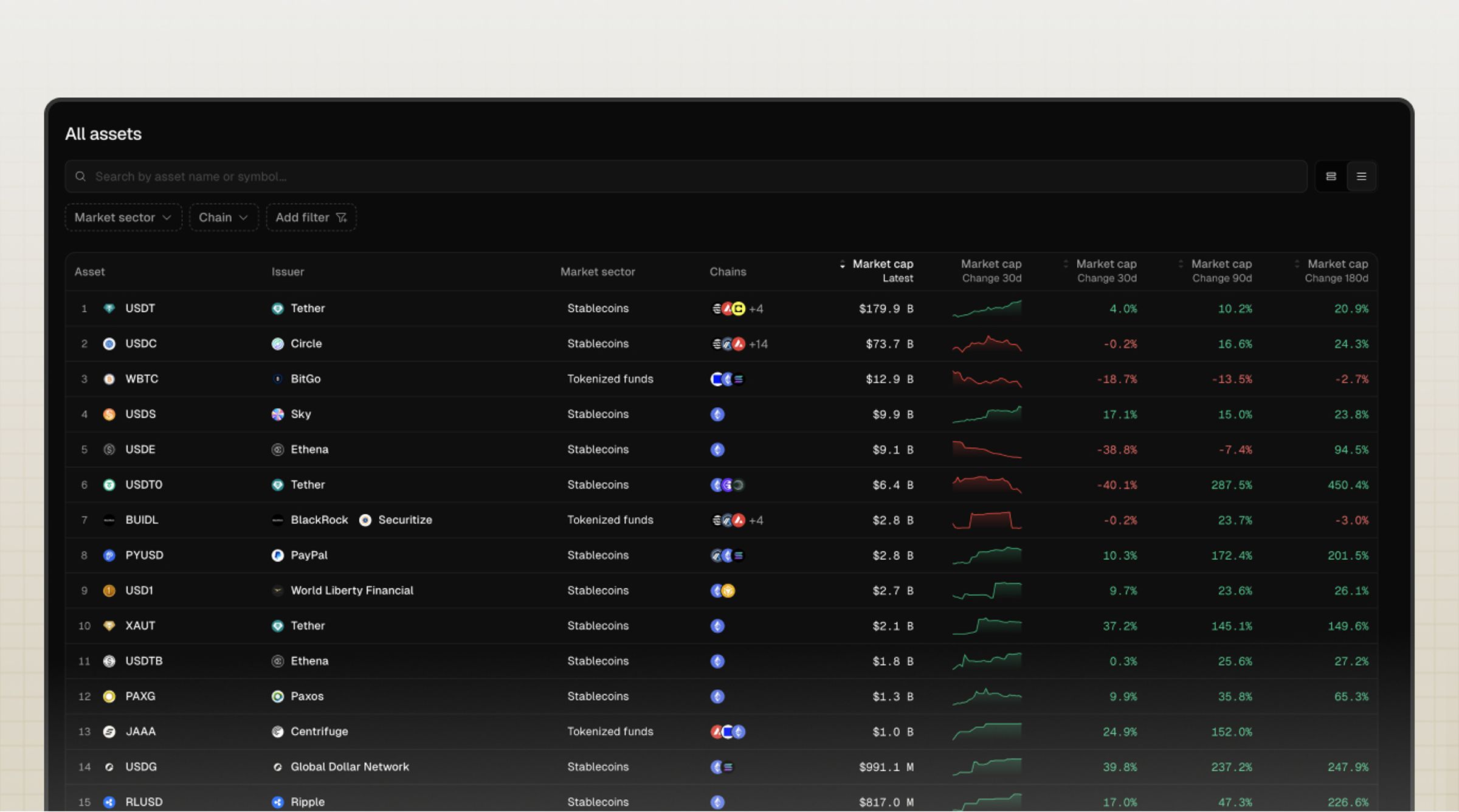
Our goal with the new Tokenized assets page is to build and maintain a single source of truth for stablecoins, tokenized funds, and tokenized stocks.

During Q4, we’ll continue rolling out more RWA-specific metrics, which will all be available in our API.


Build with us

If you’re an issuer of tokenized assets and your product isn’t yet listed on Token Terminal, get in touch. We’re actively expanding coverage to ensure a fair and accurate representation of the rapidly growing RWA market sector.

Want API access to our new tokenized assets data? Schedule a demo.

The authors of this content, or members, affiliates, or stakeholders of Token Terminal may be participating or are invested in protocols or tokens mentioned herein. The foregoing statement acts as a disclosure of potential conflicts of interest and is not a recommendation to purchase or invest in any token or participate in any protocol. Token Terminal does not recommend any particular course of action in relation to any token or protocol. The content herein is meant purely for educational and informational purposes only, and should not be relied upon as financial, investment, legal, tax or any other professional or other advice. None of the content and information herein is presented to induce or to attempt to induce any reader or other person to buy, sell or hold any token or participate in any protocol or enter into, or offer to enter into, any agreement for or with a view to buying or selling any token or participating in any protocol. Statements made herein (including statements of opinion, if any) are wholly generic and not tailored to take into account the personal needs and unique circumstances of any reader or any other person. Readers are strongly urged to exercise caution and have regard to their own personal needs and circumstances before making any decision to buy or sell any token or participate in any protocol. Observations and views expressed herein may be changed by Token Terminal at any time without notice. Token Terminal accepts no liability whatsoever for any losses or liabilities arising from the use of or reliance on any of this content.

Leituras Relacionadas

How Will the US Midterm Elections Stir the Market? Citi Presents a Roadmap for 50 and 30 Days Before the Election

With the U.S. midterm elections less than three months away, investors are reassessing the potential market impacts of various political outcomes. Citigroup's strategy team has outlined a trading framework, suggesting that bond markets could rally if the Republican party loses its current unified control of Congress and the White House. The elections on November 3 will determine the composition of the House and Senate. Currently, Republicans hold the presidency and both chambers. Prediction market Polymarket indicates a 48% perceived chance of Democrats winning both houses, though officials warn such data is often misunderstood and is not an official forecast. Citigroup strategists, led by Alex Saunders, argue that a divided government—where different parties control separate power centers—would likely benefit bonds by weakening fiscal expectations and pushing Treasury prices higher, as lower prospects for major new spending typically lead to falling yields. They note that 10-year Treasury yields often decline in such scenarios. Beyond bonds, the election is expected to influence stocks and credit. Historically, markets begin to feel pressure approximately 50 trading days before the vote due to policy uncertainty. However, a relief rally in equities often emerges around 30 days prior to Election Day, potentially extending through year-end. The rise of prediction markets like Polymarket and Kalshi is changing how participants view elections, though their growth sparks concerns about public misinterpretation and potential market volatility if odds diverge from certified results. Sector-wise, Citigroup believes a divided government could benefit cyclical tech and certain industrial stocks, while defensive sectors like healthcare and consumer staples might lag. For investors, the key is assessing whether the election outcome alters the fiscal policy trajectory, Treasury supply expectations, and the market's pricing of future interest rates, with power dispersion seen as supportive for bonds and potentially boosting risk appetite in select equities.

marsbitHá 3m

How Will the US Midterm Elections Stir the Market? Citi Presents a Roadmap for 50 and 30 Days Before the Election

marsbitHá 3m

After Admitting Failure Seven Months Later, Farcaster is Again Seeking a New Operator

Seven months after taking over, Farcaster's current operator, Neynar, has announced it is seeking a new team to take over operations of the decentralized social protocol and its associated products, including the flagship Farcaster client and the Clanker platform. Neynar co-founder Rishav Mukherji acknowledged the company failed to meet its goals since acquiring Farcaster from its original creators in January, citing a combination of a tight-knit community, high operating costs for the main app, and slow market growth as reasons requiring a different organizational and funding structure. Farcaster is a decentralized social protocol allowing users to maintain identity, content, and social graphs across different client applications. Despite Neynar reducing infrastructure costs by 80% and decentralizing protocol operations further, the challenge of scaling consumer adoption and sustaining the flagship app remains unresolved. The original founding team at Merkle Manufactory had previously struggled to grow the user base beyond 200,000-300,000 monthly active users. This marks the second major operational handoff for Farcaster in less than a year, following a similar transition by competitor Lens Protocol. The search for a new operator highlights a recurring difficulty in Web3 social: maintaining and growing consumer-facing applications while the underlying decentralized protocols continue to function. The structure of the potential handoff—whether products will be transferred together or separately—and details regarding the return of Neynar's remaining capital are still pending. Services continue to operate normally for users in the interim.

marsbitHá 33m

After Admitting Failure Seven Months Later, Farcaster is Again Seeking a New Operator

marsbitHá 33m

Trading

Spot
活动图片