Shiba Inu Team Issues Last Chance To Shibarium Hacker Before Time Runs Out

bitcoinistPublicado em 2025-11-04Última atualização em 2025-11-04

Resumo

Shiba Inu’s core contributors and the K9 Finance DAO have escalated their recovery campaign with an on-chain ultimatum to the...

Trusted Editorial content, reviewed by leading industry experts and seasoned editors. Ad Disclosure

Shiba Inu’s core contributors and the K9 Finance DAO have escalated their recovery campaign with an on-chain ultimatum to the Shibarium bridge exploiter, deploying a new bounty contract funded with 20 ETH and broadcasting the terms directly to the attacker via Ethereum Input Data Messages (IDM).

Shiba Inu Team Drops Final 20 ETH Deal

The latest IDM, sent on November 3, 2025 at 06:32 UTC from a K9 developer-labeled account, lays out a trustless path to return frozen KNINE tokens and claim the reward before the offer decays and then expires. “Dear Shibarium Bridge Hacker… New 20 ETH bounty to return stolen KNINE tokens,” the message reads, specifying the bounty contract address and the atomic settlement flow: “Settlement is atomic when we call recoverKnine(). KNINE is transferred back to Shibarium bridge and ETH is transferred to you.” It also sets explicit time parameters: “Bounty will start to decrease in 21-days (Nov 18)… [and] will expire in 28 days (Nov 25).”

The 20 ETH bounty is escrowed on Ethereum at 0x5EA2…D4d0, a verified contract titled “KnineRecoveryBountyDecayAcceptMultiFunder,” which shows a current balance of 20 ETH and identifies k9dev.eth as the creator five days earlier. The contract’s read/write interfaces and verified source enable the attacker to permission the bounty contract to spend KNINE and, if desired, call an explicit accept() function to lock the deal before the team triggers the recoverKnine() settlement.

Public messaging from Shiba Inu developer Kaal Dhairya has amplified the urgency. In a post on X, Dhairya pressed the exploiter to take the on-chain offer: “Yo, Shibarium bridge attacker, wake up—grab free cash before the offer expires this time and do something right.” The remark follows weeks of damage-control updates about validator-key compromise and a multi-firm investigation.

K9 Finance confirms this is the final structured attempt to resolve the episode without litigation or further escalation. In an ecosystem post published by The Shib Magazine, the team states that the 20 ETH contract “makes good on a public promise… to extend one final, larger bounty offer to the entity behind the Shibarium Bridge exploit,” after an initial on-chain 5 ETH proposal in mid-September was rebuffed.

According to that account, the exploiter counter-demanded 50 ETH; K9 declined, reiterating that the KNINE at issue is blacklisted and unusable. The new contract, they add, is designed to close the loop “without direct communication” through an atomic exchange once approval is granted.

K9 has also warned the community to ignore opportunistic scams around the bounty discourse. “Watch out for scams, imposters, and malicious links. This is the last post in the thread,” the DAO wrote on X as it wrapped a public update sequence, underscoring there will be no token migration or “v2” related to this incident. The caution aims to preempt fake claim portals and phishing that often proliferate after high-profile exploits and bounty announcements.

The “last chance” framing reflects the arc of the incident since mid-September, when a flash-loan-aided validator capture enabled the attacker to authorize a malicious state and drain bridge assets, sparking a series of containment steps and an initial bounty. Contemporary coverage documented the 5 ETH on-chain offer and its 7-day decay/30-day expiry schedule; the new 20 ETH contract iterates on the same “code is law” design but with higher stakes and a shorter fuse on the decaying component.

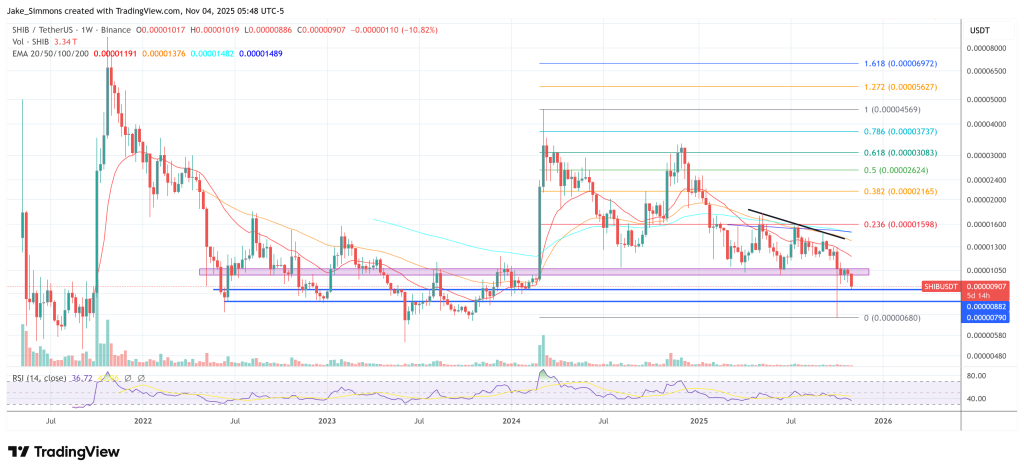
At press time, Shiba Inu traded at $0.00000907.
Shiba Inu price
Shiba Inu price, 1-week chart | Source: SHIBUSDT on TradingView.com
Featured image created with DALL.E, chart from TradingView.com
Editorial Process for bitcoinist is centered on delivering thoroughly researched, accurate, and unbiased content. We uphold strict sourcing standards, and each page undergoes diligent review by our team of top technology experts and seasoned editors. This process ensures the integrity, relevance, and value of our content for our readers.

Jake Simmons has been a Bitcoin enthusiast since 2016. Ever since he heard about Bitcoin, he has been studying the topic every day and trying to share his knowledge with others. His goal is to contribute to Bitcoin's financial revolution, which will replace the fiat money system. Besides BTC and crypto, Jake studied Business Informatics at a university. After graduation in 2017, he has been working in the blockchain and crypto sector. You can follow Jake on Twitter at @realJakeSimmons.

Leituras Relacionadas

How Will the US Midterm Elections Stir the Market? Citi Presents a Roadmap for 50 and 30 Days Before the Election

With the U.S. midterm elections less than three months away, investors are reassessing the potential market impacts of various political outcomes. Citigroup's strategy team has outlined a trading framework, suggesting that bond markets could rally if the Republican party loses its current unified control of Congress and the White House. The elections on November 3 will determine the composition of the House and Senate. Currently, Republicans hold the presidency and both chambers. Prediction market Polymarket indicates a 48% perceived chance of Democrats winning both houses, though officials warn such data is often misunderstood and is not an official forecast. Citigroup strategists, led by Alex Saunders, argue that a divided government—where different parties control separate power centers—would likely benefit bonds by weakening fiscal expectations and pushing Treasury prices higher, as lower prospects for major new spending typically lead to falling yields. They note that 10-year Treasury yields often decline in such scenarios. Beyond bonds, the election is expected to influence stocks and credit. Historically, markets begin to feel pressure approximately 50 trading days before the vote due to policy uncertainty. However, a relief rally in equities often emerges around 30 days prior to Election Day, potentially extending through year-end. The rise of prediction markets like Polymarket and Kalshi is changing how participants view elections, though their growth sparks concerns about public misinterpretation and potential market volatility if odds diverge from certified results. Sector-wise, Citigroup believes a divided government could benefit cyclical tech and certain industrial stocks, while defensive sectors like healthcare and consumer staples might lag. For investors, the key is assessing whether the election outcome alters the fiscal policy trajectory, Treasury supply expectations, and the market's pricing of future interest rates, with power dispersion seen as supportive for bonds and potentially boosting risk appetite in select equities.

marsbitHá 3m

How Will the US Midterm Elections Stir the Market? Citi Presents a Roadmap for 50 and 30 Days Before the Election

marsbitHá 3m

After Admitting Failure Seven Months Later, Farcaster is Again Seeking a New Operator

Seven months after taking over, Farcaster's current operator, Neynar, has announced it is seeking a new team to take over operations of the decentralized social protocol and its associated products, including the flagship Farcaster client and the Clanker platform. Neynar co-founder Rishav Mukherji acknowledged the company failed to meet its goals since acquiring Farcaster from its original creators in January, citing a combination of a tight-knit community, high operating costs for the main app, and slow market growth as reasons requiring a different organizational and funding structure. Farcaster is a decentralized social protocol allowing users to maintain identity, content, and social graphs across different client applications. Despite Neynar reducing infrastructure costs by 80% and decentralizing protocol operations further, the challenge of scaling consumer adoption and sustaining the flagship app remains unresolved. The original founding team at Merkle Manufactory had previously struggled to grow the user base beyond 200,000-300,000 monthly active users. This marks the second major operational handoff for Farcaster in less than a year, following a similar transition by competitor Lens Protocol. The search for a new operator highlights a recurring difficulty in Web3 social: maintaining and growing consumer-facing applications while the underlying decentralized protocols continue to function. The structure of the potential handoff—whether products will be transferred together or separately—and details regarding the return of Neynar's remaining capital are still pending. Services continue to operate normally for users in the interim.

marsbitHá 33m

After Admitting Failure Seven Months Later, Farcaster is Again Seeking a New Operator

marsbitHá 33m

Trading

Spot
活动图片